To plan a first trip together with a new partner, settle four things out loud before anyone opens a booking site: what the trip is for, how much you are both willing to spend, how fast you want to move, and who handles which bookings. Everything after that is logistics. Get these four right and the rest of the plan writes itself, in about a week of evenings.
I plan most trips alone, so the shift from one brain deciding everything to two people deciding together is the part I get asked about most. It works better than people expect, as long as the conversations happen before the money moves, not after.
Here is the process I would use, and the checkpoints that tell you each stage actually worked.
Table of Contents›
- What You Need Before You Book
- Step-by-Step: How to Plan a First Trip Together With a New Partner
- 1. Talk About What the Trip Should Feel Like
- 2. Agree on the Practical Boundaries
- 3. Choose a Destination That Suits Both Travel Styles
- 4. Build a Flexible Shared Itinerary
- 5. Book Lodging and Key Experiences Together
- 6. Prepare for Different Travel Rhythms
- 7. Review the Plan and Leave Room to Be Together
- Common Mistakes and How to Fix Them
- Frequently Asked Questions
- How soon is too soon to travel with a new partner?
- What is a good first trip for a couple?
- How long should a first trip together be?
- How do you split travel costs with a new partner?
- What if my partner does not want to travel?
- Should we share a room on our first trip together?
- Conclusion: Start With the First Conversation
What You Need Before You Book
You need agreement on six things before a single reservation is made. Most first-trip arguments happen because one of these was assumed rather than discussed.
- Shared dates. Name the actual days out loud, including the travel days on each end. Half of scheduling arguments are just people counting different weekends.
- A ceiling, not a number. Agree the maximum you would each spend in total, and what that money buys in plain terms. A ceiling stops the creep that happens on day two when someone suggests a nicer dinner.
- One trip goal. Pick the feeling you want at the end. Rest, discovery, food, nature, or simply being together. One primary goal beats five must-see lists.
- A pace. Decide how many hours of the day are yours, and how early you are willing to start. This is the most underestimated variable in the whole trip.
- Documents in order. Check passport validity dates, visa rules, and anything requiring lead time before you pick a destination. Retrofitting a destination to a bad document date is a wasted month.
- A planning appetite check. Find out whether you want a fully arranged week or a loose one with a few anchors. Neither answer is wrong. Mismatched answers are the problem.
Add a seventh if either of you is nervous about airports or flying. Airport behaviour is where a lot of first-trip friction shows up, and knowing that in advance takes the sting out of it.
Step-by-Step: How to Plan a First Trip Together With a New Partner
This process takes seven stages and roughly one week of short conversations, and it works in any order as long as stages one and two happen before any money is committed. The checkpoints at the end of each stage tell you whether you are ready to move on.
1. Talk About What the Trip Should Feel Like
Start with the emotional purpose, not the destination list. Ask what a good version of this trip looks like from the couch, before either of you pictures an airport.
One person often says something like “I just want to switch off for four days”. The other hears “we need a holiday” and starts pricing beaches. Same words, completely different trips.
Write down one sentence each, then compare. If the sentences genuinely cannot be merged, you have your answer before spending anything.
Checkpoint: you can both finish the sentence “this trip is about…” in the same ten words.
2. Agree on the Practical Boundaries
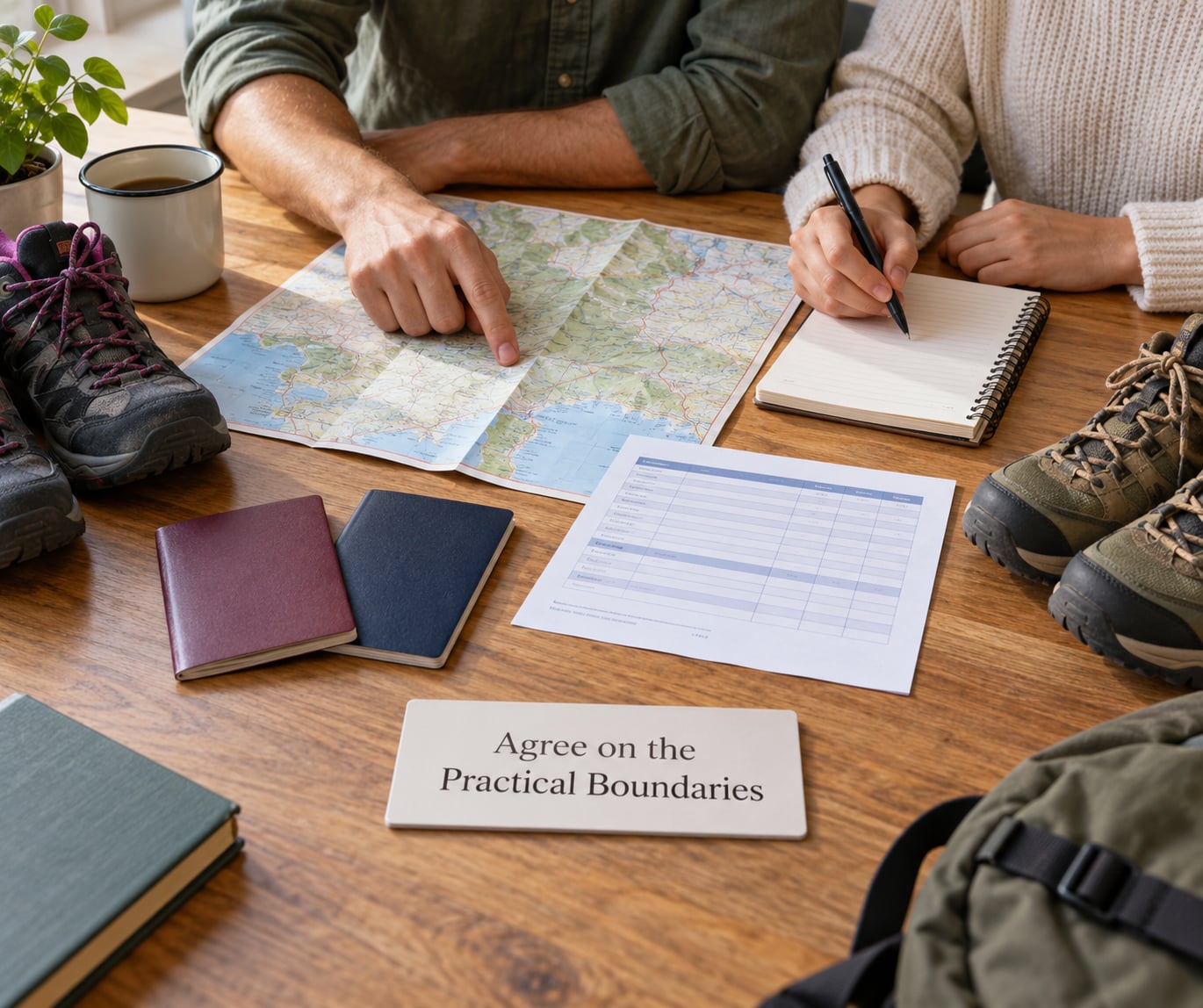
This is the conversation most people postpone, and it is the one that saves them. Cover the total ceiling, what happens if one of you overspends, and how quickly either person can change a plan.
Three splitting patterns work most of the time. Split everything down the middle, which is simplest and fairest when incomes are close. Take turns, where each trip is one person’s treat. Or book separately and pay your own way, which takes more admin but removes the ledger completely.
Forums keep circling the same question, and the honest answer is that nobody is obligated to pay for a whole trip in a new relationship. The conversation is where that becomes clear, before the first hotel hold.
Also decide the boundaries nobody argues about until day one: dietary needs, smoking, how early the alarm goes off, and whether phones come out at dinner.
Checkpoint: each of you can state the ceiling and the splitting method without checking a message.
3. Choose a Destination That Suits Both Travel Styles
Match the place to your energy, not to the photographs. Look at a normal weekday in the destination rather than the best weekend of the year.
Score the trip in three ways: short days where you are mostly walking or standing, medium days with a plan and a couple of hours free, and intensive days with early starts and long transfers. Count how many of each you want in a week.
Most people who disagree about destinations are actually disagreeing about that ratio. A city with museums suits someone who wants two structured days and a lot of unplanned walking. A small island with a good beach suits someone who wants zero structured days.
Getting this wrong is where learning how to plan a first trip together with a new partner usually stalls. You research ten places and agree on none of them.
| Style pair | Where it usually bites | Compromise that works |
|---|---|---|
| Planner and spontaneous | Plans feel like a cage to one side, chaos feels like waste to the other | Anchor one thing per day in a shared calendar, leave the rest open |
| Early riser and night owl | The first and last hours of the day | One person owns mornings, one owns the evening, meet in the middle for dinner |
| Comfort spend and simple spend | Nightly lodging and transport choices | Set the lodging tier once, then keep daily spending neutral |
| First-timer flyer and experienced flyer | Airport pace and document handling | Experienced person handles check-in and timing, newer flyer chooses the seat and the films |
For a first trip together, shorter and closer wins nearly every time. Commenters on travel forums repeatedly describe keeping the first one to three to five days on purpose, as a test rather than a showcase. Long-haul itineraries turn small misunderstandings into a nine-hour problem.
Checkpoint: you can each name two things you would be genuinely disappointed to miss, and they are not the same list.
4. Build a Flexible Shared Itinerary
Write the itinerary as a day-by-day page with four lines per day: one anchor, one optional, unscheduled time, and travel buffers. Resist anything more detailed.
The anchor is the thing you would both be annoyed to skip. The optional is the thing that is lovely if the day goes well. The unscheduled block is the part that saves the trip, because weather, tiredness and wrong turns will eat into your plan whether you allow for it or not.
Travelers who debrief honestly afterwards keep repeating the same pattern: one structured day and one completely free day, repeated. That balance works for a three-day city break and for a week elsewhere.
Checkpoint: the plan fits on one screen per person. If it needs a second screen, you have overbooked.
5. Book Lodging and Key Experiences Together
Book the accommodation together and in one place, then compare on what actually changes the trip: total cost including transport to the door, room setup, and how forgiving the cancellation terms are.
For a new couple, look at the room and bathroom honestly rather than optimistically. A windowless bathroom and a shared shower are fine for some people and a real problem for others, and finding that out at the door is worse than finding it now. Read the recent reviews for the specific room type, not the property average.

Split the workload by strength rather than by fairness. One person books and compares lodging, the other researches what you will actually do once you arrive. Travellers who divide planning this way report it removes the planning stress almost entirely, and it stops one of you spending eight evenings on logistics.
One person should hold the confirmations. A shared note or folder with booking references, addresses, and the local emergency number costs you five minutes now and saves a search through a hundred emails later.
Checkpoint: both of you can open every booking confirmation without asking the other person for it.
6. Prepare for Different Travel Rhythms
A short pre-trip checklist covers the logistics that do not belong in the planning conversation. Documents and their offline copies, insurance that actually covers what you are doing, prescriptions, and one emergency contact each who is not on the trip.
Share live location for the whole trip. It is the least romantic item on the list and the one that gets used most, usually by the person who gets separated in a crowd.
Agree a check-in habit rather than a constant-contact rule. Fifteen minutes at breakfast and an evening check-in keeps the logistics light without turning the trip into a monitored project.
Pack for both climates if you are merging two people’s ideas of what to bring. Two of everything is heavier, but the spare jacket and the shared charger have rescued more than one trip.
Checkpoint: each of you can say aloud where the passports, the insurance documents and the local address are.
7. Review the Plan and Leave Room to Be Together
Set aside twenty minutes, ideally in person, and go through the plan once. Identify the two or three non-negotiables, assign the loose jobs, and confirm who holds the documents.
Then decide deliberately what stays unscheduled. Protecting that space is what keeps the trip from turning into an errand run with romantic parts squeezed between transfers. One signature moment a day, phone-free, does more for the trip than a full extra day of sightseeing.
Afterwards, spend fifteen minutes on the debrief. What worked, what you would change, what you learned about how the other person travels. Couples who do this treat it as the fastest way to learn each other’s rhythms, and it is the part most people skip.
Checkpoint: you both know the first thing you are doing on arrival, and the one thing you are deliberately not doing.
Common Mistakes and How to Fix Them
Overplanning. Two people nervous about the same trip will each add things until the week has no gaps. Fix: one anchor a day, written down, and treat the empty blocks as part of the plan.
Choosing an expensive destination to impress each other. The trip then becomes a performance with a budget attached, and the pressure to have a perfect time rises. Fix: pick the place on fit, not on how it looks as a backdrop, and set the ceiling before you look at anything.
Booking nonrefundable things too early. Flights are a large exception because fares move, but hotels, car hire and attraction tickets often lock weeks ahead. Fix: make the trip feel real with refundable holds first, then convert once you are both still in.
Treating compromise as losing something. Half the plan being yours is not a defeat. Fix: keep one full day in the plan that only the other person has designed, and protect it.
Not talking about money until the first night. This is the loudest recurring worry in reader discussions about first trips, and the one most likely to sour an otherwise good week. Fix: have the budget conversation in the same week you have the first one about what the trip is for.
A couple of small rules help most: assume good intent about a bad mood, and never resolve a scheduling disagreement in a queue. If one of you needs an hour alone, say when you will be back rather than slipping out.
Frequently Asked Questions
How soon is too soon to travel with a new partner?
There is no fixed month that makes travel right or wrong, and no rule about how long you have known each other. What matters is whether you have seen each other handle ordinary pressure: a cancelled plan, a shared bill, a long day with nothing scheduled. Most couples find three to five days early on is the sweet spot, because a problem surfaces while there is still room to talk about it.
What is a good first trip for a couple?
A short, close-to-home trip with one clear anchor per day is the safest first choice. A long weekend in a city you can reach without a long transfer tends to suit most early relationships, since a delayed flight ruins a day rather than the week. Pick somewhere that suits your energy on an ordinary weekday, not somewhere chosen for how it photographs.
How long should a first trip together be?
Three to five days is the range most experienced travellers recommend, and it is the number that comes up again and again in reader discussions. Long enough to get past the first awkward evening and settle into a rhythm, short enough that a clash does not become a whole wasted holiday. If one of you is nervous about flying, a weekend is plenty for a first outing.
How do you split travel costs with a new partner?
Three patterns work: split everything evenly, take turns so each trip is one person’s treat, or book and pay separately so nobody keeps a ledger. Whichever you choose, say it before the first booking and put it in writing in a shared note. Nobody is obligated to cover a whole trip, and pretending otherwise only makes the first awkward moment happen later.
What if my partner does not want to travel?
Plenty of people simply have not found a trip they want yet, and that is worth separating from someone who is not interested in going at all. Ask what would make it appealing, then offer one concrete option rather than a folder of possibilities. If they would rather stay home and you want to go, travelling with a friend is a fine answer and nobody is being tested by it.
Should we share a room on our first trip together?
It is a normal thing to feel unsure about, and the options are not a test of commitment. Two single beds in one room, or two rooms with a connecting door, both work and both are common. Check the bathroom honestly rather than optimistically, since windowless rooms and shared showers annoy some people and not others. Deciding it together removes a whole category of first-night tension.
Conclusion: Start With the First Conversation
Learning how to plan a first trip together with a new partner is mostly about when those conversations happen. Ask what the trip is for, set the ceiling in the same breath, then pick a destination that fits your energy on a normal weekday.
From there: keep the plan to one anchor a day, split the bookings by strength, and leave the gaps unfilled. Book nothing you cannot change, and go.