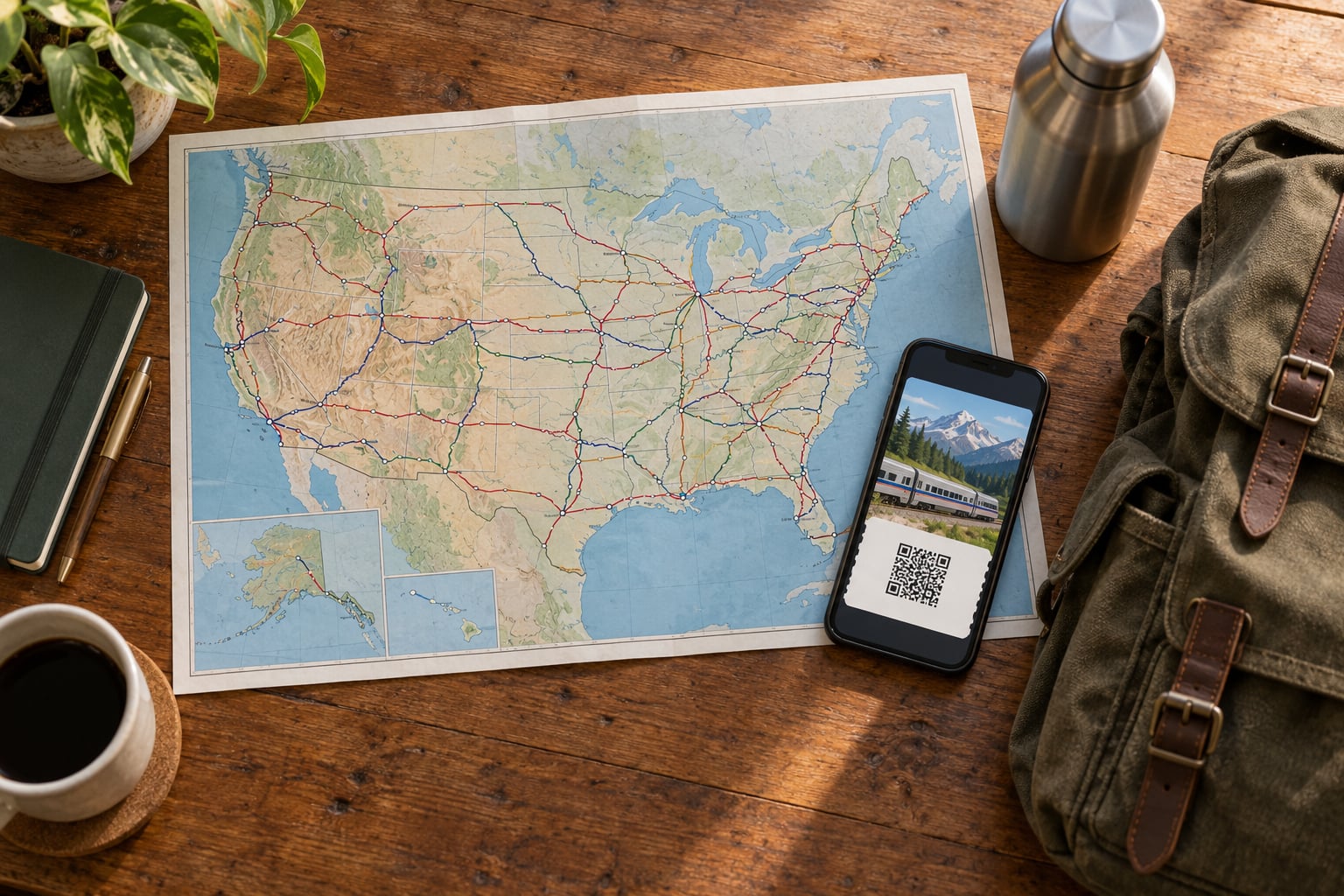
To travel by train in the United States for the first time, you book a specific train and seat online, arrive at the station about 30 minutes before departure with a photo ID and your eTicket, then board in the group printed on your ticket. There is no check-in desk, no security line, and no gate to clear. Everything else follows from that.
The operator you will almost certainly use is Amtrak, the federally chartered passenger rail company that runs intercity trains through 46 states, Washington DC and three Canadian provinces, stopping at more than 500 stations. Regional operators run smaller trains on shorter stretches, and some journeys end with a connecting bus.
Rail here is slow and scenic in roughly equal measure. It is not the fastest way between cities, but you arrive in the center of town, watch the country change outside the window the whole way, and never once stand in a security queue. For a first trip, the Northeast Corridor between Boston, New York, Philadelphia and Washington is the gentlest introduction. The big scenic routes reward a second one.
Table of Contents›
- What You Need
- Step-by-Step
- How to travel by train in the United States for the first time: plan your route
- Choose and book your ticket
- Get to the right station early
- Find your train and board safely
- Make transfers and arrive at your destination
- Common Mistakes
- Frequently Asked Questions
- How far in advance should I book a U.S. train ticket?
- Do I need to print my train ticket or can I show it on my phone?
- How do I know which platform my train leaves from?
- Can I bring a large suitcase on a U.S. train?
- What should I do if my U.S. train is delayed or canceled?
- Is train travel in the United States beginner-friendly?
- Conclusion
What You Need
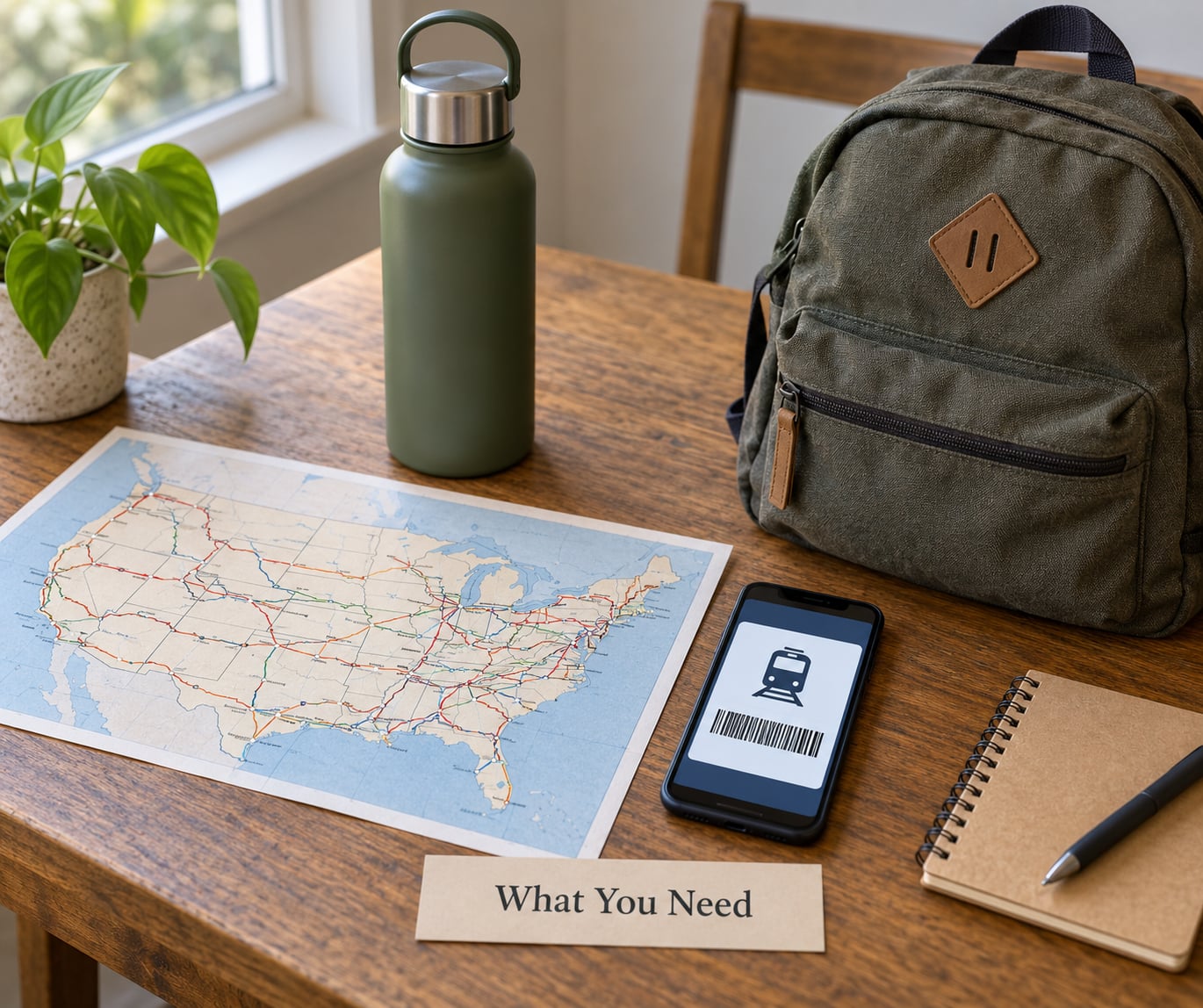
Six things. Everything else you can sort out on the platform.
- Photo identification. A passport if you have one, or a state driver’s licence. The name on it should match your booking, and you may be asked for it on board by the conductor.
- Your eTicket. It arrives by email and lives in the Amtrak app or a wallet pass. The booking reference number printed at the top is what staff look for first.
- Your train number, departure time and station name. All three are on the ticket. Station names repeat across the country, so the city and the station matter more than you think.
- A way to pay. Cards work in the dining car and cafe on most routes. Carry a little cash for station shops and small towns where terminals are unstaffed.
- Downloads. Cell coverage drops in canyons and tunnels, and riders regularly report losing signal entirely in places like the Moffat Tunnel and Glenwood Canyon canyon. Maps, tickets and entertainment belong on the device, not in the cloud.
- Passport and visa details if you are crossing into Canada. The Adirondack to Montreal, the Maple Leaf to Toronto and the Cascades to Vancouver all cross the border, and documentation is checked before you board, not at the border.
One timing rule gets you through every station: Amtrak’s own guidance is to arrive about 30 minutes before departure. At a small stop that is plenty. At a major hub such as Washington Union Station in DC, where boarding-group information often posts late and the concourse is large, allow 45 to 60 minutes. Finding the right track takes longer than most first-timers expect.
Step-by-Step
How to travel by train in the United States for the first time: plan your route
Start by asking who actually operates the train between your two cities. Amtrak covers the long-distance spine of the country, and it is the only operator that reaches most small towns and national park gateways. Regional operators, some of them run by states or by Amtrak itself, cover shorter corridors and are often faster on those routes because they make fewer stops.
The main decision is whether the route suits the trip you actually want. Compare the city pairs on travel time, station location and total trip length, not just on the fare. A route that takes 30 hours can be a better holiday than six hours of airport time, and a route that takes 30 hours can also be a poor choice if you were hoping to arrive before dinner.
Expect buses in the plan. Amtrak Thruway buses connect places the rail network does not reach, and they appear in your itinerary as a normal segment rather than a disruption. When a rail line is damaged or closed, riders may be moved onto a bus to finish the trip, so keep a buffer between a train arrival and any non-refundable booking on the other end.
| Route | Typical scheduled time | Sleeper | What it is known for |
|---|---|---|---|
| Acela (Boston–Washington) | About 3.5 hours end to end | No | Easiest first train trip in the country |
| California Zephyr (Chicago–San Francisco area) | About 51 hours | Yes | River gorges and high desert, the most-requested scenery |
| Empire Builder (Chicago–Seattle or Portland) | About 46 hours to Seattle | Yes | Rocky Mountains, Mount Rainier and Glacier on the return |
| Southwest Chief (Chicago–Los Angeles area) | About 43 hours | Yes | Painted Desert, approach into Los Angeles at dawn |
| Coast Starlight (Seattle–Los Angeles) | About 34 hours | Yes | Pacific coast views, best run between October and April |
| Auto Train (Lorton, Virginia–Sanford, Florida) | About 27 hours, non-stop | Yes | The only truly non-stop long-distance run |
The rule of thumb most experienced riders use for views: the right-hand side of the train faces west, the side you want when heading west. Heading east, the good side is the one facing the direction of travel that catches afternoon light. Sit on the side away from the sun if you plan to sleep.
Choose and book your ticket
Booking opens roughly 11 months before departure, and fares climb steeply in the final weeks. The single most repeated piece of advice from experienced travellers is to book early, and the reverse is just as common: buying at the last minute is the expensive mistake. For a fixed trip with a fixed date, book as soon as the schedule opens.
You will see several fare families on the booking screen, and they differ in one meaningful way, flexibility. The most restricted fares usually carry no changes or refunds after purchase. Mid-level fares allow changes with a fee. The most flexible option costs more but lets you move the date or cancel with a small charge. Read the restriction line before you pay rather than assuming all fares on a train behave the same way.
Your passenger details matter more than they would for a flight. The name must match your ID, and birth dates are used to price a child’s fare. A minor error here is the most common reason a passenger gets pulled off a train at the platform.
Decide one-way or round trip in the same session. A round trip booked as two separate one-ways is often cheaper than a single round-trip fare, so price both ways before you commit. If you plan more than one long-distance ride in a year, join Amtrak Guest Rewards before you book; points accrue per dollar spent and status tiers bring dining credits and companion travel benefits that make a second trip cheaper.
Get to the right station early
The station is the most common first-timer error, and it is almost always a name collision. Washington Union Station and Union Station in Los Angeles are different buildings in different states, and several cities have more than one Amtrak stop. Open the map view in your booking confirmation and check the street address, not just the city.
Arrival times depend on what kind of station it is:
| Station type | Arrive this early | Why |
|---|---|---|
| Small town, unstaffed platform | 20 to 30 minutes | Nothing to do but wait; the departure board may be the only update you get |
| Mid-size city station | 30 to 35 minutes | Enough to find the platform and stow a bag |
| Major hub such as Washington Union Station | 45 to 60 minutes | Long walks, escalators and boarding information that posts late |
| Interchange where you change trains | 60 minutes | A missed connection is your responsibility, not the operator’s |
Inside the station, watch the departure boards. Amtrak stations rarely have the single big split-flap board you remember from other countries, so you may be tracking a screen per platform or a small display near the waiting area. The track or platform number appears there, often shortly before boarding begins.
Before boarding starts, check one thing: whether your stop is a passenger stop or a scheduled service break. Some stops exist only so the train can wait for a freight movement, and it may not open its doors. Riders on forums have reported standing on the platform as the train pulled away, so listen for the announcement rather than assuming.
Find your train and board safely
Boarding is organised into groups, usually announced as Group A, then B, then C, over the station announcement system. Your eTicket shows your group along with your car number and seat. Board in your group, not first, unless you have a connection to make or a service animal.
Walk the length of the platform to find your car number painted near the car door, not the nearest door. On a Superliner, a two-level bilevel train, car position depends on how many stairs your seat needs. Handicapped and accessible cars sit at a consistent low level near the locomotive end, and the crew at the door will point you in the right direction.
Show your ticket to the crew member at the car door. There is no security screening and no check-in counter; an ID check may happen later by the conductor moving through the car.
Stow your bag where the seat number tells you to. The placement rules are strict for a reason: an overhead bin bag above an exit row, or a bag at the end of a coach row, blocks the aisle and the crew will move it. Above-deck storage on the upper level takes most carry-ons; on the lower level, use the space under the seat in front of you.
Then look up. The upper level of a Superliner is roughly nine inches from the roof at its lowest point, and the gangway plates between cars shift as the train moves. Hold the red-and-white grab bars while you cross, and do the walk between cars one-handed. Everything else about moving through an Amtrak train is far more casual than that.
Make transfers and arrive at your destination
Not every long-distance route runs door to door. The Coast Starlight ends in Los Angeles and the California Zephyr historically finished at a bus terminal across the bay, so expect a scheduled transfer that reads like a separate ticket. Read your confirmation end to end so nothing surprises you at 6pm.
Overnight itineraries work differently. A sleeper booking means a boarding time listed late in the evening and a wake-up call in the morning, usually with a target arrival several hours before a daytime train departs from the same station. If your onward train leaves early, treat that buffer as the minimum.
When a delay is announced, do these things in the first ten minutes. Do not move to a different platform or car until staff tell you to. Open the Amtrak app or check the departure board and note whether the delay is under an hour, several hours, or a cancellation with a replacement plan. If the delay exceeds an hour, visit the service desk or call the number on your ticket: riders are rebooked onto the next available train when one exists, and for a cancellation you are entitled to a refund of the unused portion rather than being left to buy a new ticket themselves. Keep your ticket in hand for every conversation.
The underlying reason for most delays is worth knowing once. Long-distance trains share track with freight, and on single-track mountain routes a freight train with a lower priority can simply overtake them. Oncoming freight is the single most common reason a western route arrives late, and delays tend to cascade forward down the line. It is not something you did wrong, and it is not always avoidable.
Common Mistakes
- Booking the wrong station. Fix: open the address on the confirmation and check it against where you are staying, not against the city name.
- Arriving at departure time. Fix: treat the printed time as when the doors close, and be at the station 30 minutes earlier, more at a hub.
- Assuming every train follows the same rules. Fix: check whether your route is long-distance or regional. Regional trains often have unreserved seating, no checked-bag service, and no dining car.
- Overpacking. Fix: each passenger may carry up to two pieces that fit within 26 by 12 by 10 inches, plus one smaller personal item, and may check two more pieces with a combined weight limit of 50 pounds each.
- Forgetting the group on the ticket. Fix: memorise the group letter before you reach the platform, because boarding starts in order and you will not be let back on.
- Expecting airport-level service. Fix: coffee is poured for you on some routes, and there are no seat belts, no headphone charge and no fixed meal time. Bring your own water.
- Missing the 750-mile assistance requirement. Fix: if you need boarding help, a service animal space or accessible equipment on a trip over 750 miles, request it in advance rather than at the door.
- Getting sun on the wrong side. Fix: heading west, take the right-hand side for scenery; heading east, take the side away from the sun if you plan to sleep.
Two rules keep the carriage pleasant for everyone. The Quiet Car is genuinely quiet, including phone calls, so use headphones. And wear shoes or socks on the gangway plates between cars; the plates are textured metal and hard on bare feet.
For a solo traveller, a roomette with its own toilet is worth the extra money over coach for an overnight, and a private bathroom matters more than bed width to most people who have done the trip. Lock your daypack in the closet, keep your phone charged before you turn in, and use the grab bars when walking at night.
Frequently Asked Questions
How far in advance should I book a U.S. train ticket?
Tickets usually open for sale about 11 months before departure, and prices rise sharply in the final weeks, especially on summer and fall weekends. Book as soon as the schedule opens if your dates are fixed. If they are not, book a few weeks out for the best balance of price and flexibility. Buying the day before is the exception, not the rule, and it can cost far more than the same seat booked in advance.
Do I need to print my train ticket or can I show it on my phone?
Your phone is enough. The eTicket arrives by email and can be opened in the Amtrak app or saved as a wallet pass, and crew scan or read the booking reference number. Keep a screenshot as a backup in case signal drops inside the station, since the same canyons and tunnels that kill your data plan can affect station Wi-Fi. A printed copy is helpful but not required.
How do I know which platform my train leaves from?
Check the departure boards in the station, or the station page on the Amtrak website, which lists scheduled platforms. Platform information frequently appears only shortly before boarding, so an early arrival is not wasted time. At large stations like Washington Union Station, information may also be spoken over the announcement system and posted near the main waiting area. Listen for your train number and boarding group.
Can I bring a large suitcase on a U.S. train?
You can bring up to two carry-on pieces that fit within 26 by 12 by 10 inches each, plus one smaller personal item, and check two additional pieces at no charge with a limit of 50 pounds per piece. Oversize items such as bicycles and instruments are usually welcome with advance notice. Very large suitcases are best checked rather than wrestled into an upper-level storage bin, where a hard case will not fit.
What should I do if my U.S. train is delayed or canceled?
Stay put until staff give instructions, then find out whether the delay is minor or a cancellation. For a short delay you keep your seat and your booking. For a cancellation or a delay that means you will miss a connection, go to the service desk with your ticket: riders are rebooked onto the next available service, and the unused portion of a cancelled trip is refundable. Long routes may be completed by bus instead.
Is train travel in the United States beginner-friendly?
It is, with one caveat: booking is more confusing than boarding. Once you are on the train there is no security queue, no gate and no routine inspection, and the crew walk through with a scanner checking tickets. The Northeast Corridor between Boston, New York, Philadelphia and Washington is the easiest place to start because services are frequent and short. Long-distance routes are slower and more likely to be delayed.
Conclusion
Do one thing first: pick a single city pair, look at the schedule a few weeks out, and book before the price moves. Everything after that is routine — arrive 30 minutes early, watch the board, board in your group, find your car number, stow your bag.
The first trip feels strange mostly because U.S. stations are quiet and there is no queue. The second time you will walk in, find a seat by the window and know which car you want. Pick a short Northeast Corridor run to learn the mechanics, then book one of the western scenic routes when you have the time to slow down.