Booking a venue for a workshop or class comes down to four things: knowing how many people are actually coming, matching the room to what you will be doing, agreeing what the hire fee covers, and putting it all in writing. The whole process usually takes a few weeks of admin for a single session, longer if you are starting a recurring class series.
Most first-time hosts get stuck on the first step and treat venue hunting as a browsing problem. It is closer to hiring a room: you have a brief, a budget, a set of questions, and a signature at the end.
Table of Contents›
- What You Need
- Step-by-Step: How to Book a Venue for a Workshop or a Class
- Define the Workshop Requirements
- Create a Venue Comparison Checklist
- Contact Venues and Ask for Availability
- Visit or Review the Space
- Confirm the Total Cost and Contract
- Pay the Deposit and Prepare for the Event
- Common Mistakes
- Frequently Asked Questions
- How far in advance should I book a venue?
- Should I book a venue or a private room?
- What should be included in a venue rental agreement?
- How do I know if a venue is accessible?
- Can I serve food or drinks at the venue?
- What is the best way to confirm the booking?
- Conclusion
What You Need
Before you contact a single venue, have these settled. Ambiguity at this stage is what comes back as a surprise charge or a broken layout on the day.
- Dates and hours — including your setup time and your clear-away time, which are not the same as your session hours.
- Realistic attendance — the people who will physically be in the room, not the people who clicked register.
- Workshop format — seated lecture, tables with work surface, rows with space to move, or open floor.
- Accessibility needs — step-free access, accessible restroom, seating that can be moved, hearing support.
- Equipment list — projector and screen, sound, Wi-Fi, power outlets, tables, whiteboard, water.
- A budget ceiling per session, worked out from your ticket price and the number of attendees you need to break even.
- Your insurance position — public liability cover is worth arranging before you sign anything, not after.
- Your timeline — when tickets go on sale, which is always after you have the room confirmed.
A one-page brief with those eight items fits on a screen and reads fine in an enquiry email.
Step-by-Step: How to Book a Venue for a Workshop or a Class
Define the Workshop Requirements
Write the brief before you look at rooms, not after. One paragraph covering subject, audience, start and end time, expected headcount, room layout, equipment, accessibility and setup time is enough to make two venues comparable.
Headcount needs honest maths. For a free session, roughly half of those who register tend to turn up; for a paid ticketed one, the turnout sits closer to three quarters or more. Plan the room and your materials for the paid number, and add a small buffer for people who arrive without a place.
Then check the layout against the room. A space rated for thirty seated as rows may only take twelve around worktables once you add the aisle space, and that difference decides how many tickets you can sell.
Create a Venue Comparison Checklist
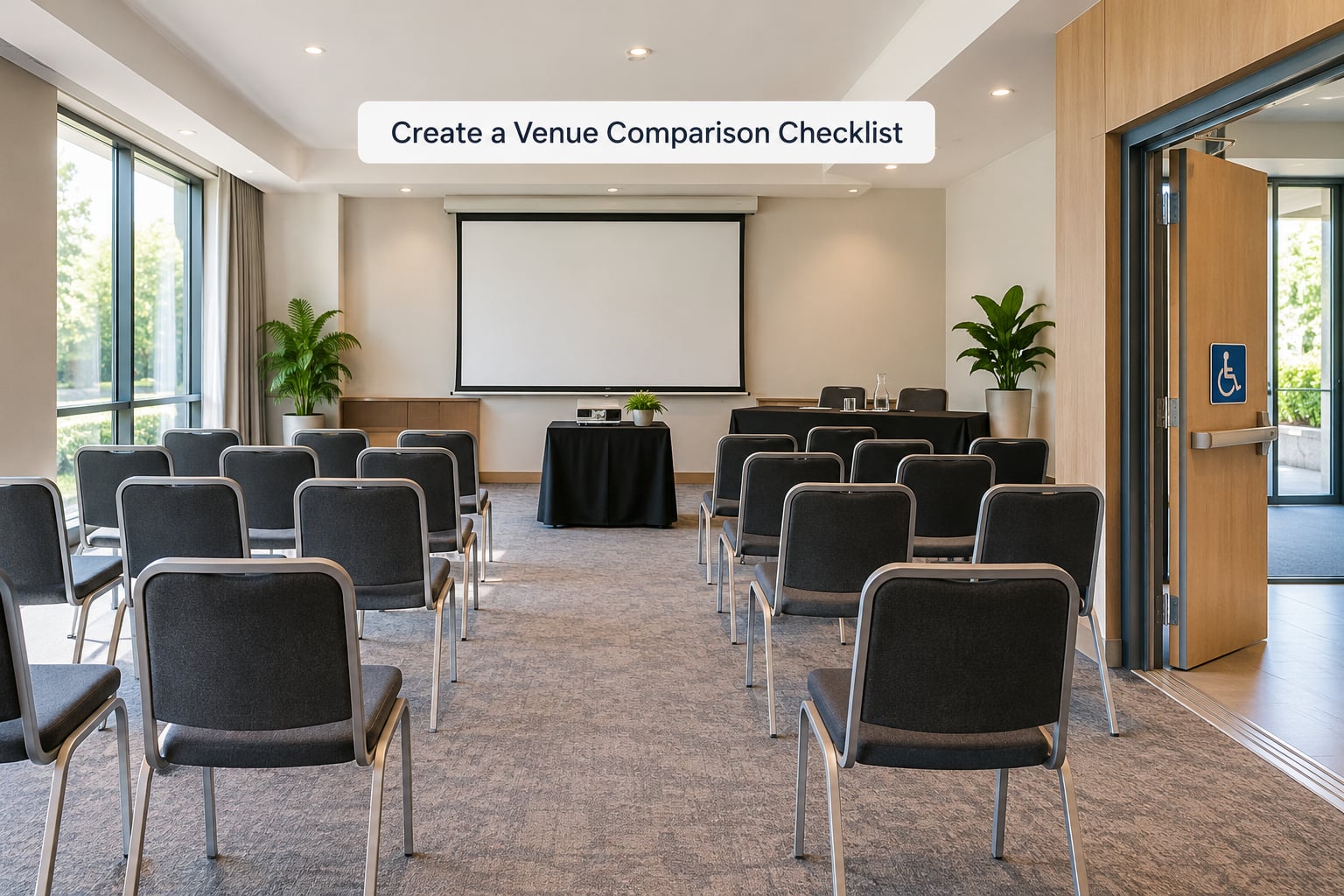
Use the same checklist for every space so you are comparing like with like. Location, capacity and layout, what equipment is included, accessibility, noise limits, parking and transit, setup and clear-away window, storage, cancellation terms, and the total cost including commission or minimum spend.
Keep a simple table like this one while you work through candidates.
| Venue type | Typical capacity | Setup time | Best for |
|---|---|---|---|
| Community centre or village hall | 20 to 60 | Generous, often included | Regular classes, family sessions |
| Library meeting room | 8 to 20 | Short, check carefully | Talking-based sessions, small groups |
| Park pavilion or community room | 15 to 40 | Varies, often self-managed | Seasonal and outdoor-linked workshops |
| Independent cafe back room | 8 to 25 | Limited, work around trade | Small craft and conversation sessions |
| Private studio or maker space | 8 to 20 | Usually generous | Making, ceramics, fibre, repair work |
| Co-working meeting room | 6 to 14 | Short, often bookable by the hour | Training, business workshops |
| Hotel meeting room | 15 to 40 | Standard, may be charged | Corporate sessions, catering included |
| Marketplace-listed space | 10 to 50 | Varies, confirm in writing | One-off hires, unusual spaces |
Then match the space to the discipline, because the physical demands differ more than people expect.
| Workshop type | What the room must have |
|---|---|
| Pottery and ceramics | Wet space, sink, splash protection, drying racks, kiln access |
| Floristry | Water at the table, washable surfaces, somewhere to sweep up |
| Textiles and fibre | Comfortable seating, good natural light, lap space |
| Photography | Power, controllable light, blackout if shooting |
| Wellness and yoga | Clear floor space, heating, changing space, low noise |
| Food sessions | Kitchen access, food hygiene requirements, ventilation |
Contact Venues and Ask for Availability
Three or four good enquiries beat thirty. Warm introductions land better than cold email — hosts in the same circles regularly get a referral that turns a polite refusal into a conversation, because a referred person is taken seriously straight away.
A short enquiry that gets answered keeps you in the running. Something like:
Hello, I’m running a two-hour [workshop type] for about [number] people on [date]. I’d need the room from [setup time] to [clear-away time]. Could you tell me whether the space is available, what the hire fee covers, whether tables and screen are included, what your cancellation terms are, and whether there is a minimum spend or commission on ticket sales?
A written reply should give you dates, capacity, an itemised fee, what’s included, access times and policies. If any of that comes back vague, ask again before you visit — a site visit is a poor substitute for clear terms.
Ask these ten questions before you commit to anything:
- Who handles the booking, and who is your contact on the day?
- Is the fee flat, or a percentage of ticket sales, or both?
- What does the fee include — furniture, cleaning, Wi-Fi, equipment?
- How early can I set up, and how long do I have to clear away?
- Is there a minimum spend, minimum hours, or minimum headcount?
- What are the cancellation and rescheduling terms, and what happens if I cancel?
- Do I get the space exclusively, or is it shared with other customers?
- Can I bring outside catering, and is alcohol allowed?
- Do you require public liability insurance, and do you need a certificate on file?
- Will you promote the session to your customers, and can I leave material for them?
Visit or Review the Space
Stand in the room and look at it as a participant. Check the entrance from the pavement, whether there are steps, where the nearest accessible restroom sits, and how the light falls at the time of day you will be running.
Ask for a look at the power outlets, the Wi-Fi, the heating or ventilation, and where materials can be stored between sessions. Try a chair at a table and see whether there is room to stretch without hitting the next person.
Stand outside during arrival time too. Street noise, parking, a bus route that stops running early, and a room where you can hear the next-door conversation all matter more than the photographs suggest.
If you cannot visit in person, ask for a live video walkthrough at the time of day you will use, and for photos of the setup already in place rather than of the empty room.
Confirm the Total Cost and Contract
The headline rate is rarely the total. Small hosts most often get caught by a minimum spend on food and drink or a commission on ticket sales, which can erase the advantage of a cheap hourly room. Work out what each space costs you per attendee once every extra is added.
Deal structures look like this:
| Structure | How it works | Suits |
|---|---|---|
| Flat hire fee | Fixed cost for the hours, paid by you | Ticketed classes with a known headcount |
| Percentage of ticket sales | You pay a share of what you take | New sessions with uncertain turnout |
| Revenue share | You split the take with the venue | Venues that bring their own audience |
| Venue pays you | They hire you to run it, you keep the margin | Established hosts and venues with staff shortages |
| Space for footfall | Free room in exchange for drinks spend or their mailing list | Cafes and shops running on quiet evenings |
Before signing, read for: dates and hours including setup, capacity limit, fee and deposit, payment deadlines, included equipment, damage liability, cleaning, cancellation deadlines, insurance requirements, and who to call on the day. Get rid of anything you did not expect — every unclear line becomes a decision you make on the morning, in front of twelve people.
Pay the Deposit and Prepare for the Event
Pay by invoice or card to a business account rather than a personal one, keep the invoice, and get a written confirmation that names both parties and the dates. A message saying “see you on the 14th” is not a booking.
Two weeks out, confirm access — door codes, alarms, where to park, who opens up — and share your final headcount. Ask about storage if you are bringing materials in early, and whether you can collect them afterwards.
In the week before, send attendees the address, the entrance, transit and parking, accessibility details and what to bring. On the day, arrive early enough to set up before anyone else does, check the room temperature and lighting, and keep to your clear-away time.
Common Mistakes
- Sizing the room to your signups rather than your turnout. Fix: confirm the venue’s maximum capacity first, then sell against it.
- Assuming setup time is free. Fix: write the load-in and clear-away hours into the agreement.
- Overlooking accessibility. Fix: visit it, or get photos and measurements, rather than trusting a listing.
- Assuming equipment is included. Fix: list everything you need and confirm each item separately.
- Relying on a verbal yes. Fix: nothing is booked until a contract or a clear written confirmation exists.
- Ignoring minimum spend and commission. Fix: compare quotes on cost per attendee, not on the hourly rate.
- Locking yourself into a long contract after one trial. Fix: run a taster session first, then agree a short block of dates.
If you want one booking tip: start with a taster session. It tests the room, the layout and the actual turnout before you commit to a term.
Frequently Asked Questions
How far in advance should I book a venue?
Book as soon as your dates are fixed, because popular spaces and larger rooms go early. For a one-off session, four to eight weeks is often workable. For a recurring class series, approach venues a term or a season ahead, since you are asking to hold the same slot every week and hosts plan their calendars that way.
Should I book a venue or a private room?
A reservable event space gives you the room for your hours and usually bundles furniture and cleaning. A private room inside a hotel, cafe or shared building often costs less and brings footfall, but comes with noise limits, other customers nearby, and sometimes a minimum spend on food and drink. Choose the private room if you are free with the trade-offs.
What should be included in a venue rental agreement?
It should name the dates and hours, including setup and clear-away, the capacity you may hold, the rental fee, deposit amount and payment deadlines, the equipment included, rules on damage and cleaning, cancellation and rescheduling terms, insurance requirements, and who to contact on the day. If a clause is missing, ask for it in writing rather than assuming the default.
How do I know if a venue is accessible?
Ask the venue directly rather than judging from photographs. Confirm a step-free route from the street, doorway widths, an accessible restroom, whether furniture can be rearranged, and where the nearest parking and transit stop sit. Then verify it in person, since listed dimensions and actual conditions often differ.
Can I serve food or drinks at the venue?
Possibly, but you need permission before you advertise it. Outside catering, home-baked items, alcohol and any on-site food preparation may each be governed by a separate policy or fee, and food served publicly can bring hygiene rules of its own. Ask early, because it affects your booking choice as much as the fee does.
What is the best way to confirm the booking?
A signed contract is best. At minimum, get a written confirmation stating the final dates, hours, total cost, payment terms, what is included, the policies that apply, and named contacts for both parties. Email is fine as the format; what matters is that both sides have agreed the same terms in writing before tickets go on sale.
Conclusion
Start with the brief. One page covering dates, real headcount, format, accessibility, equipment and budget is what turns a search into a shortlist, and it is what lets you compare written replies on equal terms. Then list the spaces that genuinely match it, ask for availability and an itemised cost in writing, and only commit once the capacity, setup window and cancellation terms are settled in a contract. Everything after that — tickets, materials, promotion — gets much easier.