You avoid foreign transaction fees by using a card or account with a 0% foreign transaction fee, paying in the local currency rather than your home currency, and limiting cash withdrawals to low-fee ATMs. Most cards add 1% to 3% to every foreign-currency purchase, whether you are standing in the shop or sitting at home buying from an overseas website.
That three percent sounds small until you run the numbers on a real trip. Spend the equivalent of a few thousand on hotels, meals and train tickets and you have quietly handed over a few percent of your entire travel budget to a fee nobody warned you about.
I have watched the same thing happen to friends who travel constantly and still carry a card with a 3% fee, because nobody ever sat them down and did the arithmetic. The fix is not complicated. It just needs doing before you leave, not in an airport queue at midnight.
Rules and rates differ by country of issuer and change often, so treat everything below as a working method rather than fixed pricing. Check your own card’s current terms before you rely on any of it.
Table of Contents›
- What You Need
- Step-by-Step: How to Avoid Foreign Transaction Fees
- Choose a Card or Account With No Foreign Transaction Fee
- Check Whether a Fee Is Really a Foreign Transaction Fee
- Compare the Exchange Rate Before Paying
- Choose the Right Currency at Checkout
- Use a No-Fee Payment Method for Purchases
- Limit ATM Withdrawals and Choose Low-Fee ATMs
- Avoid Paying in Home Currency Online
- Set Alerts and Track Every Transaction
- Check Statements and Dispute Errors Promptly
- Have a Backup for Cards That Fail Overseas
- Create a Simple Before-You-Travel Fee Check
- Common Mistakes
- Paying in your home currency at the terminal
- Assuming a low fee is a zero fee
- Treating no-foreign-fee as mid-market
- Withdrawing small amounts often
- Accepting the ATM’s currency conversion
- Forgetting that online purchases count
- Using one card only
- Leaving fee disputes for months
- Frequently Asked Questions
- What is a foreign transaction fee?
- Do debit cards charge foreign transaction fees?
- Which credit cards have 0% foreign transaction fees?
- Why am I being charged a foreign transaction fee at home?
- Can I get a foreign transaction fee refunded?
- Conclusion
What You Need
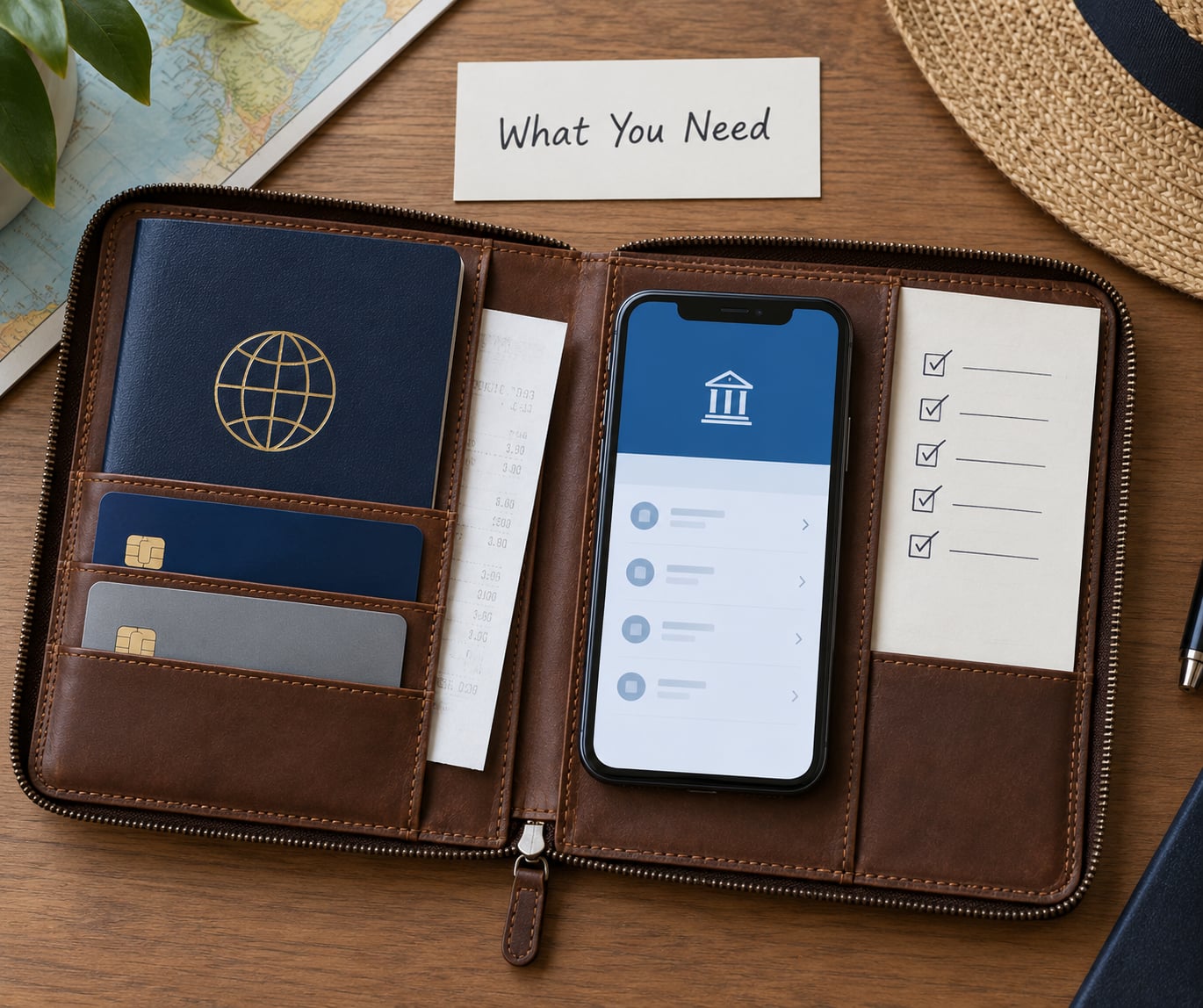
Before you compare anything, gather what you already own. Most travellers are carrying the answer to their fee problem already and have not read the fine print.
- Your card’s terms or fee schedule. Most bank websites have a fees or pricing page listing the foreign transaction fee as a single percentage. Find it and write the number down.
- Two payment methods on different networks. One Visa or Mastercard for everyday spending, plus a backup on a different network. Decline-rates spike in small towns and at independent venues.
- Your bank’s app, logged in before departure. You will want to check alerts, freeze and unfreeze cards, and see pending charges without hunting for a phone number.
- Any multi-currency account you hold. Providers like Wise and Revolut hold several currencies at once and convert at the mid-market rate, which is a different model entirely from a card with a 0% fee.
- Trip details: dates, countries, and rough spending per day. This is what tells you how much cash to withdraw, which feeds directly into your ATM costs.
- A note of your issuer’s support number stored somewhere offline. Searching for a bank’s fraud line on a foreign connection with a frozen card is a miserable way to spend an evening.
If you cannot find your card’s fee percentage in five minutes, call the number on the back of the card and ask. That single call removes the biggest unknown in the whole plan.
Step-by-Step: How to Avoid Foreign Transaction Fees
Choose a Card or Account With No Foreign Transaction Fee
A true no-foreign-transaction-fee product states 0% or no foreign transaction fee in its current terms. That is the whole test.
Watch for three traps. A promotional 0% period that expires mid-trip is not a 0% fee. A low 1% or 2.5% rate is better than 3% but still a real charge. And some cards waive the fee only in certain regions, so confirm the waiver covers every country on your itinerary.
Fee levels also depend on where your account is issued. A US card with a 3% fee has no bearing on what a Canadian, Australian or European issuer charges for the same transaction, so read the terms of the card actually in your hand.
Reviews on r/personalfinance repeatedly recommend the Charles Schwab debit card for zero foreign and zero ATM fees, with the main reported drawback being a daily ATM withdrawal limit around 500 in local terms. Capital One cards also come up often, but travellers consistently flag that the waiver is card-specific rather than issuer-wide. Check the specific card before you assume coverage.
Check Whether a Fee Is Really a Foreign Transaction Fee
Bank statements describe fees in inconsistent language, and travellers often dispute a charge that was never a foreign transaction fee in the first place.
Here is what each charge actually is:
- Foreign transaction fee — charged by your issuer when a purchase is denominated in another currency. A flat percentage, commonly 1% to 3%.
- Currency conversion markup — the hidden spread inside the exchange rate itself. Even a 0% fee card is not always at the true mid-market rate.
- ATM withdrawal fee — charged by your bank for the withdrawal, plus a separate fee from the ATM operator.
- Dynamic currency conversion — a merchant-side charge for letting you pay in your home currency instead. This is the one that should never be accepted.
- Late payment or interest charges — nothing to do with currency at all.
If a statement line reads foreign transaction fee, that is the one described in step one. If it says currency conversion, ATM fee or FX service charge, treat it differently.
Compare the Exchange Rate Before Paying
A 0% foreign transaction fee is only part of the cost. The exchange rate your card network applies may still carry a markup of its own.
Check the rate on the day you plan to pay, compare it with the mid-market rate you would find on a currency reference site, and work out the gap. Visa and Mastercard conversion typically adds roughly 0.25% to 1% on top of the mid-market rate. Multi-currency account providers are usually closer to the mid-market rate, sometimes charging a small, explicit fee instead.
On a large spend that difference is worth pausing over. On a six-unit coffee it is not worth thinking about at all.
Choose the Right Currency at Checkout
At the terminal, the machine will offer you a choice: pay in the local currency, or pay in your home currency. Always take the local currency.
The home-currency option is dynamic currency conversion, and it is a trap. The terminal’s rate is set by whoever operates the machine, usually with a 3% to 8% margin folded in, plus the card’s own fee. Choosing it means paying twice, once at a bad rate and again through the fee.
The advice that repeats across r/digitalnomad and r/travel threads is identical: decline, take the local currency, let your own card do the conversion. The one exception worth knowing is a partner or merchant that insists on billing you in your home currency regardless. When that happens, ask for a merchant-side refund so they reverse the charge in the same currency it was taken.
Use a No-Fee Payment Method for Purchases
Four options cover most overseas spending, and each behaves differently.
Travel credit card at 0% FX — the simplest choice for everyday spending, with cardholder protections on top. High-yield debit card at 0% FX — spends straight from your balance and often has no annual fee. Multi-currency account — you hold local balances and convert at the mid-market rate when you choose, which suits longer stays or anyone receiving income abroad. Prepaid travel card — you load it before departure, which limits the damage if it is lost; r/PersonalFinanceCanada notes these are praised for zero foreign fees, with lower cashback than premium options.
For a two-week trip, a 0% card is plenty. For several months abroad, or if you are paid in a foreign currency, a multi-currency account starts to make more sense.
Limit ATM Withdrawals and Choose Low-Fee ATMs
Cash is where foreign fees multiply fastest, because you can pay three separate charges on one withdrawal: your bank’s fee, the ATM operator’s fee, and the conversion spread if the machine offers to convert into your home currency.
Three rules fix most of it. Use ATMs attached to banks, which travellers on r/travel consistently recommend over standalone machines in tourist areas. Always decline the machine’s offer to convert to your home currency. And withdraw larger amounts less often, because per-transaction fees punish small stops harder.
One constraint catches people out: daily withdrawal limits. The Schwab debit card’s reported limit of around 500 is a live issue for longer trips. Plan around your limit rather than discovering it at the airport on departure day.
Avoid Paying in Home Currency Online
Online purchases made from foreign merchants count as foreign transactions even when you never leave the house. Booking a flight on a foreign airline site, paying a hotel deposit from a Japanese platform, or renewing a domain priced in euros can all trigger the fee on a card you thought was travel-only.
On every international site, look for the currency selector and switch it to the local currency before you reach payment. Many booking sites remember the choice; a few quietly reset it to your home currency, so check again on the payment screen.
Some merchants add their own processing fee for local-currency payments. It happens most often on European ticket sites. It is usually a flat charge, and even so it is generally cheaper than a 3% card fee on the same amount.
Set Alerts and Track Every Transaction
Most fee surprises are simply fees nobody looked at. Turn on push notifications for your card in the banking app before you fly, and set a low or zero international usage alert if your issuer offers one.
Two habits help. Leave a small buffer in the account so a pending foreign charge never triggers an overdraft fee, which is a different cost entirely. And check pending transactions every few days rather than only at the end of the trip, so anything odd gets caught while you can still act on it.
Travellers on r/CreditCards also warn that issuers are more sensitive to accounts used 100% overseas. A normal travel pattern of home purchases plus a foreign trip is unremarkable; a permanently foreign pattern with no domestic activity can trigger a review. Keeping one genuine home-currency transaction on the account is a cheap safeguard.
Check Statements and Dispute Errors Promptly
Yes, some foreign transaction fees can be removed, and the process is faster than most people expect.
Match every foreign-currency line on your statement against the receipt or booking confirmation. Look for duplicate charges, a fee applied to a transaction that was clearly in your home currency, or a withdrawal you do not recognise. Disputes are far easier within the first few weeks, because the evidence is still fresh and the issuer can still trace it.
Send the issuer the transaction date, amount, currency and the merchant name, and ask specifically for the foreign transaction fee to be credited rather than the whole purchase reversed. Refunds for a genuine fee are commonly processed as a statement credit within one or two billing cycles.
Have a Backup for Cards That Fail Overseas
Solo travellers carry more risk than couples with two sets of documents, so plan the failure case before you need it.
Keep two cards on two different networks, stored in separate places rather than both in one money belt. Carry a modest amount of local cash as a bridge for the first day or two. Download your bank’s app and save the support number offline before departure, and tell someone at home which card you are carrying and where.
Acceptance is uneven in smaller towns, at independent guesthouses and at market stalls. A card that works in a capital city may fail an hour outside it, which is the practical argument for carrying a little cash regardless of how fee-averse you are.
Create a Simple Before-You-Travel Fee Check
Ten minutes with a notebook or a note on your phone covers the whole plan. Record, for each card and account you will bring:
- Foreign transaction fee percentage, and where you found it in the terms
- ATM withdrawal fee and your daily withdrawal limit
- Whether the card sits on Visa, Mastercard or another network
- Which exchange rate source it uses, and roughly how far from mid-market it runs
- Whether the backup card is on a different network
- Issuer support number, stored offline
- Cash planned per day, and which ATMs you will use
Redo this check whenever you change cards, not just before a trip. A card you switched to last year may carry a different fee structure than the one you remember.
Common Mistakes
Most foreign transaction fees come from a short list of avoidable errors.
Paying in your home currency at the terminal
This is dynamic currency conversion, and it is the single most expensive choice at the till. Fix: when the machine asks, choose the local currency every time, without reading further.
Assuming a low fee is a zero fee
A card advertising 1% is still charging you 1% on every foreign purchase. Fix: read the current fee schedule and look for an explicit 0% or no foreign transaction fee.
Treating no-foreign-fee as mid-market
Zero fee does not guarantee the best exchange rate. Card network conversion commonly adds a further markup. Fix: compare the rate on the day you pay against the mid-market rate.
Withdrawing small amounts often
Per-transaction fees make frequent small withdrawals expensive, and daily limits bite on long trips. Fix: withdraw larger amounts less often, from bank-owned ATMs.
Accepting the ATM’s currency conversion
The machine offers to hand you your home currency at a poor rate, on top of the operator’s fee. Fix: always decline and take the local currency.
Forgetting that online purchases count
Foreign airline sites, foreign hotels and overseas software subscriptions all trigger the fee at home. Fix: switch every international checkout to local currency and check the payment screen again.
Using one card only
A decline or block abroad with no backup means high-cost emergency cash. Fix: two cards, two networks, stored separately.
Leaving fee disputes for months
Evidence gets harder to trace and issuer goodwill fades. Fix: reconcile statements weekly and raise anything unfamiliar within days.
One more worth naming: signing up for a card and assuming the terms stay put. Issuers change fee schedules, and promotional periods end. Recheck before each trip.
Frequently Asked Questions
What is a foreign transaction fee?
A foreign transaction fee is an extra charge, usually 1% to 3% of the transaction, added when you use a card for a purchase in a foreign currency. It applies abroad and at home when buying from an overseas website. Some issuers fold the cost into the exchange rate rather than showing it as a separate line, which is why it is easy to miss until you read the terms.
Do debit cards charge foreign transaction fees?
Yes. Debit cards charge foreign transaction fees on exactly the same basis as credit cards, because the conversion happens at the payment network before the charge reaches your account. Plenty of debit cards advertise 0%, including widely recommended travel options, so check the specific card rather than assuming debit means no fee or credit means a fee.
Which credit cards have 0% foreign transaction fees?
Several major issuers publish 0% foreign transaction fee cards, including options from Capital One and Discover, and online banks such as Charles Schwab offer 0% cards and debit cards. The waiver is usually card-specific rather than issuer-wide, so confirm the exact card in the current fee schedule. Typical fees elsewhere range from 1% to 3%.
Why am I being charged a foreign transaction fee at home?
Because the merchant is foreign, not because you travelled. Any payment to an overseas merchant counts as a foreign transaction, including foreign airline bookings, overseas hotels, international software subscriptions and foreign stores online. Your card converts the currency and applies the same fee it would have applied abroad.
Can I get a foreign transaction fee refunded?
Often yes, particularly if the fee was charged through a merchant-side conversion you did not agree to, or applied to a clearly domestic transaction. Contact your issuer promptly with the date, amount, currency and merchant, and ask specifically for the fee to be credited rather than the purchase reversed. Keeping receipts makes the difference between a quick credit and a long argument.
Conclusion
Start tonight, not tomorrow: open your card’s fee schedule and write down the foreign transaction percentage. If it is anything above 0%, look for a replacement well before you need one, because new accounts take time and applying abroad rarely works.
Then hold to the two rules that do most of the work. Pay in the local currency, every time, without exception. And keep cash withdrawals rare, bank-owned and in useful amounts.
Before you fly, confirm the fee is 0%, check your daily ATM limit, carry a second card on a different network, switch international websites to local currency, turn on transaction alerts, and save your issuer’s number offline. That is the entire checklist. 2026 fees change and issuer terms vary by country, so verify your own card’s current terms once more before you travel.