Learning how to drive safely on a mountain road in winter comes down to four habits: slow well below the posted limit, pick a low gear before the grade starts, leave a gap of six to ten seconds, and be willing to turn back. Most trouble happens on the way down, where gravity wins if you stay in too high a gear.
A mountain road in winter stacks three hazards at once: low traction, a steep grade, and very little room to recover from a mistake. Add narrow switchbacks and a cut bank with no shoulder, and an ordinary error becomes an incident within seconds. That is why the advice in most guides focuses on descents rather than climbs.
This guide is written for drivers heading into snowy or icy conditions, whether you are crossing a pass solo, driving a rental you have never sat in before, or taking a family to a mountain town. It runs from preparation to arrival, and it ends with what to do when the road stops cooperating.
Updated for 2026 with current chain-control levels and gear-selection methods for automatics and electric vehicles.
Table of Contents›
- What You Need
- On the vehicle side
- On the equipment side
- On the information side
- On the clothing side
- Step-by-Step: How to Drive Safely on a Mountain Road in Winter
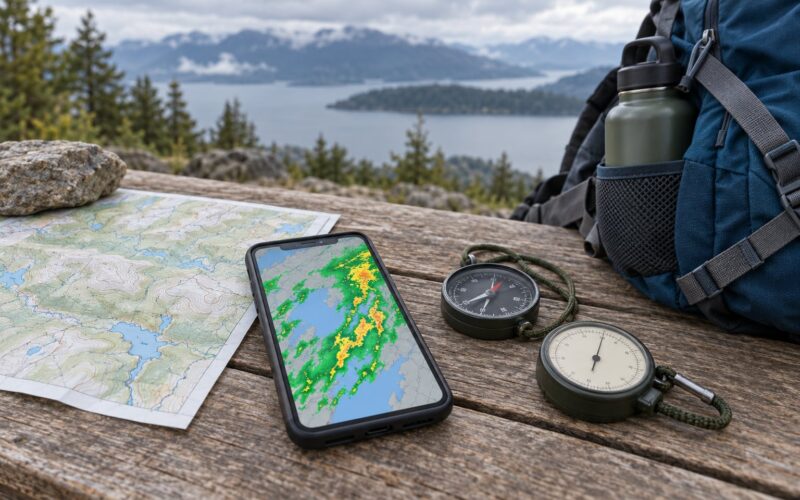
- How to Check the Road and Weather Before Leaving
- How to Prepare Your Car for Snow and Ice
- How to Drive Uphill on an Icy Mountain Road
- How to Drive Safely on a Mountain Road in Winter Without Losing Control on the Descent
- How to Handle Curves, Snowbanks, and Poor Visibility
- What to Do When You Get Stuck or Lose Traction
- Common Mistakes
- Braking too late
- Driving faster than the conditions allow
- Steering while braking hard
- Riding the brakes down the grade
- Leaving cruise control engaged
- Switching traction control off
- Assuming AWD solves the drive
- Ignoring chain controls and weather warnings
- Frequently Asked Questions
- Do I need snow chains to drive safely on a mountain road in winter?
- What tires are safest for driving on snowy mountain roads?
- How do I know whether a mountain pass is too dangerous to drive?
- Should I use cruise control or a lower gear on a snowy mountain road?
- How should I brake when driving downhill on ice?
- What emergency supplies should I keep in my car during winter mountain travel?
- The Bottom Line
What You Need
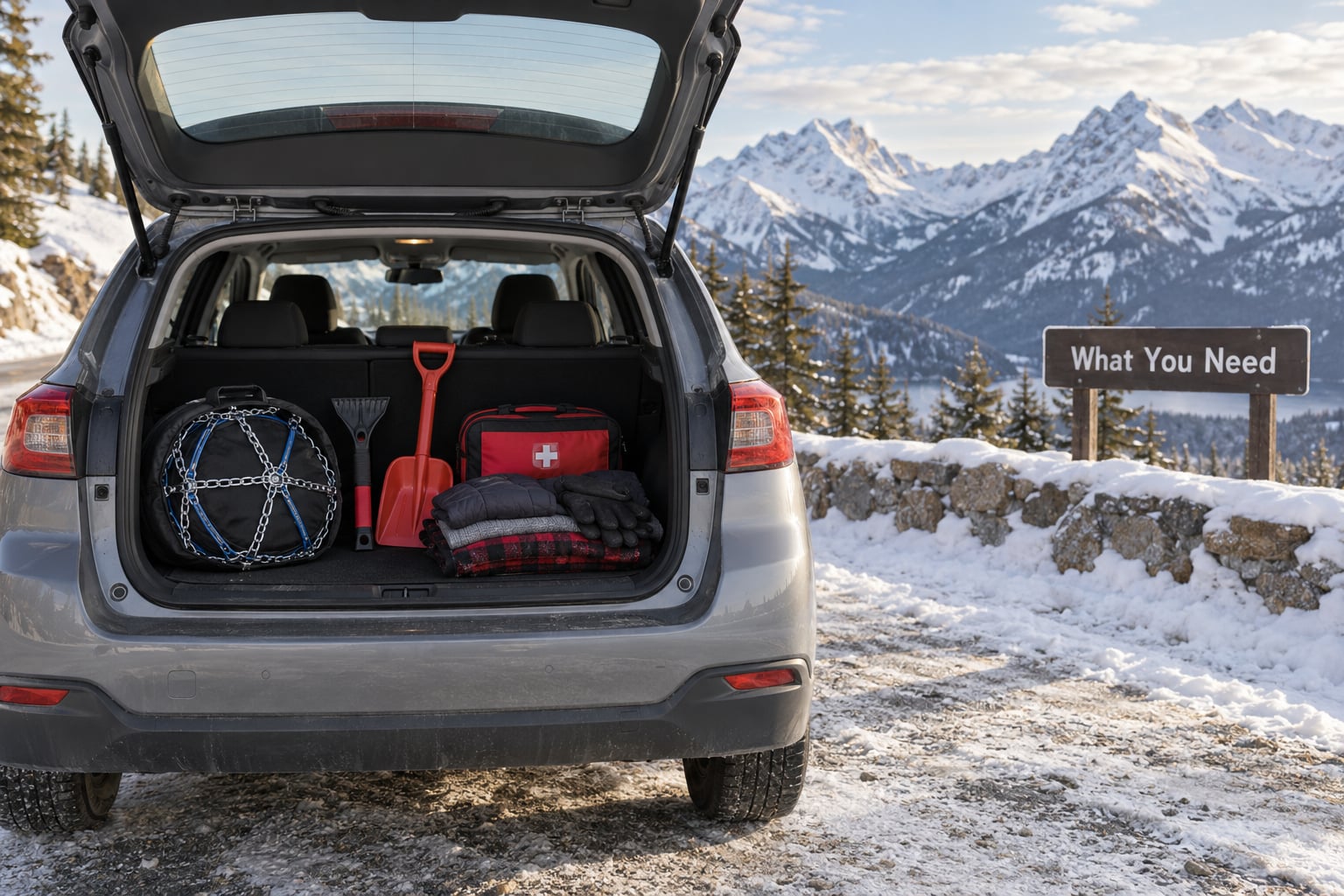
Before you turn the key, line up four things: the right car, the right equipment, current road information, and clothing that works if the trip stalls. Missing any one of them turns a two-hour drive into an evening on a dark roadside.
On the vehicle side
- Tires carrying the 3PMSF snowflake mark, with at least 3/32 inch of tread and closer to 4/32 for a mountain route.
- A drivetrain that suits the climb: front-wheel drive is workable, all-wheel drive is helpful, four-wheel drive adds a low range on serious grades.
- Brakes that respond fully on the first firm press, plus fluid and coolant checked the week before.
- Whatever your car needs to get down a grade in a low gear: manual, automatic with a low or L mode, paddle shifters, or an EV with strong regenerative braking.
On the equipment side
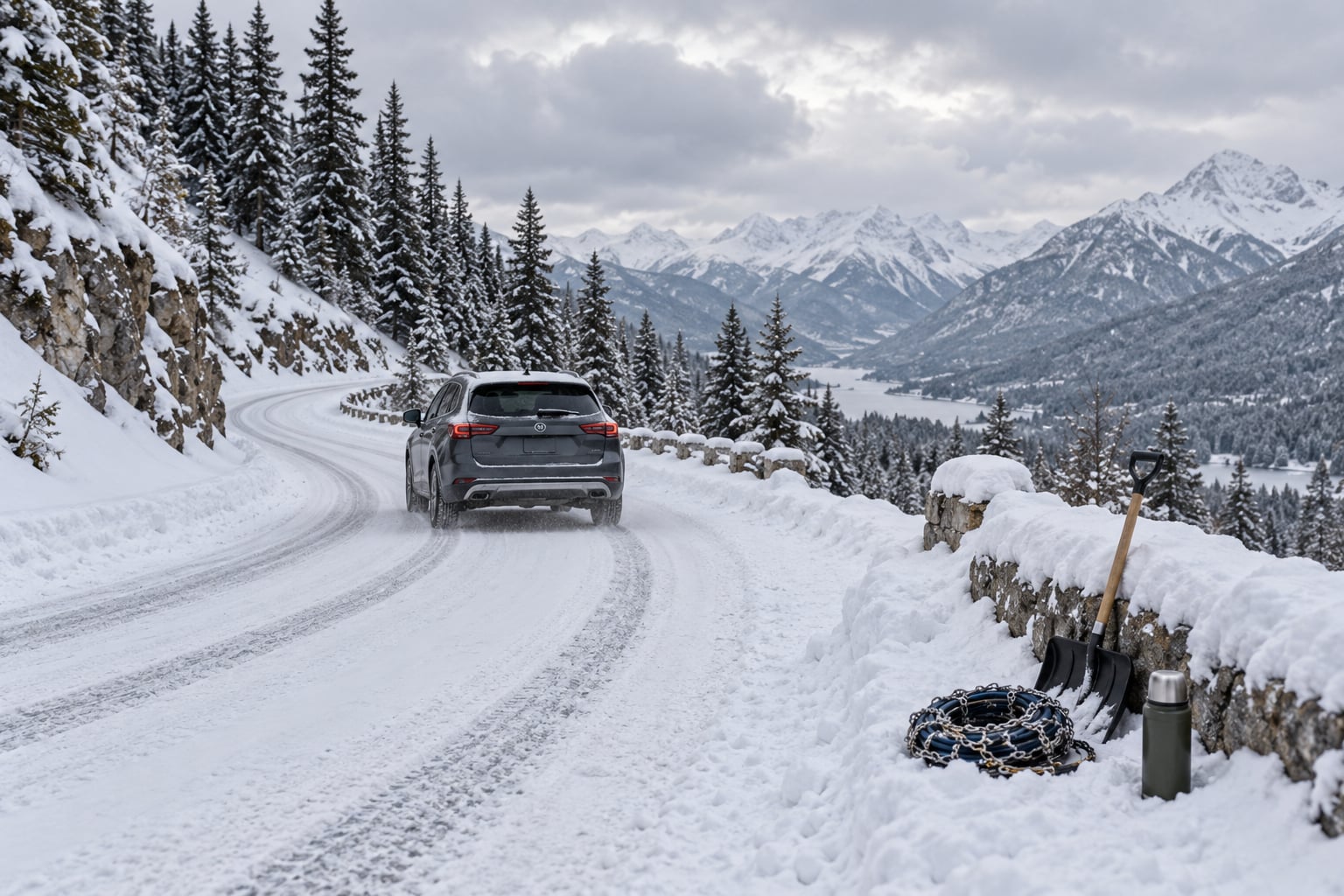
- Snow chains that fit your tires, plus a second pair if a passenger will be installing them.
- Ice scraper, snow brush, and a small shovel for clearing a wheel well or the tailpipe.
- A flashlight or headlamp, a charged phone, a power bank, and a car charger.
- Warm blanket, sleeping bag rated well below freezing, extra layers, water, and high-energy food.
- Reflective vest or triangles, traction mats, a bag of sand or kitty litter, and a basic first aid kit.
On the information side
- Your state or provincial road authority site and its 511 service for closures and chain controls.
- A mountain pass-specific forecast including the temperature at the summit, not just at your door.
- A backup route, fuel stops, and at least one place to turn around safely.
- Someone outside the car who knows your route, your vehicle, and when you expect to arrive.
On the clothing side
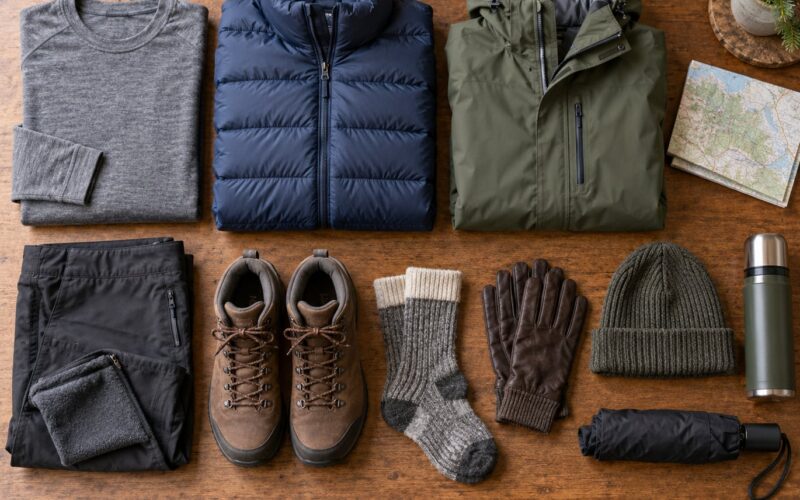
Dress in layers you can stay in for three hours of a stalled car, not for the five minutes it takes to reach a shelter. Keep a wool or synthetic layer against your skin, a windproof and waterproof shell, insulated gloves, and a hat you can keep on. Boots with real grip matter more than a heavy coat, because you will be walking on ice if the worst happens.
Step-by-Step: How to Drive Safely on a Mountain Road in Winter
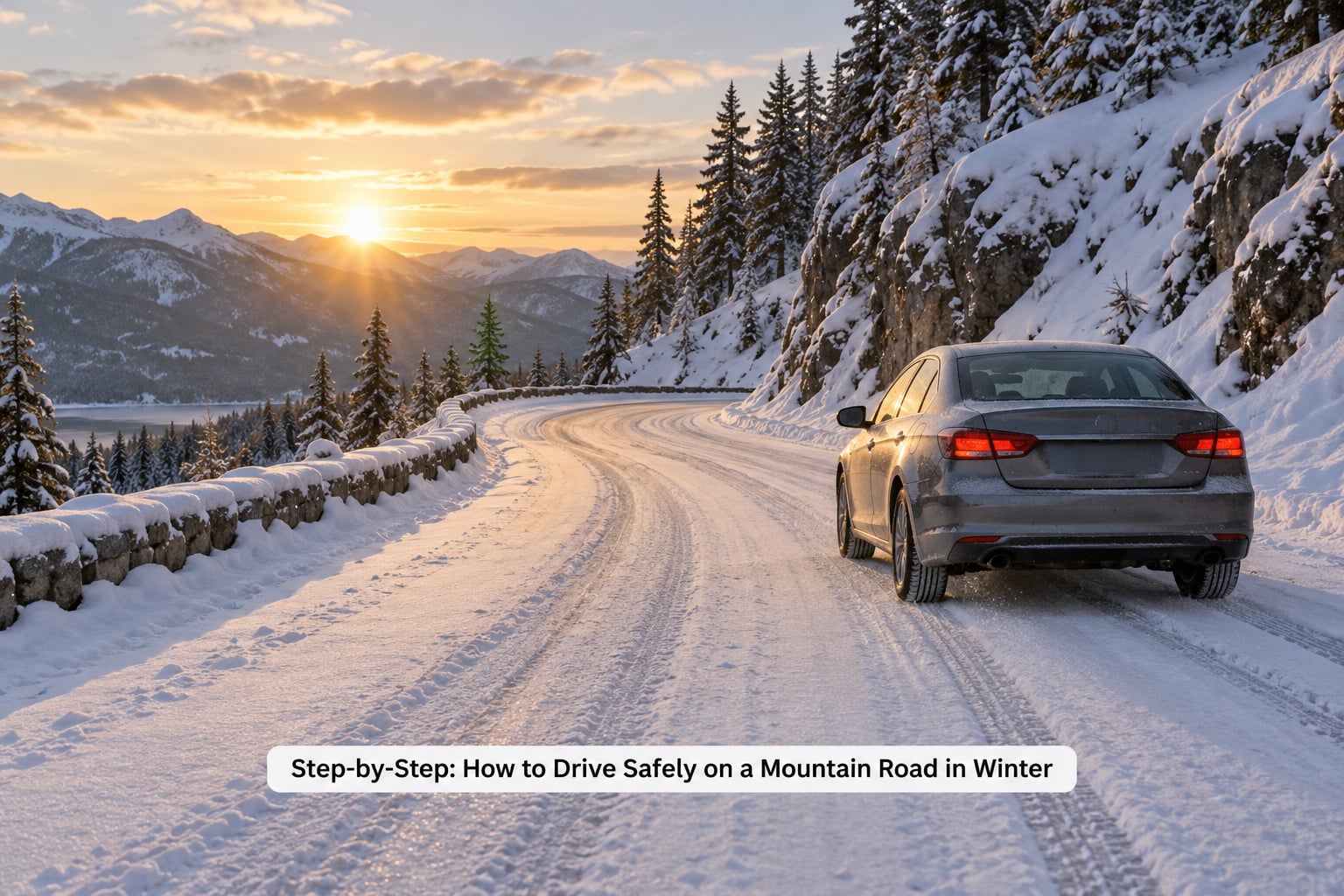
The order matters. Check conditions, prepare the car, drive up, drive down, handle what the road throws at you, and know how to recover. Skipping straight to the descent is how people end up on the shoulder with cooked brakes and no plan.
How to Check the Road and Weather Before Leaving
Start with the road authority for the states or provinces on your route, not a general weather app. Look for closures, restrictions, and chain control levels, then read what each level requires. At R1, traction devices such as snow chains, snow tires with the 3PMSF mark, or an approved traction device must be on hand and be installed when directed. R2 and R3 extend that to chains required on every axle or on all four wheels, with only four-wheel-drive vehicles carrying an exemption on some roads, and chains are mandatory once you reach R3.
Then look up the forecast for the pass summit rather than the valley. Mountain weather changes in minutes, and a pass can sit ten degrees below freezing with falling snow while the town you left is clear and mild. Note the elevation gain on your route, since that tells you whether the climb is long enough to overheat the car on a hard pull.
You will tell how to drive safely on a mountain road in winter at two o’clock in the afternoon, not at seven the next morning. If the trip needs dusk or darkness, add headlights that actually throw a beam, and expect wildlife on the road once the sun drops.
Finish with the escape plan. Know your fuel stops, your turn-around points, and the nearest town below the pass in case you need to retreat. Then set a clear rule: if the pass is closed, if chain controls are active and you have no chains that fit, if visibility drops below the distance you can see the road ahead, or if forecasts show the storm arriving before you clear the summit, you turn back.
How to Prepare Your Car for Snow and Ice
Traction comes from tires first, everything second. Winter tires with the 3PMSF snowflake are designed for cold temperatures below 45F, when all-season rubber hardens and stops biting. Check tread with a coin or a depth gauge and aim for 4/32 inch on a mountain route, since a worn winter tire loses its edge far sooner than a worn summer tire does. Look across all four tires for uneven wear, which shows a tire that needs rotation or replacement.
All-wheel drive helps you get moving. It does not shorten your stopping distance, and it does not help you steer around a skid. Braking and steering still depend entirely on the front tires finding grip, which is why overconfidence in an AWD vehicle is one of the most common causes of winter crashes.
Walk the rest of the car. Brake pads that are near the end of their life will fade on a long descent. Cold weather thickens oil and shrinks the battery, so both deserve a check. Make sure the defroster blows hard at the windshield, the wipers are in good rubber, and the washer fluid is rated below freezing. Warm the cabin while you clear snow, and keep the tailpipe and the area under the bumper free of packed snow if you will be stopped with the engine running.
Check your chains against your tire size before the trip, and read the fitting instructions once at home. On a rental, spend the first ten minutes finding the chains in the trunk, learning which dial tightens them, and identifying the gear selector, the traction control switch, and the brake pedal feel before you join traffic. A rental with unfamiliar controls is a different risk from a rental with unfamiliar road.
How to Drive Uphill on an Icy Mountain Road
Climbs are the easier half of a mountain route, but they set up the descent. Choose a low gear before the grade steepens rather than after the car starts laboring, and feed the throttle in rather than flooring it. Sudden throttle on a snowy uphill grade spins the wheels and, on a rear-wheel-drive vehicle with weight in the rear, breaks the rear loose.
Turn cruise control off before the hill and keep it off for the whole trip. A set speed will happily hold a pace your tires cannot support when you come around a shaded bend. Stay in your lane, keep a generous gap to anything ahead, and avoid stopping mid-climb where the uphill lane has no shoulder and traffic cannot see you.
If the vehicle starts to slide on the climb, ease off the accelerator rather than adding more. Look where you want to go, hold the wheel still, and let the weight settle. If the car will not pull away in a low gear, spread the climb across two runs with a pull-off, or turn around.
How to Drive Safely on a Mountain Road in Winter Without Losing Control on the Descent
The descent decides whether the day goes well. In a high gear, your brakes have to absorb the full pull of gravity through friction pads alone, and those pads heat up fast on a long grade. Once they overheat, brake fade sets in and the pedal travels farther with less bite, which is the worst possible moment to need it.
The fix is simple and mechanical: pick the lowest gear your vehicle offers before you start down and let the engine do most of the work. On a manual, drop to third or fourth on a moderate grade, or second on a steep one, and tap the brake between downshifts so you do not stall. On an automatic, use the L or M mode or the paddle shifters to select a low gear manually; on an EV, set the strongest regenerative braking level available, which will hold the car down a hill with almost no brake use.
Use one input at a time. Brake, then release and let the engine hold the speed. Do not brake and steer hard at the same moment, since the locked front tires cannot turn the car. Keep your speed low enough that you can stop within the distance you can actually see, which on ice is several times the dry-pavement figure.
On repeated long descents, plan a five to ten minute stop with the engine running and the parking brake off so the brakes cool. Signs of heat include a pedal that feels soft, a smell of hot brakes, or a brake warning light. If you feel fade, shift lower, coast more, and give the pads time.
How to Handle Curves, Snowbanks, and Poor Visibility
Slow down before the curve rather than in it. Braking on a straight lets you carry a controlled entry speed into the bend, and looking through the turn and past the snowbank tells you where the road actually goes before you reach it. In switchbacks, take each turn as a separate event: brake, turn, straighten, then look ahead again.
Leave six to ten seconds of following distance in winter, more if it is falling snow. In deep snow, stay in the ruts cut by vehicles ahead rather than riding the smooth crust that builds in the wheel paths, since that crust is slicker than the loose snow beside it.
Black ice forms where the road loses solar heat or gains moisture: bridges, shaded curves, the inside of a tight turn, tunnel entrances and exits, and the lowest point of a dip. Feel for it as a sudden, quiet loss of grip with no visible cause. The response is to lift off the accelerator, keep the wheel pointed where you want to go, and brake only if you have to, gently.
In low visibility, a whiteout removes the road edges entirely. Follow the ruts, keep your speed down to what you can see, and use the shoulder or a wide place to wait if the storm overtakes you. Veteran drivers driving these passes regularly will pull over and wait out bad conditions rather than push through, because two bad conditions at once is what accidents are made of. Watch for plows and their spreaders at reduced speed, never pass one working, and stay back from the tailgate.
What to Do When You Get Stuck or Lose Traction
If the car starts to skid, first instinct is to grab the brake or spin the wheel. Both make it worse. Lift off the accelerator, keep the steering wheel pointed where you want the car to go, and let the vehicle coast until grip returns. Pressing the brake locks the tires and removes your ability to steer.
With ABS on, stand on the brake pedal and let the system pulse; it is designed for exactly this situation. Without ABS, brake firmly but not to a full lock, pump the pedal to release and reapply grip, and hold the wheel straight. Either way, look in the direction you want to travel rather than at whatever is sliding past the window.
If you are truly stuck in deep snow, stop, put the vehicle in park or neutral, and set out to clear snow from under the tires, behind each wheel, and around the exhaust pipe. Place traction mats, a bag of sand, or boards in front of the driven wheels, then use gentle, steady throttle to move off. Rocking between drive and reverse works, but spinning the tires on ice digs a worse hole. On a pickup, moving weight back toward the axle restores rear traction.
Call for help rather than trying to force it, and stay with the vehicle unless you are certain help is close. A car is visible, warm, and has supplies in it. Walking a mountain road in a whiteout in a storm coat is how a fender-bender turns into an emergency. Keep the hazard lights on, the cabin warm, and the tailpipe clear whenever the engine runs.
Common Mistakes
Almost every dangerous habit on a winter mountain road is a normal habit that was safe somewhere else.
Braking too late
Downhill drivers often hold their speed until the corner arrives, then brake hard mid-turn, which locks the tires and kills steering. Fix: finish braking on the straight, before the curve, and enter it slowly.
Driving faster than the conditions allow
Speed feels fine until the shaded bend with ice on it. Fix: pick a speed based on the worst surface ahead, not the clear road you just left.
Steering while braking hard
Two demanding inputs at once overwhelm the front tires. Fix: brake, then steer, never both aggressively at the same moment.
Riding the brakes down the grade
Constant light pressure cooks the pads and water does not help. Fix: choose a low gear, use engine or regenerative braking for most of the descent, and brake only when the speed needs changing.
Leaving cruise control engaged
Cruise control holds a speed through a curve you cannot see. Fix: switch it off before the climb and keep it off for the trip.
Switching traction control off
Some drivers read that traction control hurts performance and turn it off in snow. On a low-grip surface it is helping you, and on a steep climb it is often what gets you over a rutted section. Fix: leave traction control and stability control on. They cut throttle and brake individual wheels for you, which is exactly what a sliding car needs.
Assuming AWD solves the drive
All-wheel drive gets you moving; it does not shorten stopping distance or make a slide recoverable. Fix: drive to winter conditions regardless of the badge on the tailgate.
Ignoring chain controls and weather warnings
The most expensive decision on the trip is made at the bottom of the hill, in the wrong tires, with no chains. Fix: check the road authority before you leave, carry the right chains, and honor a turn-around rule you set in advance.
Frequently Asked Questions
Do I need snow chains to drive safely on a mountain road in winter?
Often yes. A chain control at R1 requires a traction device on hand and installed when directed, and R2 and R3 extend the requirement, with all-wheel drive sometimes exempt only at lower levels. Snow tires carrying the 3PMSF snowflake mark count as traction devices on many roads. Chains do not replace winter tires or cautious speed, so carry a set that fits your tire size and know how to fit them before you need them.
What tires are safest for driving on snowy mountain roads?
Tires with the 3PMSF snowflake symbol, because their compound stays flexible in cold temperatures where all-season rubber hardens. Aim for at least 3/32 inch of tread and closer to 4/32 inch for mountain routes. Studded tires grip packed snow and ice better but are restricted or banned in many states and provinces, so check local rules before fitting them.
How do I know whether a mountain pass is too dangerous to drive?
Turn back when the pass is officially closed, when chain controls are active and you have no chains that fit, when you cannot see the road edge ahead of you, or when the forecast puts the storm over the summit before you clear it. Also turn back if you feel uneasy about conditions. Waiting at a rest area for two hours is far cheaper than a recovery on a guardrail.
Should I use cruise control or a lower gear on a snowy mountain road?
Never cruise control. Adaptive cruise control and regular cruise will hold a speed into a curve your tires cannot grip, and a wheel-speed sensor on ice can behave in ways that surprise you. Use a lower gear instead: manual third or second, an automatic L or M mode or paddle selection, or the strongest regenerative braking level on an electric vehicle.
How should I brake when driving downhill on ice?
Select a low gear first so the engine or motor handles the descent, then brake only to adjust speed. Use the brake intermittently rather than holding constant pressure, and never brake hard while turning. Keep a speed from which you can stop within the distance you can see, because ice stretches stopping distance several times beyond the dry figure.
What emergency supplies should I keep in my car during winter mountain travel?
Carry a blanket or sleeping bag rated well below freezing, extra layers, water and high-energy food, a flashlight or headlamp, a charged phone and car charger, an ice scraper, a shovel, traction mats or sand, a first aid kit, and reflective gear. Keep the fuel tank above half and clear snow from around the tailpipe if you will be stopped with the engine running.
The Bottom Line
If you only do one thing differently, pick a low gear before the descent starts and leave the brakes out of it. Everything else on this list makes that easier: winter tires, chains that fit, a full tank, a kit in the trunk, and a route you can retreat from. Check the road authority the morning you leave, and if conditions have turned, simply turn around.
Get the mechanics right once and the rest is habit. Slow down, choose the low gear, leave the gap, and know when to go back. That is how to drive safely on a mountain road in winter, and it works whether you drive a rental crossover or the pickup you have owned for twenty years.