To plan a rainy day in a city, read the hourly forecast to work out how long the rain lasts, pick one large indoor place that can absorb four or five hours instead of a string of small stops, and route the day around stations and covered walkways rather than distance. Add a warm meal and one thing you do with your hands. Match the shape of the plan to the shape of the rain.
That last sentence is the whole method. Rain comes in two very different shapes, and a day planned for one shape falls apart under the other.
A convective summer storm is loud, arrives without much warning, dumps everything in twenty minutes and leaves. A frontal system is grey, quiet, steady and may sit over the city until dark. The first one needs a coffee and a bookshop. The second one needs a plan with a spine. Most ruined city days happen because someone built the second kind of day and then got the first kind of weather, or the reverse.
There is also a second thing worth saying plainly, because it changes what you plan for. A rainy city day is rarely ruined by the activity itself. It is ruined in the twenty minutes of wet transit between two perfectly good indoor options. People come back from a rainy day saying the museum was boring or the cafe was nothing special, when what actually happened was that they stood at a soaked crossing at 2pm with wet feet and gave up.
So the planning happens before you pick anything. Here is how I would do it, and how to adjust it whether you are traveling alone, bringing kids, or just stuck in your own city for a day. If you have done this before and it went sideways, the fix is usually in the first hour, not the fourth stop.
Table of Contents›
- What You Need
- Step-by-Step
- 1. Check the forecast, not just the rain icon
- 2. Choose one neighborhood as your rainy-day base
- 3. Build a route with both indoor and outdoor moments
- 4. Reserve or verify the essential stops
- 5. Add a food stop that suits the weather
- 6. Add one small pleasure with no strict schedule
- 7. Keep a wet-weather backup and an easy ending
- Common Mistakes
- Frequently Asked Questions
- What can I do in a city when it rains all day?
- What should I pack for rainy weather travel?
- What type of shoes to wear on a rainy day?
- How do I get my steps in when it rains?
- How do I spend a rainy day in a city alone?
- What if my plans close or cancel because of the weather?
- Start with the forecast, then keep the day flexible
What You Need
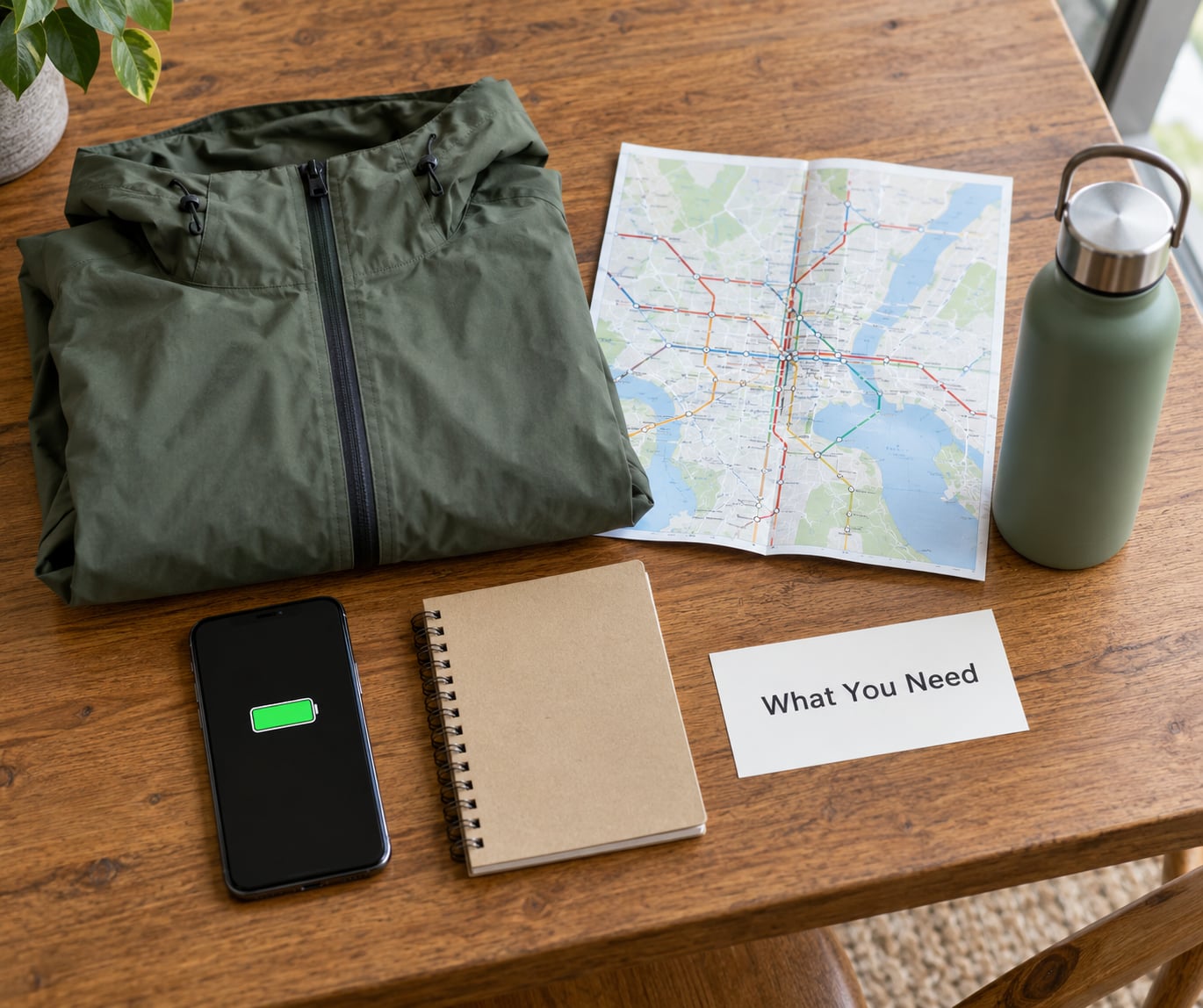
None of this is expensive and most of it you already own. The point of the list is that a rainy day fails on logistics long before it fails on ideas.
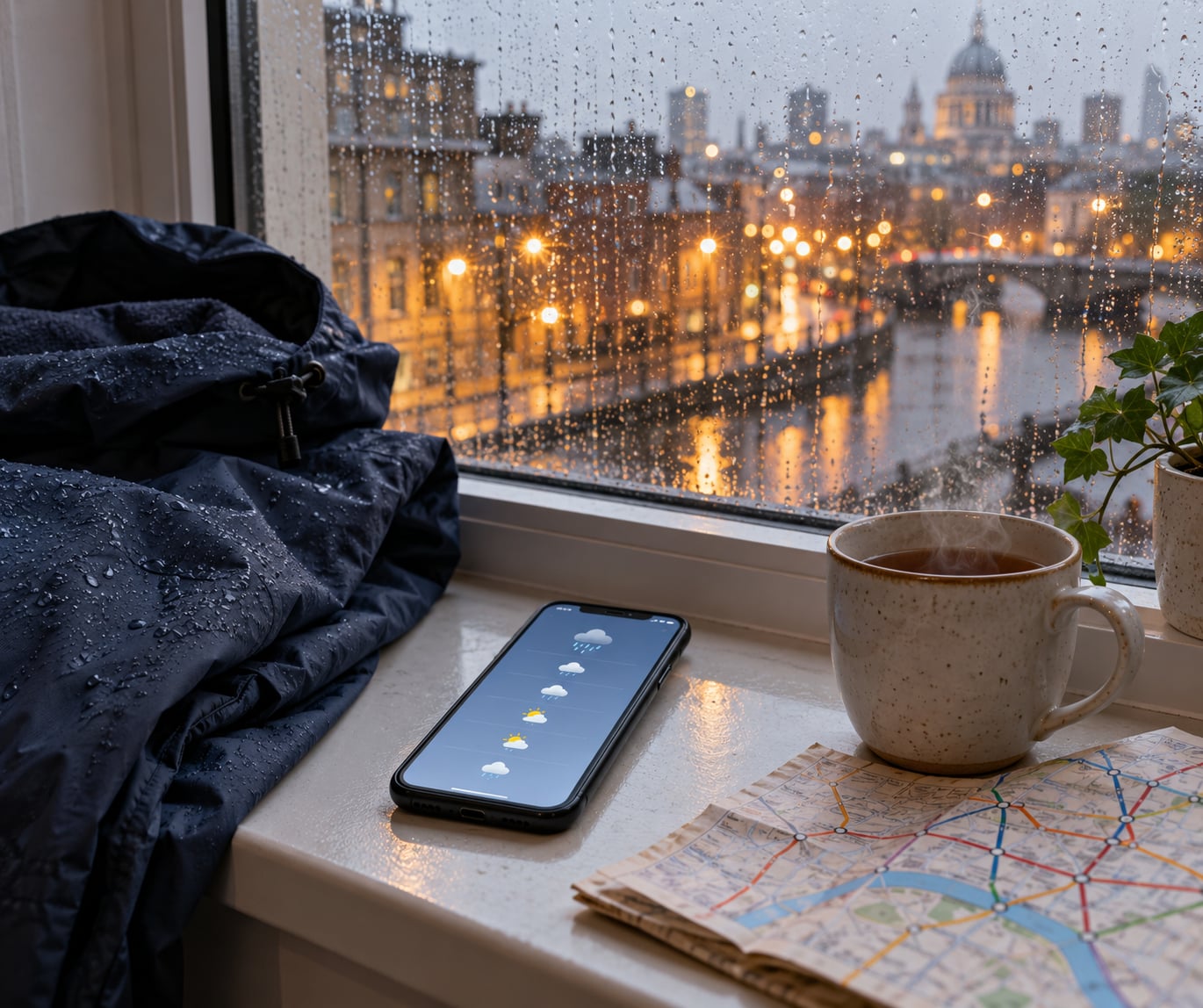
- An hourly forecast, not the daily one. The daily view says 70% chance of rain. The hourly view tells you it is 11am to 2pm, which is a completely different day to plan.
- Your transit map, loaded and usable offline. Not the paper one in a hotel lobby. Know which stations have lifts, which have long concourses, and which lines surface above ground.
- A contactless card or a small amount of cash. Some smaller venues and covered markets still do not take cards, and a queue at a wet ticket machine is miserable.
- Waterproof outerwear with a hood. A hood beats a street umbrella in wind, and it leaves both hands free for a camera, a coffee, or a wet umbrella that has to be carried.
- Shoes with grip. Wet pavement and wet stairs are the actual hazard. Smooth leather soles on polished station floors are how people break a wrist.
- A charged phone and a power bank. Your map, your tickets and your photos all live on it, and cold rain drains a battery faster than warm rain.
- A dry bag or a zip pouch. For a passport, a wallet, a book, and one dry layer of clothing. This is the single cheapest item on the list and the one that most changes the day.
- A notebook or a notes app. Somewhere to put a thought before it disappears. Rainy days are unusually good for noticing things.
- A loose spending limit. Not a budget, a ceiling for the day that you are not allowed to exceed. It stops the improvisation from turning into regret.
Step-by-Step
Seven steps, in order. The first two decide the shape of the day, the middle three fill it, and the last two keep it from falling apart.
1. Check the forecast, not just the rain icon
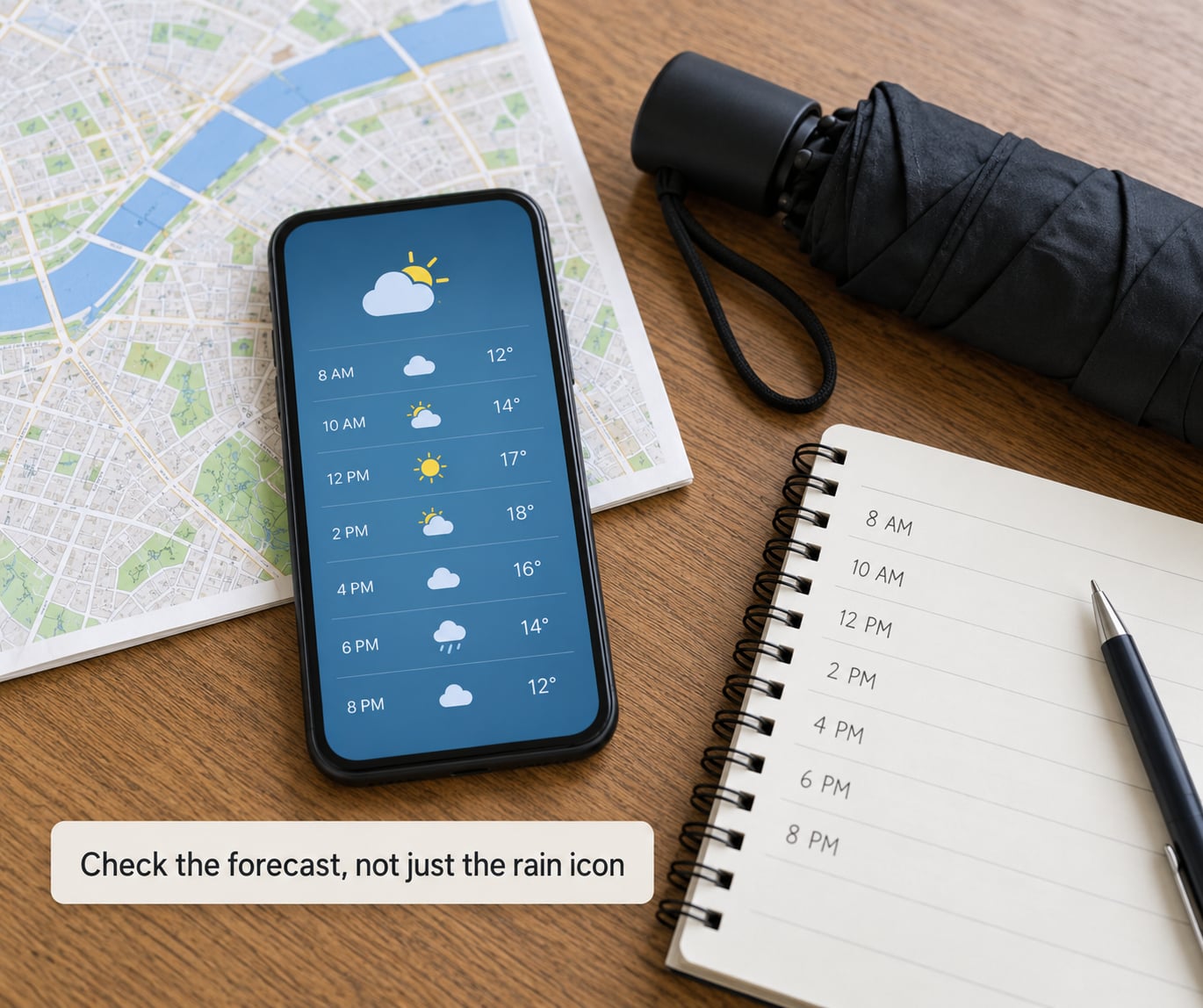
Read the forecast for character, not just probability, because probability tells you nothing about what to do.
Look at five things. Timing matters most: a rain band that clears by lunchtime leaves you a normal afternoon. Intensity decides whether you can cross an open square or need a covered route. Temperature decides whether you can sit outside under awnings or whether a cold drizzle will have you sheltering by noon. Wind decides whether an umbrella is a tool or a liability, since most cheap ones invert inside out in the first gust. Daylight matters because a wet, dark evening kills plans that a wet afternoon does not.
Then check for warnings. A thunderstorm warning means open squares, exposed ferries, tall viewpoints and isolated trees are genuinely bad ideas, not merely wet ones. A flash flood warning means low-lying streets, underpasses and river paths are out, and you should not try to walk around a flooded section.
| How long the rain lasts | What it usually is | Shape the day like this |
|---|---|---|
| Under an hour | Passing shower or short convective burst | Do your normal outdoors plans and keep one indoor stop on standby. Sit it out in a cafe or a bookshop. |
| Two to three hours | A band moving through, or a storm cycle | One indoor anchor timed for the middle of the band, with a short outdoor walk either side of it. |
| All day | Frontal system, or persistent drizzle | One large indoor destination that can absorb five hours, minimal transit, one warm meal, one hands-on activity. |
| Overnight | Stalled front, tropical monsoon, or winter rain | Build toward an evening plan that does not depend on daylight, and keep your evening plan indoors too. |
Temperate cities do not really have a rainy season, they have wet months and storm seasons, and the character of the rain changes with the season. Summer rain tends to be convective: short, violent, spaced apart. Winter rain tends to be frontal: long, steady, unremarkable. Planning a summer storm itinerary for a wet autumn afternoon is how people end up standing in a drizzle at 6pm with nowhere to be.
2. Choose one neighborhood as your rainy-day base
Pick a single walkable area and treat it as home for the day. Cross-city travel is what turns a rainy day into a wet one, because every transfer is extra exposure.
A good rainy-day base has four things. Enough indoor density that you can improvise without crossing town. Somewhere to sit down and eat within a few minutes. A station or covered route that reaches it, so you can arrive dry even if it is already raining. And a mix of venue types, so that if the museum is packed you have somewhere else within walking distance.
For someone who has never been to the city, this is the version that works: plan the neighborhood, not the landmarks. The famous sights are usually the most exposed and the most crowded in bad weather. The neighborhood behind the station, with a market hall, a library reading room, three cafes and a second-hand bookshop, will give you a better day and cost you nothing to research.
Two rules of thumb. Choose a base with a covered market or an indoor shopping street, because that is what turns a wet crossing into a walk. And choose a base with at least one free option, because free venues are the ones that never need booking and never run out.
3. Build a route with both indoor and outdoor moments
Alternate indoor and outdoor stops so the day keeps a rhythm. All indoor for six hours feels like a waiting room, and being outdoors in light rain for fifteen minutes is usually fine.
The trick is to choose outdoor moments that are short and sheltered. A covered market hall, an arcade between buildings, a station concourse with shops, a colonnade, a bridge with a walkway, or a short stretch between two doorways under awnings. What ruins a day is not being outside; it is standing still in the open with nowhere to go.
On walking: it is possible to get your steps in a wet city without getting wet. Malls, station concourses, covered market halls, large public libraries with long reading rooms, department stores, and even a walk through three arcades can add up. Forum threads about rain in cities keep coming back to the same complaint, that people cannot get their steps in. The honest fix is a mix of indoor walking and one short outside loop once the rain eases.
Build the route backwards from the anchor. Start with the one large indoor place that can absorb the middle of the day. Add the meal next to it. Then add one short sheltered outdoor moment on each side, so you arrive and leave in small pieces rather than one long dash. Most rainy-day plans fail at the front door or the back door, not in the middle.
4. Reserve or verify the essential stops
Check the venue’s own website on the day, not a listicle you read last year. Hours, timed entry, temporary closures, and access all change.
Four things to verify. Whether the venue is open today, because many close one weekday a week and it is rarely the day you assume. Whether you need a timed ticket, and whether the slots you want are still there. Whether there is a same-day or flexible cancellation policy if you booked something non-refundable and the weather turns. And whether access is working, since lifts fail and stairs flood.
A warning about paid viewpoints. Rooftop observatories, sky decks, rooftop bars and open ferries are sold on the view, and in low cloud there is no view, and the refund terms are rarely generous. Do not spend an expensive ticket on a promise of weather. Put that money into something the rain cannot take away, like a museum, a long lunch, or a concert.
Where you can, choose venues that need no booking at all. Public libraries, free galleries, covered markets, bookshops, and most cafes will not ask you to reserve on a wet day, which means you can decide at 10am what the afternoon looks like.
5. Add a food stop that suits the weather
Make the meal an anchor rather than a fallback. Rainy days want something hot, something slow, and something that comes with permission to sit.
A bowl of noodle soup, a hot breakfast, or a plate of dumplings is the archetypal wet-weather meal because it is fast, hot and needs no ceremony. A tea room or a long cafe sit-down works when the rain is steady rather than heavy, since you can stay an hour without anyone moving you on. A bakery counter with a warm loaf is the cheapest version of the same idea. And a proper lunch, taken slowly, is what turns a bad-weather day into a memory you did not plan.
Two practical notes. Eat before you leave the shelter, not during it, because eating standing up in the rain is the opposite of the point. And if you are on your own, a counter seat or a table facing the room is a much easier solo seat than a booth or a two-top against a wall, which sets a conversation you did not ask for.
6. Add one small pleasure with no strict schedule
Give the day one thing that has no start time and no outcome. This is the step that stops a rainy day feeling like a waiting list.
Options that work: an hour in a bookshop with no intention of buying anything, a gallery of local art you have never seen, a craft or ceramics shop where you can handle things, a bathhouse or a pool, a cinema with a film you would not have chosen on a sunny day, a live music venue with a small early set, a market stall you stop at because it smells good, or a photography walk with a specific prompt.
For the photography version, rain gives you reflections, color on wet stone, people under umbrellas, and windows glowing from the inside. Pick one prompt before you go out, such as every yellow thing you can find, and the walk stops being a walk and becomes something with a finish line.
Keep this item last on the list and give it a whole block of time. It is the part that gets sacrificed when the day runs late, and it is usually the part you remember.
7. Keep a wet-weather backup and an easy ending
Know your retreat before you need it. A nearby refuge within a five-minute walk, a place with sockets and no time limit, and a way home that does not need a taxi.
Two fallbacks, at two scales. The midday refuge is somewhere you can sit for two hours without buying anything, because plans fail around 2pm more often than at any other hour. The evening fallback is your room or a bar near it, and the bar matters, because a wet evening in a hotel room alone is the version of this day that people actually remember badly.
Rain matters much less after dark. Evening plans are almost always indoors anyway, so the weather stops being an obstacle and becomes the reason you chose them in the first place. A late meal, a small theater, a set of live music, a bath and an early night are all improved by rain.
Leave the ending loose. Do not book a train or a flight connection less than ninety minutes after your last indoor stop, because transit does run late in bad weather, and because a rainy day that ends in a scramble is worse than a rainy day that ended twenty minutes later with dry feet.
Common Mistakes
Overpacking the itinerary. Six stops on a wet day becomes four stops and a lot of standing around. Cut it to two real things and one optional.
Spreading across the whole city. Every extra transfer is extra wet. One neighborhood, one anchor, one meal nearby.
Putting the outdoor sight first thing. Most people lose the day at 9am because the weather was fine at 9am and terrible by 11. Start indoors, save the outside for when you have read the hourly forecast and can see it easing.
Relying on a street umbrella. It fights you on a crowded sidewalk, it inverts in wind, and it does nothing for the wind chill that makes you cold. A hooded waterproof jacket over grippy shoes beats it every time, and cheap folding umbrellas are fine as a backup rather than the main plan.
Not checking current hours. Many attractions close one weekday a week, and temporary closures happen. Check the venue’s own site the morning of, and never rely on an opening time you remember from a listicle.
Treating heavy rain as a reason to stay in all day. That is how the low mood starts. Get outside once, briefly and sheltered, before lunch.
Booking the exposed stuff. Rooftops, open decks, elevated walkways, open-top ferries, hilltop viewpoints. In low cloud you pay for a view that does not exist and stand in wind to prove you came.
Going where everyone else goes. The obvious indoor attraction is packed exactly when it rains. The second-tier choice, the neighborhood gallery or the lesser-known reading room, is often better in bad weather for that reason.
Planning only to look at things. Museum fatigue is real. Add one activity where your hands are involved and the hours stop being a queue.
Forgetting the return journey. Working out how to get back when you are tired, wet and carrying a coffee is worth more than a third venue.
And one more for anyone traveling alone: assuming a rainy day needs a companion. It does not. Bookshops, museums, long lunches, walking routes with a specific prompt, and even a bathhouse all work solo, and they work better than a group activity that requires coordinating five people who are all having a slightly different day.
Frequently Asked Questions
What can I do in a city when it rains all day?
Pick one large indoor place that can absorb four or five hours, a national museum, a big gallery, a botanical conservatory, a market hall or a major library reading room, and build the day around it. Add a hot meal within a few minutes walk, one short sheltered outdoor moment, and one thing you do with your hands such as a workshop or a craft shop. Keep the whole plan inside one neighborhood so nothing depends on a long wet transfer.
What should I pack for rainy weather travel?
A hooded waterproof jacket, shoes with grippy soles, a packable umbrella as backup, a dry bag or zip pouch for documents and electronics, a spare pair of socks, one quick-dry layer, and a power bank. Waterproof shoes matter more than any umbrella because wet feet follow you all day. Skip heavy boots if you can, since they take a day to dry.
What type of shoes to wear on a rainy day?
Trainers or walking shoes with a textured rubber sole that grips wet pavement and, more importantly, wet station stairs and escalators. Smooth leather soles and flat rubber are slippery. Waterproof boots keep your feet dry but need a day to dry out, so bring a change of socks rather than relying on them. Add spare socks to your day bag; wet feet end the day early.
How do I get my steps in when it rains?
Use indoor routes deliberately: station concourses, covered market halls, large shopping arcades, department stores and long library reading rooms. A fifteen-minute loop inside a big concourse is easy and completely dry. Then add one short outdoor walk once the hourly forecast shows the rain easing, rather than forcing a long walk through steady rain and getting soaked for it.
How do I spend a rainy day in a city alone?
Most indoor activity works solo if you choose it for that. Bookshops, museums, galleries, libraries, cinema matinees, planetariums, swimming pools and bathhouses are all designed for one person. Long lunches and counter seats at a cafe are easier than two-tops. Take a photo walk with a fixed prompt, such as finding every yellow thing in the neighborhood, so the day has a small purpose and a finish line.
What if my plans close or cancel because of the weather?
Keep one anchor that needs no booking, such as a library, a covered market or a free gallery, as a reserve for the whole day. Check the venue site and any local transit alerts the morning you go out. If an attraction closes, move the meal earlier rather than cancelling it, since a hot meal is always available and usually closer than you think.
Start with the forecast, then keep the day flexible
If you do one thing, open the hourly forecast before you choose anything else, and let it decide the shape of the day rather than the attractions.
Then pick a sheltered neighborhood with a covered route into it, book only the one stop that genuinely needs a ticket, and put a warm meal on the plan as an anchor rather than an emergency. Leave the rest loose enough that you can move it an hour in either direction without losing the day.
Rain is not a cancellation. In most cities it is a quieter version of the trip you were already going to take: fewer crowds in the places you wanted to see, hot drinks you would not have lingered over, and a slower pace that suits seeing things closely. That is how to plan a rainy day in a city and still enjoy it. A city in the rain is still a city. The plan is just shaped differently.