Choosing a campsite for your first camping trip comes down to four decisions in order: which campground you stay at, which type of site your gear needs, which individual pitch you take, and which rules you follow once you arrive. Get that sequence right and the booking takes an afternoon. Get it wrong and you spend your first night wrestling with a car that will not fit in the site or a pitch that floods at 2am.
This guide walks through that process the way I would explain it to a friend. No jargon without a translation, no list of pretty campsite photos to go by. Just what to check, in what order, and how to tell whether the answer is actually good.
Table of Contents›
- What You Need Before You Choose a Campsite
- Step-by-Step: How to Choose a Campsite That Fits
- Set Your Trip Requirements
- Check the Campground Location
- Compare Site Types and Facilities
- Evaluate Comfort, Privacy and Noise
- Review Rules, Availability and the Booking Details
- Common Mistakes First-Time Campers Make
- Frequently Asked Questions
- What is the easiest campsite type for a first camping trip?
- How far in advance should I reserve a campsite?
- Do all campgrounds have showers and flush toilets?
- How do I choose between a tent site and an RV site?
- Can I stay at a campground with children or pets?
- What should I do if the campsite is not suitable when I arrive?
- Conclusion
What You Need Before You Choose a Campsite
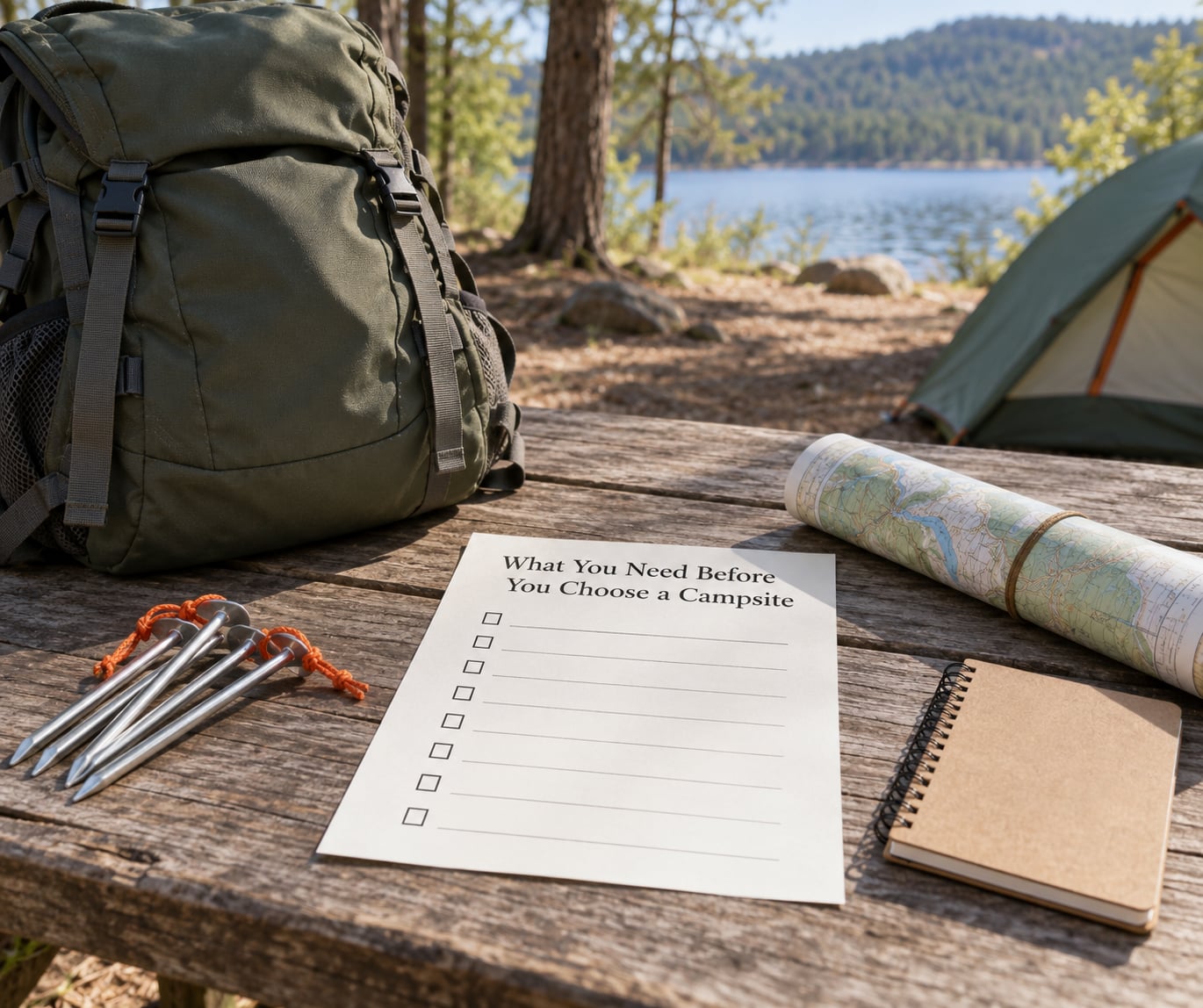
Most disappointing first trips trace back to a decision made on a phone, in a car park, without the basics written down. Before you open any booking site, get these five things clear.
- Your dates and the season. This decides availability more than anything else. Peak weekends at popular campgrounds fill months ahead, while the same place in late spring or early autumn is often wide open.
- Your setup and its size. A two-person backpacking tent, a family dome tent and a 30-foot caravan need completely different pitches. Measure your vehicle’s length with the tow ball if you have one, and add clearance at both ends.
- Who is coming. Solo travellers, couples, families with small children and dog owners each want a different pitch, and some campgrounds restrict certain site types to adults only.
- Your non-negotiables. Decide now whether you need flush toilets, hot showers, electricity or a pitch within a short walk of the car. Everything you can drop is a campground you can choose freely.
- Your experience level and your tolerance for faff. A first trip is not the time to learn a wood stove, carry water in from a spigot a quarter mile away or dig a cathole in the dark.
One more thing worth deciding in advance: how much you are happy to drive. Campgrounds within an hour of home are where most beginners start, because a flat battery or a forgotten stove is a much smaller problem close to a town.
Step-by-Step: How to Choose a Campsite That Fits
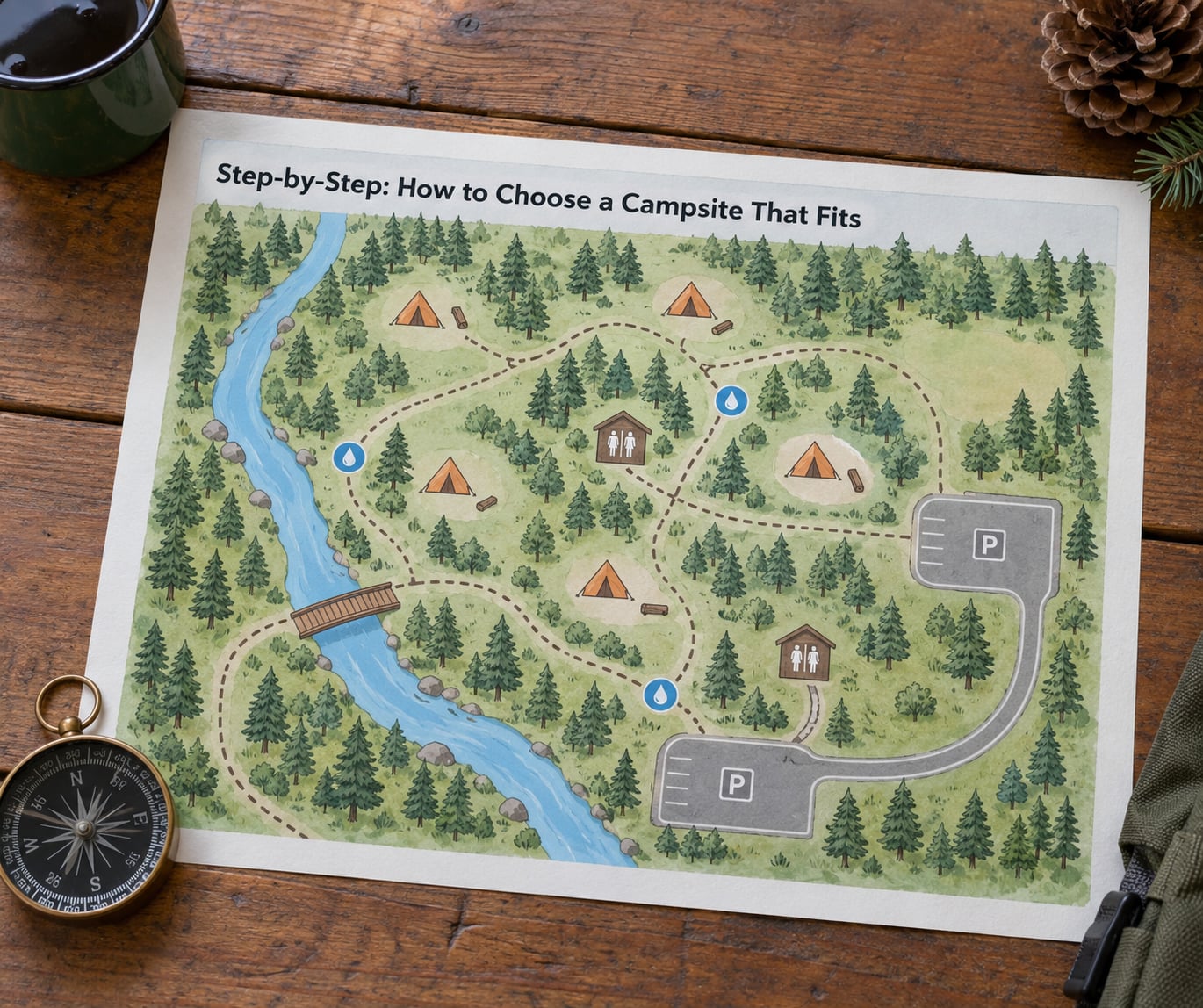
Work through these five steps in order. Each one narrows the field, so resist the urge to jump to booking as soon as something looks nice in a photograph.
Set Your Trip Requirements
Start by writing down what your trip actually needs, then decide what it can do without. Most first-time campers do better at a developed campground than on dispersed land, because a developed site gives you a flat pad, a fire ring, a picnic table and a restroom within a few hundred feet.
State and national park campgrounds are the usual starting point for beginners. One camper described state parks as an excellent place to get used to camping, since they usually have showers and power while you are still figuring things out. National park campgrounds tend to be more spectacular and considerably harder to book.
Dispersed camping on public land is not a first trip. It sounds simple because there is no booking page, but you are the one finding level ground, checking for dead wood overhead and carrying everything in, and the rules vary by land manager in ways that catch people out. Save it for the second or third weekend.
Check the Campground Location
Scenery is the last thing to weigh, not the first. A valley view means nothing if the access road is unpaved and you have a low-clearance car, or if the nearest grocery store is 45 minutes away.
Look at drive time from your home, not just distance on a map. Then check what sits within 15 minutes of the gate: a town for firewood, gas and a pharmacy, a grocery store, an attraction for a rainy afternoon, and the nearest hospital or urgent care. For a first trip, being near a town is a feature, not a compromise.
Check cell coverage too, especially if you are camping alone. Reviewers on camping forums repeatedly flag this as the thing they check before booking. If the map shows weak signal and no bar at the site, plan to download offline maps and tell someone your exact pitch number and arrival time before you leave.
Compare Site Types and Facilities
Site type jargon is the single biggest source of first-timer confusion, so here is the decoder.
- Walk-in site. You park at the car and carry your gear to the pitch, usually a short distance. The simplest option for tent campers with a car nearby, and often the quietest because RVs park elsewhere.
- Back-in site. You reverse in and park. Plenty of turning room, but you must swing your tailgate around a tree, so measure your vehicle against the site’s depth before booking.
- Pull-through site. Drive straight in, drive straight out. Easiest on arrival at dusk, the hardest to find, and often reserved for larger rigs.
- Tent-only site. Marked as such on most booking maps. On Recreation.gov you can filter to tent-only sites so you do not end up at an RV pad with a picnic table wedged between a sewer hookup and a slide-out space.
- Group site. Several pitches grouped together for families or clubs. More space and privacy from strangers, but you are still close to your own group.
- Primitive or dispersed site. No restroom, no table, no fire ring in most cases. Fine for an experienced camper, wrong for a first night.
On facilities, learn the difference between a flush toilet and a vault toilet, and whether the showers are hot and coin-operated or cold and seasonal. Many campgrounds list showers as an amenity while the building is locked from October to April, so check the season as well as the existence. Electric hookups come in 20, 30 and 50 amp versions and you only need them if you are running a heavy draw; most first-time tent campers need none of them.
Ask what cooking is allowed. Some sites have a fire ring and no grill, some ban open flames outright during fire restrictions, and some allow a small stove but nothing else. A campground with a strict no-fire rule is fine as long as you plan meals that do not need open flame.
Evaluate Comfort, Privacy and Noise
Now you are choosing the pitch, not the campground. This is where photographs help least, because the same site looks calm in June and packed in July.
Look for level, well-drained ground. A gentle slope is fine; a hollow that collects water is not. Flatness is the single most repeated campsite criterion in camper discussions because a level pitch is the difference between a good night’s sleep and a night spent sliding downhill. Walk the site in daylight if you can, and press the ground hard with your heel to check for give.
Next, check the ground surface for roots and rocks that will end up under your sleeping pad, and look up. Dead or low branches are a real hazard in wind and a common cause of tent damage, and standing dead wood across a campsite is a sign the area is used by more than you would like to know.
Shade is a trade-off rather than a straight win. Mature tree cover is lovely in summer and can drop a steady cold rain on your tent in autumn, while an open pitch in July means an oven by two o’clock. If your campground has both, choose based on the forecast and your tolerance for condensation.
Privacy and noise come from distance. Walking distance to the restroom and to the road matters more than the number of pitches between you and your neighbour, and restrooms placed at the far end of a loop are the quietest spot even in a busy park. For a corner site with a neighbour on one side only, ask for it when you book. If you are camping alone, a site away from the entrance road, away from the playground and visible from the host’s site is the combination most first solo campers wish they had asked for.
Weather exposure is the last comfort check. Watch for prevailing wind direction, which campground staff usually know by heart and are happy to tell you if you ask, and remember that higher elevation means colder nights than you may expect.
Review Rules, Availability and the Booking Details
Before you pay anything, read the campground’s own page rather than the photo on a booking site. You are looking for the specific rules that can end your trip.
- Reservation window and booking platform. National park sites run through Recreation.gov, many state parks through their own state system, and private campgrounds through their own website or a marketplace. Confirm you are on the official page, and check whether tent-only sites can be filtered on the map.
- Arrival and quiet hours. Many gates close in the evening and do not reopen until morning, so know your latest check-in time. Quiet hours are usually posted and enforced, sometimes by rangers.
- Maximum stay length. A 14-day limit is common on national forest and bureau land, and some campgrounds cap stays at a few nights at once.
- Fire restrictions. Fire bans can be declared mid-season with little notice. A ban may mean no campfires at all, only a stove, or a permit you have to collect in person.
- Distance from water. Camp at least 200 feet from lakes, streams and shorelines. This is a widely applied rule for erosion, water quality and wildlife, and rangers do check it.
- Pets, children and group size. Some sites restrict dogs to certain loops, require a leash at all times, limit the number of people per pitch, or exclude children from sites near the road.
If you are booking by phone rather than online, three questions are worth asking: can you be assigned a site away from the entrance road, is there a specific site number with the setup you need, and what is the after-dark check-in procedure if you run late.
Arrive in daylight. Even a site you researched carefully looks different at dusk, and setting up a tent for the first time in the dark is a genuine test. If you must arrive late, pack the headlamp before you pack the marshmallows.
Common Mistakes First-Time Campers Make
Choosing by price alone. The cheapest pitch in a campground is often the one furthest from facilities, closest to the road or on a slope. Compare what you get, not what you pay.
Booking an RV site by accident. Tent campers who pick a drive-up site because it looked roomy often arrive to find they cannot reverse in with their car. Filter to tent-only or walk-in sites and check the site’s depth against your vehicle.
Ignoring the drainage. A site that looks dry in the afternoon can be a shallow pool by morning rain. Look for ground that slopes gently away and sits above the lowest point of the loop.
Assuming amenities are available. Showers close seasonally. Drinking water spigots fail. Restrooms lock at night at some parks. Confirm each facility you care about, and treat unconfirmed amenities as absent.
Booking too late. Popular campgrounds fill early in peak season, and by the time you are ready, the only thing left is a walk-in site in a crowded loop. Book ahead, and if everything is booked, shift your dates by a week rather than your standards down.
Skipping the rules. Fire bans, stay limits, quiet hours and the 200-foot water rule are the four that generate fines and evictions. They are all posted; read them before you arrive.
Trying to do too much on night one. The goal of a first trip is not a complete camp setup. Camp near the restrooms, keep dinner simple, and stop adding tasks once you are tired.
Forgetting the plan for a full campground. Decide a second and third option before you leave home, ideally on the same drive and in the same general area, so that a full first choice is a minor annoyance rather than a wasted weekend.
Frequently Asked Questions
What is the easiest campsite type for a first camping trip?
A walk-in tent site at a developed state or national park campground is the easiest starting point. You park nearby, carry your gear a short distance, and you get a level pad, a fire ring, a picnic table and a restroom nearby. It avoids the maneuvering involved with a back-in or pull-through site and usually places you further from RVs, so it tends to be quieter too.
How far in advance should I reserve a campsite?
For popular campgrounds in peak season, two to three months ahead is a reasonable target, and six months is safer for holiday weekends and heavily visited national parks. In the shoulder season you can often book a week or two out. Leave a little slack anyway, because weather-related closures and maintenance work can change availability at short notice.
Do all campgrounds have showers and flush toilets?
No. Vault toilets, which are a simple hole in the ground with a structure around it, are still common in national parks and on dispersed land. Showers are rarer still, often coin-operated, and frequently seasonal or closed when water is restricted. If a restroom and a hot shower matter to you, confirm both with the campground directly and ask when the shower building is open.
How do I choose between a tent site and an RV site?
Tent sites are usually smaller, quieter and priced lower, and many are walk-in, meaning you carry your gear from the car. RV sites are wider and deeper, usually with electric hookups, water and a pad made for a vehicle. Pick a tent site unless you are arriving in a camper, trailer or large van, and filter booking maps to tent-only sites so you are not shown RV pitches.
Can I stay at a campground with children or pets?
Most campgrounds welcome both, but the rules vary a lot. Some require dogs on a leash at all times or restrict them to certain loops, and some exclude children from sites near the road or the entrance. Group size limits and quiet hours tend to be stricter in family-adjacent loops. Tell the campground your group composition when you book so they can assign a suitable site.
What should I do if the campsite is not suitable when I arrive?
Talk to the host or ranger before you unpack. If the pitch is unoccupied, most campgrounds will move you, and a partial refund is common if the site is genuinely unusable. If your assigned site is taken, ask for a walk-in site or another loop. Document problems with photos before you leave, and check the reservation policy on refunds before assuming you will get one.
Conclusion
Start by writing down the three things your first camping trip genuinely cannot do without, then compare two or three campgrounds against them rather than against each other. Confirm the site type fits your gear, check the rules on the campground’s own page, and settle the details before you drive out. Pick a developed walk-in site near restrooms for your first one, and save the scenery for later trips.