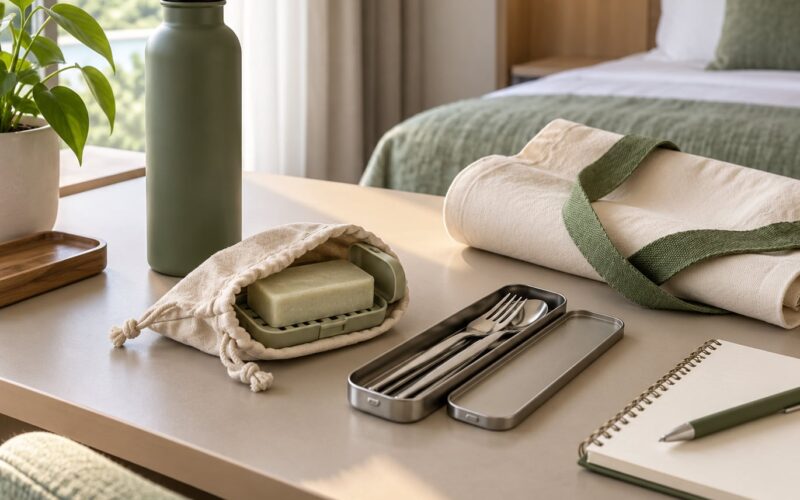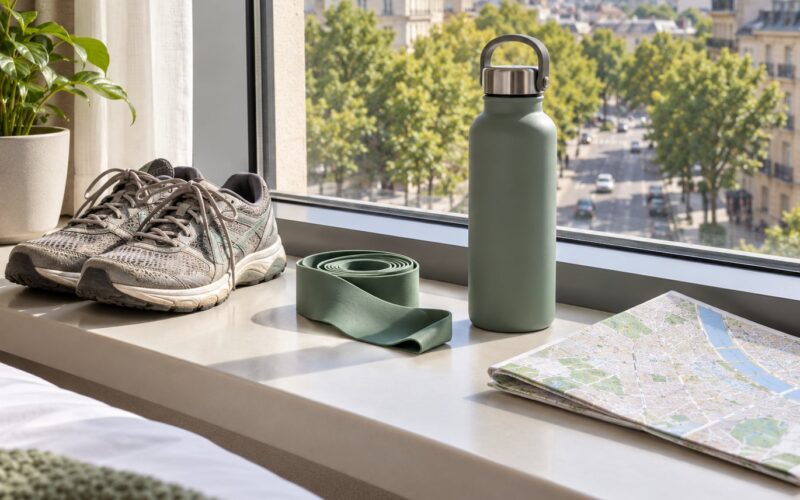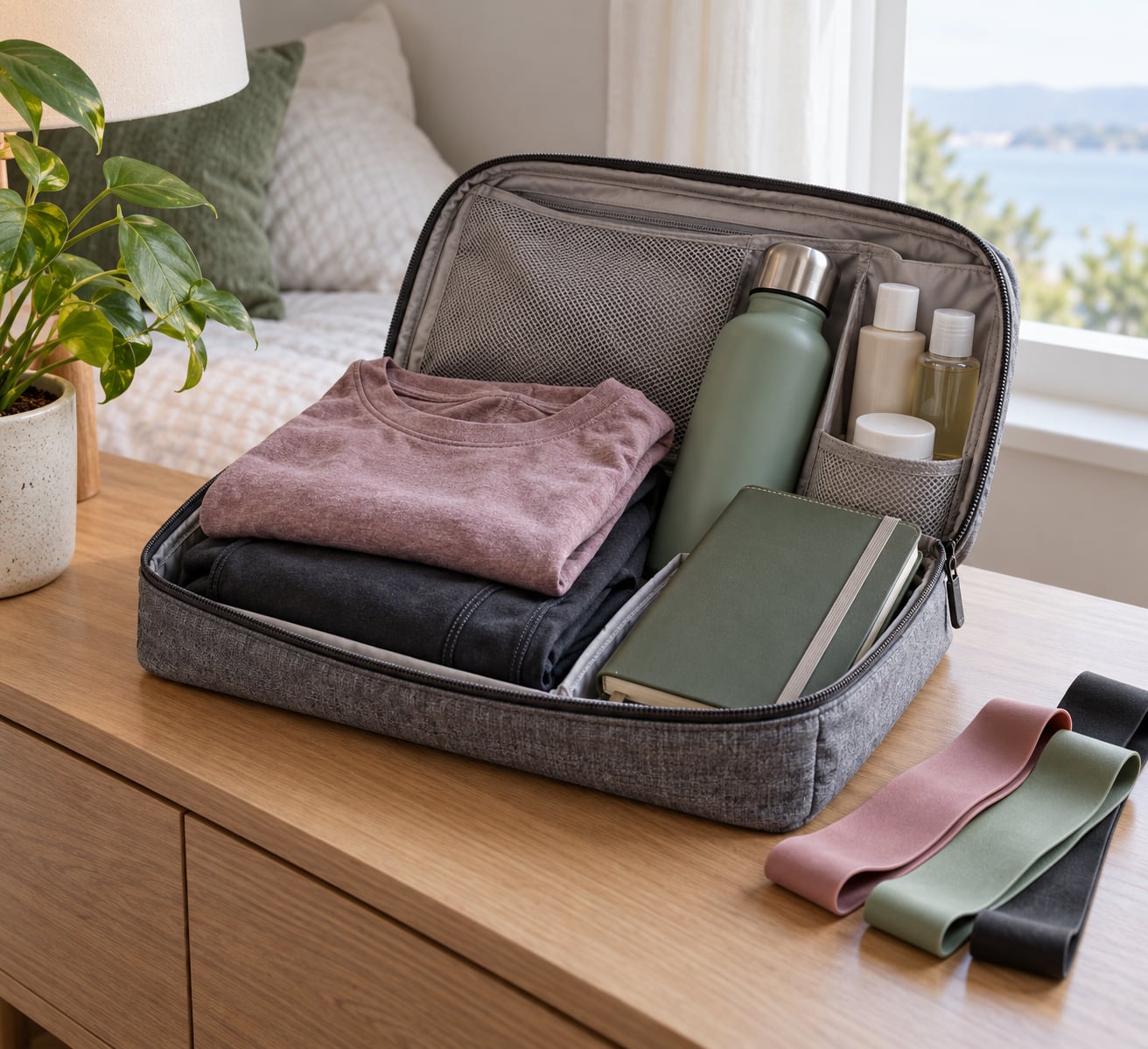
To keep a morning routine while traveling, pick three habits you will do no matter where you wake up, set one wake-up time that matches your sleep need and the local day, and lay everything out the night before. Most people fail because they try to recreate their entire home routine in a hotel room with a mini fridge. Three anchors is enough. You can build the rest once you know how those first days go.
I travel alone most of the time, and the routine that survives is a small one: a glass of water, ten minutes outside, and a note about what the day needs. Everything else, the cold plunge, the 60-minute gym session, the elaborate breakfast, goes quiet on the road. What I have learned is that a routine does not need to be impressive. It needs to still be there on the morning after a red-eye, in a hostel in March, on the day a tour bus leaves at 6:15.
This guide goes narrow on purpose. You will get a five-step framework, micro-routines for overnight and week-long trips, and the specific reason your routine keeps collapsing on day three. Budget about fifteen minutes of setup and five minutes of thought each morning. Difficulty is low. The hard part is deciding in advance what you are willing to drop.
Table of Contents›
- What You Need
- Step-by-Step: How to Keep a Morning Routine While Traveling
- 1. Choose a Three-Anchor Routine
- 2. Set Your Wake-Up Time
- 3. Prepare the Night Before
- 4. Build a Flexible Morning Sequence
- 5. Protect the Habit After the First Day
- Common Mistakes
- Copying your home routine wholesale
- Packing the equipment
- Checking the clock constantly
- Skipping breakfast entirely
- Forcing the workout
- Abandoning everything after one disrupted morning
- Scheduling every minute
- Frequently Asked Questions
- How do I keep a morning routine when my travel schedule changes every day?
- Should I follow my normal routine during a time-zone change?
- What is the best morning routine for a short trip?
- How can I exercise without a gym while traveling?
- What should I do if jet lag makes my usual morning routine impossible?
- How do I resume my normal routine after returning home?
- Start With One Wake-Up Time and Three Anchors
What You Need
You need less than you think. Here is the full list, and most of it is a decision rather than an object.
- A shortened routine on paper. Three anchors, written on one card in your phone or a folded receipt. It goes in the same bag every trip so you never rebuild it from scratch.
- A destination wake-up time. A single local time you plan to be up, chosen before you land, based on sleep need and what the first day demands.
- One outfit decided the night before. Comfortable enough for a walk, good enough to walk into a cafe in without thinking about it.
- Basics decanted. Toothpaste, skincare, and any medication in carry-on containers under 100 ml. Decanting once at home beats repacking at 6 a.m. in an airport queue.
- One offline note. A paper notebook or a downloaded note with your anchors, your wake-up time, and the address you need to find in a language you cannot read.
- Optional movement gear. Resistance bands that weigh nothing, or nothing at all. Travelers who train their own body report 10 to 15 minute routines that need zero equipment.
Before departure, scout what your destination actually offers. Find the nearest grocery store, the closest cafe with outdoor seating, a park within a ten-minute walk, and a pool or gym if you care about training. Knowing that a bakery opens at 7:30 and the park is two blocks behind your building removes a lot of morning friction. Scouting in advance is the single step people skip and then blame their own discipline for.
If you are staying somewhere with a kitchen, treat that as a routine enabler. A room with a kettle and a fridge means you can eat the same simple breakfast every morning, and that is worth more than a nicer view.
Step-by-Step: How to Keep a Morning Routine While Traveling
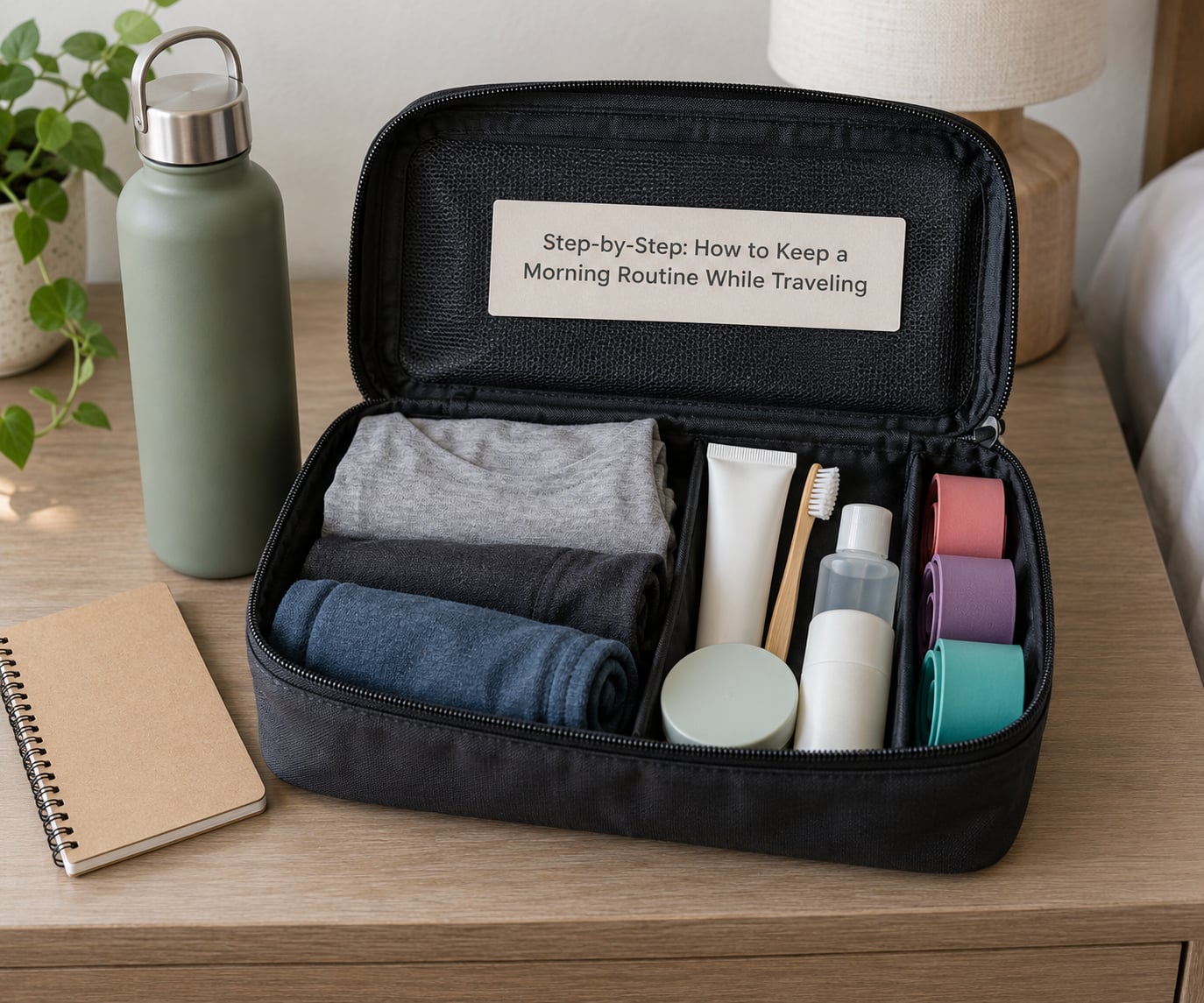
Here is the whole method in five steps:
- Pick three anchors. Choose from water, daylight, movement, reading, breakfast, or planning. Three is the ceiling.
- Set a destination wake-up time. Work backward from how much sleep you need and what the first day requires, then shift gradually rather than overnight.
- Prep the night before. Ten minutes for clothes, water, breakfast, tech, and gear. This step carries more weight than the routine itself.
- Run a flexible sequence. Have a 5-minute, a 20-minute, and a 45-minute version. Use the short one without apology.
- Reset weekly. On the last evening of each week, decide what stays for the next week and what gets dropped.
Now the detail behind each step.
1. Choose a Three-Anchor Routine
Write your home routine down and cross out everything that needs equipment, a kitchen, or more than fifteen minutes. What survives is your anchor list. Water before coffee. Ten minutes of daylight. A short walk. Reading four pages. Breakfast you actually eat. Two minutes of planning.
The 80/20 version comes up constantly among slow travelers: keep the 20 percent of habits that hold your mood together, let the rest go until you are somewhere with a kitchen. A paper planner travels better than an app in my experience, and it also cannot die at 30 percent battery in a foreign city.
How do you know the short version is working? Three signals. You get up without dread, you are not standing in a hotel lobby at noon wondering what happened to the morning, and you still make decent choices about food and alcohol. That is enough. Anyone on a three-anchor routine will outperform someone running a full home routine on day four.
2. Set Your Wake-Up Time
Work backward. Most adults need seven to nine hours, and getting less for several nights will show up as poor food decisions and low patience, not as feeling tired in an obvious way. Take your sleep need, add the hours of time-zone difference, and then subtract what your first morning requires.
A worked example. Home wake-up is 6:30 in one time zone, you land in a zone five hours ahead, and your first commitment is a 15:00 meeting. Waking at 6:30 local would mean a night of three hours of sleep, which is not a plan, it is a punishment. Waking at 8:00 gives you roughly six hours and lets you walk into that meeting as a person.
Crossing more than three zones, shift by two or three hours in each direction a few days before departure rather than making one giant move. That works for bedtime too. If you cannot pre-shift, protect the two things that actually anchor your circadian rhythm: waking at a consistent local time and getting bright light within an hour of waking. Everything else is negotiable.
If melatonin or any other sleep aid is part of your normal routine, keep it on your original local schedule for the first few days and then move it across. Travelers who mess this up by shifting everything at once tend to report worse jet lag, not better. Anything prescribed stays on your doctor’s instructions, obviously.
3. Prepare the Night Before
This is where routines on the road survive or die. Ten minutes the evening before beats thirty minutes of morning effort. My hotel checklist is the same seven items every time:
- Clothes for tomorrow laid out, including something warm for the walk.
- Water bottle filled and by the door, or a note about where to buy water in the morning.
- Phone alarm set to the destination wake-up time, with a second alarm fifteen minutes later.
- Breakfast decided. Not cooked. Decided.
- Movement gear out, or the plan changed to a walk.
- Notebook and pen on top of the bag.
- Charging cable by the pillow, so the phone is not dead at 6 a.m.
Rental apartments and guesthouses have one advantage hotels rarely do: a kitchen and a door that stays unlocked. Unpack the morning you arrive, even if it is only putting your clothes on a shelf and finding the kettle. People describe unpacking immediately as the fastest way to stop a temporary place from feeling temporary, and I agree.
4. Build a Flexible Morning Sequence
A working sequence runs light to heavy, because the order matters more than the content. Waking, water, light, body, food, then planning. Brain work before daylight and movement is a mistake most people only learn about on day three of a trip.
The 5-minute version for overnight stops, red-eye landings, and days with a 7 a.m. train: water, curtains open, ten slow breaths, write tomorrow’s first task on the notebook.
The 20-minute version, the one I use most: water, ten minutes of daylight or a walk, a simple breakfast, one page of planning. That fits comfortably before breakfast crowds and city noise.
The 45-minute version for a stay of four nights or more, or a resort with space: add a real movement session, either bands in the room or a walk with purpose, and a longer planning block.
Weather and schedule should reshuffle the sequence rather than delete it. On a rainy morning, daylight moves to a hotel window or a covered arcade, and movement moves indoors. If a tour starts at 6:15, water and planning happen the night before instead, and the morning routine shortens to your first two anchors.
A hotel room is more workable than it feels. Six feet of floor beside the bed is enough for mobility work. The wall is a handhold. A chair is a stretching prop. What you cannot do indoors is walk far, so on those days choose ten minutes outside at breakfast and skip the rest.
5. Protect the Habit After the First Day
The first two mornings are the easy part. Everyone is motivated. The routine actually gets tested on a multi-city trip, when you move hotels every three nights and everything must be rebuilt from a suitcase.
For multi-city travel, keep two things fixed above all others: the wake-up time and the water. Everything else gets rebuilt on arrival within one hour, using whatever the new place offers. For work trips, put planning last in the morning and keep it to one page, because the day already arrives full of other people’s priorities. For leisure days with friends, plan one deliberate slow morning per week and stop negotiating about it.
Accommodation type changes the routine more than trip length does. A hotel gives you reliable water, a desk, and often a gym on another floor, so your anchors can stay outdoors. A hostel gives you a kettle, a locker, and a shared bathroom, which means your anchor has to be things you can do in thirty seconds in a hallway or outside the door. A campsite or a rental car gives you space but no water tap, so the water anchor shifts to filling a jug the night before.
Camping deserves one extra note. There is no sunrise alarm and no shower, so the routine collapses into whatever the weather allows. Keep water and movement only, and accept that this is a week where the routine is a memory, not a schedule.
Then do the weekly reset. On the last evening of each week, write three things: which anchors survived, which one kept falling, and what you will change. Most of the time the answer is that the anchor was too big. A 45-minute workout becomes a 15-minute walk, permanently, and the habit comes back the next morning.
Travelers who keep routines long-term tend to describe the same thing, in different words: the streak is nice, but flexibility is what makes it last. Missing a day is information, not a verdict. Resume with the 5-minute version rather than doubling up on the next morning.
Common Mistakes
These are the problems that come up again and again, with the fix that actually works.
Copying your home routine wholesale
A routine built for a commute and a full kitchen does not survive a rental with a kettle and two mugs. Cut it to three anchors and treat everything else as a luxury for longer stays.
Packing the equipment
Yoga mats, adjustable dumbbells, and a 400-item supplement stack turn into dead weight and guilt. Bodyweight work and resistance bands cover almost everything, and short no-equipment routines stick better than ambitious ones.
Checking the clock constantly
Looking at the time every ten minutes tells your body it has lost track of the day, which is exactly the feeling of jet lag. Check once, at waking, then leave the phone face down until breakfast.
Skipping breakfast entirely
Not eating does not save time; it moves the problem to 11 a.m., when you are making poorer choices from whatever is open. Keep one familiar breakfast item even when everything around you is new.
Forcing the workout
A gym session that requires unfamiliar equipment, a new city, and a commute is not discipline, it is friction stacking up. Walk instead, ten minutes, no negotiation.
Abandoning everything after one disrupted morning
The single missed morning is where most routines die, because people try to make up for it later and quit by Thursday. Drop back to the 5-minute version the next day. That is the whole recovery plan.
Scheduling every minute
People who treat travel like an office with no commute burn out by day five. Leave one unplanned hour each morning. Solo travelers in particular need that gap for the unexpected thing, which is usually the reason they booked the flight.
Frequently Asked Questions
How do I keep a morning routine when my travel schedule changes every day?
Fix the wake-up time and one or two anchors, and let the rest follow the day. Keep water and daylight as the constants, since both are available in almost any lodging. Rebuild the remaining anchors within an hour of reaching each new place. If a day starts at 6:15, move planning to the night before and shorten the morning rather than skipping it.
Should I follow my normal routine during a time-zone change?
Not exactly. Keep the sequence, but move the clock. A wake-up time that matches local daylight usually beats a wake-up time that matches home, even if it feels wrong for the first few days. Aim for seven to nine hours and get bright light within an hour of waking. Keep any sleep supplement or medication on your original schedule until your sleep has shifted.
What is the best morning routine for a short trip?
On a one or two night trip, do not build a routine. Keep three things: water, ten minutes outside, and a written note of where you need to be. Morning planning matters more on short trips because your window is small. Use the ten minutes before leaving the room to confirm addresses, transit, and tickets, then go and enjoy the place.
How can I exercise without a gym while traveling?
Bodyweight work needs no equipment and no planning, so it survives any lodging. A 15-minute set of squats, incline push-ups on a wall or desk, glute bridges, a plank, and a short walk covers the bases and needs no floor space beyond about six feet. Resistance bands add weight for almost nothing in a bag. If you have joint issues or a medical condition, check with a clinician first.
What should I do if jet lag makes my usual morning routine impossible?
Cut to two anchors for the first two days: water and daylight. Morning light exposure is the single most useful thing you can do, so get outside within an hour of waking even if it is only for coffee outside the door. Skip intense training, keep caffeine moderate, and eat your main meal near local mealtimes. Rebuild the rest of the routine once two nights of sleep have improved.
How do I resume my normal routine after returning home?
Give it three days and restart with the short version. Jet-lagged sleep and a reset home environment make a full routine feel impossible on day one, and forcing it usually fails. Keep the wake-up time you used on the trip if it is reasonable, hold onto one habit you adopted while away, and add the next anchor on day three. The full version returns on its own within a week.
Start With One Wake-Up Time and Three Anchors
If you do one thing from this guide, write three anchors on a card tonight and pick a wake-up time for your first destination before you book the rest of the trip. Everything else, the micro-routines, the weekly reset, the evening prep, you can add once those two decisions are made. A morning routine that survives the road in 2026 is the one small enough that you still do it on the day you least want to.