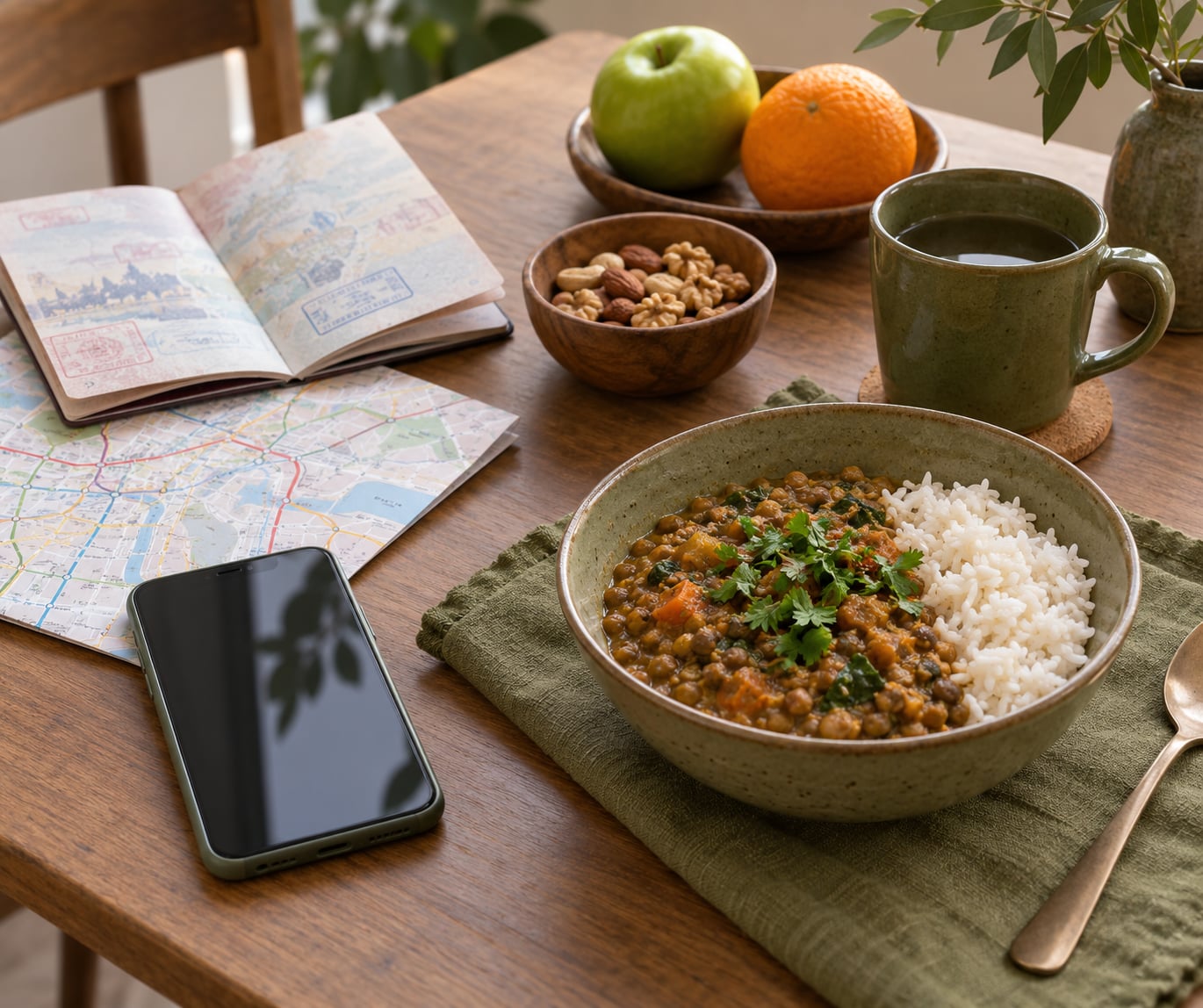
The salad plate is a planning failure, not a cuisine failure. To travel as a vegetarian without eating only salad, you need a small repeatable system: learn the local word for vegetarian and the words for meat, know which dishes hide animal products, carry one backup snack, and be ready to cook or assemble a meal yourself when a town runs out of options. Set aside an hour of prep before you leave home and most of the problem disappears.
I have eaten the same bowl of lettuce in four countries, and I would rather not do it again. The trick is that vegetarian food abroad is usually abundant but rarely labelled. Nobody puts vegetarian on the board because most locals do not need the sign. That is exactly why the work happens before you arrive, not at the table.
Last updated: October 2026
Table of Contents›
- What You Need to Eat Well as a Vegetarian on the Road
- Step-by-Step: How to Travel as a Vegetarian Without Eating Only Salad
- 1. Learn the words for vegetarian food and the words for meat
- 2. Research meals before you leave your accommodation
- 3. Build a varied meal instead of ordering a salad
- 4. Keep one backup snack in your bag
- 5. Ask clear questions when a menu is unclear
- 6. Use markets and convenience stores to travel as a vegetarian on a small budget
- 7. Eat socially without making the trip about your diet
- Common Mistakes That Leave You Eating Only Salad
- Frequently Asked Questions
- What should a vegetarian order instead of salad when restaurants have few choices?
- How do I know whether a restaurant dish is really vegetarian?
- Can vegetarian travelers request airline or train meals in advance?
- What are the best portable vegetarian snacks for a long trip?
- How can I find vegetarian food in a small town or rural destination?
- What should I do if vegetarian meals are unavailable or expensive?
- Conclusion
What You Need to Eat Well as a Vegetarian on the Road
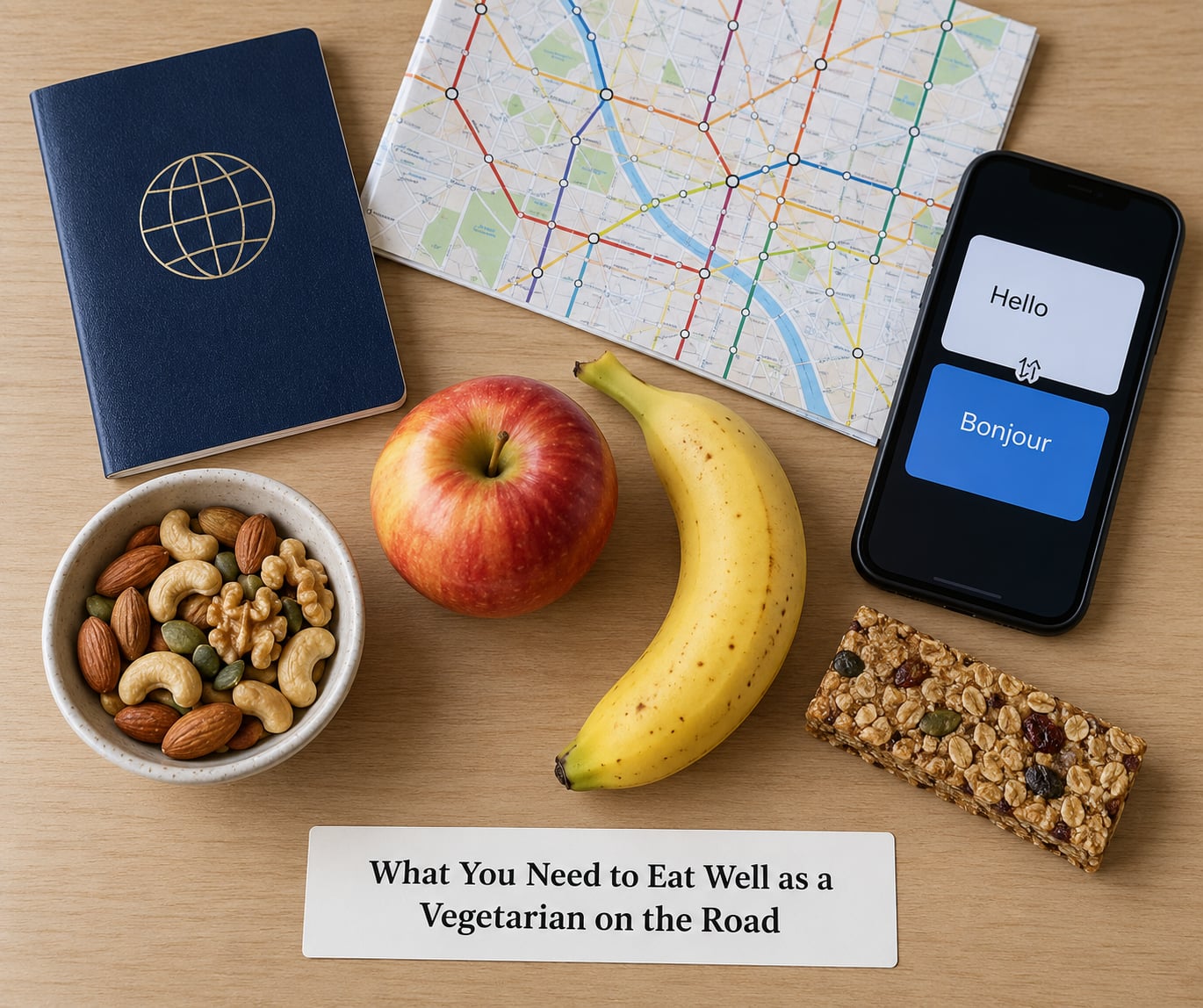
Before the trip, four things earn their keep:
- The local word for vegetarian, plus four words for meat: chicken, beef, pork, fish. There are hundreds of vegetables and about a dozen common meat terms, so learning the meat words gets you further.
- A phrase card on your phone with one sentence: I am vegetarian, no meat and no fish please. Show it rather than trying to explain. On a code block I once photographed and carried for a fortnight, this single line did more work than any phrasebook.
- One portable snack that survives a day in a bag: nuts, roasted chickpeas, fruit, crackers with cheese, or sealed bread from a bakery that morning.
- Access to a kitchen at least every few days. A hostel kitchen, an apartment with a hob, or a weekly grocery shop is what turns a hard town into a normal one.
Add one translation app with offline language packs, and one restaurant-finding app that filters by vegetarian options. Those two cover most of the language gap.
Step-by-Step: How to Travel as a Vegetarian Without Eating Only Salad
1. Learn the words for vegetarian food and the words for meat
Learn both halves of the vocabulary before you land. Useful terms include the local word for vegetarian, vegetable, and the phrase no meat, which is the one that actually stops the kitchen from adding chicken stock to your rice.
Spanish soy vegetariano, Italian sono vegetariano, French je suis végétarien, Greek imaste vgarianos, Portuguese sou vegetariano, Thai jay, Japanese beizai ryori or shoshin ryori for a restaurant that specialises in it. You will get the tones wrong, and it still lands.
How to tell it worked: the server repeats it back before walking to the kitchen, or points at the right column on a printed menu.
2. Research meals before you leave your accommodation
Open the map app on the lobby wifi and save three places before you go out. One proper vegetarian restaurant for a treat, one place with an obvious vegetable or rice dish, and one grocery store or market for the fallback.
Search in the local language using the word you just learned. If you are learning how to travel as a vegetarian without eating only salad, the reason salad becomes the default is that decisions get made at 7pm when you are hungry. Scanning menus at 10am is what prevents that.
How to tell it worked: you can name your dinner and a backup without opening your phone while queuing.
3. Build a varied meal instead of ordering a salad
Stop looking for a single dish labelled vegetarian and start assembling a plate from parts. Carbohydrate plus protein plus fat plus vegetables is all you need.
- Vegetable curry or shakshuka with rice and bread
- Tofu or chickpea noodles from a street stall
- Falafel in pita with pickled vegetables
- Lentil soup with a side of bread
- Spanakopita, a baked filo pie with spinach and feta
- Dosa or chana masala in South Asia, where the default plate is already meat-free
- Two vegetable sides as a main, which works when nothing is labelled
How to tell it worked: you leave full and are not thinking about food two hours later.
4. Keep one backup snack in your bag
Pick something shelf-stable and non-fragile: nuts, seeds, roasted chickpeas, dried fruit, a protein bar, crackers, or sealed bread. Fresh items like bananas and apples survive a day fine but not three days in a hot pack.
Two practical notes. Airport security rules differ by country, so plain unopened snacks are the safest bet. And if you carry anything shelf-stable, you skip refrigeration entirely, which removes the whole storage question.
How to tell it worked: you have eaten it once at an airport so the first time in a new country is not the test.
5. Ask clear questions when a menu is unclear
Servers say yes too quickly. Ask a question that is harder to guess the answer to: Does this contain meat, fish, meat stock, fish sauce, cheese, or eggs? That wording gets a real check in the kitchen instead of a reassuring nod.
On a night when you cannot get a straight answer, say thank you anyway and accept that some kitchens cannot separate a vegetarian dish from the main menu line. In Japan and much of Thailand, fish sauce and dashi are in the base of an apparently vegetable dish, so no meat is not the same as no animal products.
How to tell it worked: the plate arrives without meat, and it does not arrive with a side of confusion.
6. Use markets and convenience stores to travel as a vegetarian on a small budget
Supermarkets are the most underrated tool on this list. You can assemble a whole day from cooked grains, canned chickpeas or lentils, tofu, cheese, olives, bread, fruit and a jar of sauce, for a fraction of what three restaurant meals cost.
Storage and safety: keep cold items cold. Perishables should not sit unrefrigerated for more than about two hours in warm weather, or one hour above 90F/32C. If there is no fridge, buy the cooked food and eat it now.
How to tell it worked: you ate better than the restaurant down the road and spent roughly a third of the money.
7. Eat socially without making the trip about your diet
When you eat with people who do not share your diet, choose a restaurant that serves mixed dishes and order from the shared part of the menu. Ask for a vegetable side to be made as an extra, request sauces on the side, and stop repeating your diet after the first explanation. On travel forums like r/VeganChill and veganforum.org, travellers who get the smoothest group dinners are the ones who pick a restaurant and order like everyone else, then eat their own plate.
Solo is harder socially but easier logistically. You can choose what to eat every night, so treat that as freedom rather than a problem to apologise for.
How to tell it worked: nobody at the table is talking about your diet by the second course.
Common Mistakes That Leave You Eating Only Salad
Treating salad as the default. The fix: order a rice, noodle, bread or potato dish with vegetables built into it.
Assuming vegetarian means fully plant-based. In many countries the translation covers only no meat, not no animal products. Say which one you need.
Forgetting protein and carbohydrates. A plate of leaves is not a meal. Every order should have one of each.
Relying on a single restaurant. If one place is your only option and it is closed on your day off, you end up at a bakery. Always keep two backups.
Overlooking hidden meat. Stock, bouillon, fish sauce, dashi, ghee, worcestershire sauce, parmesan made with animal rennet and Caesar dressing all slip through. Ask about the base, not the topping.
Carrying snacks that spoil or break. The fix is shelf-stable and unopened, nothing that needs a fridge or a knife.
Apologising for the way you eat. You are requesting a dish, not asking a favour. That single reframe removes most of the social awkwardness solo travellers report.
Frequently Asked Questions
What should a vegetarian order instead of salad when restaurants have few choices?
Order a dish built around a starch with vegetables cooked into it. A vegetable curry with rice, tofu or chickpea noodles, falafel in pita, lentil soup with bread, or a spinach and feta filo pie all travel well as a main. If nothing is labelled, ask for two vegetable sides and treat them as your plate. That gets you a full meal instead of a starter.
How do I know whether a restaurant dish is really vegetarian?
Ask a question that is hard to guess rather than a yes or no question. Try: does this contain meat, fish, meat stock, fish sauce, cheese or eggs? That forces a kitchen check. Also ask what the base is. Vegetable and rice dishes often sit on chicken stock, and in Japan and much of Thailand the base is dashi or fish sauce, which matters even though no meat is visible.
Can vegetarian travelers request airline or train meals in advance?
Yes, on most airlines, and it is free. Book your seat, then open your reservation and add a special meal such as a vegetarian or vegan option. Most carriers need the request 24 to 48 hours before departure, so do it as soon as you book rather than at the airport counter. Long-distance trains and some ferry services do the same through their website or app.
What are the best portable vegetarian snacks for a long trip?
Nuts, roasted chickpeas, dried fruit, protein bars, crackers with hard cheese, and sealed bread are the most useful because they need no refrigeration and survive a bag. Fresh fruit such as bananas and apples holds up for about a day. Skip anything that needs a fridge, and check the airport rules in each country you fly through before packing.
How can I find vegetarian food in a small town or rural destination?
Skip the restaurant hunt and go to the supermarket, market or bakery instead. Assembling a meal from cooked grains, canned legumes, tofu, cheese, olives, bread and fruit will beat a hard town restaurant on both price and variety. Where you do eat out, choose a place with a shared mixed menu and pick a vegetable dish from it rather than looking for a vegetarian restaurant that does not exist.
What should I do if vegetarian meals are unavailable or expensive?
Change where you eat rather than what you ask for. Supermarkets, bakeries, market stalls and takeaway counters rarely have a vegetarian dish, but they have all the parts of one. Cooking in a hostel kitchen or your rental extends this further. If you eat out regularly and options are limited and pricey, a flexitarian approach of mostly vegetarian with the occasional fish or egg meal keeps you healthy without costing you the trip.
Conclusion
Save two reliable restaurants before you leave your accommodation, pack one shelf-stable snack, and learn the local word for vegetarian plus four words for meat. That is the whole system, and it takes an hour at home rather than a week of salads abroad. Eating well as a vegetarian while travelling comes down to variety, preparation and flexibility, not menu labels. And if you eat strictly by preference rather than by medical need, say so plainly and ask for the dish without apologising.