Yes, you can fly with a reusable water bottle as long as it is empty at the checkpoint. Security rules limit liquid, not containers, so an empty bottle of any size or material passes through. Drain it at home, refill after the checkpoint, and top up on the ground wherever a tap, fountain or station appears.
Knowing how to travel with a reusable water bottle and refill it anywhere comes down to one repeating loop: empty, fill, drink, clean. Once you know where the taps are in an airport, a station, a hostel kitchen or a small town square, the bottle stops being an extra thing to carry and becomes the thing that makes every other part of travelling simpler.
These are US security rules, and they change. Outside the US, airports in the EU, UK, Australia and elsewhere apply their own liquid limits, so check the rules for the country you are flying from and into.
Table of Contents›
- What You Need
- Step-by-Step: How to Travel with a Reusable Water Bottle and Refill It Anywhere
- Choose a Bottle That Fits Your Route
- Pack It Clean and Easy to Reach
- Refill at Reliable Water Sources
- Treat Water When Safety Is Uncertain
- How to Travel with a Reusable Water Bottle Through the Day
- Clean and Store It After Every Use
- Common Mistakes
- Frequently Asked Questions
- Can I take a reusable water bottle through airport security?
- What is the best reusable water bottle size for travel?
- How do I know whether a public fountain or tap is safe?
- Can I refill from a stream or natural spring while traveling?
- How often should I clean a reusable water bottle?
- What should I do if I forget my water bottle at a hotel?
What You Need
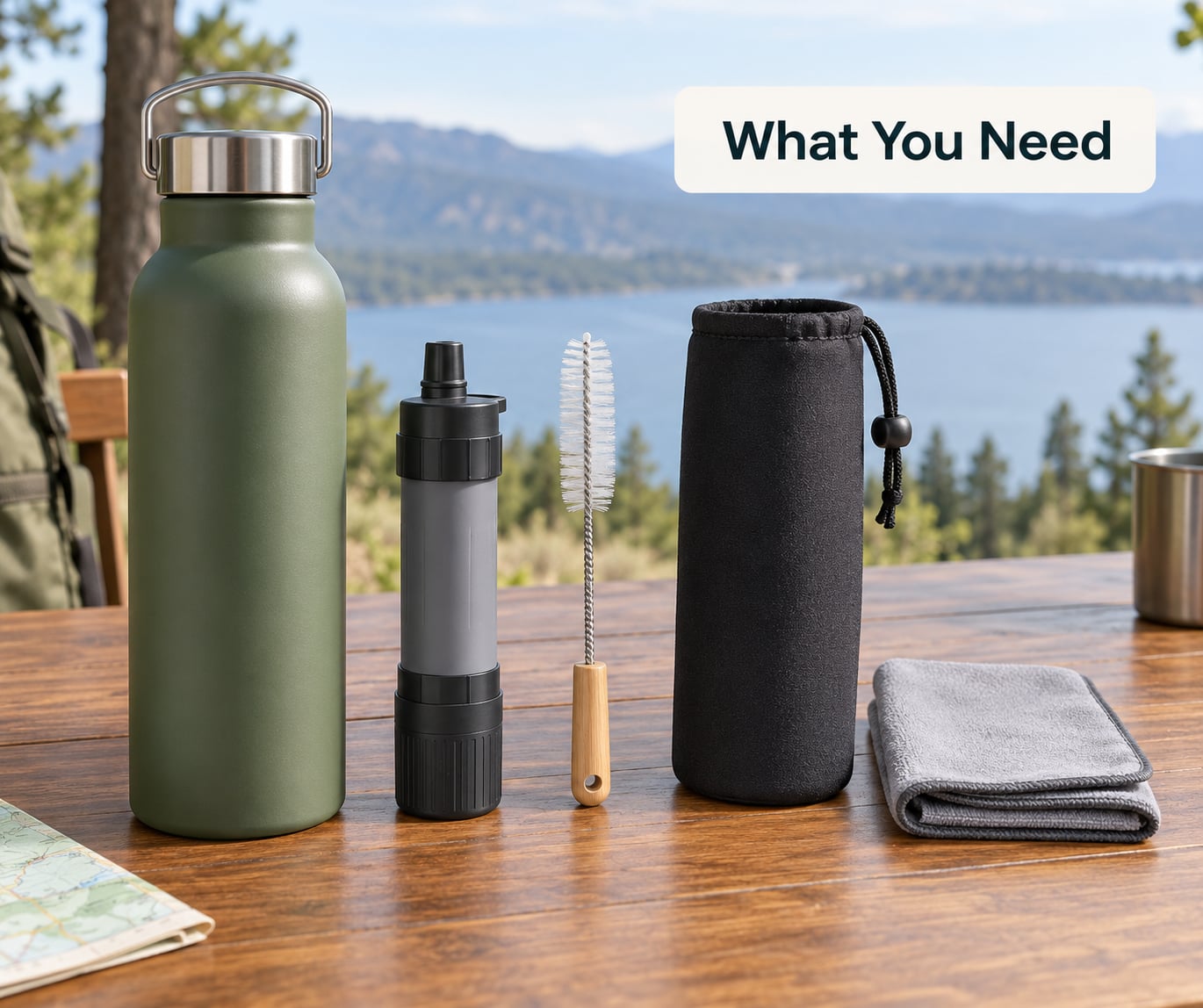
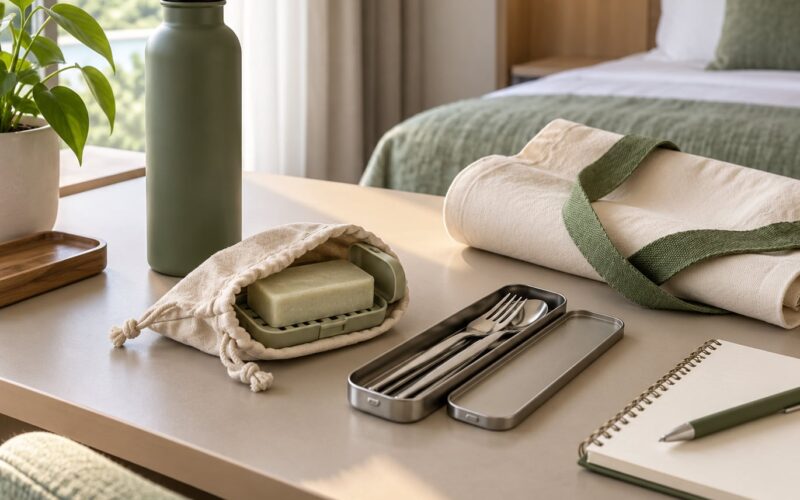
A bottle is the easy part. The kit that makes the routine reliable on a two-week trip is short: one bottle, one way of purifying water when a source is questionable, a brush for the parts a dishwasher will not reach, and enough backup water to reach the next reliable tap.
Start with the bottle itself. Stainless steel keeps water cold for hours and survives being dropped on a cobbled street. Plastic is lighter and cheaper to replace. Collapsible silicone packs flat when empty, which matters when your bag is already full.
Add a purification option only if your route crosses places where tap water is genuinely uncertain. A filter cartridge in the lid or base handles most suspended sediment. Purification tablets handle viruses and bacteria but need time to dissolve and work. Neither is a substitute for drinking water from a source you trust.
A soft sleeve is more useful than people expect. It protects the finish, gives you something to grip a wet bottle with, and lets you loop a cord through it.
Carry a small brush and a drop of unscented detergent. Sugar, coffee and salt residue are what make a bottle smell, and smell is usually what makes a traveller give up on washing it.
Finally, plan for the gap between taps. A collapsible pouch or a couple of bottles filled before you leave a town buys you the hours between a station that is closed and the next one that is not.
Step-by-Step: How to Travel with a Reusable Water Bottle and Refill It Anywhere
Choose a Bottle That Fits Your Route
Match the bottle to the kind of day you are having, not to the biggest size you can find. Urban sightseeing with a crossbody bag and hotel rooms with tap water needs something that fits in a small bag. A full day of walking or a hike needs more capacity than your hand can comfortably carry.
Capacity is the first filter. Roughly 500 ml covers a long walk between reliable taps. A litre or more suits hiking, hot weather and long transfers where you cannot stop. Bigger is not better when the water has to travel in your hand for eight hours.
Weight matters more than most buyers expect. A stainless steel bottle feels solid and ends up noticeable by hour six. Reviewers comparing bottles over long walking days keep pointing out that metal is heavier than plastic, and that weight adds up faster than expected.
Insulation only earns its cost if you drink the water cold. A vacuum-insulated double wall is worth having in summer or on a long transfer. It is pointless on a three-hour city hop where you finish the bottle before it cools.
Mouth width is the feature people forget. A wide opening takes ice cubes, accepts a bottle brush, and dries properly. A narrow sports spout is fine for a gym bag and annoying to clean on a trip.
Screen size the lid, not the bottle. A leak-proof screw cap with a carry loop survives a rucksack. A push-button spout is quicker to drink from but more likely to leak sideways if it is knocked over.
Check the airline’s carry-on dimensions before you commit. Most airlines publish a size limit for bottles the same way they do for cabin bags, and a bottle that does not fit usually ends up emptied and binned at the gate.
Pack It Clean and Easy to Reach
Wash the bottle the night before you leave and dry the lid gasket separately. Gaskets are where smell lives, and a bottle that smells stale in week two will be abandoned in week one.
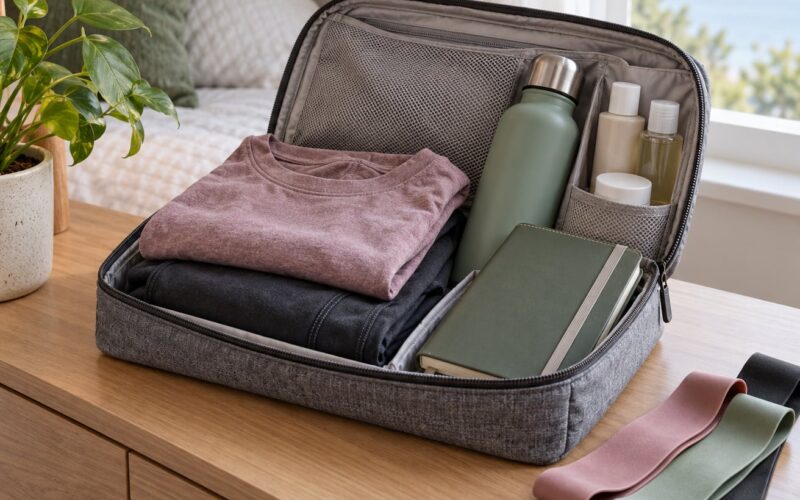
Pack it empty, upright if you can, with a small towel around it if your bag tends to tip. A sleeve solves both problems at once.
Keep the purification device and tablets in the same pocket as the bottle, not buried in a wash bag. If you are deciding whether to treat water, you want the answer in your hand in ten seconds.
Fill your bottle before you leave home and drink from it on the way to the airport. That final stretch before security is where people show up with a dry bottle and no chance to refill.
For security, expect to drain it. An empty bottle is fine in carry-on and in checked luggage. A full one is treated as a liquid over 100 ml, which is 3.4 ounces. TSA describes the rule as 3-1-1: containers of 3.4 ounces or less, one clear resealable quart bag, one bag per passenger.
Solid frozen water passes, because it is not in liquid form. Partly frozen or slushy water is treated as liquid and will be drained, so freeze it solid and leave it solid.
Opaque or oversized bottles and anything that looks like it has a hidden compartment are likely to be pulled for a closer look. A bottle with visible contents you can see through usually moves faster through the queue.
Glass is the material to avoid in checked luggage. It is heavy, it breaks, and a broken bottle in a suitcase is a bad start to a trip.
Outside the US, the picture is similar but the numbers come from another authority. EU and UK rules apply the same 100 ml container limit in a clear bag. Australia allows a 100 ml container that fits in a small bag with other items. Empty bottles are generally fine everywhere; filled ones rarely are.
Refill at Reliable Water Sources
A bottle-filling station is a tap built for bottles: usually filtered, often touch-free, and mounted somewhere you can hold a container underneath. Larger airports put them near restrooms and food courts. FlyerTalk users confirm airside stations at Heathrow and elsewhere, so a lounge membership is not a requirement.
The important detail is that most stations sit on the airside, after security. If your flight is long and you arrive dry, you are in trouble until you are through the checkpoint. Top up at home or at the terminal entrance before you queue.
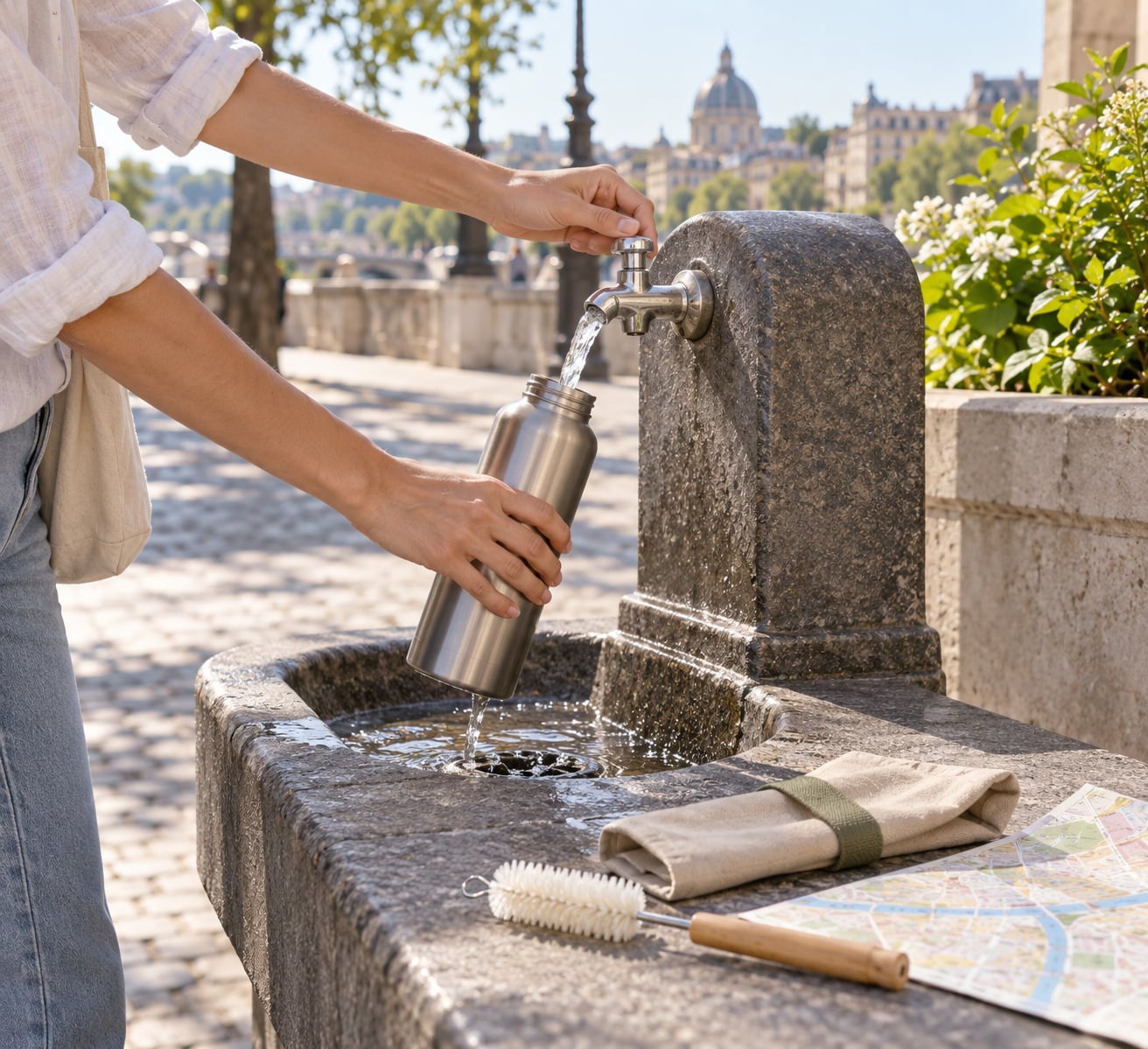
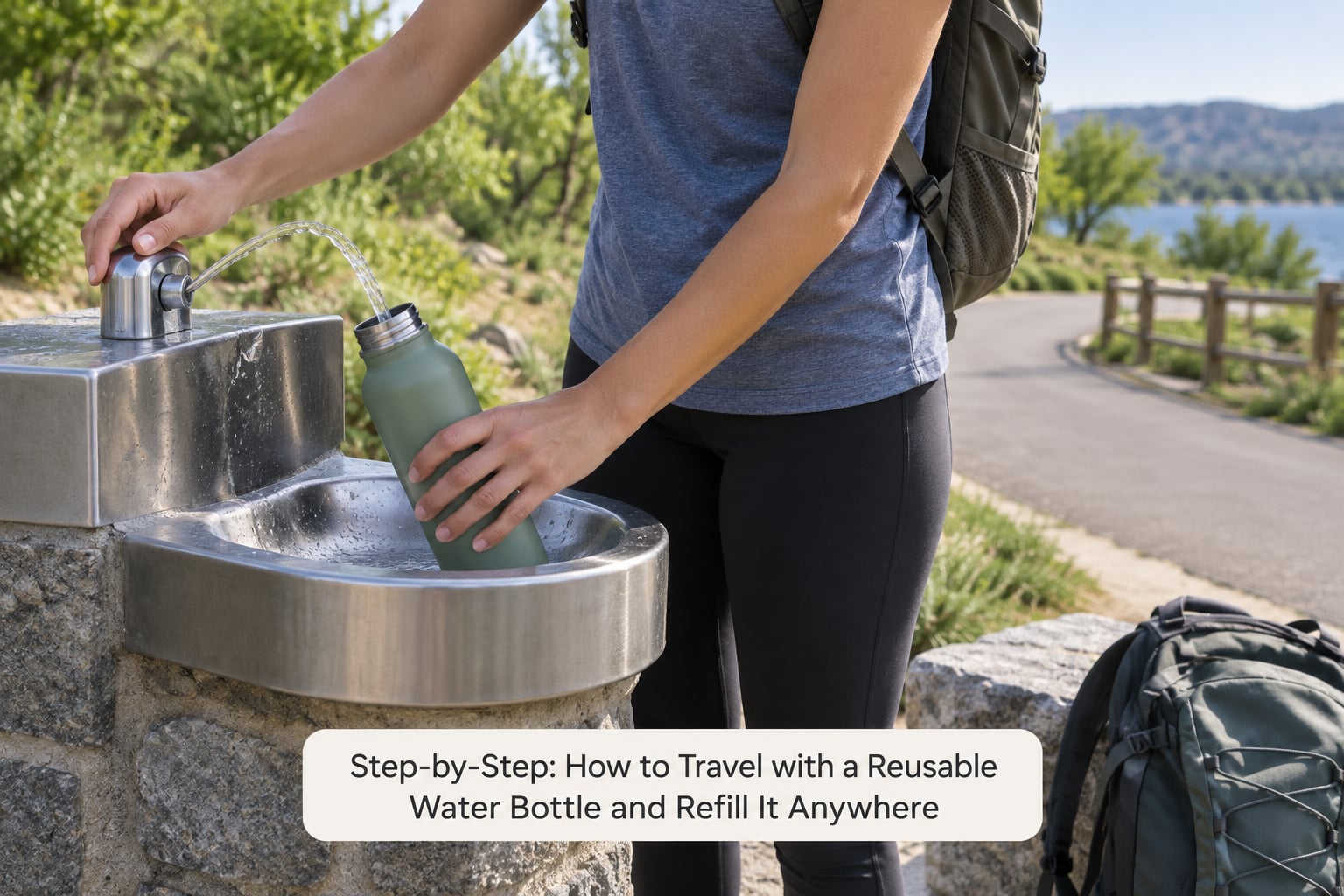
Fountains are the reliable backup. Travellers describe the simplest routine there is: refill whenever you wash your hands. Any faucet works, which makes it the default answer across most of Europe and North America.
Ask when you are unsure. “Is this tap drinking water?” gets a straight answer in most European stations, cafés and fuel stations. In cafés and restaurants, the tap is usually the same mains water that goes into the kettle, and staff will tell you.
Hotels and hostels are the easiest source most travellers never use. Room taps and bathroom sinks are drinkable in countries with treated mains water, and hostel kitchens usually have a tap and a filter jug. Drinking water is also a reasonable thing to ask reception about.
Beyond those, the options by travel mode look like this:
- Plane: airside stations and fountains after security, and on board you can ask a flight attendant whether the galley water is available to top up a bottle.
- Train and coach: station concourses and carriage toilets have taps. Some high-speed trains in Europe sell water at the bistro car, and vending machines are common.
- Ferry and cruise: buffets fill bottles without fuss, and terminal security usually treats them the same way airport security does, so drain before you board.
- City streets abroad: public fountains in squares and parks, city refill machines in some Asian cities that charge a small amount per litre, and taps at petrol stations and cafés.
- Road trip: petrol station forecourts and fast-food restaurants. The forecourt tap is treated mains water; the tap inside the café is not a drinking fountain.
Two sources to skip: the airplane lavatory sink, which is not potable, and a bottle you have left sitting in a hot car. The first is a rule, the second is a judgement call most travellers already make.
Treat Water When Safety Is Uncertain
Clear water is not the same as safe water. A stream can run clear over livestock fields, and a tap in a building with an old roof can carry whatever is in the tank. Appearance tells you nothing useful.
Know before you go which countries advise against drinking tap water, and treat accordingly. If you are filtering anyway, treat any natural source with the same caution you would give a tap you had never seen.
Use a filter for sediment, cloudiness and most bacteria. Use a UV device or purification tablets when viruses are the concern or when you cannot be sure what is in the water. Tablets need the full time printed on the packet, and drinking one too early is the most common way they fail.
Travellers who carry a purifier report that it earns its place on questionable water far more often than on ordinary tap water. On routes with reliable municipal water, it sits in the bag unused.
Check what your filter claims to remove. Most remove particles and bacteria. Very few remove viruses, and the marketing rarely makes that distinction clear.
How to Travel with a Reusable Water Bottle Through the Day
Top up before you leave anywhere with a tap. The best refill point is the one you just walked past, not the one two hours ahead that may be closed.
Refill during transfers, not after them. A layover is exactly when you do not want to be hunting for water with a boarding pass in your teeth.
Drink steadily rather than chasing volume. Sip at intervals through the day; forcing litres at once is uncomfortable and mostly ends in the toilet. Airports and trains are dry, and so are flights.
Cabin air is dry enough that hydration is a comfort issue, not just a health one. A little electrolyte drink on a long haul helps with how you feel, especially if you are crossing time zones.
Carry it where your hands are free. A side pocket, a crossbody strap, or a carabiner on the strap of your daypack all work. This matters more than it sounds when a site requires a locker check and you are carrying everything else on your body.
To keep water cold, freeze the bottle solid before you sleep and put it in an insulating sleeve. Ice from a vendor at the station is fine too, but a wide opening is what lets you drop it in without a funnel.
Clean and Store It After Every Use
The daily routine takes two minutes. Rinse, add a drop of detergent, cap it, shake, rinse, invert to drain, leave the lid off overnight.
Clean the gasket and the cap threads separately. Those are the two places people skip, and both are where smell and biofilm start.
Pull out any infuser or filter cartridge on a deeper clean and wash it on its own schedule, following the maker’s instructions. A filter that is never washed slows down and eventually stops doing its job.
For a deeper clean, a diluted vinegar soak or a baking soda and water paste will break down residue that detergent alone leaves. Rinse until there is no smell at all.
Let the bottle dry completely before you close it. Trapped moisture in a closed bottle is how a clean bottle goes sour in a daypack.
Storing it matters too. Keep it separated from anything oily or fragranced in a bag, and never seal it in a wet plastic bag at the bottom of a suitcase.
Common Mistakes
Arriving at security with a full bottle. It gets drained, and you watch the water go. The fix takes five seconds: empty it into a bathroom or fountain before you join the queue, and refill after the checkpoint.
Treating a fountain as automatically safe. Some airport fountains are unfiltered, and travellers have noticed flow quality and taste issues. In a country where tap water is meant to be drinkable, fountains are generally fine. Elsewhere, fill from a tap you have confirmed or treat it.
Not checking whether stations are airside. Most are, and that means no water on the long walk to security. Fill before the terminal if you are flying for more than a few hours.
Buying a bottle that fights you. Heavy metal for a city trip, a narrow mouth you cannot clean, a push spout that leaks in a rucksack. Each one pushes people back to buying plastic bottles on the road.
Ignoring the purification instructions. Tablets dissolved too early, filters used past their rated life, and UV devices used in a bottle with sediment on the wall all fail quietly. Read the packet once at home.
Overpacking. Four containers, two gadgets and a full cleaning kit for a weekend is more weight than the bottle saves. One bottle, one purification method, one brush.
Forgetting local rules. Security limits differ outside the US, and some countries and cities have their own advice about tap water. A quick check before departure saves a queue and a stomach.
Leaving cleaning for last. A bottle that smells is a bottle you will replace, and the replacement is usually a single-use one.
One more worth naming: leaving the bottle in a locker or behind at a stop. Solo travellers lose things more often than pairs do, because nobody else is carrying a spare.
Most of these mistakes come from planning the bottle and not the route. A ten-minute search for how to travel with a reusable water bottle and refill it anywhere in your destination usually turns up a local refill map or the names of the stations you will actually pass, which is faster than improvising at the gate.
Frequently Asked Questions
Can I take a reusable water bottle through airport security?
Yes, as long as it is empty. Liquid limits apply to liquid, not to the container, so an empty bottle of any size or material is allowed in both carry-on and checked bags. A full bottle over 100 ml, which is 3.4 ounces, is treated as a liquid and will be drained at the checkpoint. Fill it after the checkpoint instead.
What is the best reusable water bottle size for travel?
About 500 ml suits city travel, hotel rooms and days with reliable taps. A litre or more works better for hiking, hot weather and long transfers where you cannot stop. Bigger is not automatically better, because the weight lands in your hand all day. Check your airline’s carry-on dimensions before buying.
How do I know whether a public fountain or tap is safe?
In countries where tap water is treated and drinkable, public fountains and building taps are generally fine, though some fountains are unfiltered. The reliable test is local: ask a café, hotel or station staff member, and follow official travel advice for the country. Where tap water is not advised for drinking, use a filter or purification tablets.
Can I refill from a stream or natural spring while traveling?
Only if you treat it. Clear water says nothing about what is in it, and streams can run through pasture and farmland. A filter removes sediment and most bacteria; purification tablets or a UV device handle viruses. Clear and cold is not the same as safe, and the same rule applies to any natural source you have not seen before.
How often should I clean a reusable water bottle?
Rinse and wash it every day you use it. Two minutes of warm water, a drop of detergent, a shake, and a rinse is enough for the daily routine. Do a deeper clean when you notice smell or film, and always clean the cap threads and gasket separately. Let it dry fully open before you close it, or it will sour inside a closed bottle.
What should I do if I forget my water bottle at a hotel?
Ask reception first, because bottles get handed in or turned in to the desk fairly often. If it is genuinely gone, buying a single-use bottle for the day is fine, and a supermarket or convenience store is much cheaper than an airport or station shop. Check your lost property when you get home, and keep a note of anything engraved on the bottle.
Start tonight: wash the bottle you already own, dry it properly, and pack it empty for next time. Learn where the taps are on your usual route, keep the purification option in the same pocket as the bottle, and the rest of the routine takes care of itself.