Knowing how to find a tea house in a city you do not know is mostly a vocabulary problem. The words tea house, tea room, and bubble tea shop describe three different businesses, and most map searches hand you the wrong one first. Fix the search term, filter the results by style and review quality, cross-check the shortlist, and you will have somewhere worth sitting down within about twenty minutes.
A tea house serves tea as the main event, usually loose leaf or pot service in a quiet room. A tea room is the Western, afternoon-tea version, with tiers of finger food and a set time slot. A boba shop sells sweetened milk tea to go, usually fast, with no seating. A tea cafe is the loose middle ground, which is where most people actually end up.
Table of Contents›
- What You Need
- Step-by-Step: How to Find a Tea House in a City You Do Not Know
- Search by tea type, neighborhood, and experience
- Use reviews and recent photos to check the fit
- Confirm location, hours, booking rules, and payment
- Common Mistakes
- Frequently Asked Questions
- What is the difference between a tea room and a tea house?
- How do I search for a tea house in a language I do not speak?
- How can I tell an authentic tea house from a cafe or boba shop?
- Do I need a reservation at a tea house?
- What should I order on my first visit to a tea house?
- What do I do when reviews disagree or a listing looks out of date?
What You Need

None of this needs money or a membership. It needs a phone and about half an hour of patience, which is a lot cheaper than the wrong lunch.
- A smartphone with offline maps. Download the map of the city before you lose signal, and save the neighborhoods you plan to walk through.
- A map app and one directory. Google Maps, Apple Maps, or OpenStreetMap handles location and walking routes. Pair it with a tea-specific directory like TeaMap for style tags.
- A translation tool. Camera-based translation is enough to read a menu board and a posted hours sign.
- One payment method. Carry a little cash. Plenty of small tea rooms still take it and nobody wants to be the person blocking the counter while fumbling.
- Free time, or at least one free afternoon. Tea houses cluster in specific districts. Finding them properly means walking a few blocks of the right neighborhood, not the nearest pin.
Step-by-Step: How to Find a Tea House in a City You Do Not Know
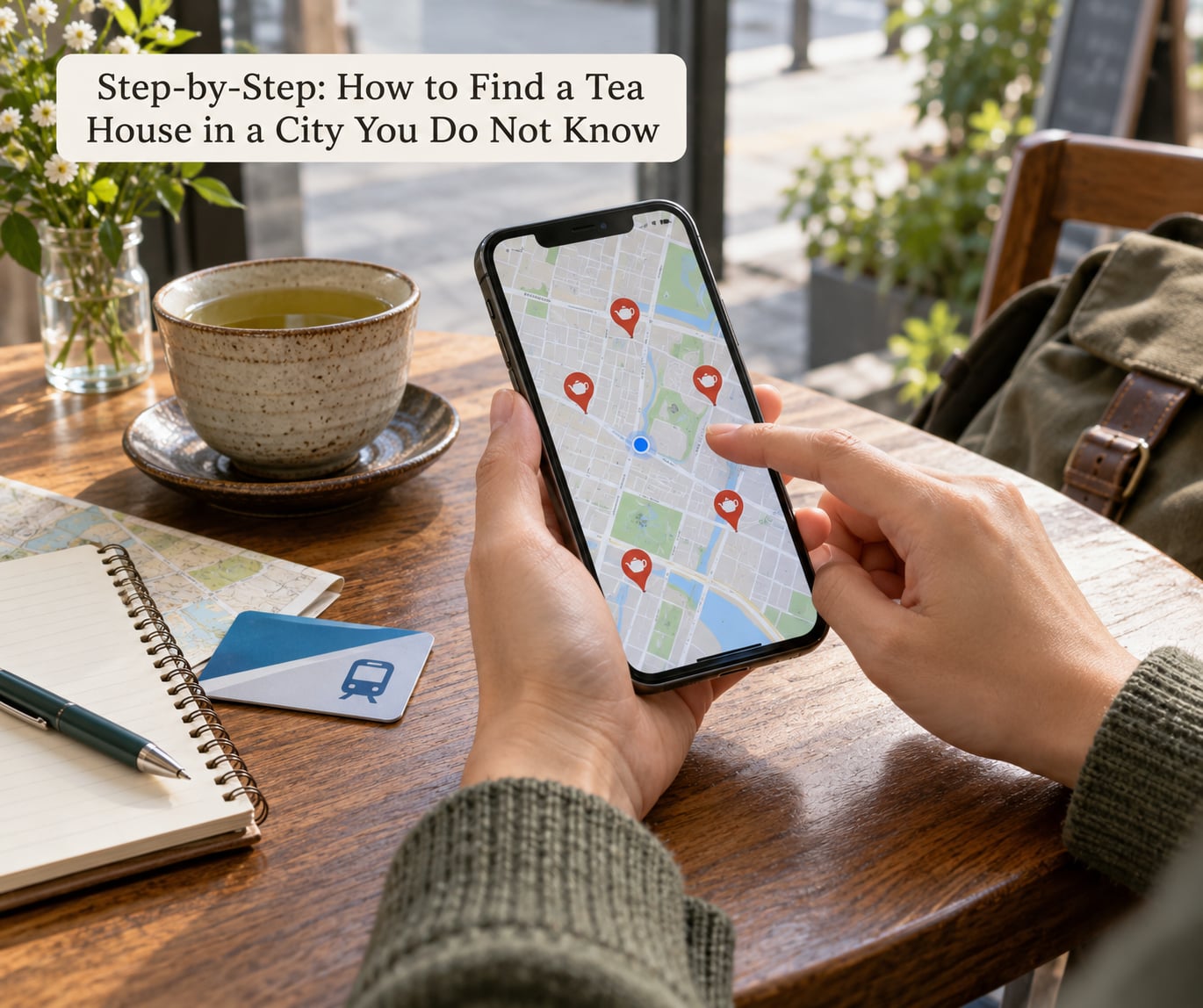
- Decide what kind of tea experience you want before you search, because the terms change the results completely.
- Search the city name with the right term for that type: tea house, tea room, teahouse, or traditional tea house.
- Add a district, neighborhood, or landmark to the query so results narrow to places you could actually walk to.
- Filter the results by open now, seating, and price, then drop anything that only serves iced milk tea.
- Read the ten most recent reviews, looking for locals seated inside rather than photo-heavy tourist posts.
- Check recent photos for loose leaf pots, teapots, and brewing gear, not blenders and sealed cups.
- Call or message ahead to confirm hours, reservation rules, seating, and how they take payment.
- Walk in, order one pot, and ask the person pouring it where they would send a friend.
That last step matters more than the other seven combined. The person brewing tea in front of you knows the rooms that are still good this month.
Search by tea type, neighborhood, and experience
Start by naming the experience. A gongfu tea ceremony means small pots, many steepings, and a host who steeps for you, and those rooms rarely share a listing category with an afternoon tea room. Match the term to the experience and the noise drops away.
Neighborhood is the second lever. In most cities, tea houses cluster in specific districts, and searching within one beats searching city-wide every time. Look for older commercial streets, university quarters, arts districts, and Chinatown-adjacent blocks. A search scoped to a named neighborhood returns a dozen real rooms; a city-wide search returns a thousand boba chains.
When you are outside an English-speaking country, search in the local language once you have a translation tool. Local terms bring up tea rooms that never bothered with an English listing, and those tend to be the ones with actual regulars. Copy the local word for the style you want into your map app and run the same search again.
Use reviews and recent photos to check the fit
Review sites for tea are dominated by bubble tea, so the default ranking is wrong for you. Skip the top-ranked pin and read down to the fourth or fifth result, then sort by newest. Recent reviews tell you whether the business still exists under the same name, which is the first thing to check in a city you just landed in.
Style tags help more than star ratings. TeaMap tags listings as victorian, urban, country, or asian, which tells you the room, the music, and the formality before you walk in. Victorian usually means afternoon tea with scones and cream. Urban means a modern room with loose leaf and a laptop policy. Asian means a ceremony space, often with small pots and no conversation for the first twenty minutes.
Users on r/Upperwestside have the sharpest version of this complaint: map results are dominated by bubble tea when what they wanted was something like a floating mountain, a proper brewing room. The fix is the same in every city. Read the reviews for who is sitting inside. A room full of people working at three in the afternoon on a weekday is a local tea spot. Five stars from three visitors is not.
Photos do the last bit of filtering. A loose leaf pot, a gaiwan, a brewing tray, shelves of tins, a proper kettle: those are tea rooms. A blender, a row of sealed cups, a menu board of flavored names: that is a boba shop, no matter what the listing says.
Confirm location, hours, booking rules, and payment
Most failures happen at this step, after the search already worked. Listings go stale, so treat anything older than a few months as unverified until you call or check a recent photo. Confirm the branch, since chains and independent rooms with similar names sit on the same street.
Ask three things: are you seated with table service or counter, do you need a reservation, and what do you take payment. Formal afternoon tea services often run as a set menu in fixed time slots and book out on weekends. Casual loose leaf rooms usually do not book at all and welcome a walk-in. Neither answer is wrong, but you want to know which one you are walking into.
On cost, expect a wide spread and check before you commit. A pot of loose leaf in a neighborhood room is a modest bill. A formal afternoon tea with tiers of food runs several times higher. Hotel lounges and destination tea ceremonies sit at the top. The reviews will usually name a number or a range for a pot, and that is more reliable than anything a map listing shows.
Asking a local tea house for a recommendation yourself is the move most people skip. Buy something small, then ask a question that shows you are not writing a review: where do you drink tea when you have a whole afternoon free. In my experience the answer is a different room than the one I would have picked, and it is usually cheaper.
Common Mistakes
Confusing a cafe with a tea house. A cafe sells coffee first and tea as an afterthought. If the menu leads with espresso and cold brew, you are in the wrong category. Search tea terms only and skip anything with a drive-through.
Trusting a listing nobody has updated. Owners move, hours change, rooms close. A listing with no photos from the last year is a guess. Check for recent customer photos and a recent review date before you commit to a crossing of the city.
Picking the most popular result. The top pin in most cities is the boba chain with the most volume. Popularity measures foot traffic, not tea quality. Sort by review recency instead and read what people say about the room itself.
Ignoring the neighborhood context. A cluster of tea rooms in one district usually means cheaper rent, long-established shops, and people who have been drinking the same thing for twenty years. A lone listing far from any cluster is more often a cafe that happens to serve tea.
Skipping etiquette and accessibility. Sit where the room directs you, since seat choice is often a small signal about the service level you get. Ask whether laptops are welcome before you open one. If stairs are the only way up, the review section usually mentions it, and it is easier to know before hauling a bag up two flights.
Planning only one option. A rainy afternoon in an unfamiliar city deserves a second pin. Keep one backup fifteen minutes away so a closed door does not eat the whole day.
Frequently Asked Questions
What is the difference between a tea room and a tea house?
A tea house serves tea as the main event, usually loose leaf brewed in small pots, often with a ceremony component. A tea room is the Western afternoon-tea version: a set service with finger food in tiers, usually at a booked time. A boba shop sells sweetened milk tea to go with no seating. Searching the wrong word is why map results feel wrong.
How do I search for a tea house in a language I do not speak?
Run the search in the local language using the word for the style you want, then use camera translation on the results page. Local-language searches surface rooms that never wrote an English listing, and those tend to have regulars rather than visitors. Add the district name too, since it narrows the list to somewhere you can walk to in one sitting.
How can I tell an authentic tea house from a cafe or boba shop?
Look at the equipment, not the signage. Loose leaf pots, a gaiwan, a kettle, shelves of tea tins, and a brewing tray mean a tea room. A blender and a wall of sealed cups mean a boba shop, no matter what the listing claims. Reviews that mention steeping, pot service, leaf grades, or refills are another strong signal that tea is the point of the visit.
Do I need a reservation at a tea house?
It depends on the type. Casual neighborhood tea rooms generally take walk-ins and do not book. Formal afternoon tea services and hotel lounges often run as a fixed menu in set time slots and fill up on weekends. Ask before you travel, and if you cannot reach anyone, go early rather than late, since the early slot is usually the easiest one to get.
What should I order on my first visit to a tea house?
Order one pot of loose leaf and nothing else first, so you can judge the tea before the food arrives. Ask the server what the house is known for and order that. If you want the full experience, afternoon tea is served in a fixed order: sandwiches first, then scones with clotted cream and jam, then cake. Add a pot for the table rather than a plate per person.
What do I do when reviews disagree or a listing looks out of date?
Sort by newest and check the photo dates. If the most recent images and reviews are old, treat the listing as unverified and cross-check the name on a second map or a directory. When reviewers conflict, weight the ones describing the room over the ones describing the price, and look for mentions of locals being present during the day. A backup pin fifteen minutes away protects the afternoon.
Search by neighborhood rather than by city, filter out anything serving only milk tea, and verify the current details before you walk across town. Start with one well-reviewed option and a second pin fifteen minutes away, and the rest of the afternoon takes care of itself.