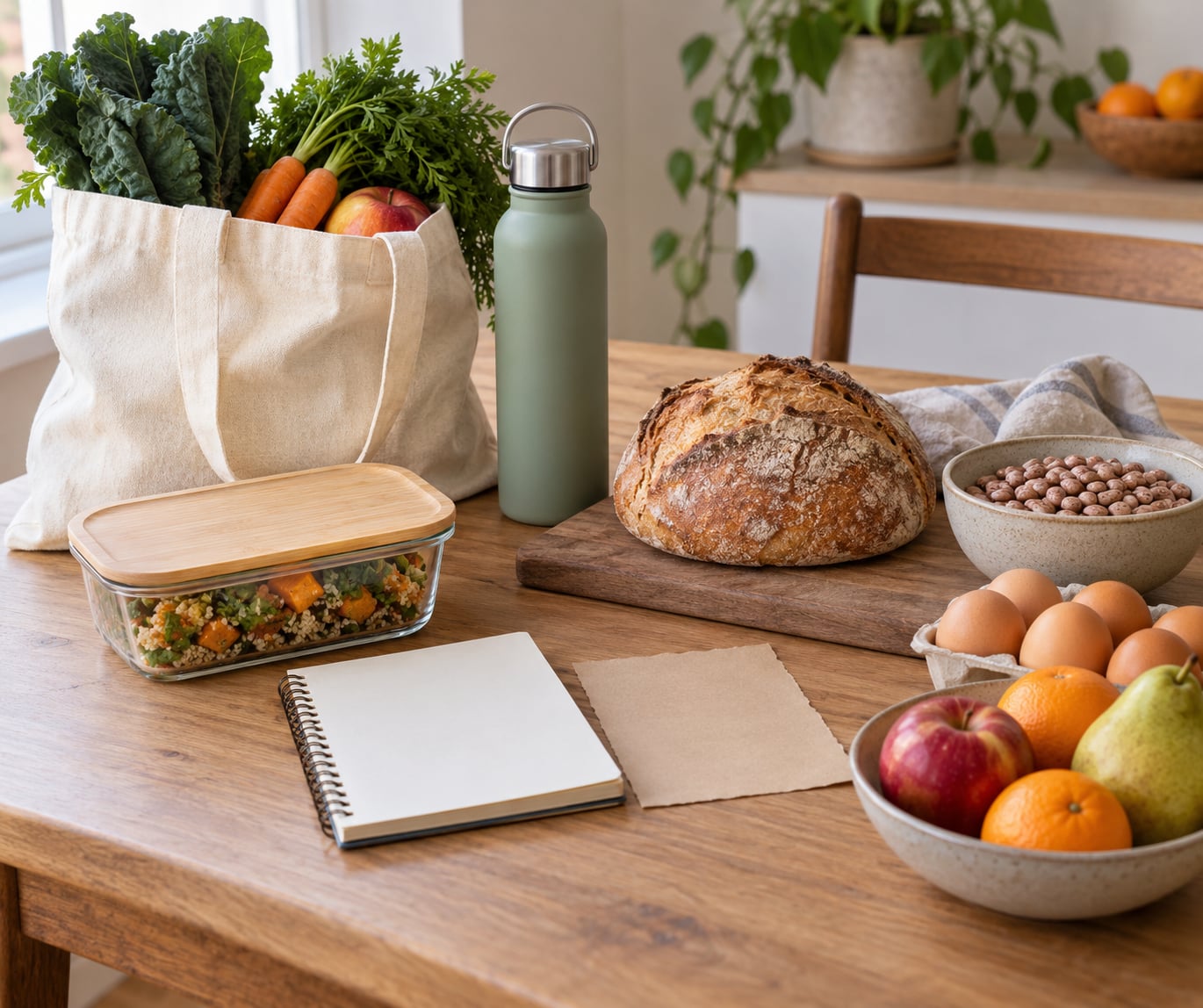
You eat well on a tiny trip budget by deciding, before you leave, that most of your calories come from a supermarket or a market rather than a restaurant menu. The system takes about twenty minutes to set up and about ten minutes each time you shop. The honest version is that eating well while traveling is a shopping problem more than a cooking problem.
Travelers who struggle with this usually try to spend less per restaurant meal, which barely moves the number. The bigger win is changing where the meals come from: one or two eating-out meals a day at most, everything else assembled from cheap staples, fruit, and something ready to eat.
Table of Contents›
- What You Need
- Step-by-Step: How to Eat Well on a Trip When You Have a Tiny Budget
- 1. Set a Daily Food Budget and Choose Flexible Meals
- 2. Shop Like a Local, Not a Tourist
- 3. Build a Two-Part Meal Plan
- 4. Make Breakfast and Water the Low-Cost Anchors
- 5. Cook Only When It Saves Money or Adds Enjoyment
- 6. Store Leftovers Safely and Know When to Stop Spending
- Common Mistakes
- Frequently Asked Questions
- How can I eat cheaply while traveling?
- What is the best food to buy at a supermarket for a trip?
- Is street food safe for budget travelers?
- How long can I keep leftovers without a refrigerator?
- What can I eat with no cooking facilities?
- How do I manage a food allergy or special diet on a small travel budget?
- Conclusion: Start With One Flexible Shopping Plan
What You Need
The kit is small, and most of it fits in a backpack pocket. You need a daily food amount written down, a reusable shopping bag, a refillable water bottle, and one food-safe container with a lid.
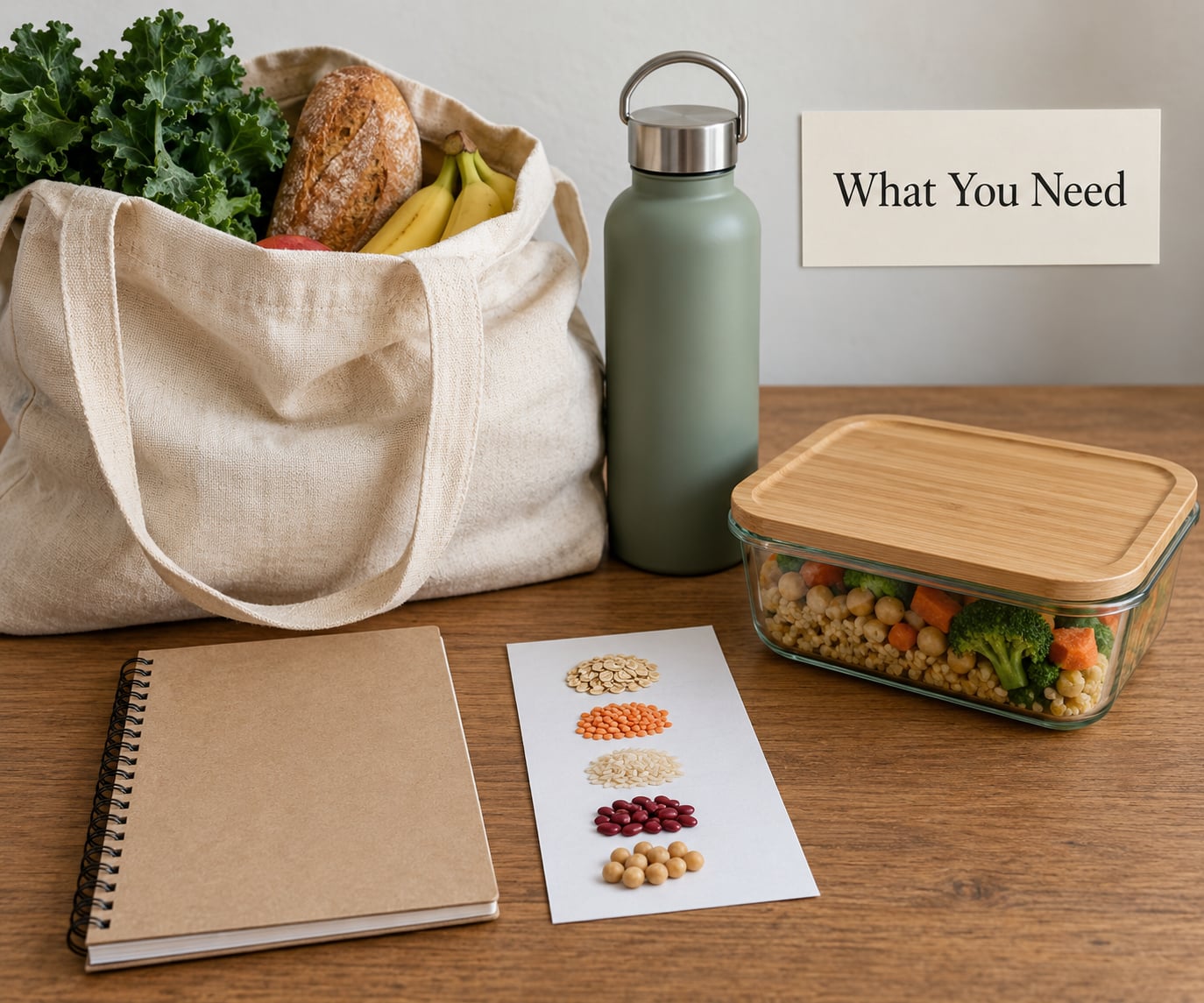
A small knife or multitool helps when the only option is a whole flatbread and a hard cheese. Beyond that, what matters is somewhere to keep cold food: a fridge in the room, a shared hostel kitchen, or an insulated bag with a cold pack. That is the item people skip and then miss.
You do not need cooking skills, a camp stove, or a meal kit. Travelers who pack equipment they never use usually end up buying the same groceries anyway.
Step-by-Step: How to Eat Well on a Trip When You Have a Tiny Budget
Each step below says what to do, what it looks like in practice, and how you can tell it worked. Read them in order the first time, then use them as a checklist on later trips.
1. Set a Daily Food Budget and Choose Flexible Meals
Divide the total money you set aside for food by the number of days, then hold back roughly a tenth of that for delays, missed connections, or a day when prices surprise you. Write the number down in local currency once you arrive, because exchange rates and city prices move constantly and no useful figure travels between countries.
Then build meals around filling foods: oats, rice, bread, eggs, beans, yogurt or a fortified plant-based alternative, seasonal fruit, and whatever local starch fills you up cheaply. A bowl that has protein in it holds together for hours; a bowl of plain carbs collapses by mid-afternoon, which is exactly the failure travelers complain about.
You know the step worked when you can name the three places you will buy food and have a rough number for each. Most people cannot.
2. Shop Like a Local, Not a Tourist
A convenience store near a landmark charges for convenience. A supermarket a fifteen-minute walk away does not. A wet market, street market, or neighborhood bakery is usually cheaper than both, and it is where the food tastes local. Compare two or three of these per trip rather than defaulting to whatever is directly under your accommodation.
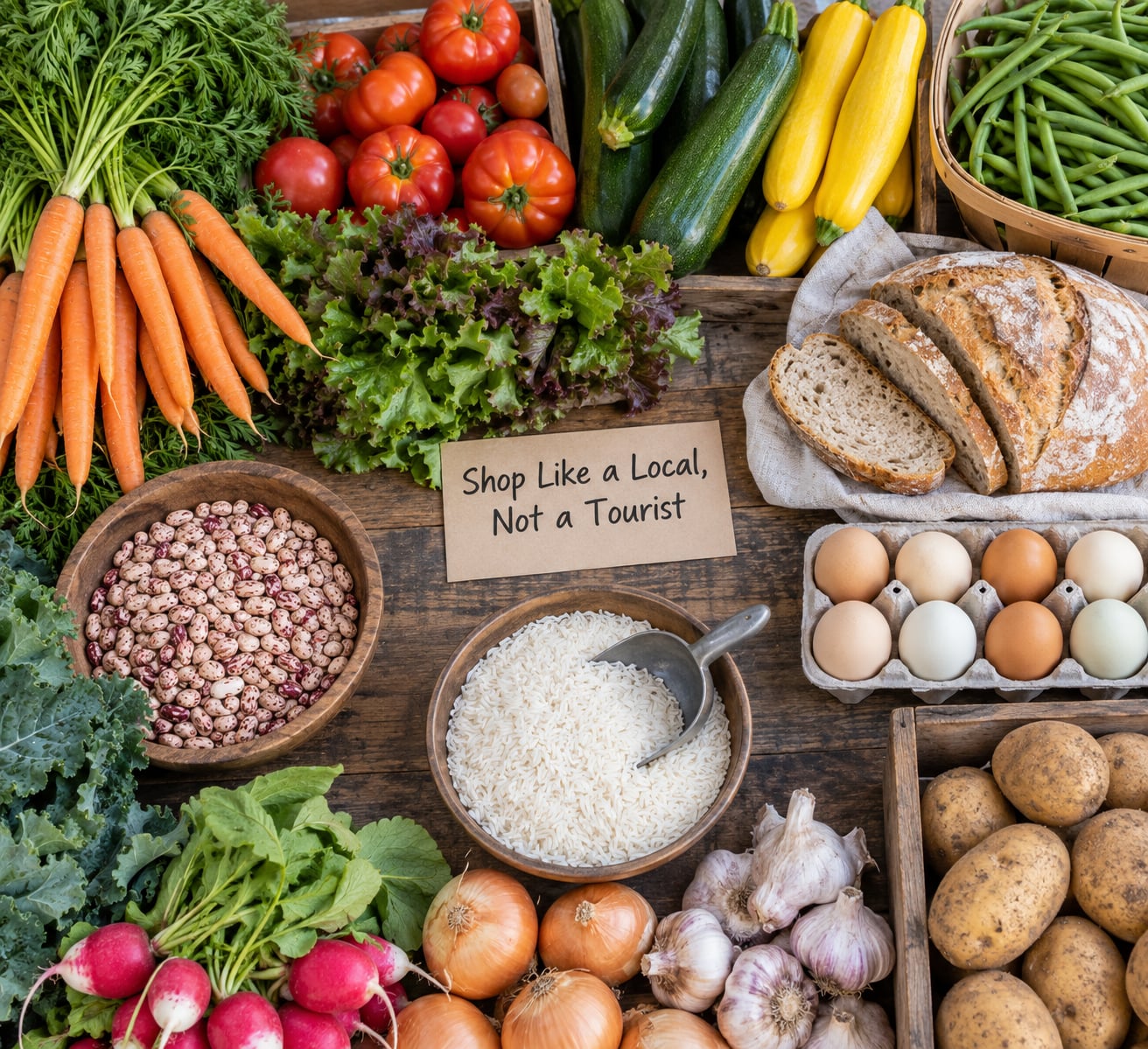
Buy staples in small quantities and produce in season, not in a rush. Look at prices calmly instead of grabbing the first thing; markets with a printed price list per kilogram are the easiest to read, while stall prices are often negotiable or simply lower before peak tourist hours.
You know it worked when your basket has one filling staple, one protein, and one piece of produce for the next few days, and you spent noticeably less than you would have at the shop downstairs.
3. Build a Two-Part Meal Plan
The cheapest meals are usually half prepared specialty, half grocery component. Buy a local specialty that is ready to eat — a filled flatbread, a bowl of noodles, a pastry, a portion of grilled fish — and pair it with fruit, yogurt, nuts, or bread you picked up earlier. You get the thing you would only eat on a trip, at a fraction of a full restaurant meal.
The second pattern is turning one meal into the next. Cook or buy more than you need at dinner and assemble lunch from it the following day, which turns two eating-out meals into one and a half.
Keep this honest, though: do not buy perishables two days early unless you have real cold storage. Cold below 40°F (4°C) is the line, and anything you cannot keep cold should be bought for the meal right after you buy it.
4. Make Breakfast and Water the Low-Cost Anchors
Breakfast is the meal travelers pay the most for relative to what it does. Oats cooked with water, bread with fruit, yogurt, eggs, or a fortified porridge give you the same start for a fraction of the cost, and they are also the two or three items that are cheap almost everywhere.
Water is the other anchor. Refill at a tap or a filtered station rather than buying bottles all day, and treat tap water as drinkable only when people locally confirm it is. Where you cannot confirm it, use sealed water for drinking and still refill for washing up. On long transit days, carry a filled bottle from the last safe source you passed.
Adjust the plan if you have a medical diet, an allergy, a mobility limit, or a swallowing difficulty. Ask locally rather than guessing, and in the United States a doctor or registered dietitian is the right person for advice specific to you. Any warning sign that needs more than a different lunch is a reason to stop and get care, not a reason to shop for a workaround.
5. Cook Only When It Saves Money or Adds Enjoyment
In a hostel or guesthouse kitchen, four approaches cover almost everything: no-cook assembly (bread, cheese, tomato, olive oil), boiling (pasta, rice, eggs), frying or searing (anything you would want a hot pan for), and reheating leftovers. A pot and a pan are usually enough for the first two and last two.
Cook once, not four times. Make one batch of a stew, curry, or pasta and eat it twice, rather than preparing a separate dish per night. Wasted ingredients cost the same as eaten ones, and often more because you then buy again.
Skip cooking on the days you have no kitchen, no time, or no clean water access. Eating out on a rest day is part of the plan, not a failure of it. You know the step worked when cooking cut your meal count and did not add an hour of washing up each night.
6. Store Leftovers Safely and Know When to Stop Spending
Cold food belongs below 40°F (4°C), which means a working fridge or a well-iced insulated bag. Refrigerate perishables within two hours of preparation, or within one hour when it is hot out. When in doubt, do not keep it.
Cook to the safe minimum internal temperature: 165°F (74°C) for poultry, 160°F (71°C) for ground meat, and 145°F (63°C) for whole cuts and fish. In places where you cannot judge temperature, choose food cooked hot and fresh in front of you — busy stalls turn over their stock quickly, which is the real reason street food is safer than it looks.
Knowing when to stop spending is the last skill. Set your daily number in the morning, and when you reach it, eat what you bought. Airport food, gas stations, convenience stores, and delivery fees will quietly take a day’s budget in a single purchase; the fix is not discipline at the counter, it is closing the day’s spending before you get there.
Common Mistakes
The most expensive mistake is eating every meal where tourists eat. Walk fifteen minutes back from the landmark before you decide anything, and the same city often becomes affordable.
The second is buying water repeatedly. A bottle you refill a dozen times costs a fraction of twelve bottles, and the tap question is solvable with one local question.
The third is overbuying fresh food. Buy for the next two or three meals, not the whole week, unless you have confirmed storage. Spoiled produce is the most expensive thing a cheap-food plan can buy.
Skipping breakfast to save money usually backfires, because you eat more expensively by eleven. Cooking elaborate meals in a shared kitchen is the fourth, since effort and washing up cost more than the ingredients.
Ignoring storage conditions is the fifth, and it is the one with real consequences: a day of walking on food kept warm for six hours is a lost day and a lost budget.
A few habits fix most of this at once. Go to markets when they are busy but not at closing time, when prices soften. Share ingredients with a travel companion or a kitchen neighbor rather than each buying a full set of spices. Ask about tap water once, then remember the answer. And keep one sealed, shelf-stable emergency item in your bag for the missed bus.
Frequently Asked Questions
How can I eat cheaply while traveling?
Move most meals to self-catered food and treat restaurants as one planned meal a day. Buy staples, produce, and eggs at a supermarket or market a short walk from your accommodation, keep one filling staple in your bag, and drink water you refill rather than bottles you buy. The saving comes from where meals come from, not from ordering less when you do eat out.
What is the best food to buy at a supermarket for a trip?
Oats, rice, pasta, bread, eggs, beans or lentils, yogurt or a fortified plant-based alternative, nuts, and seasonal fruit. These travel well, keep, fill you up, and are cheap in most countries. Add one item that is only available where you are, so you are eating locally as well as cheaply.
Is street food safe for budget travelers?
Usually, and the reason is turnover, not the street. Stalls cooking hot in front of you, with a queue, rarely hold food long enough for bacteria to build up. Look for food cooked to order, served piping hot, and handled cleanly. Skip anything sitting at room temperature, and be cautious with raw salads and cut fruit you cannot peel yourself.
How long can I keep leftovers without a refrigerator?
Treat anything perishable as safe for about two hours at room temperature, or one hour in hot conditions, and discard it after that. With a fridge or an insulated bag holding food below 40°F (4°C), cooked leftovers generally keep three to four days. When in doubt about temperature, throw it out; replacing one meal costs far less than a lost travel day.
What can I eat with no cooking facilities?
Bread with cheese, nuts, fruit, yogurt, tinned fish, olives, and hard-boiled eggs need nothing but a knife and a surface. Many markets sell ready-to-eat dishes to carry to a park or a square. Combine one prepared specialty with fruit or nuts and you have a full meal for a fraction of restaurant pricing.
How do I manage a food allergy or special diet on a small travel budget?
Learn two or three words in the local language for your allergen and for free-from, and check labels in the supermarket before you buy. Cooking your own base meals gives you the most control and is usually cheaper. Ask staff directly instead of assuming, and carry a backup item from home for days when translation gets complicated.
Conclusion: Start With One Flexible Shopping Plan
Start with one shopping trip to a supermarket or neighborhood market: one filling staple, one produce item, and one prepared specialty, then adjust the plan to local prices and whatever storage you have. Eating well on a tiny budget is not about finding a cheaper restaurant. It is about building the habit of buying your own food and keeping your daily number in view. Updated for 2026, and worth revisiting with the last day of any trip in mind: that final airport meal is the one that hurts.