Learning how to use a gaiwan for beginners comes down to three things: a small measure of leaf, very short steeps, and a steady three-finger grip. Put 3 to 6 grams of loose tea in a 100 to 150 ml bowl, pour on water hot enough for that tea, wait 10 to 30 seconds, and pour the liquid out through a gap between the lid and the rim. Ten minutes of practice is enough to get a good cup.
A gaiwan (pronounced “guy-wahn”) is a lidded bowl used for gongfu cha, a focused style of Chinese tea brewing built on small volumes and repeated infusions. Instead of one long steep, you get six or seven short ones from the same leaf, and each cup tastes noticeably different from the last.
Beginners usually overcorrect. The instinct is to pack in more tea and steep it longer, which is the fastest route to a bitter cup that makes people blame the tea. Less leaf and less time is the whole trick.
My own first session involved more tea tray than tea tray-side pouring, and one thumbprint burn that faded in a minute. Two or three sessions later it stopped feeling like a project at all, which matches what people on r/tea and r/GongFuTea tend to report.
Table of Contents›
- What You Need to Use a Gaiwan for Beginners
- Step-by-Step: Your First Gaiwan Brew
- Step 1: Choose and Measure Your Tea
- Step 2: Fill the Gaiwan and Warm It
- Step 3: How to Use a Gaiwan for Beginners
- Step 4: Check the Infusion
- Step 5: Pour the Tea Safely
- Step 6: Restrink and Finish
- Common Mistakes and How to Fix Them
- Frequently Asked Questions
- How much tea should I put in a gaiwan?
- What temperature water should I use for a gaiwan?
- How long should the first cup steep?
- How do I pour from a gaiwan without burning myself?
- Does the gaiwan lid keep the tea warm?
- What tea is easiest to start with?
- Start With One Steep
What You Need to Use a Gaiwan for Beginners
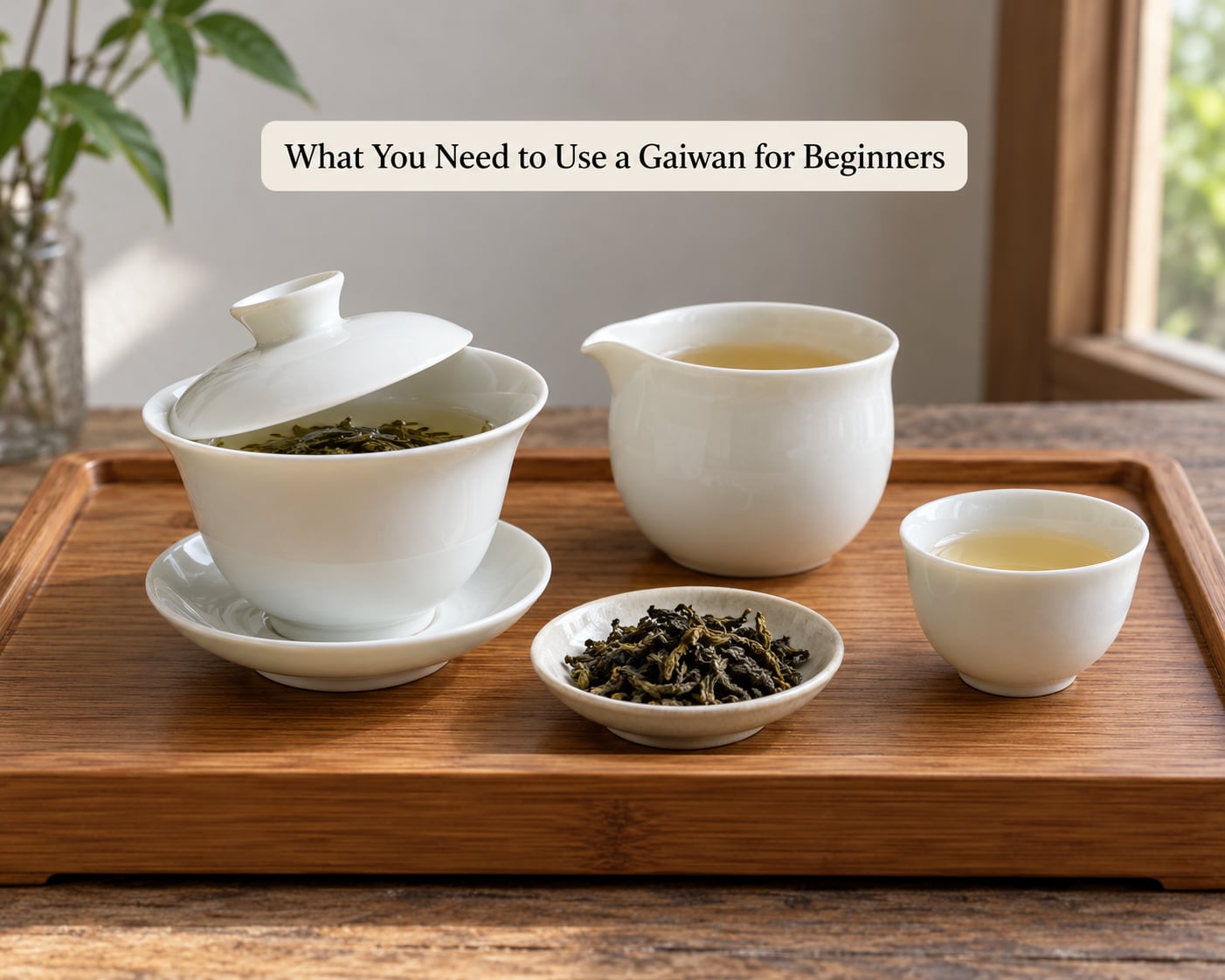
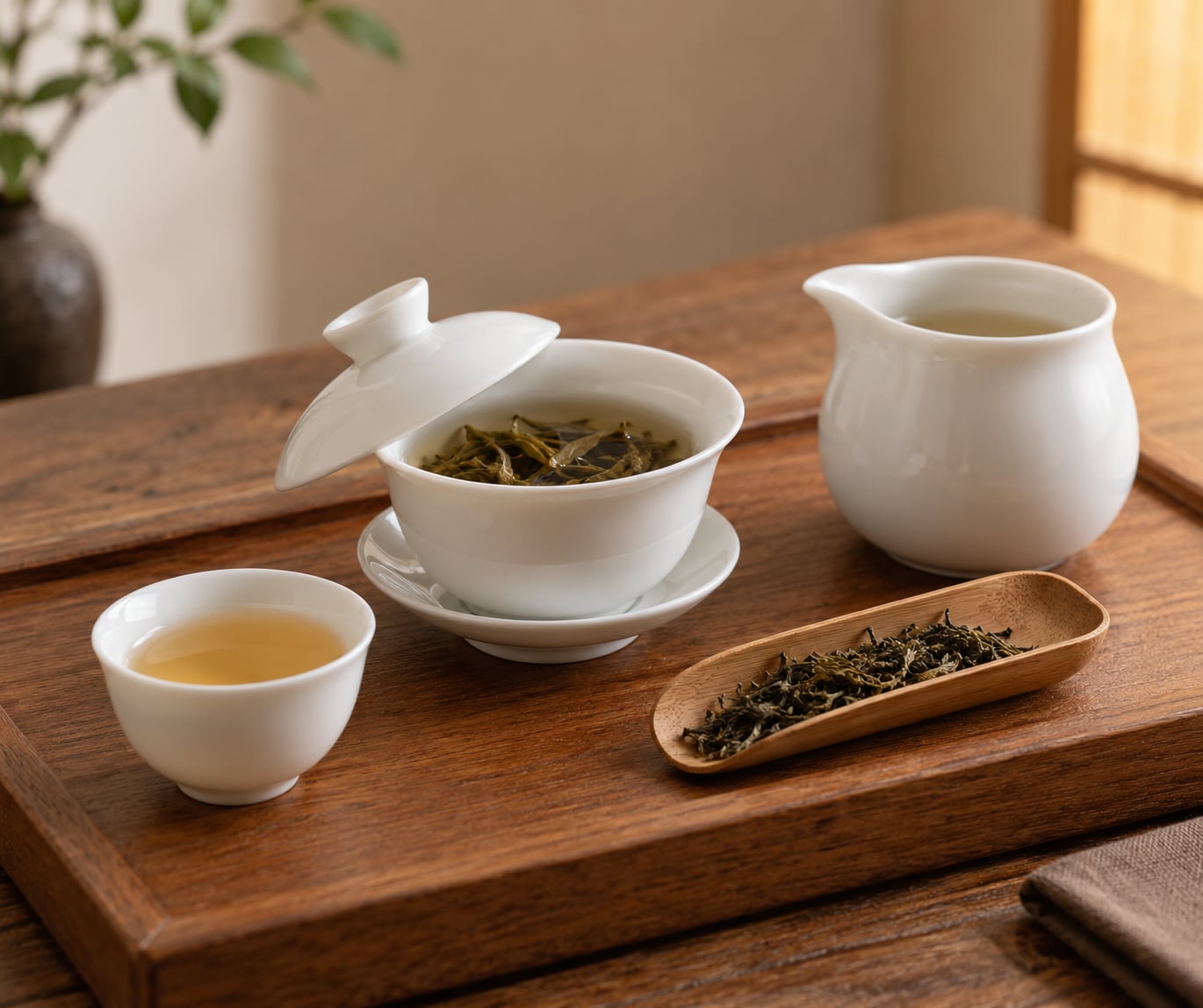
A gaiwan is three pieces: a bowl, a lid that fits inside it, and a shallow saucer. The lid is the important bit, because the gap between lid and rim is the strainer. There is no filter to buy and nothing to replace.
For your first setup, gather a kettle with a steady pour, a small kitchen scale if you have one, a timer, and a tasting cup or two. A tea tray is nice, not required. A plain table works, and a folded towel under the saucer does more for safety than most beginners expect.
Size matters more than people think. Start with a 100 to 150 ml bowl. Anything larger holds so much water that the temperature drops while you brew, and the small ones force you into short steeps too early, which is exactly the habit you want to build.
Porcelain is the classic beginner material because it shows color and aroma clearly. It also heats up fast, so save the delicate cups for later. If you plan to brew dark teas and shou pu-erh regularly, a stoneware bowl tolerates boiling water far better than thin porcelain.
A gaiwan pitcher is a small jug that catches the last of the infusion so nothing drips on the tray. It is the one accessory I would still pick up early, because a full decant is what keeps your later infusions from tasting bitter.
Step-by-Step: Your First Gaiwan Brew
Step 1: Choose and Measure Your Tea
Loose leaf only, and start smaller than you think. A useful beginner ratio is about 5 grams of leaf per 100 ml of water, which in a 120 ml bowl is roughly a rounded tablespoon. Lighter teas want less, darker ones want more, and the table below breaks it down by type.
Level the measure with a finger or the edge of the scoop. Do not press the leaves down and do not tap the bowl to settle them, because compact leaf steeps unevenly and the bottom of the bowl over-extracts while the top barely infuses.
Step 2: Fill the Gaiwan and Warm It
Pour a little hot water into the empty bowl, swirl it around the sides to warm the porcelain, and tip it out. Do the same with the lid. A cold bowl drops your water temperature several degrees, and cold porcelain also feels hotter against your fingers once the tea is in it.
Then add your measured leaf and fill with water to just below where the lid will sit. Resting the lid on the bowl gives you a natural fill line, and staying a finger’s width under it is the simplest insurance against a scald.
| Tea type | Leaf per 100 ml | Water temperature | First steep | Typical infusions |
|---|---|---|---|---|
| Green | 3 g | 175 to 185 F (80 to 85 C) | 20 to 30 seconds | 3 to 4 |
| White | 4 g | 190 to 200 F (88 to 93 C) | 30 to 45 seconds | 4 to 6 |
| Oolong | 5 to 6 g | 195 to 205 F (90 to 96 C) | 10 to 20 seconds | 6 to 8 |
| Black | 5 g | 200 to 212 F (93 to 100 C) | 10 to 20 seconds | 3 to 5 |
| Shou pu-erh | 6 to 7 g | 205 to 212 F (96 to 100 C) | 10 to 20 seconds | 6 to 10 |
Rolled oolong and compressed pu-erh usually get a quick rinse first: 5 seconds of water at around 160 F, poured straight off. It wakes the leaves and washes away dust. Skip it for loose leaf green and white tea, which loses aroma in a rinse it does not need.
Step 3: How to Use a Gaiwan for Beginners
Pour the water in slowly down the side of the bowl rather than straight onto the leaf, which is gentler on delicate green tea. Cover with the lid and set the lid knob where you can reach it, then leave the bowl completely alone.
Resist lifting the lid to peek. Every peek lets heat out and lets aroma go with it, and both push you toward an over-steeped cup on the next round.
Step 4: Check the Infusion
When the timer goes, lift the lid and smell it. The wet leaf and the inside of the lid hold more aroma than the cup does, and this is the fastest read you will get on whether the tea is ready.
Look at the liquor before you taste it. Pale gold for green and white, deep amber for a roasted oolong, near-red for black. Then pour a small amount into a cup and drink it. Thin and sharp with no body means it needs more time, and a dry, rasping finish means it needs less. This check is the habit that makes how to use a gaiwan for beginners click, because it turns brewing into a loop you can adjust rather than a one-shot guess.
Step 5: Pour the Tea Safely
This is the part people practice most, and it is the part worth practicing before tea is involved. Do a few rounds over the sink with cool or barely warm water first.
Rest the lid knob in the crook of your thumb, with your index and middle fingers on the rim on the far side, leaving a gap of a few millimeters on the side nearest you. You are holding the rim, not the bowl body. Keep the gaiwan close to upright as you tilt it, so the hot stream runs down the inside wall and away from your fingers rather than over them.
Pour in short bursts to each cup, and keep the flow below the lid so leaves stay behind. When the bowl is nearly empty, slide the lid fully across the opening to catch the stragglers, then tip that last drop into a cup or your pitcher.
Step 6: Restrink and Finish
Refill with hot water and add 5 to 10 seconds to the previous steep. The second infusion of a good oolong is often the sweetest one, and the third is where beginners start to notice how much further the same leaf will go.
Pour each infusion out completely every time. Liquid sitting on the leaves keeps extracting whether you are ready or not, and that leftover pool is the usual reason a third steep tastes worse than the second. Most leaf runs six or more infusions; stop when sweetness fades and only astringency remains.
Common Mistakes and How to Fix Them
Too much leaf. More than about 6 grams per 100 ml is gongfu territory, and beginners overshoot it constantly. Halve your measure and steep the same time. You can always add leaf on the third infusion.
Pouring water onto the lid. Water running over the lid during filling wets the knob and puts hot liquid where your thumb is. Aim down the inner wall, and fill a finger’s width under the lid line.
Leaving the bowl uncovered. Without a lid the water cools fast and aroma escapes, so you chase flavor with more leaf. Cover it, and keep it covered through the whole steep.
Gripping the bowl body. The flared rim is designed to be held, and the heat stays in the bowl. If your fingers still feel hot, use the saucer, set the bowl down more often, or choose a bowl with a higher knob and a wider flare.
Tilting the gaiwan far over to pour. Rotate your wrist instead of lowering the whole bowl. A steep angle sends the stream over the rim and across your knuckles, which is the most common way beginners burn themselves.
Pouring every cup in one go. That long stream runs hot, splashes, and drains the last drops over your fingers. Pour a couple of centimeters into each cup in turn, and use a gaiwan pitcher for the final pour.
Judging by color alone. Liquor color varies wildly between the same tea and the same brew, so it is a weak signal. Smell the lid, then taste a small cup.
Not pouring the infusion out fully. A puddle left on the leaf over-extracts the next round. Empty the bowl every time, and if the last drop will not come, tilt the lid to catch it.
One more that is worth repeating: a bitter first cup is not bad tea. It is almost always too much leaf, too much time, or water left sitting on the leaves. Adjust one thing at a time and the second cup usually fixes it.
Frequently Asked Questions
How much tea should I put in a gaiwan?
For a first brew, use about 5 grams of loose leaf per 100 ml of water, which fills a 120 ml bowl roughly one-third of the way. Green and white tea want a little less, around 3 to 4 grams, while shou pu-erh and oolong take 5 to 7. Measure with a scale if you have one, and level the scoop rather than packing it down, since compressed leaf steeps unevenly.
What temperature water should I use for a gaiwan?
Match the water to the tea. Green tea steeps best around 175 to 185 F (80 to 85 C), white tea at 190 to 200 F, oolong at 195 to 205 F, and black tea or shou pu-erh can take full boiling water at 212 F. Pouring boiling water over delicate green tea makes it bitter in seconds. A kettle you cannot control is a problem, so a variable temperature kettle helps.
How long should the first cup steep?
Ten to 20 seconds is the usual range for oolong, black tea, and pu-erh, and 20 to 30 seconds for green tea, which needs a little longer to open up. White tea with large downy buds often takes 30 to 45 seconds. Longer than that and the tannins start to dominate, which is why gongfu brewing uses short steeps rather than the four minutes a mug method calls for.
How do I pour from a gaiwan without burning myself?
Hold the rim, not the bowl. Rest the lid knob in the crook of your thumb with your index and middle fingers on the far rim, leaving a small gap on the side nearest you, then keep the bowl close to upright as you pour. Aim the stream at the inside wall so it runs down, not over your fingers. Practice over a sink with cool water first, and a brief pink patch is normal early on.
Does the gaiwan lid keep the tea warm?
Partly. The lid stops aroma escaping and slows heat loss, but it is not an insulated lid, and a gaiwan cools faster than a prewarmed teapot. Warm the bowl and lid with a splash of hot water before brewing, fill to just under the lid line, and pour fairly soon after the steep. Keeping the lid on between infusions helps more than the lid does during one.
What tea is easiest to start with?
A lightly oxidized oolong such as a green style oolong or a gentle white tea is the easiest place to start, because the leaves are forgiving and the sweet spot is wide. Avoid starting with heavily roasted oolong or raw pu-erh, where the flavor swings hard between under and over steeped. Black tea works too, and forgiving of a few extra seconds, which makes it a good confidence builder.
You do drink from a small cup rather than the bowl. A single serving in a 120 ml gaiwan is usually split across two to four tasting cups, and the gaiwan is drained with a pitcher or into those cups until it runs dry. Drinking straight from the bowl is done occasionally among regulars at a tea house, so if you do it at home, expect a small shower on your chin.
One gaiwan is also enough for any tea. Wash the bowl between styles, since a strong oolong leaves a roasted note that a delicate green tea picks up on the next brew.
Start With One Steep
Pick one loose leaf tea you already like, a 100 to 150 ml bowl, and a spoon of leaf. Do not change three things at once, because then you cannot tell which one fixed the cup.
Brew it once, taste it, then change one variable: five more seconds, or half a gram less leaf, or ten degrees cooler water. Keep notes on your phone for a few sessions, because the difference between “too strong” and “too bitter” is much easier to spot on the fourth cup than the first. That is the honest answer to how to use a gaiwan for beginners: measure a little less than feels right, wait a little less, and taste before you pour for anyone else.
Once short steeps feel normal, the repeated infusions are what pull you in. That is the point of the whole vessel, and it arrives faster than most people expect.