A cafe that’s good for a long conversation is a sit-down room with comfortable chairs at table height, a soft hum instead of silence, decent space between tables, and no pressure to order fast or leave. You can read most of that from the doorway in about three minutes.
That matters more than it sounds. Most cafes are built for a ten-minute stop, and picking the wrong one means spending two hours leaning forward and raising your voice. For conversations with real weight — meeting a partner’s parents for the first time, catching up with someone you have not seen in years, an informal interview — the room shapes what gets said.
This guide is city-agnostic on purpose. Venue lists go stale within months, so instead you get a check you can run on any cafe, in any town, before you commit to a table.
Table of Contents›
- What You Need
- Step-by-Step
- Start with the conversation you need to have
- Check the noise level at the right time
- Look for seating that supports conversation
- Ask about time, service, and table policies
- Confirm lighting, privacy, and interruptions
- Make and test the first visit
- Common Mistakes
- Frequently Asked Questions
- How quiet should a cafe be for a long conversation?
- What is the best time to visit a cafe for a relaxed conversation?
- Can I stay at a cafe for two hours if I keep ordering?
- How can I tell whether a cafe will be crowded on a particular day?
- What kind of seating is best for talking at length?
- What should I do if the cafe becomes too noisy after I arrive?
- Conclusion
What You Need
You need six pieces of information, and most of them are available before you walk through the door. The first is current noise, which you can estimate from recent reviews and posted hours. The second is the seating layout — whether there are sofas, banquettes and small two-tops rather than bar stools and one communal slab.
Third, opening hours and, crucially, when the kitchen stops. Fourth, table policies: whether there is a posted time limit or a two-hour rule for large tables. Fifth, service style — table service, counter service, or a system where nobody comes to you at all. Sixth, whether the room actually permits relaxed conversation, which is the one thing no website will tell you.
When a cafe publishes none of this, you fill the gaps the same way every time: search recent reviews for the words quiet, lively, packed and loud, check the map listing’s busiest hours, look through recent customer photos for the room rather than the pastry, and then ask one direct question at the counter. People who post in cafe communities are blunt about this. One regular on r/Coffee_Shop put it plainly: the review apps get buried under mainstream venues, and “the best way is probably asking locals but that’s often difficult.”
Step-by-Step
Start with the conversation you need to have
Write down how long you expect to talk and how much privacy it needs. A catch-up with an old friend, a first date, a study group of four, a first meeting with parents and a sensitive exchange are five different briefs, and one venue will not suit all of them.
A lively room full of chatter works for a friend you have known for years, because you lean in without it feeling like a rule. The same room ruins a first meeting with someone’s parents. Before searching, decide which of these you are in.
Check the noise level at the right time
You want a hum, not silence and not a roar. The target is roughly the noise of a busy restaurant where you can talk across the table without raising your voice. Someone looking for a venue on r/FoodLosAngeles described it as wanting somewhere “quiet enough for a conversation but not totally dead,” and that phrasing is exactly the calibration to aim for.
Check at the hour you actually plan to be there, not at opening. The two ends of the day are the most reliable: right after the doors open, and the mid-afternoon lull between the brunch crowd and the after-work crowd. Read music separately from crowd noise, because a cafe with quiet music and a full room is louder than one with loud music and four people in it.
Watch where the sound comes from. An espresso machine, a blender or an open kitchen in a small hard-surfaced room will undo a good afternoon more reliably than a full crowd will.
Look for seating that supports conversation
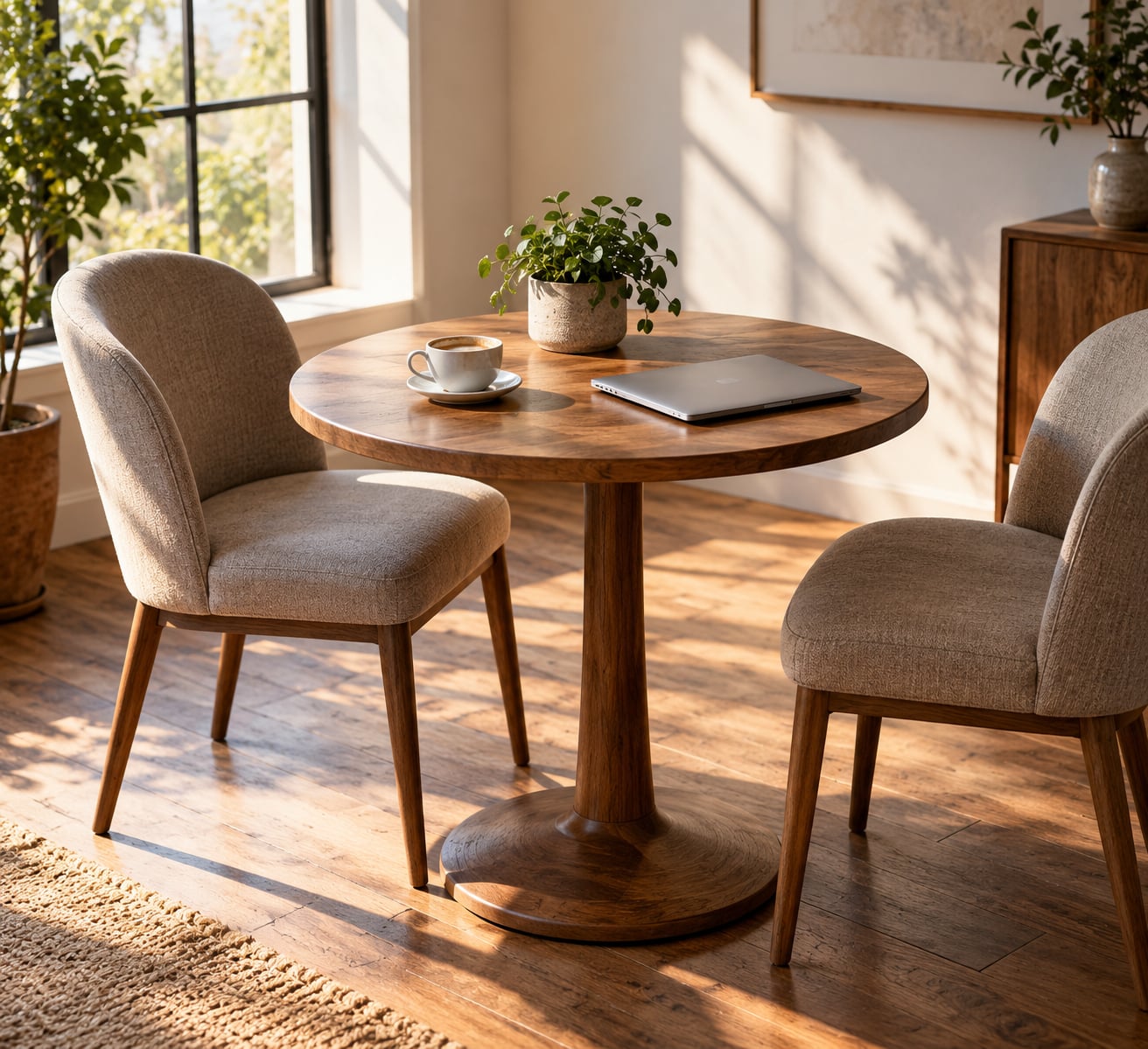
Two people talking need a table roughly the size of a dinner table, chairs with backs and arms, and about a metre of clearance to the next table. Banquettes and sofas are the best seats in the room because a low back blocks some of the noise around you. Small two-tops along a wall work well; bar stools and window ledges do not.
The geometry of a room decides whether people socialise in it. A regular on r/Coffee described the cafes where they actually spend time with people as the ones “with lots of small tables that are close together,” and the observation holds up: clustered small tables invite talk, while one long communal table with laptops quietly enforces solitude.
Outdoor seating works too, especially when the tables are well spaced and there is greenery around them — a r/Sacramento recommendation praised a big patio with spaced-out tables for exactly this reason. Check the street before you sit down. A sidewalk table beside a bus stop is a different experience at 3pm than at rush hour.
Ask about time, service, and table policies
Ask directly and politely at the counter: “Do you have a time limit on tables when it’s not busy?” It is a normal question and it is answered normally. People do it constantly — one thread on r/CambridgeMA simply noted that a cafe with plenty of seating means “no problem loitering there for hours.” Plenty of seating is a proxy for tolerance.
Establish the service style too. If nobody comes to the table, you are going to queue at the counter every forty minutes, and that breaks a conversation more thoroughly than noise does. Find out when the kitchen closes, whether a second drink is worth ordering, and whether tipping is expected.
If the answer changes once you are seated — a time limit appears, the room fills, a host circles — take it as information about the venue rather than about yourself. Move on if the sign was clear enough to act on.
Confirm lighting, privacy, and interruptions
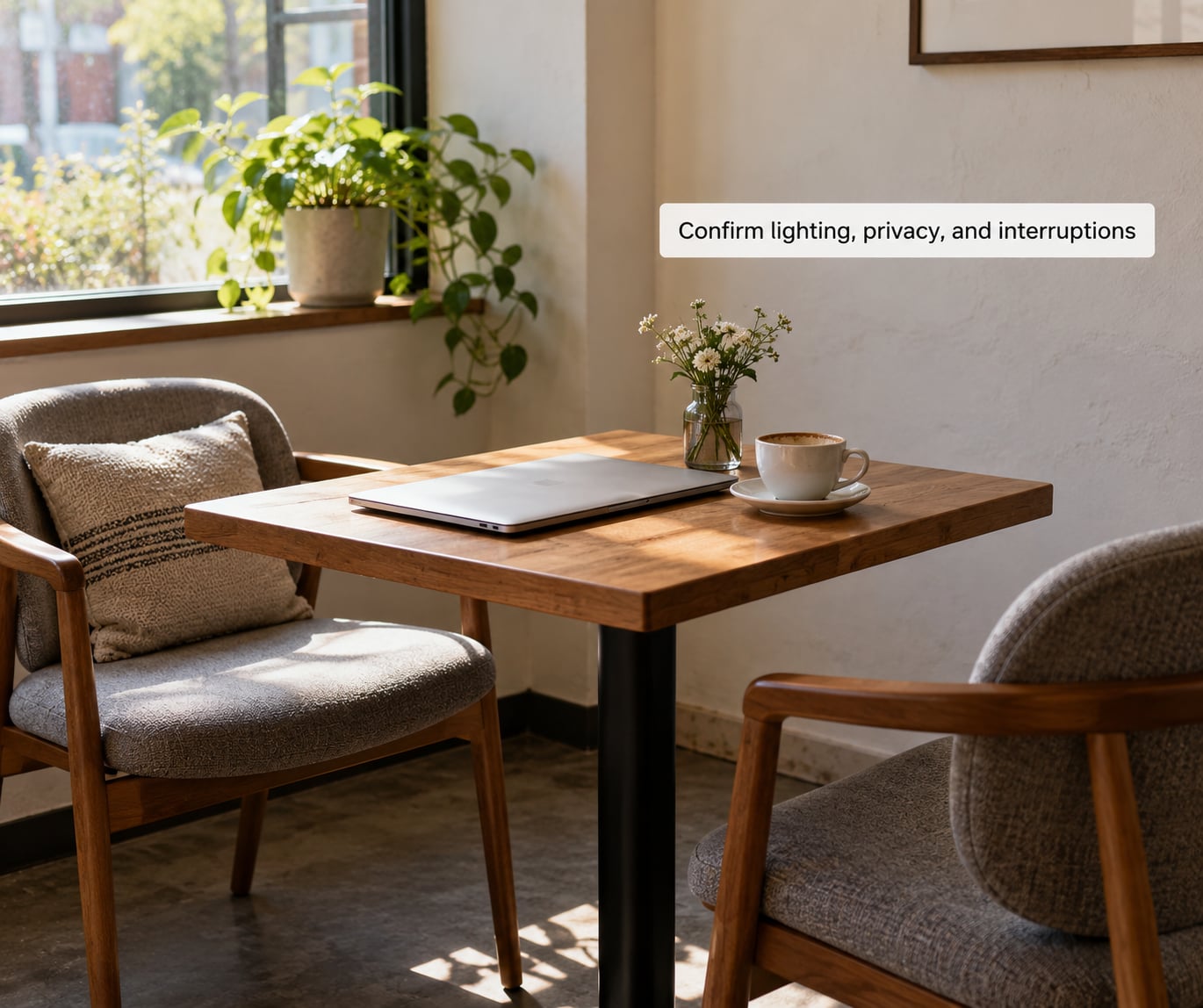
You do not need silence, and you should not chase it. What you need is a room where both of you can hear without leaning, see each other without a glare, and look private enough to say the awkward part.
Check four things from the doorway: whether the light is warm and low rather than a single overhead spot, how close the nearest table is, whether the door or a delivery route puts staff in your eyeline, and whether anything runs behind the seats. A corner banquette with a wall behind it and no server path across it is the best seat in most rooms.
Shared tables are fine for two or three people and awkward for four. Outlets matter far less here than they do for working, because a charger in the wall is actually a small negative sign — it means the room was designed for laptops rather than talking.
Make and test the first visit
Plan the first visit as a test rather than as the event. Arrive on time, stand inside for a minute and listen, then choose a seat based on what you hear rather than on where the light looks nicest in a photograph. Most rooms have one zone that works and one that does not.
Settle in for ten minutes before judging. Staff greet regulars, background music settles to a lower volume, and the mid-morning rush either arrives or does not. If the room stays loud after fifteen minutes, move: shift to a sofa, move away from the counter, or go to the back room or patio if there is one.
If nothing works, treat it as useful information about the neighborhood rather than a bad afternoon. Move one door down and try again, or shift the plan to a quieter hour. Plenty of people discover the good cafe this way, by walking the block and listening through the glass.
Common Mistakes
Choosing from photos. Every interior photograph is shot with an empty room and no music. Read the room in the map’s customer photos instead, where the tables are full and the lighting is honest.
Reading the cafe at the wrong hour. A quiet 9am and a packed 12:30pm can be the same room with a completely different conversation. Check the listing’s busiest-hours graph and go just before or well after the peak.
Assuming quiet means good for talking. It does not. A near-silent room with hard surfaces makes every word audible and every pause long, while a softly buzzing room with upholstered seating is easier to talk in. Aim for the hum, not the hush.
Overlooking shared tables and tight spacing. If every chair is 30cm from the next conversation, you will hear three other people’s conversations for two hours. Check the clearance before you commit.
Ignoring the table policy. Nobody enjoys being asked to move. Ask about time limits before ordering, and if the cafe has a rule, pick the venue without one for the longer sit.
Skipping the food menu. Ordering a second drink or a small plate is normal in a sit-down cafe and gives the staff a reason not to wonder about you. Cafes with a full menu and a late kitchen are the safest place to stay awhile.
Two habits help more than anything else: treat being greeted by name as a good sign, because staff who recognise you tend to check on you less, and keep a second cafe in mind as a backup. Having somewhere else to go removes the anxiety that makes a long visit uncomfortable for everyone.
Frequently Asked Questions
How quiet should a cafe be for a long conversation?
Aim for the sound of a busy restaurant where you can talk across the table at a normal conversational volume without leaning in. Total silence is not the goal. A near-empty room with hard surfaces and low lighting makes every pause feel long and pushes people to speak quietly, which is worse for a real discussion. If you have to raise your voice for the person opposite to hear you clearly, it is too loud for the conversation you planned.
What is the best time to visit a cafe for a relaxed conversation?
Just after opening, and the mid-afternoon gap between the brunch crowd and the after-work crowd, are the two most reliable windows in almost every city. Both give you a full room of regulars, low music volume and staff who are not sprinting. Avoid the ninety minutes either side of the lunch and dinner peaks, when queues, blenders and delivery traffic make sustained talking impossible. Check the listing’s busiest-hours graph before you commit to a time.
Can I stay at a cafe for two hours if I keep ordering?
Usually yes, in a sit-down cafe with table service and a food menu, especially if it is not peak hours. Ordering a second drink or a small plate is normal and removes any awkwardness about a long stay. Small two-tops and bar seating often carry a shorter informal expectation than large communal tables. If you expect more than about two hours, ask at the counter when you order rather than after you have already settled in.
How can I tell whether a cafe will be crowded on a particular day?
Check three things before you travel. The map listing’s busiest-hours graph shows the shape of a typical day and how it shifts by weekday. Recent reviews, sorted by newest, usually mention a rush by day and time. Weather matters too: rain and cold push people indoors and spike foot traffic. If you can arrive twenty minutes before the predicted peak, you will get a quieter room and a better table.
What kind of seating is best for talking at length?
A banquette or sofa with a low back gives you both a comfortable seat and a bit of acoustic cover, and it suits two to three hours better than almost anything else. A small two-top for two people works well if there is roughly a metre of clearance to the next table. Avoid bar stools, window ledges and communal tables, which are built for short stops or solo work rather than two people facing each other for hours.
What should I do if the cafe becomes too noisy after I arrive?
Move before you settle. Shift away from the counter and the door, take a sofa or banquette seat along a wall, or move to a back room or patio if one exists, and give it ten minutes to settle down. If the room stays loud, pay for what you have had and walk to the next cafe — most blocks have several. Staying and straining to be heard for two hours wears on both people far more than a second coffee does.
Conclusion
Start by naming the conversation: how long it runs, and how much privacy it needs. Then check the two things that decide the outcome — noise at the hour you plan to arrive, and whether there is soft seating with space around it. Confirm the table policy with one question at the counter, and you have done the work.
Before you sit down, remember five things. Listen for a hum rather than silence. Sit on a banquette or sofa, not a stool. Keep clear of the counter, the door and the machine. Arrive just before or well after the peak. Order a second drink if you are staying awhile.
If your first choice is packed when you get there, walk one door down rather than waiting it out. Blocks are full of near-identical rooms, and the second one is often better than the one you planned for.