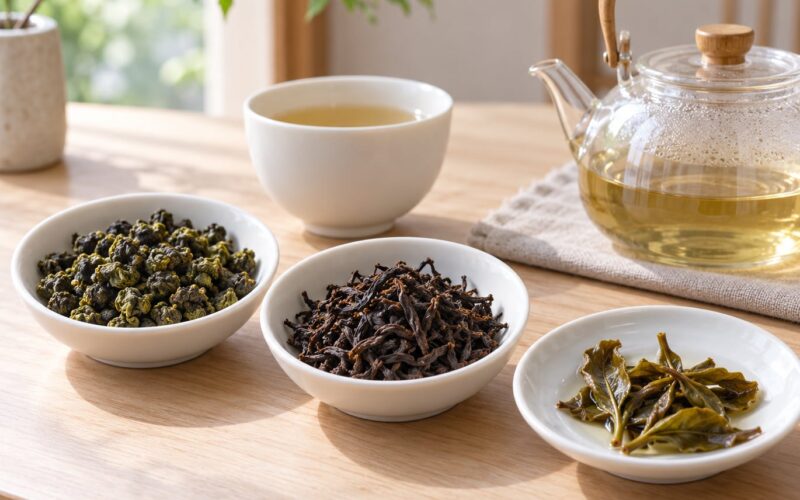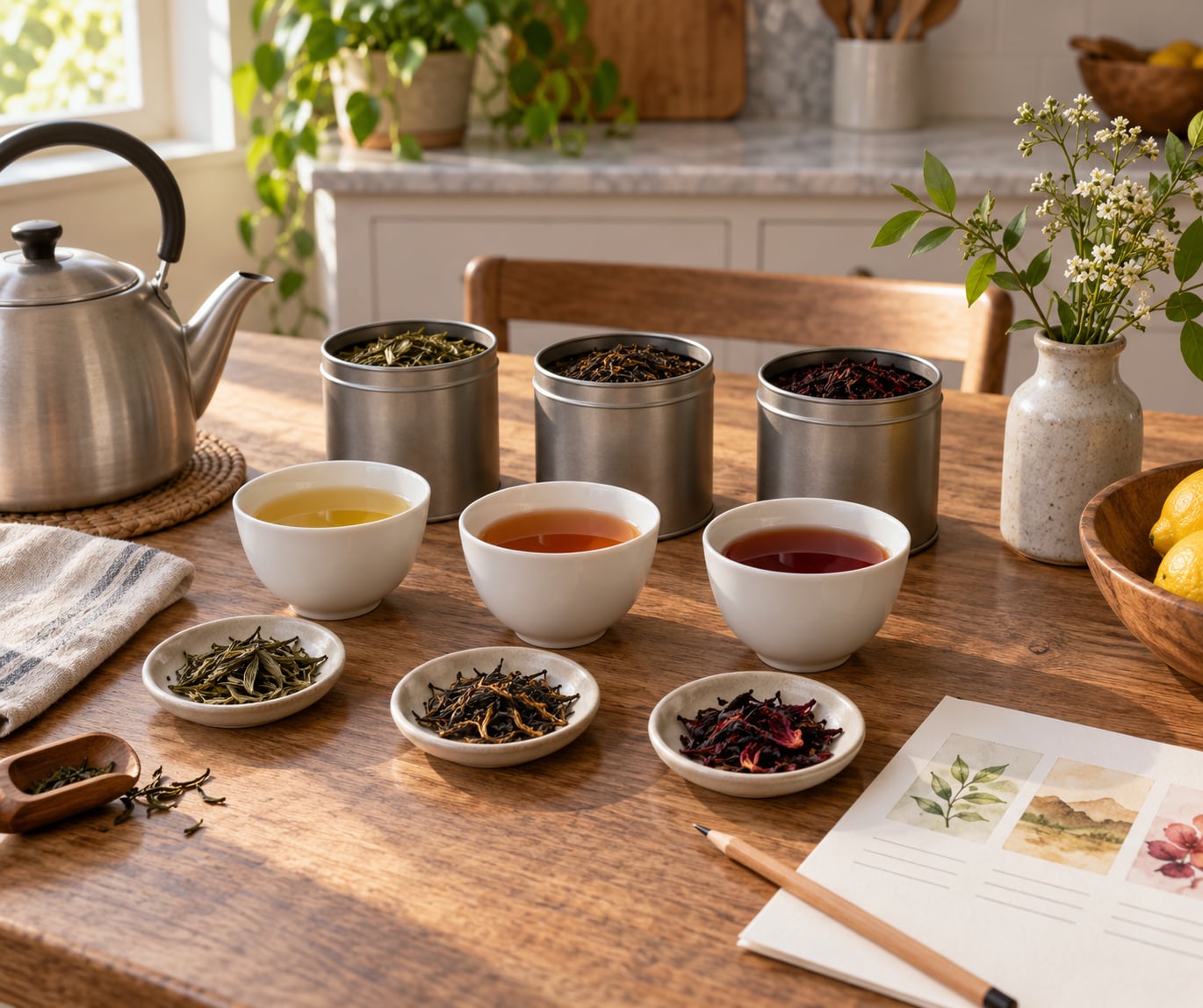
To plan a tea tasting at home with friends, serve three to five contrasting teas to four to eight guests and give the whole session about 90 minutes. Pick a theme, brew every sample with the right water temperature and steeping time, pour into identical white cups, and have everyone write tasting notes before you compare. The tricky part is not choosing tea. It is the logistics: water at two temperatures at once, enough cups to rinse between samples, and a snack that stays out of the way.
Host on a Saturday or Sunday afternoon, set the table before anyone arrives, and give yourself 20 minutes of prep time per tea. That is a normal home evening that happens to have a method to it, and it is far less demanding than it sounds. As of 2026, most hosts I know get the most out of a tasting by keeping it small, going in a fixed order, and never serving more than five cups per person.
Table of Contents›
- What You Need
- Equipment and tea, with quantities per four guests
- Step-by-Step: How to Plan a Tea Tasting at Home With Friends
- 1. Choose a Tea Theme and Number of Samples
- 2. Invite Friends and Set the Expectations
- 3. Prepare the Tea, Water, and Tasting Space
- 4. Brew Each Sample Consistently
- 5. Guide the Tasting and Record Impressions
- 6. Finish with Pairing, Conversation, and a Group Favorite
- A 90-Minute Run of Show
- Common Mistakes
- Serving too many teas
- Brewing everything at one temperature
- Skipping the palate cleanser
- Judging aroma after the tea has cooled
- Serving strongly flavoured food
- Treating tasting notes like a pass-or-fail test
- Frequently Asked Questions
- How many teas should I serve for an at-home tasting?
- Should I use loose-leaf tea or tea bags?
- Do I need a thermometer to brew tea for friends?
- What food should I serve with a home tea tasting?
- How long should a tea tasting with friends last?
- Do I need special tasting cups to get started?
- Conclusion
What You Need
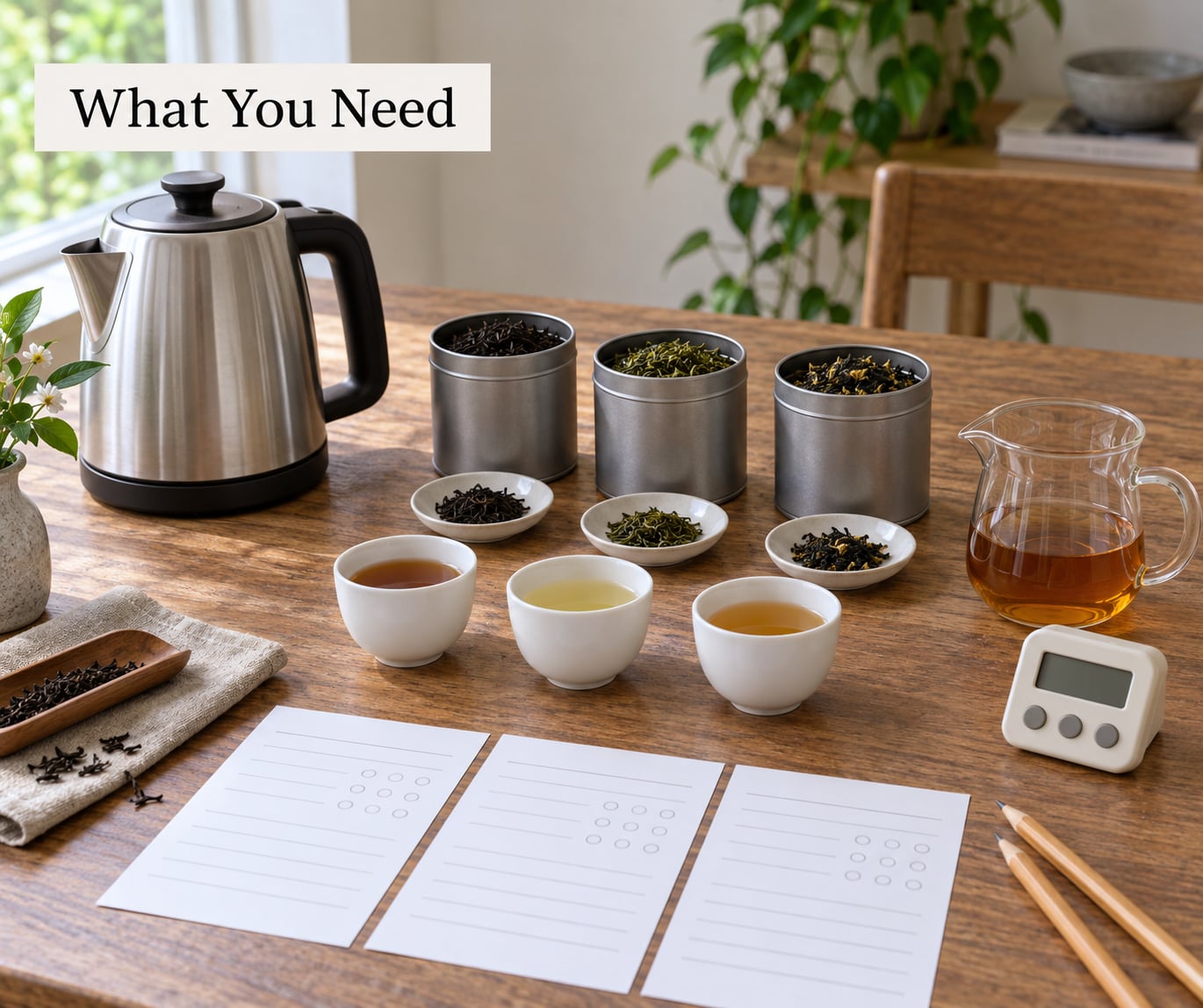
Most of this list is already in your kitchen. The two things worth buying fresh are plain white cups and a small timer, because colour comparison and consistent steeping are the parts beginners skip and then wonder why nothing tastes different.
Equipment and tea, with quantities per four guests
- Kettle: one standard kettle plus a second one if you plan to brew a light tea and a dark tea within the same 15 minutes. Fill and heat both the night before and leave them covered.
- Thermometer or a printed temperature guide: a cheap kitchen thermometer on an instant-read, or a chart taped inside a cabinet. Guesswork is the number one reason a home tasting falls flat.
- Timer: a phone timer with labels, one per tea type, so nobody has to ask what started when.
- Tasting cups: 3 small white ceramic cups per guest, plus 2 spare. White and unglazed on the outside so the liquor colour reads true. Avoid scented or perfumed teaware, which carries detergent and floral notes into every cup.
- Small pitchers or one pouring carafe: 3 pitchers, one per tea, so you can pour samples without shuffling cups around the table.
- Tasting notes and pencils: index cards or a single printed sheet per guest with one row per tea. A simple template: name, colour, aroma, taste, finish.
- Water: fresh, cold, potable tap water or filtered water. Water that tastes of chlorine or sits too long kills delicate green and white teas. Do not use hot tap water.
- Palate cleanser: plain water at room temperature and neutral crackers or plain bread. That is all you need.
- Tea: 3 to 5 teas, roughly 10 g per tea for four guests. Buy 15 g if you are running a blind tasting with a sample you might have to re-steep.
Step-by-Step: How to Plan a Tea Tasting at Home With Friends
1. Choose a Tea Theme and Number of Samples
Three to five samples is the sweet spot. Fewer than three and there is nothing to compare against, so the afternoon becomes drinking tea rather than tasting it. More than five and the nose gives up: by the sixth cup your guests can no longer tell whether an aroma is a real difference or the ghost of the last one they smelled. That is palate fatigue, and it is the reason experienced tasters stop at three or four even when the lineup is exciting.
Pick one of five easy flights and stop there:
- Green tea flight: a pan-fired Chinese green, a Japanese sencha, and a roasted hojicha. Big aroma differences, forgiving to brew.
- World tea flight: an Assam, a Darjeeling, a sencha, and a chamomile tisane. The easiest sell to guests who are not yet tea drinkers.
- One type, many grades: three grades of the same oolong, or three black teas from one region. This is the flight that teaches the most.
- Same tea, different brew: one black tea at 2 minutes, 3 minutes, and 4 minutes. Surprisingly the most talkative flight there is.
- Rainbow flight: white, green, oolong, black, plus a tisane. Five samples, and the widest spread of colours in the cups.
Whatever you choose, buy from one or two sellers so the quality is consistent. One weak sample makes the whole afternoon feel like homework.
2. Invite Friends and Set the Expectations
Four to eight people is the workable range, and that ceiling is about room, not tea. Beyond eight people the conversation breaks into side conversations and nobody hears the person who just smelled something interesting. Invite two more than you want if the evening is more social than serious, and none more.
In the invite, say what it is and say it plainly: we are going to brew five teas side by side and compare them. Nothing is being tested and there is no wrong answer. Ask any two hosts and you will hear the same thing, that logistics rather than tea choice is the hard part of a home tasting, and the invitations that name the format are the ones that turn up eight people who actually engage.
Ask about caffeine before the day rather than on it. Include one caffeine-free option, such as rooibos or a mint tisane, brewed at the same 212°F as the black tea and poured last so nobody is handed the mild one by mistake. If someone dislikes tea entirely, roasted and smoky profiles read as coffee-adjacent, and a decaf or herbal cup gives them something to hold without singling them out.
3. Prepare the Tea, Water, and Tasting Space
Measure the leaves the day before, one pile per tea, roughly 10 g each, and label them A, B, C so you are not choosing mid-session. If you are doing a blind tasting, leave the tins out of sight entirely. One hour before, bring out plain white cups, one pitcher per tea, water, crackers, and a jug of room-temperature water for rinsing.
Set the tasting order from lightest to most robust: green and white first, then oolong, then black, then pu-erh, with the herbal last. Light teas have delicate aromas that heavy ones will smother, and once you go strong you cannot go back. Rinse cups and pitchers with hot water and dry them before the first pour, because a wet cup dilutes the first sip.
Skip scented candles, floral air fresheners, and heavily scented hand soap. Every one of those shows up in the aroma of the tea, and guests will describe what they smell in the room rather than what is in the cup.
4. Brew Each Sample Consistently
Consistency is what makes a tasting fair. Use the same water, the same leaf weight, and the same steep time for every cup of a given tea, and pour equal amounts so nobody gets a full cup and nobody gets a teaspoon of coloured water.
| Tea type | Water temperature | Steeping time | Leaf per 8 oz |
|---|---|---|---|
| White tea | 200 to 205°F | 4 to 5 min | 2 g |
| Green tea | 175 to 185°F | 2 to 3 min | 2 g |
| Oolong | 190 to 195°F | 3 to 4 min | 3 g |
| Black tea | 200 to 212°F | 3 to 4 min | 2 to 3 g |
| Pu-erh | 212°F, rinse first | 3 to 4 min | 4 g |
| Herbal or rooibos | 212°F | 5 to 7 min | 3 g |
If you are running green and black in the same session, boil one kettle, pour it into a second jug, and let the jug cool for eight minutes. That gives you two temperature bands without two kettles on the stove, and it is the detail that separates a smooth afternoon from a scramble.
Brew each tea to a little more than the amount you need for the table, and hold the pot. If a guest wants more, a second and third infusion from the same leaves is a highlight rather than a failure, especially for oolong and pu-erh.
5. Guide the Tasting and Record Impressions
Walk the group through the same six steps for every sample. It takes about four minutes per tea and it stops the session turning into a lecture.
- Look at the dry leaves. Pass the tin around before brewing. Sniffing the dry leaf is the opening ritual most hosts enjoy most, and it sets expectations before the first sip.
- Look at the liquor. Hold the cup to a window. Note colour and clarity, then set it on a white saucer so guests can see how it lightens as it cools.
- Smell the wet leaf and the cup. Before sipping, inhale the steam and the empty cup. Do this with every tea, and do it early, while the cup is still hot enough to carry aroma.
- Slurp the first sip. Slurping aerates the tea and spreads the taste over more of the tongue. It looks undignified and works. Say so once, or your guests will feel silly and quietly skip it.
- Take three more sips. First sip is aroma, second is body, third is finish. Let each sample go cold and taste it again, because the finish changes as the tea cools.
- Write two words before anyone talks. Private notes first, then discussion. This stops the first loudest opinion from setting the table’s verdict.
Have everyone name their favourite at the end, out loud, with a reason. Nobody declares a universal winner. You will hear one person describe a green tea as grassy and another as soapy, and both of those are the same aroma read by two different noses, which is exactly the point of doing it with friends.
6. Finish with Pairing, Conversation, and a Group Favorite
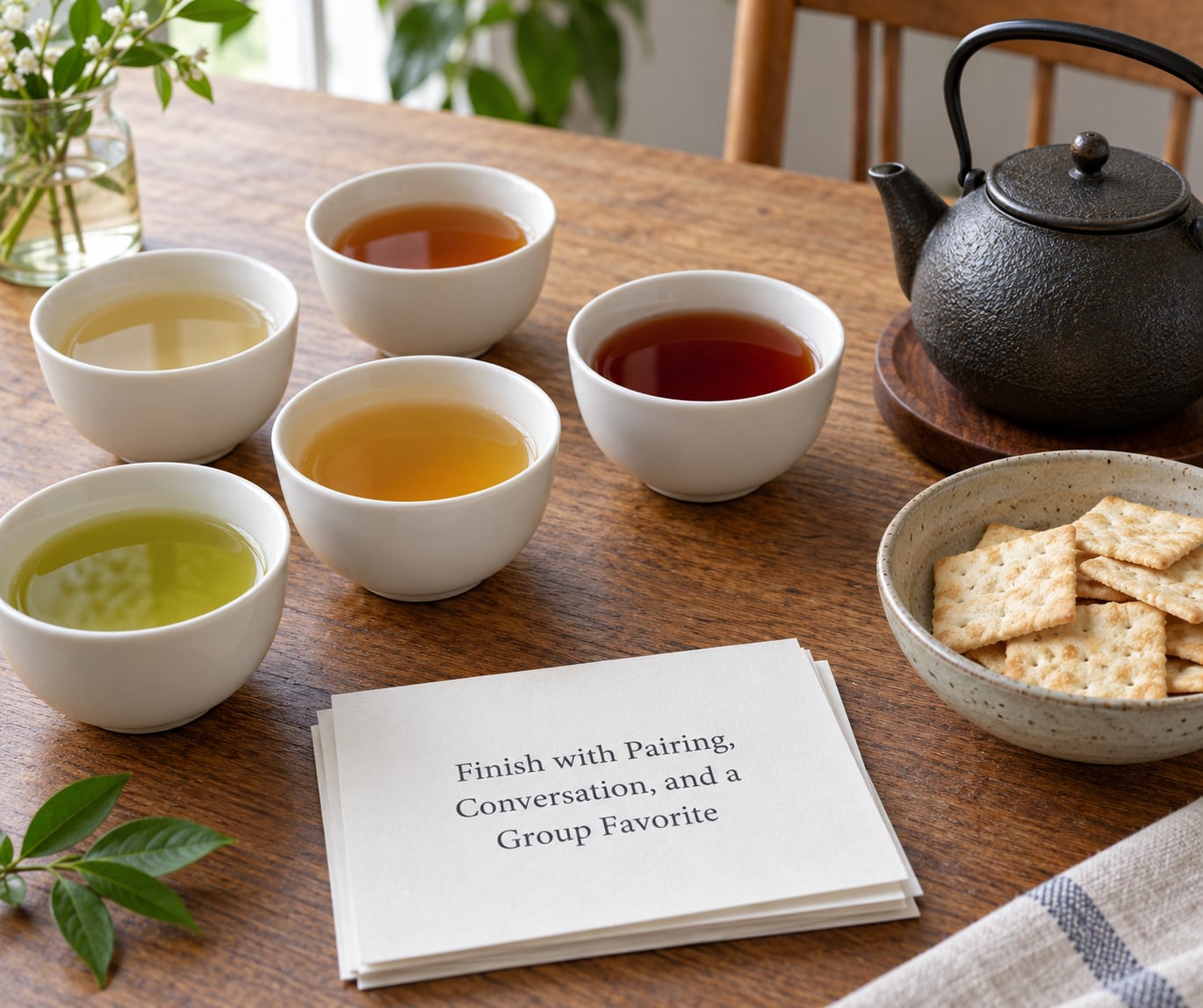
Compare the sheets at the end. Each guest announces their favourite and one reason for it, and the host writes the choices on a single sheet that everyone photographs before it goes in the bin. It sounds gimmicky and it is the most reliably good part of the evening, because it turns a private opinion into a small group conclusion.
Serve food that stays quiet: plain crackers, mild cheese, cucumber, oatcakes, a bowl of unsalted popcorn. Strongly flavoured food, chocolate, and heavily spiced bites all reset the palate, and a guest who eats a curry before sample three will score everything the same. Green tea and plain water work as free cleansers between pours.
Let the last 15 minutes run without structure. People keep pouring, refilling cups, and comparing notes while the kettle goes cold again, and that unstructured tail is usually when the real conversation happens.
A 90-Minute Run of Show
- 0 to 10 min: everyone seated, water and crackers poured, dry leaves passed around, sheet explained.
- 10 to 30 min: samples one and two, brewed back to back, about 8 minutes each including discussion.
- 30 to 55 min: samples three and four, same rhythm, with a water rinse between.
- 55 to 70 min: sample five if you have one, otherwise re-steep the best leaf from the flight.
- 70 to 90 min: favourites, reasons, and one photo of the finished sheet.
Add 20 minutes of setup and 20 minutes of cleanup and you are looking at roughly two and a half hours of your Saturday. That is the honest number most guides leave out.
Common Mistakes
Serving too many teas
More than five and aromas blur together until everyone tastes the ghost of the first cup. Fix: cap the flight at five and let the leftovers go into a second round another day.
Brewing everything at one temperature
Boiling water scorched green and white tea, and cool water leaves black tea flat and thin. Fix: use the table above, and split your kettles into two temperature bands before guests arrive.
Skipping the palate cleanser
Without crackers and plain water between samples, the fourth tea tastes like the third. Fix: keep a jug of room-temperature water on the table and refill it every round.
Judging aroma after the tea has cooled
A cup that has gone lukewarm smells of nothing. Fix: smell the dry leaf, the wet leaf, the steam, and the empty cup, in that order, while the tea is still hot.
Serving strongly flavoured food
A single piece of dark chocolate or a spiced biscuit flattens everything after it. Fix: neutral crackers, plain bread, or mild cheese, and nothing with chilli, citrus, or smoke.
Treating tasting notes like a pass-or-fail test
Somebody says grassy, somebody says fishy, and the room goes quiet. Fix: remind everyone that tasting notes are descriptions, not verdicts, and disagreement is the useful part.
Two more small things that help. Never ask a guest to guess the origin or the price. And put the leftover leaf in a labelled tin afterwards, because the question that comes at the door on the way out is always whether they can take some home.
Frequently Asked Questions
How many teas should I serve for an at-home tasting?
Serve three to five teas. Three is the minimum that lets guests compare, and five is about the point where the nose starts blending one aroma into the next, which is called palate fatigue. If you want to show off a sixth tea, do it on a different day or serve it after the score sheets are handed in so nobody is judging it on a tired nose.
Should I use loose-leaf tea or tea bags?
Loose leaf gives you control over leaf quantity and steeping time, and it is easier to smell the dry leaf, which is half the fun. Bags are completely fine for beginners, though. Pick bags of whole-leaf or large-leaf tea rather than dust-grade bags, and use one bag per cup instead of one per pot, so every guest gets an equal-strength sample.
Do I need a thermometer to brew tea for friends?
A thermometer helps, but a printed chart taped inside a cabinet works nearly as well. The temperatures that matter are roughly 175°F for green, 195°F for oolong, and 212°F for black tea, herbal, and rooibos. If you have neither, boil the water, pour it into a second jug, and wait eight minutes for the middle band. Guests will not notice the difference.
What food should I serve with a home tea tasting?
Serve food that stays neutral: plain crackers, oatcakes, mild cheese, cucumber, and unsalted popcorn. Keep room-temperature water on the table as a cleanser between samples. Avoid chocolate, chilli, strong spices, and anything with citrus, because those flavours flatten the taste buds and every tea after them starts to look the same.
How long should a tea tasting with friends last?
About 90 minutes for five teas with four to eight guests, plus roughly 20 minutes setting up and 20 minutes cleaning up. Allow eight minutes per sample, including the pouring, the sniffing, the sipping, and the short discussion. The final 15 minutes run without structure, and that is usually the part people remember most.
Do I need special tasting cups to get started?
No. Any small, plain, white cup works, and a clear glass works too if you want the colour. What you want to avoid is scented or perfumed china, floral patterns, and heavily scented soap, because those smells read as tea aroma and confuse everyone’s notes. Budget for three cups per guest plus two spares, so you can rinse between samples.
Conclusion
Start smaller than feels generous. Choose three contrasting teas, set out plain white cups and a printed tasting sheet, heat the water, and pour the lightest sample first. Once the group has compared one, the rest takes care of itself. Adjust the number of guests and the food to suit your friends, and let the method stay the same.