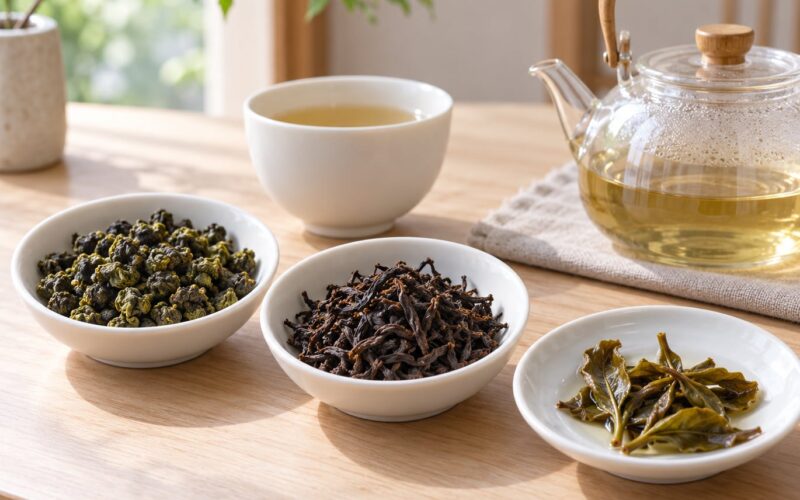
There is no single right answer, which is why this question causes so much argument. Green tea is best at 70-85°C (158-185°F), white tea at 75-90°C (167-194°F), oolong at 85-95°C (185-203°F), black tea at 85-95°C (185-203°F), pu-erh and herbal infusions at 90-100°C (194-212°F), and matcha at 70-80°C (158-176°F). Too hot pulls out bitterness and drying astringency; too cool leaves a thin, grassy cup that tastes like warm water with a leaf floating in it.
Every tea shop, brewer blog and forum thread gives you a different number for the same tea. Most of them are not wrong, they are answering slightly different questions. Some are talking about the water in the kettle, some about the water as it lands on the leaf, and some about the finished cup in your hand.
This guide fixes that by giving you one reference chart, then explaining what the numbers mean and how to adjust them when the cup tastes wrong. Every temperature here is a starting point, not a rule. A miss of a few degrees barely registers; a miss of fifteen degrees is the difference between a lovely cup and a ruined one.
Table of Contents›
- What Water Temperature for Each Type of Tea?
- How Does Water Temperature Change Tea Brewing?
- What Water Temperature for Each Type of Tea by Style?
- Green tea temperature
- White tea temperature
- Oolong tea temperature
- Black tea temperature
- Pu-erh temperature
- Herbal, rooibos and maté temperature
- Matcha temperature
- Varietal breakpoints inside each family
- What Water Temperature for Each Type of Tea Should You Use for Loose Leaf vs. Bagged Tea?
- How to Adjust the Temperature When Your Tea Tastes Bitter or Weak
- Frequently Asked Questions
- What water temperature is best for tea?
- Is 200F too hot for tea?
- Does boiling water make tea bitter?
- Do I have to boil the water first and then cool it?
- Should I preheat my teapot and cups?
- Does hot water extract more caffeine from tea?
- Conclusion
What Water Temperature for Each Type of Tea?
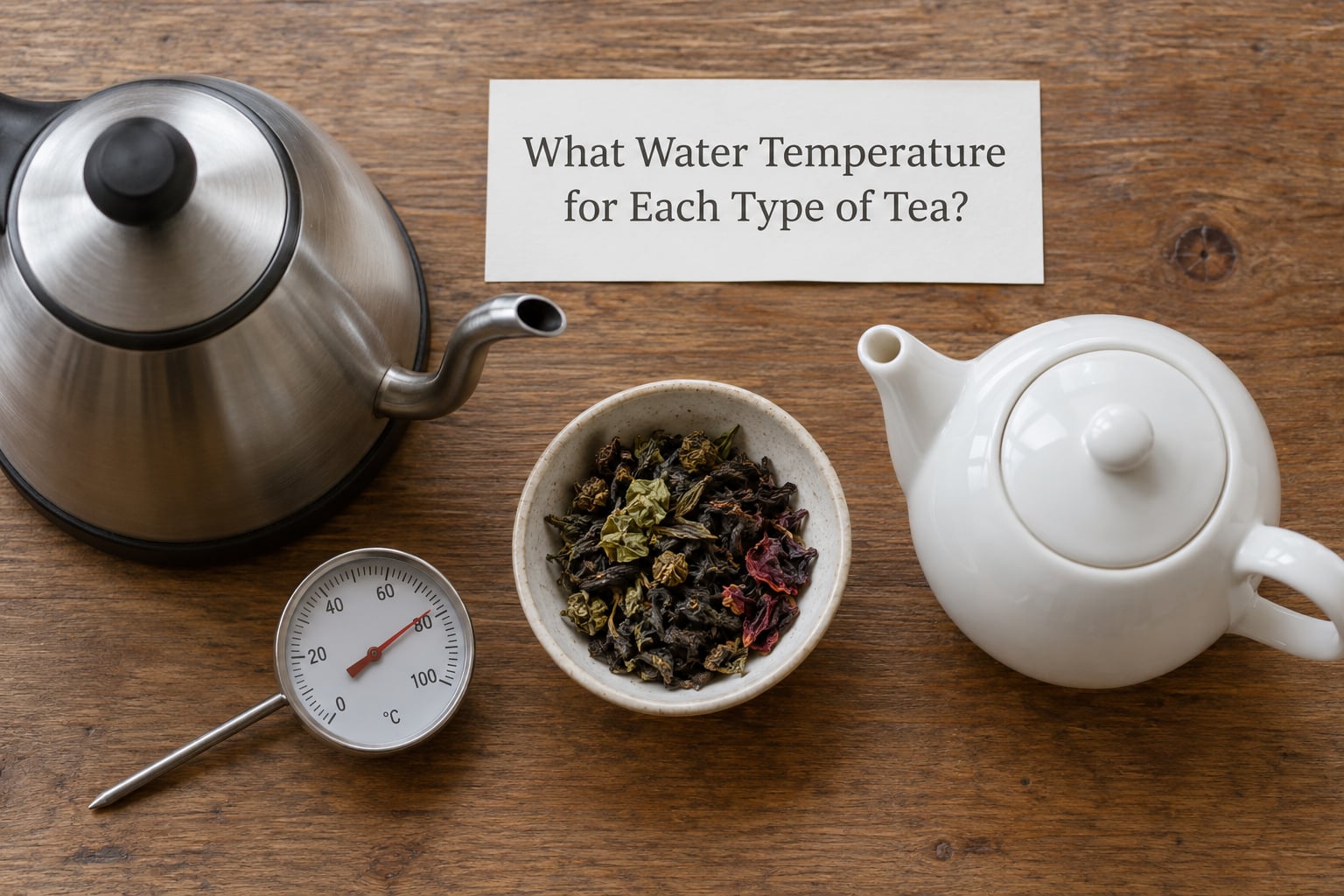
Here is the short version. The temperature column is the water as it hits the leaf. The wait column is what to do with an ordinary kettle that only boils.
| Tea type | Temperature | Steep time | Wait after boiling |
|---|---|---|---|
| Green tea | 70-85°C (158-185°F) | 60-90 seconds | 2-4 minutes |
| White tea | 75-90°C (167-194°F) | 2-4 minutes | 3-4 minutes |
| Oolong tea | 85-95°C (185-203°F) | 45-90 seconds | 1-2 minutes |
| Black tea | 85-95°C (185-203°F) | 2-4 minutes | 1-2 minutes |
| Pu-erh (ripe and raw) | 90-100°C (194-212°F) | 10 seconds to 5 minutes | Use straight from the boil |
| Herbal, rooibos, maté | 90-100°C (194-212°F) | 5-10 minutes | Use straight from the boil |
| Matcha | 70-80°C (158-176°F) | Sieve, then whisk | 4-5 minutes |
Two notes on reading that chart. First, the steep times assume roughly two grams of leaf per 200ml of water for a western-style brew. More leaf means shorter steeps. Second, black tea sits at the same range as light oolong because the leaf is broken and oxidised, so it gives up its contents fast.
For a beginner with no thermometer, the phrase that gets quoted most on forums is worth learning by heart: boil, then wait. Water at a rolling boil is 100°C (212°F), and it loses temperature at a predictable rate in an open jug.
How Does Water Temperature Change Tea Brewing?
Hot water is a solvent, and it dissolves different compounds from the same leaf at different speeds. Temperature decides which ones arrive first and in what proportion.
The compounds that give tea its sweetness and savoury depth are amino acids, chief among them L-theanine. These dissolve readily, even in water around 50°C (122°F). The compounds that give tea bitterness and the drying mouthfeel known as astringency are catechins, including EGCG, plus caffeine and other polyphenols. Those need more heat and more time to leave the leaf.
So when you push the temperature up, bitterness and astringency arrive faster and eventually overwhelm everything else. When you drop the temperature down, you get sweetness and umami first, then the cup just runs out of extraction and tastes thin. Neither end is wrong, they are just different drinks. Cold brewing green tea sits at the low end deliberately, pulling sweetness with almost no bitterness.
Aroma compounds follow their own rule. The volatile oils that give a green tea its fresh, marine note or an oolong its orchid top note start escaping the leaf at around 60-70°C (140-158°F). Boiling water drives most of them straight out of the pot and up the wall, which is why over-boiled tea tastes flat and dull even before bitterness sets in.
Two practical variables sit on top of all this. The first is the vessel. A cold porcelain pot can drop the water you carefully measured by ten degrees or more in the thirty seconds it takes to steep. Preheat the pot and the cups with a little of your hot water, tip it out, then brew. A thicker cast iron pot holds heat far better and forgives more; thin glass and porcelain drop fast.
The second is pouring. Water cools in the air on the way from kettle to pot, and it cools again in transit down to the cup. That is why experienced drinkers aiming for a 80°C steep often set the kettle higher, and why pouring from a height is a legitimate cooling trick rather than a myth.
What Water Temperature for Each Type of Tea by Style?
Green tea temperature
Green tea is the least oxidised tea and the most fragile. Its brewing window is also the widest, from about 50°C (122°F) for the very best shaded tea to 85°C (185°F) for the rolled, roasted kinds.
White tea temperature
White tea is barely oxidised at all and the buds are tender, so it wants cooler water than most people give it. Experienced drinkers do brew mature, large-leaf white teas close to the boil, and they are usually right for those particular teas. Bud-heavy teas like silver needle do not take that at all.
Oolong tea temperature
Oolong sits in the middle, and how far up the middle depends on how roasted it is. Light, floral oolong wants the lower end. Roasted rock oolong and dan cong want the top. Under-brewing a light oolong gives you a thin, watery cup with no aroma; boiling a roasted one flattens the stone fruit and roasted notes that make it worth drinking.
Black tea temperature
Black tea handles heat well, which is why it is the easiest tea to brew. Give it water a few degrees below the boil and a short steep and you get a clean, bright cup with the astringency that makes it taste like tea rather than like warm fruit juice.
Pu-erh temperature
Pu-erh takes boiling water without complaint, and for a good reason: it is post-fermented and already broken down. Ripe pu-erh can take several minutes and even a rinse first. Raw pu-erh is fussier, and near-boiling water for a short steep suits it better than a long soak.
Herbal, rooibos and maté temperature
Tisanes have no leaf structure to protect and no delicate aromatics to lose, so boiling water is genuinely the right answer. The exception is any herb or spice blend with a floral or citrus top note, which tastes dull at a full boil. Rooibos and maté both take boiling water happily.
Matcha temperature
Matcha is a suspension rather than an infusion, so the usual rules change. Too hot and you scorch the powder into a bitter, flat paste instead of a smooth one. Water around 70-80°C (158-176°F) is where the sweetness comes through, and a milk latte can go a little lower again.
Varietal breakpoints inside each family
These are the specific temperatures that get people searching. They matter most if you buy the same style repeatedly rather than drinking whatever is in the cupboard.
| Tea | Temperature | Why |
|---|---|---|
| Gyokuro (shaded Japanese green) | 50-60°C (122-140°F) | Cool water protects the umami |
| Sencha (steamed Japanese green) | 70-75°C (158-167°F) | Sweetness and grass without harshness |
| Gunpowder, long jing (rolled green) | 80-85°C (176-185°F) | Tightly rolled leaves need more heat |
| Bai hao yin zhen (silver needle) | 75-80°C (167-176°F) | Downy buds scald easily |
| Shou mei (mature white) | 90°C (194°F) and up | Bigger leaves stand up to heat |
| Tie guan yin (floral oolong) | 85-90°C (185-194°F) | Low enough to keep the lilac notes |
| Wuyi yancha (roasted oolong) | 90-95°C (194-203°F) | Roasting needs the heat to open up |
| First flush Darjeeling | 80-85°C (176-185°F) | Delicate, floral, easily cooked |
| Assam or Ceylon | 90-95°C (194-203°F) | Malt and body need real heat |
| Chinese black (hong cha) | 85-90°C (185-194°F) | Sweet and malty without going harsh |
What Water Temperature for Each Type of Tea Should You Use for Loose Leaf vs. Bagged Tea?
The format changes your starting point more than most guides admit. A tea bag is a fixed dose of mostly broken leaf, so it extracts faster and wants a shorter, cooler steep. Loose leaf, especially rolled or whole, needs a little more heat and usually more time to open up.
Start with bagged tea at the low end of the range for its family and pull it early. Try a minute less than the chart suggests. Loose leaf can usually take the upper half of the range without trouble, and small broken-leaf black tea poured straight into a warmed pot takes boiling water fine.
There is a bigger difference between brewing methods than between formats. A western-style brew is one long steep in a pot, then milk or sugar if you want them. A gaiwan or a small gong fu pot is many short infusions, five to ten seconds each, with the leaf staying in the vessel between pours. The same oolong in a gaiwan usually goes slightly cooler than it would in a western pot, because the water is re-steeped many times and the leaf never gets a chance to sit and cook.
Ready-to-drink bottled tea and cold brew concentrate are a separate category again. Neither is a temperature problem. You dilute the concentrate and serve it cold, which is the one method that takes temperature entirely out of the equation.
Which brings up cold brewing, the legitimate zero-heat option. Green tea steeped in cold filtered water in the fridge for six to eight hours, at roughly one gram per hundred millilitres, gives a sweet, low-bitterness cup with no bitterness to correct for. If you have a sensitive palate or you simply do not own a kettle that hits 70°C, cold brewing solves both problems at once.
How to Adjust the Temperature When Your Tea Tastes Bitter or Weak
Two words get used interchangeably when they describe different sensations. Bitterness is taste, an unpleasant sharpness on the tongue. Astringency is texture, that dry, puckering feeling in your cheeks and gums. Green tea that has been over-steeped in hot water is usually bitter and drying at once. Black tea can be pleasantly astringent without tasting bitter at all.
When a cup goes wrong, change one thing. Not two. If you drop the temperature and shorten the steep at the same time, you have no idea which one fixed it, and you learn nothing for the next brew.
If the tea is bitter or drying: drop the water by about 5°C (9°F) and brew again, leaving everything else identical. Still bitter, drop another 5°C. If it is bitter but thin underneath, your leaf dose is probably too high rather than your water too hot, so cut the leaf instead.
If the tea is thin, grassy or sour: raise the water by 5°C (9°F), or add fifteen seconds to the steep. Sourness with no sweetness usually means under-extraction. Add a little more leaf before you add more heat, since more leaf fixes thinness without pushing you toward bitterness.
Fixing a cup you have already brewed: for bitterness, add a splash of hot water to dilute and lengthen it, or drop a few ice cubes in and drink it as cold brew. Milk also softens perceived bitterness in black tea and hides it in matcha, at the cost of the lighter aromatics you were chasing.
If the temperature was right and the cup still failed: look at the water. Very hard water flattens tea and dulls the aroma, and very soft water can make a delicate leaf taste thin and sour. Filtered or bottled water is the cheapest fix there is.
One myth worth dropping: discarding the first steep does not make the second one caffeine-free. Caffeine extracts at every temperature, including cold water, so a rinse reduces how much you drink overall, not how much caffeine is in what remains.
Two small habits do most of the work. Preheat the pot, and write down what worked. A note on the side of the tin reading 78°C, 70 seconds tells you more than any chart, because it describes your tea and your kettle rather than tea in general.
Frequently Asked Questions
What water temperature is best for tea?
There is no single best temperature, but most teas fall into a wide band. Green tea prefers 70-85C (158-185F), white tea 75-90C (167-194F), oolong and black tea 85-95C (185-203F), and pu-erh and herbal infusions a full boil at 90-100C (194-212F). Matcha wants the coolest water of all, around 70-80C. Treat every one of these as a starting point and adjust by a few degrees from there.
Is 200F too hot for tea?
200F (93C) is too hot for green, white and matcha, and just right for black tea, light oolong and rooibos. It will not make most black or herbal teas bitter. The teas it ruins are the delicate ones, where 200F scalds the buds and turns a sweet, grassy cup into something astringent. If you only ever brew one temperature, somewhere around 190F (88C) is the safest compromise.
Does boiling water make tea bitter?
It does for some teas and not others. Boiling water on sencha, gyokuro, silver needle or matcha over-extracts the bitter and astringent compounds while driving off the delicate aromas. On black tea, pu-erh, rooibos and most herbal infusions it causes no problem at all, and those teas are usually at their best straight from the boil.
Do I have to boil the water first and then cool it?
No. With a variable-temperature kettle you set the target directly and never boil. With a fixed boiling kettle you do have to start at a boil, then let it stand in an open jug. Two minutes gives roughly 95C, four minutes about 85C, and six minutes around 75C, though a cold room and a wide jug will speed that cooling down considerably.
Should I preheat my teapot and cups?
Yes, and it is close to free. A cold porcelain pot can drop the water by ten degrees or more during the first steep, which is often the reason a green tea brewed at the correct temperature still tastes harsh. Warm the pot and cups with a little of your brewing water, tip that out, then brew with fresh hot water.
Does hot water extract more caffeine from tea?
Yes, within reason. Higher temperature and longer contact both pull more caffeine into the cup, so a hotter brew contains more. But cold brewing extracts caffeine too, and discarding a first steep reduces the amount you drink overall without removing it from what is left. Very long steeps at high temperatures also pull heavy amounts of tannins, which is what most people actually dislike.
Conclusion
Start by naming the style rather than the tea. Green, white, oolong, black, pu-erh or herb tells you which row of the chart to look at, and the varietal tells you where inside that range to aim. From there, brew once, taste it, and change one thing at a time: five degrees, or fifteen seconds, or a slightly heavier scoop of leaf.
Write down what worked. Two or three sessions of that and you will know your own tea better than any chart does, which is exactly where everyone wants to end up anyway.