Good quality loose leaf tea has whole or only lightly broken leaves, an aroma that matches its type, slow expansion in the cup, and enough flavor to survive three or more infusions. Cheap tea is usually chopped fine, smells generic, and dies after a single steep. If you know how to tell good quality loose leaf tea from cheap tea, you can judge any tin in about ten minutes using your hands, nose, and one small pot.
You do not need a tasting table or a formal vocabulary. You need dry samples you can handle, a white cup or plate, water at the right temperature, and the willingness to brew a small amount and pay attention. That is the whole method, and it takes under fifteen minutes once you have done it a few times.
One warning before we start. Tea shops and forums both push back on the idea that any single signal proves quality. The top answer on the longest-running r/tea thread on judging leaves is basically patience, practice, and drinking a lot of tea. Treat everything below as evidence that adds up, not a scorecard that settles the argument.
Table of Contents›
- What You Need
- Step-by-Step: How to Tell Good Quality Loose Leaf Tea From Cheap Tea
- Check Whether the Leaves and Pieces Are Intact
- Assess Dry Leaf Color Without Assuming Darker Is Better
- Smell the Dry Leaves and Warm Leaf Cup
- Feel the Leaves for Texture and Pliability
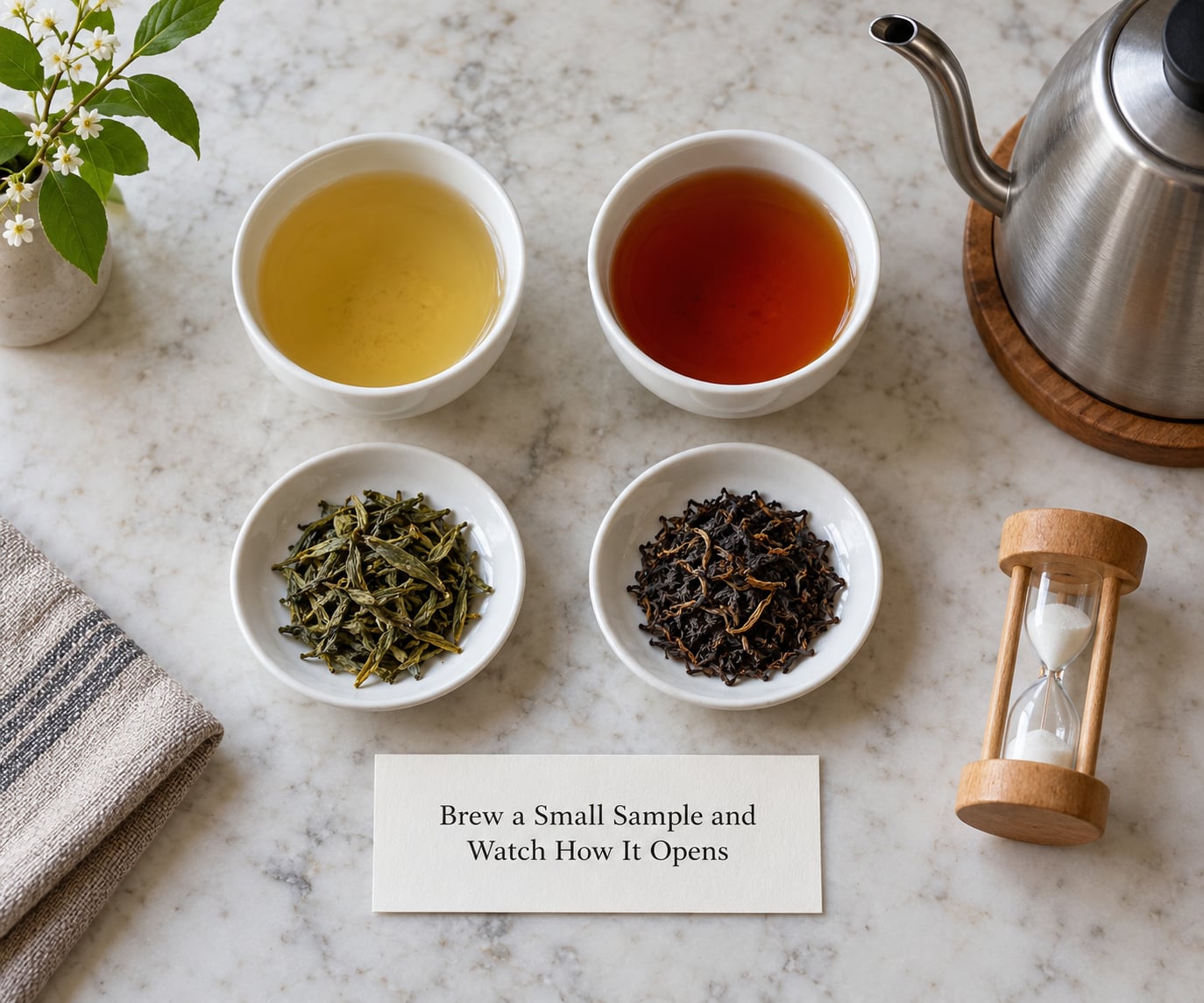
- Brew a Small Sample and Watch How It Opens
- Compare Cost, Origin, and Grade Information
- Common Mistakes
- Frequently Asked Questions
- Are whole-leaf teas always higher quality than tea bags?
- How much should good loose leaf tea cost?
- How can I tell if loose leaf tea has gone stale?
- Are flavored or compressed loose leaf teas automatically low quality?
- Do visible tea flowers, dust, or broken bits indicate cheap tea?
- Can the place of purchase really affect tea quality?
- What to Do First
What You Need
A basic tea inspection kit costs less than a takeaway lunch, and you already own most of it.
- A dry sample. Two teaspoons from the tin, poured into your palm or onto a white plate so you are looking at the leaf itself rather than through packaging.
- A plain white cup or saucer. White matters because liquor color is judged against it. Printed mugs distort the shade.
- A cup or small bowl that smells neutral. Skip anything you have been drinking coffee or smoking near. Aromas linger in ceramic and will lie to you.
- A kettle with temperature control. Not essential, but green tea made with boiling water tastes harsh, and people blame the tea for a mistake that was the water.
- Two or three small tasting cups. Side by side comparison is the only way to catch a difference you have never named before.
- A timer. Steeping by feel is guesswork until it isn’t, and guesswork is how people decide a fair tea is bad.
- Optionally a magnifying glass. Useful for inspecting dust levels and the cut edge of a broken leaf.
Handling rules matter more than the equipment. Keep scented soap, candles, coffee, and damp hands away from dry samples, and never reach for loose tea with wet fingers. Moisture wrecks the aroma of an entire tin, not just the sample.
Step-by-Step: How to Tell Good Quality Loose Leaf Tea From Cheap Tea
Run the checks in this order. Each one is cheap and fast, and each one has a specific red flag. Five signals cover most of what you can learn before and during a first brew.
- Look at the pieces. Whole or large intact leaves suggest minimal cutting. Uniform granules and fine dust suggest tea cut for fast brewing.
- Warm the leaf and smell it. Warm leaf should smell like its tea type, layered rather than one flat note.
- Check the dry leaf color under neutral light. Natural, even color for the type. Watch for bluish brightness, flat gray, or one identical shade in every piece.
- Brew it and watch. Leaves that open slowly and hold their shape usually have more substance than leaves that dissolve into the cup.
- Re-steep it. The clearest quality test there is. Count the infusions. A tea that only gives one is telling you what it is.
Check Whether the Leaves and Pieces Are Intact
Intact leaf is the most obvious signal, and the most over-read. Some teas are supposed to look broken, and some premium styles are almost entirely buds.
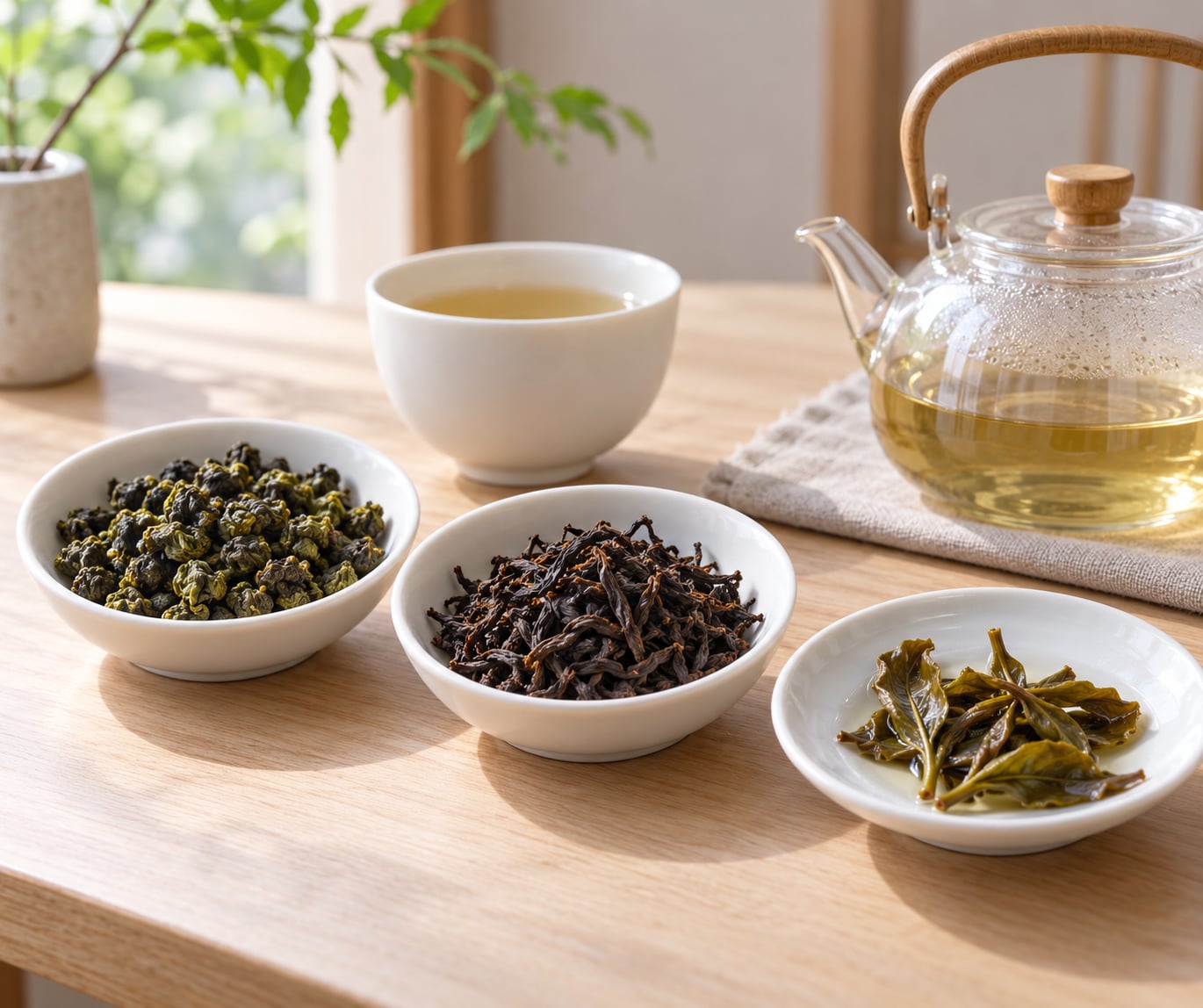
Spread the sample on the white plate and look at the mix, not at a single piece. Three grades show up in almost every tin you will meet:
- Whole leaf. Intact leaves, sometimes two or three leaves still joined at the stem, sometimes a single bud with its down. Silver Needle white tea is nearly all buds. Good first flush Darjeeling is often whole leaf with visible golden tips.
- Broken leaf. Pieces cut across the leaf. Legitimate and common in many black teas and in much of the Chinese oolong sold in the West, because larger leaves give more surface area for oxidation.
- Fannings and dust. The smallest particles. They color a cup fast and extract bitter compounds quickly, which is exactly why bagged tea is built from them. They are not bad tea. They are tea shaped for a paper bag and a three-minute steep.
Now the practical part. Natural variation is a good sign, not a defect. A handful of whole leaves, some broken pieces, and a few tips in the same sample usually reflects a real hand-plucked harvest. Suspicious is the opposite: every piece exactly the same shape and size, hard pellets, uniform cylinders, or a bag that is almost entirely fine powder with a handful of whole leaves dropped on top for the photograph.
Members on r/tea make this point constantly, and it is the single most useful beginner lesson here: tiny pieces are not automatically cheap. Some styles demand them. Judge whether the size suits the tea type you are holding.
Two things should still make you cautious. A cut edge that looks bleached or chalky can mean older leaf picked late in the season, and a bag that mixes visible leaf grades together without telling you is a sign the seller did not sort it, so you cannot be sure what you are getting. An inspector cannot verify the harvest from a photo. A dry sample in your hand can.
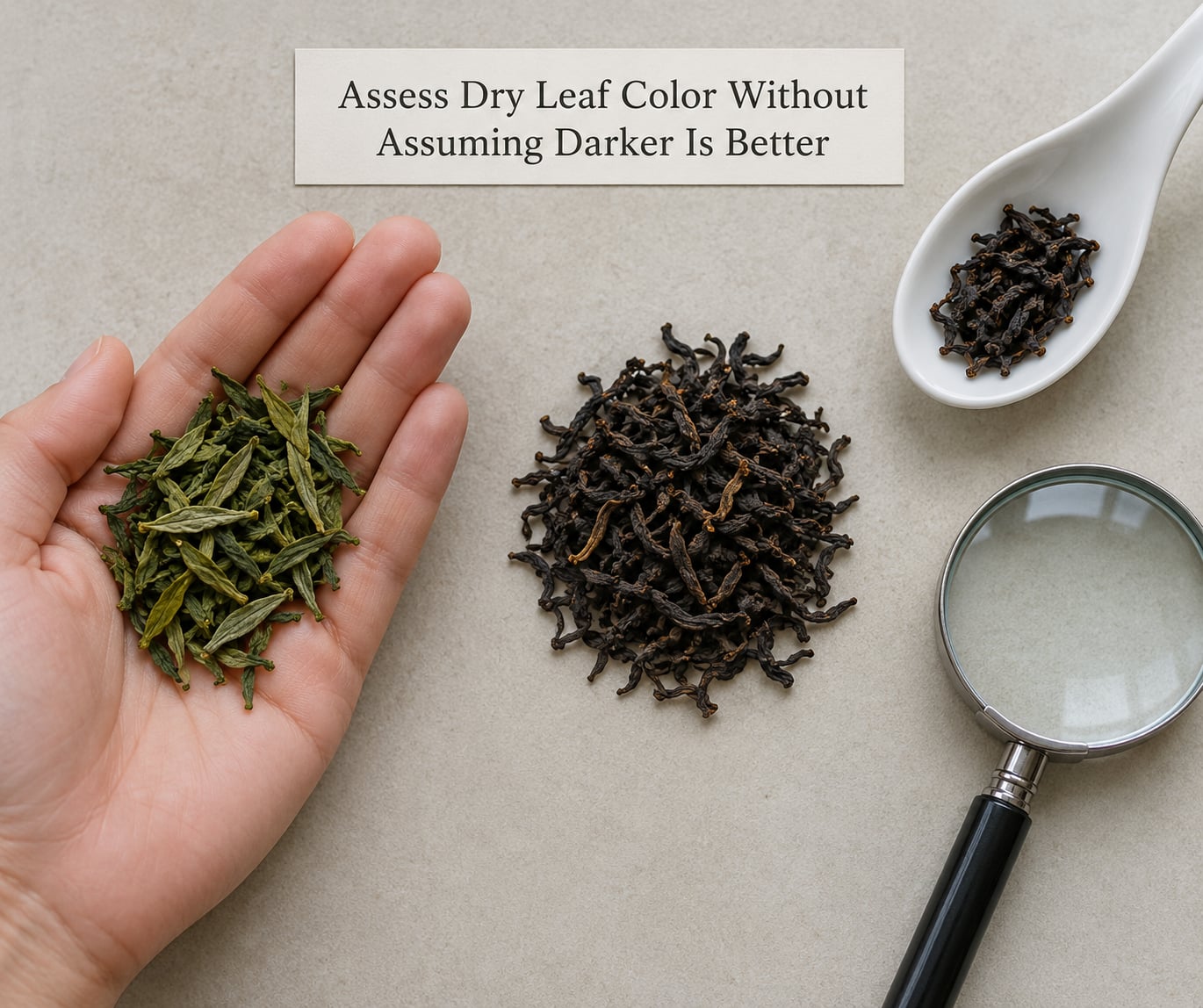
Assess Dry Leaf Color Without Assuming Darker Is Better
Compare color under neutral daylight, not under a warm kitchen bulb, and hold the expectation for the tea type in your head before you decide anything.
Each category has a normal range. A pan-fired Japanese green tea such as Dragonwell is a deep olive. A Chinese green such as Gunpowder is a tight, dark roll that opens to green in the cup. White tea is silver down to pale straw. A roasted oolong like Da Hong Pao is dark brown with a slight sheen. An herbal blend is whatever the blend is, which is why judging color works badly on flavored tea.
Natural oxidation and roasting darken leaf in ways that follow the type. Unnatural signals look different. Bluish brightness that no real leaf has. Flat gray with no life in it. Brown patches where oxidation should be even, which is the visual signature of a tea that sat damp before packing. And uniformity that looks machine perfect, where every piece matches the next exactly.
| Tea category | Typical dry leaf signal | Brewed liquor cue | Caution |
|---|---|---|---|
| Green | Green to olive, tight rolls, visible tips | Pale yellow-green, clear | Yellow, dull, or brown liquor means age |
| Black | Brown to near black, uniform curl | Deep amber to copper, bright | Dull grey-brown liquor reads as flat or stale |
| Oolong | Green-brown rolled balls or twisted strips | Clear gold to amber, layered | Dark uniform brown on a rolled oolong can be roast, not damage |
| White | Silver-grey buds and pale leaf | Very pale straw, near clear | Any strong colour means it is not white tea as sold |
| Herbal and blended | Mixed pieces, petals, roots | Whatever the blend is designed to be | Colour tells you nothing, use aroma and taste |
One caution about black tea. Even, dark, slightly glossy leaf is normal for a good orthodox black tea. Do not downgrade a black tea for looking dark when the liquor comes out bright and clear.
Smell the Dry Leaves and Warm Leaf Cup
A good dry leaf has a clear type-specific aroma, and warming it in your hands releases a second, deeper layer. Do not crush the leaf between your fingers to make it smell stronger. That squeezes out volatile oils you will never get back in the cup, and it manufactures a false impression.
Warm a small pinch in your closed palm for about twenty seconds, then lift your hand to your nose. What you are listening for is coherence. A Tie Guan Yin that has been roasted well smells of cream, orchid, and lily in layers, and the layers arrive in order. A Gyokuro smells marine and sweet, like steamed seaweed and fresh-cut grass. Good first flush Darjeeling smells musky and bright, closer to apricot than to a generic fruit note.
Red flags are more distinctive than good aromas, which is helpful, because not everyone smells everything. Mustiness is the big one, a damp cellar smell that means storage failed. Stale cardboard points at a tea that has oxidized past its point. Chemical sweetness, like fake vanilla or artificial berry in a tea that should taste of leaf, points to flavoring added over a weak base. And an aroma that belongs to a different tea entirely is a label problem.
Warmed leaf is a separate test from brewed aroma. Dry leaf tells you about processing and storage. The infusion tells you about the water and the brewing. Confusing the two is how a well-stored tea gets written off for a steep that was too long.
Feel the Leaves for Texture and Pliability
Good dry leaf is crisp and breaks cleanly between your fingers. It should feel dry, not leathery and not springy. If you roll a piece and it bends without snapping, it has taken on too much moisture.
Moisture is the quiet enemy here. Damp leaf loses aroma in storage, and the cup never recovers what the tin gave up. It is also why teas sealed with poor packaging taste dull within months while the same tea from a well-sealed bag is still singing years later.
Weight is a rough guide. Two teas of equal volume can weigh very different amounts, and the denser leaf usually carries more, but hand scales are the only honest measure and most people judging a tin at the shelf do not have one. Springiness works better. Fresh bud-heavy teas like Silver Needle spring slightly when you roll them, while old leaf tends to crumble.
Two things to keep in mind here. Bagged tea can be completely good and pass every touch test, and an expensive tea can still be flawed. Use feel as supporting evidence, not a verdict.
Brew a Small Sample and Watch How It Opens
Brewing is the final test and the one that actually settles arguments. Use the same measured amount of leaf and water for every tea in the comparison, and change one variable at a time.
A workable setup for a small sample: two teaspoons of leaf, about 200 ml of water, a first infusion of 60 to 90 seconds for black, oolong, and most herbal blends, and 45 to 60 seconds for green and white. Then steep a second time. If the tea claims several infusions, prove it.
Watch three things during the first minute. Expansion is the clearest. Good whole leaf expands roughly three to five times its dry volume as it absorbs water, opening across the infusion. Dust and fannings produce a thick cloud instead, coloring the cup fast without opening at all. Development is the second thing. Watch how the aroma shifts from the first thirty seconds through the end of the steep, and whether it smells fuller or thinner. Clarity is the third. A good liquor is clear and bright. Cloudiness with visible sediment usually means a lot of fine particle in a short brew, which is a brewing choice rather than a defect on its own.
Then taste. Look for balance rather than strength, and for a returning sweetness some tasters call huí gān, an aftertaste that comes back a few seconds after you swallow. Strong flavor is easy to produce. It says nothing about quality.
The honest limits of all of this belong in the same section. A dry leaf and a good nose can tell you the tea is fresh, cut as intended, and free of damage. They cannot tell you whether it was plucked in the right season, whether a scented batch is masking a weak base, or whether it will taste good in your water. Brewing reveals those. If you want the practitioner view, the repeated answer in tea forums is that judging quality is a trained skill, built by drinking a lot of tea of the same type and noticing the difference.
Compare Cost, Origin, and Grade Information
Price is the worst single signal and the one most people use first. Expensive tea can be mediocre, and cheap tea can be very good, because price tracks rarity, freight, and marketing as much as it tracks leaf quality. Use cost only to compute servings, not to grade a tea.
Two teas can cost the same per tin and deliver four times the number of cups. Whole leaf at three grams per infusion that holds up for five steeps gives you fifteen grams of tea. Fine dust at two grams per infusion that dies after one gives you two. That comparison needs no price at all, and it is the number worth working out before you buy.
Read the label for what it actually asserts. Grade terms like SFTGFOP describe leaf size, leaf quality, and the presence of tips, which is useful but says nothing about harvest season or skill. Origin and garden name say where the leaf grew. Processing method tells you whether the leaf was rolled by hand or crushed and curled, and whether a seller is using orthodox and CTC as loose marketing words. Harvest or packing date is the single most useful freshness clue on the whole packet, and its absence is worth noticing.
| Label term | What it tells you | What it does not tell you |
|---|---|---|
| Whole leaf | Leaf was not cut into small pieces | Whether the leaf was young, or plucked in season |
| Orthodox | Processed with traditional rolling methods | Anything about quality, since the term is used loosely |
| CTC | Crush, tear, curl, used for fast strong brewing | That the tea is bad, just that it is shaped for bags |
| SFTGFOP | Grade of size and tip content on Indian teas | Flavor, freshness, or harvest season |
| First flush | Early spring harvest, lighter and more aromatic | That it is better than a second flush for you |
| Packed on date | Approximate age of the tea | How the leaf was stored before packing |
An ingredient list deserves a quick look too. If the packet lists flavoring above the leaf and the aroma smells identical to the flavoring, you are probably drinking a scented base with a good base underneath, not a bad tea. If it lists only one ingredient and the leaf looks like one plant, the color and aroma checks above apply cleanly.
One last buying habit that costs nothing: buy less, more often. A smaller amount of fresh tea will beat a large tin that has been open for a year, and it removes the freshness question from the rest of this guide entirely.
Common Mistakes
Most wrong verdicts come from applying one rule to every tea. These are the ones I see most.
Judging by leaf color alone. Dark does not mean better, and pale does not mean fragile. White tea is pale and can age for years, while some dark roasted oolongs are excellent. Correction: pair color with liquor color and aroma before deciding anything.
Assuming larger leaves are always superior. Some of the finest oolongs are small tight pellets, and Silver Needle is buds, not leaves. Correction: ask whether the shape suits the tea type before you ask whether it looks impressive.
Treating strong flavor as high quality. Over-steeped cheap leaf will out-punch good leaf every time. Correction: taste at a fixed ratio and a fixed time, and compare like with like.
Over-steeping every tea. This is the most common home brewing error and it makes good tea taste bad. Correction: treat green and white as delicate, start cool and short, and extend only if the cup is thin.
Relying on a single steep to judge. Plenty of fine oolong and good black tea open up on infusions two and three. Correction: steep at least three times before you write a tea off.
Equating a low price with cheap tea. Loose leaf sold by weight has a wide range, and the bottom of it is often perfectly drinkable. Correction: compute cups per tin and steeps per cup instead.
Ignoring storage damage. Tea that was fine when it was packed can be dull now, and no amount of brewing fixes it. Correction: keep leaf in an airtight caddy away from light, heat, and odors, and buy smaller amounts more often.
Here is the habit that ties all of this together. Buy one small tin of a single tea type at three price points, brew all three identically, and taste them in the same session. Do that four times a year and you will build a palate faster than any checklist can. That is the actual answer to the question, and it is the answer the r/tea consensus keeps arriving at from a different direction.
Frequently Asked Questions
Are whole-leaf teas always higher quality than tea bags?
No, and the format label tells you less than people think. Whole leaf usually means less cutting, which usually means slower extraction and more flavour, but a small broken leaf can be exactly right for a particular style, and a bag can hold whole leaf. The real reason most tea bags use fannings and dust is surface area, so the cup colours fast and strong in three minutes. Judge the leaf in your hand, then judge the cup.
How much should good loose leaf tea cost?
There is no useful price to aim at, because good tea and cheap tea overlap heavily in price and quality. The number worth calculating is servings: a loose tea at three grams per infusion that holds five steeps gives you fifteen grams from the packet, while a fine dust at two grams that dies after one gives you two. Compare cups per tin, and buy less often so the tea stays fresh.
How can I tell if loose leaf tea has gone stale?
Smell it first. Stale tea gives off a dull cardboard or musty cellar note instead of a fresh, type-specific aroma, and warming it in your palm makes that worse rather than better. Brewed, stale leaf tastes flat with almost no aroma above the cup and little returning sweetness. Green and white tea show age fastest, usually turning yellowish and harsh, while dark roasted teas hold their character far longer.
Are flavored or compressed loose leaf teas automatically low quality?
No. Compressed teas, including the cake and brick forms some pu-erh and white teas arrive in, are traditional formats, not shortcuts. Flavored tea is usually a base leaf plus added flavoring, and a good scented tea has a decent base underneath it. What matters is whether the aroma is a layer or the only thing you can find. If the leaf smells like nothing but the flavoring, the base is probably weak.
Do visible tea flowers, dust, or broken bits indicate cheap tea?
Each one means something different. A few flowers in a scented blend are normal and sometimes deliberate. Broken pieces are common and often correct in black and oolong tea, which oxidize faster with more surface area. Fine dust and fannings are cut for fast brewing and are the standard contents of a tea bag. A mix of many leaf grades with nothing labelled is the real warning, since it means nobody sorted the batch.
Can the place of purchase really affect tea quality?
It affects what you can verify more than it affects what you get. Buying in person lets you smell, look, and ask questions about garden and harvest, and specialty tea shops will usually brew a sample before you commit. Online you get more detail on origin and processing but no sensory check, so read the harvest or packing date and the ingredient list. Either way, the last test is the same, and it happens in your kitchen.
What to Do First
Pick one tea you already own, pour two teaspoons onto a white plate, and look at it before you brew it. Notice whether the pieces are whole, uniformly cut, or powder, and whether they smell of something specific or of almost nothing. That single ten-minute look changes how you read every tin afterwards, and it is the fastest way to stop paying twice for the same leaf.