Keeping food cold in a hotel room without a fridge comes down to three things: a cold source with real thermal mass, an insulated container that limits heat gain, and a thermometer so you check instead of guess. Fill a bucket with ice or use a sink full of ice and ziplock bags, pack an insulated lunch bag with frozen gel packs and frozen water bottles, or call the front desk and ask for a medical fridge. Whatever you use, keep perishable food at or below 40°F (4°C) and toss anything that sat in the danger zone for more than two hours.
I learned this the hard way in a hotel in southern Spain, years ago, before it became a habit. Takeout from the night before sat in a plastic box on the desk until morning. By breakfast it was warm, and I ate it anyway because it smelled fine. That is exactly the mistake this guide is built to prevent.
Smell is not a safety test. The bacteria that spoil food and make you ill, including Salmonella, E. coli and Bacillus cereus, can multiply fast in the 40°F to 140°F (4°C to 60°C) range, and the toxins some produce survive reheating. One ruined meal costs you a whole morning of a solo trip, which makes a few dollars of gear or a trip to the front desk cheap.
Last updated for 2026. Food-safety thresholds follow current USDA guidance.
Table of Contents›
- What You Need to Keep Food Cold in a Hotel Room Without a Fridge
- Step-by-Step
- Pick a Setup to Keep Food Cold in a Hotel Room
- Pre-Chill the Food and Container
- Pack Food in Sealed Containers
- Use Ice Packs or Frozen Water Bottles
- Keep the Setup Closed and Out of Sunlight
- Check the Temperature and Know When to Discard Food
- Adjust the Method for Your Trip Length
- Common Mistakes
- Frequently Asked Questions
- Can I keep groceries cold in a hotel room overnight without a fridge?
- How long can food stay cold in an insulated bag?
- Is a hotel ice machine enough to keep food cold overnight?
- What is the safest container to use in a hotel room?
- How do I keep food cold in a hotel room when I have no cooler?
- How often should I replace the ice or frozen packs?
- Conclusion
What You Need to Keep Food Cold in a Hotel Room Without a Fridge
The list is shorter than it sounds. The two things that actually do the work are a cold source and an insulated container; everything else helps you pack tighter, measure, and refill.
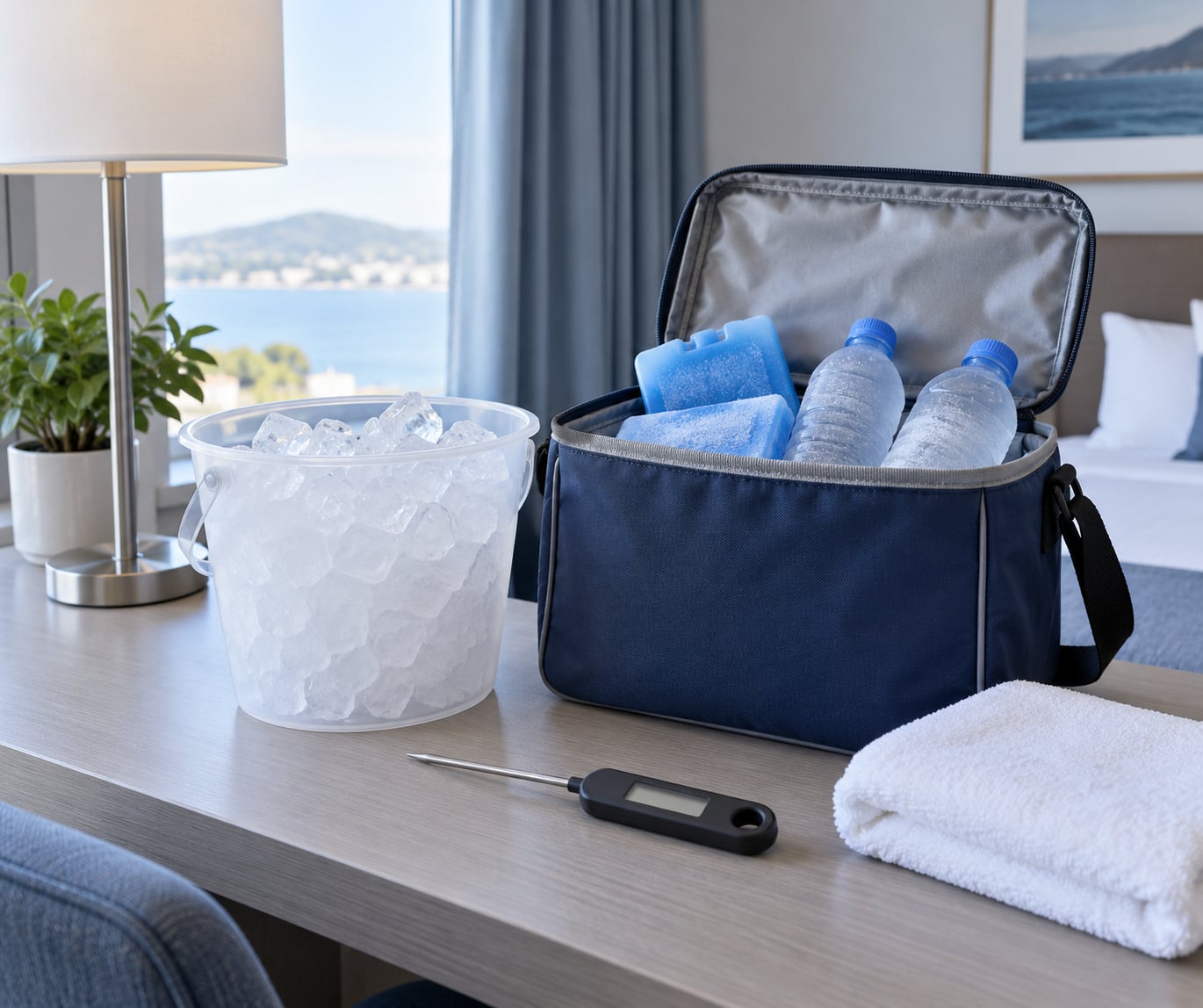
- An insulated lunch bag or soft cooler. A zip-top insulated lunch bag works for one or two nights. A soft-sided cooler with a shoulder strap holds more and survives a longer trip.
- Hard ice packs plus block ice or frozen water bottles. Gel packs cool fast but run out early. Frozen bottles hold cold far longer and do not melt into a swamp in the bag. Using both is the trick seasoned travelers use.
- A bucket, or the hotel sink. Most rooms have an ice bucket. Many also have a bathtub, which makes a genuine ice cooler surprisingly easy.
- Zip-top freezer bags or leak-resistant containers. Loose containers leak ice water into everything else in the bag.
- A small food thermometer. Cheap pocket thermometers are the difference between knowing and wondering. Push one into a bag of ice or into the coolest corner of your setup.
- A folded towel or a couple of hand towels. Air is a poor conductor. Packing the empty space in an insulated bag slows heat transfer noticeably.
- Takeout containers or deli containers with tight lids. Seal the lids with a strip of tape if you are stacking them.
For a one-night stay you need very little: a bag, a few frozen things, and access to ice. For three nights or more, bring your own gear from home rather than relying on what the property supplies, because ice policies vary and some hotels charge for a bucket or refuse loose ice in coolers. Extended-stay guests living in a room for weeks need the most, and they usually find that daily fresh grocery runs beat trying to store anything.
One item deserves its own warning. Medication, including insulin, and prepared infant formula are not food-safety problems you should improvise your way through. Those need a real refrigerator or a proper cooler, and the front desk is the first call to make.
Step-by-Step
Pick a Setup to Keep Food Cold in a Hotel Room
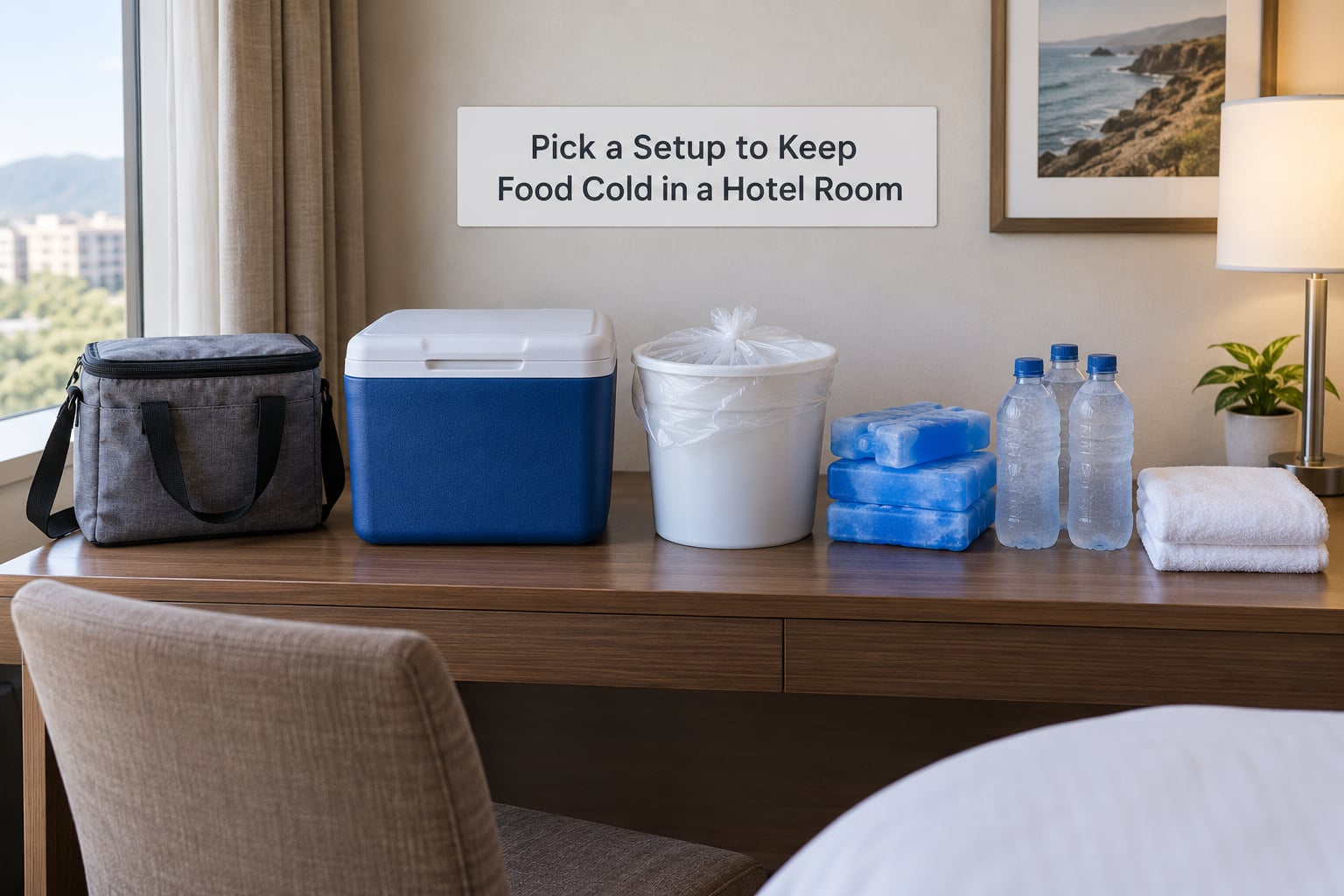
Six setups cover almost every hotel room, and they differ more in how long they hold cold than in how much they cost.
- Bucket or sink with ice and sealed bags. Holds below 40°F for roughly 8 to 12 hours if you refill before bed. Best for one night, a lot of food, and no gear.
- Insulated lunch bag with gel packs. Roughly 10 to 16 hours. Good for one to two nights and small amounts.
- Soft cooler, dual cold sources, air gaps filled. Two to three days with daily refills. This is the workhorse for multi-day trips and road travel.
- Hard cooler with block ice. Three to five days with daily refills. Worth the extra bulk for longer trips, camping, or group travel.
- Frozen water bottles only, no container. Four to 8 hours. Fine for market shopping and a single meal.
- Room minibar. Unreliable, often 50°F or warmer. Fine for drinks, condiments, and unopened items, but not for leftovers.
The bucket or sink method is the one travelers post about most. Fill the bucket with ice, add a layer of water so the food is surrounded by an ice bath rather than sitting on cubes, and put your sealed bags into it. A sink works the same way and holds more, though it drains slowly and the stopper may not seal properly. Line the bucket with a heavy bag if you are unsure it is clean.
Place ice both under and over the food. Cold sinks, and heat rises into the empty space above your containers, so ice on top does more work than most people expect.
Then make the call other travelers swear by. Ring the front desk and say: I have medication that needs to stay refrigerated. Do you have a medical mini fridge or a guest fridge available? Hotels keep these on hand for exactly this reason, and the request is routine enough that nobody will think twice about it. The same request also works for a small cooler packed with ice if the property has a machine and is willing to fill it.
Check the ice machine’s hours while you are at the desk. Some shut off at 11pm, which is exactly when you want the ice.
Pre-Chill the Food and Container
Every degree of starting temperature you remove is a degree you do not pay for later. Refrigerate or chill food before it goes into the bag, and put the insulated bag itself in a freezer for 30 minutes if you have access to one.
Use shallow containers rather than deep bowls. Heat moves through food from the outside in, so a 2-inch layer cools and re-cools faster than the same food in a 6-inch bowl. Divide large portions into several small ones and cool them uncovered in the fridge before sealing.
Warm food going straight into a bag with ice raises the temperature of the whole setup. If you only have room-temperature takeout and a bag of ice, put the ice around the sealed container and accept that you have an hour or two before you need to check it again.
Pack Food in Sealed Containers
Use leak-resistant, food-safe containers and close them properly. Tape across the lid of anything with a hinge, since those are the ones that leak first in a bag of ice.
Separate raw meat, poultry, seafood and anything messy from food you plan to eat as-is. In a hotel setup there is usually no way to wash up after raw chicken, and a leak means the whole bag takes on the smell and the risk. Put raw items in their own zip bag inside the cooler, below and away from everything else.
Label containers with the day and, for anything that needs it, the time. After two nights of takeout the difference between Tuesday’s fish and Wednesday’s fish is impossible to remember, and a label ends the guessing.
Portion as you pack. Two small containers you can eat in one sitting beat one large container that keeps getting opened and re-closed for three days.
Use Ice Packs or Frozen Water Bottles
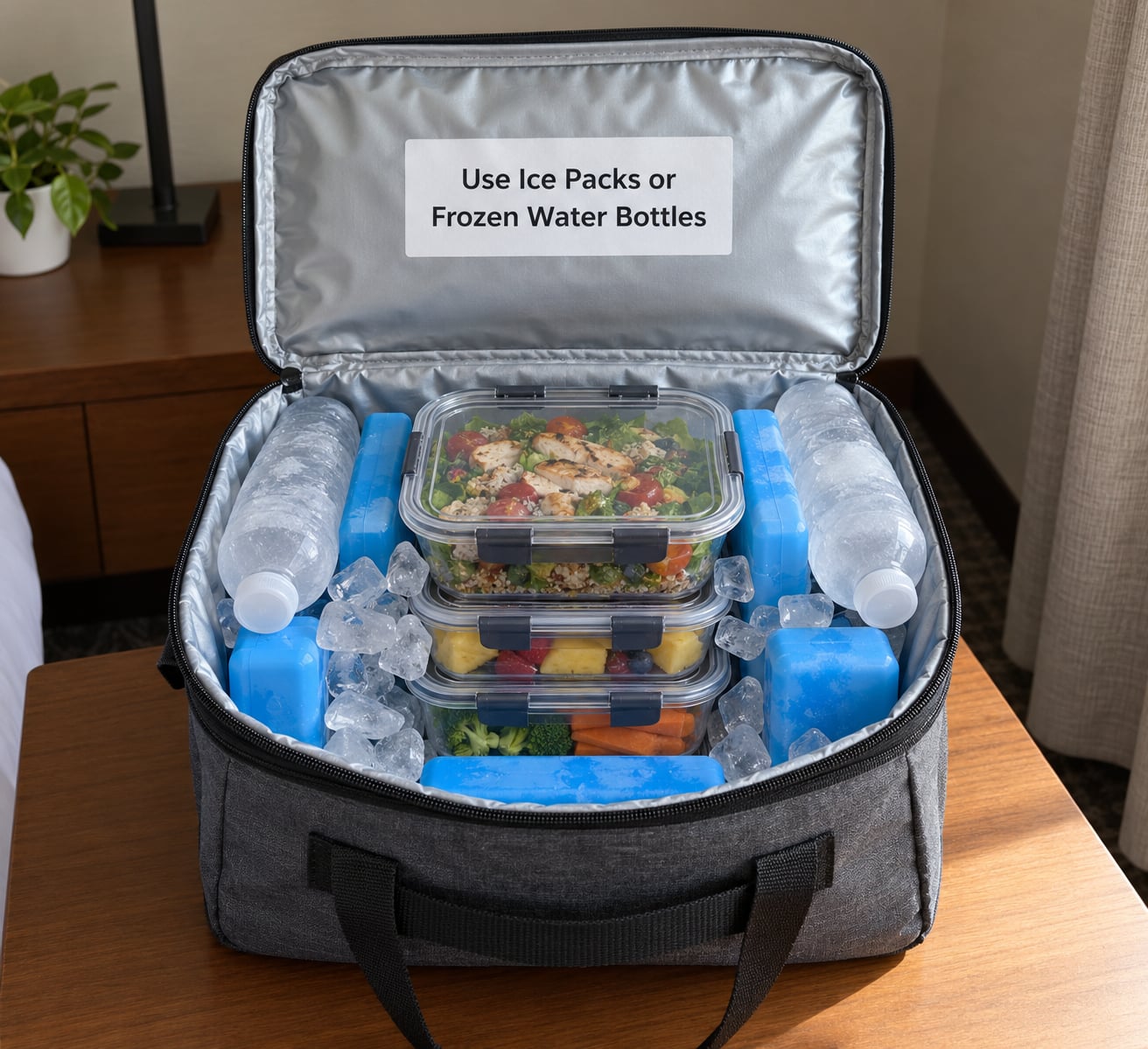
Frozen water bottles are underrated. They hold a low temperature for hours, they do not melt into a puddle inside your bag, and you can refill them from the ice machine rather than hunting for a bag of loose ice at 11pm.
Use two kinds of cold source together. Put gel packs or block ice against the food, since they sit flat and contact the container surfaces, and add frozen bottles to fill the awkward gaps. Wrap block ice in a towel or a layer of newspaper so it does not rattle or leave a wet film on everything.
Fill the empty space. A half-empty cooler is mostly air, and air moves heat quickly. Rolled towels, spare clothing, or a rolled mat fill the void and act as insulation. A well-packed insulated bag runs about 85 to 90 percent full; pack beyond that only if you are certain nothing will leak.
Set a refill point in your routine rather than reacting to warm food. Fill the bucket and top up the bag right before you turn in, and check again in the morning. Most overnight failures are simply ice that melted in an empty bucket nobody refilled.
Keep the Setup Closed and Out of Sunlight
Every time you open the bag you let cold air out and warm room air in. Open once to grab what you need, close it, and take the whole bag to the desk if you are eating away from the bed.
Choose the spot in the room carefully. Not on a windowsill, not in direct afternoon sun, and not next to a heater or a television that runs warm. The lowest shelf of a wardrobe or a closed cabinet away from the window is usually the coolest, most stable place in the room, and it also hides the evidence from housekeeping.
Air conditioning matters more than most people think. Many hotel thermostats only run while your key card is in the slot, so the unit switches off when you leave and the room warms toward the outside temperature overnight. Ask for a second card to keep in the slot, or at minimum know what your room does when you go out for dinner.
Wrap the bucket in a towel if you can. It slows melt, and it keeps condensation off the desk.
Check the Temperature and Know When to Discard Food
Cold food needs to stay at 40°F (4°C) or below. Hot food needs to stay at 140°F (60°C) or above. Everything between those numbers is the danger zone where bacteria multiply quickly.
The rule that matters most: discard perishable food left in the danger zone for more than two hours. Cut that to one hour when the air temperature is above 90°F (32°C), which is realistic in a warm room, a parked car, or a sunny balcony in summer.
A simple routine beats constant worry. Push the thermometer into the ice bath or into the coolest gap in your bag when you get back to the room, and again before you go to sleep. If a container is at or below 40°F, you are fine for several more hours. If it is above that, eat the food now rather than at midnight.
For cooked food safety, follow current USDA minimum internal temperatures: 165°F (74°C) for poultry, 160°F (71°C) for ground meat, and 145°F (63°C) for whole cuts of meat and fish. Cooked rice and pasta deserve special attention because Bacillus cereus spores survive cooking and the toxins do not always come out in a reheating oven.
Do not assume the minibar works. Vending minibars are frequently set to hold drinks rather than to refrigerate food properly, and many sit in the 50°F range. That is fine for a sealed can and wrong for leftover chicken. If you intend to use one for food, put a thermometer inside for an hour and find out.
For medication and prepared formula, skip the improvisation. A fridge at the front desk, a pharmacy, or a proper medical cooler is the answer. Ask your prescriber or pharmacist how long a given medicine tolerates a warm room before you pack.
Adjust the Method for Your Trip Length
A one-night stay barely needs a plan. Bag the food, add ice on all sides, leave it in the coolest corner, refill the bucket before bed, and eat what is left at breakfast.
A multi-day trip needs rotation. Bring frozen packs from home, restock them nightly from the ice machine, and cook or eat down the oldest item first. A shopping trip mid-week keeps things simple; a planned big grocery shop does not. Many solo travelers pick up fresh food every other day and keep the cooler for exactly that reason.
An extended stay needs a different system entirely, because a nightly improvisation stops working in week three. Extended-stay properties usually have a kitchenette and a real refrigerator, so check for that at booking rather than at check-in. If there is genuinely no fridge, switch to small daily grocery runs and a soft cooler you keep in your room, and stop storing anything you could buy nearby for less hassle.
If the room does have a working mini fridge, treat it as one of two cold sources, not the only one. It is usually small enough for drinks and a few containers, so use the cooler for the bulk. And if there is an ice machine on the floor, use it. It is free, it is close, and it solves the same problem your cooler would.
Common Mistakes
Packing food at room temperature. Warm food plus a small amount of ice warms the ice. Chill food first, or accept that you need twice the cold source for the first hour.
Overfilling the cooler. A crammed cooler has no air gap, so cold air cannot circulate and the whole thing cools unevenly. Fill to about 85 percent and let the ice sit between the containers.
Putting the setup near a hot window. Solar gain on a black bucket in afternoon sun can undo an evening’s ice work. Move it to the far side of the room or into a closed wardrobe.
Opening the container all evening. Snacking straight from the bag means it never holds temperature. Put a portion in a separate dish and close the cooler.
Treating the ice machine as permanent storage. Ice machines make ice in cycles. They do not refrigerate anything, and many switch off at night. Fill buckets on a schedule instead of assuming a freezer exists down the hall.
Leaving raw food beside ready-to-eat food. Separate it, keep it lower in the setup, and put it in its own sealed bag. There is no sink situation in most rooms to clean up after handling raw meat.
Trusting smell or appearance. Food can look and smell fine and still be unsafe. Time and temperature are the only useful measurements.
Assuming the minibar is a refrigerator. Many minibars hold at 50°F or warmer and are stocked with overpriced drinks, not food. Check before you rely on it.
Three habits that make the rest easier. Write the day on containers with a Sharpie or masking tape, wipe the cooler with a disinfecting wipe and leave it open to dry, and keep a small trash bag inside the bag so nothing sits in melt water. A cooler that smells like onion and lemon gets abandoned by day three.
Frequently Asked Questions
Can I keep groceries cold in a hotel room overnight without a fridge?
Yes, if you build an ice bath and keep it cold. Put sealed bags of food in a bucket or sink filled with ice plus a little water, add ice on top as well, and refill before you go to sleep. Most hotel ice machines stay on overnight, but check the hours at the front desk when you arrive. Anything perishable that sits above 40°F (4°C) for more than two hours, or one hour in a room above 90°F (32°C), should be discarded.
How long can food stay cold in an insulated bag?
A well-packed insulated lunch bag with gel packs and frozen water bottles holds food below 40°F (4°C) for roughly 10 to 16 hours. A soft cooler with dual cold sources and the air gaps filled runs two to three days if you restock the ice daily. Pre-chilling the bag for 30 minutes and packing it about 85 percent full makes a noticeable difference.
Is a hotel ice machine enough to keep food cold overnight?
It is enough if you commit to it. Fill a bucket with ice, add water so the food sits in an ice bath, and refill before bed. Ice machines on hotel floors often shut off around 11pm and some properties limit how many buckets a guest may fill, so ask at check-in rather than discovering the policy at midnight. For more than one night, bring your own frozen packs and use the machine to top them up.
What is the safest container to use in a hotel room?
A leak-resistant container with a lid that seals, or a zip-top freezer bag, will keep your other food safe. Avoid anything that cracks or leaks when packed on ice. Raw meat and seafood belong in a separate bag, positioned below and away from food you plan to eat cold. Keep containers shallow rather than deep, because heat moves through food from the outside in.
How do I keep food cold in a hotel room when I have no cooler?
Use the bucket or the sink. Fill it with ice and a little water, put your sealed bags inside, add ice on top, and keep it in the coolest part of the room away from sunlight. A frozen water bottle wrapped in a towel works for a few hours at a time for smaller amounts. If you have perishable food for several nights, call the front desk and ask for a medical fridge.
How often should I replace the ice or frozen packs?
Check once in the evening and once in the morning with a pocket thermometer rather than guessing. Refill the bucket before you turn in, since an empty bucket overnight is the most common failure. Frozen gel packs soften after six to eight hours and lose their charge, so swap them overnight. Frozen water bottles can be topped up from the ice machine each morning and last two to three days.
Conclusion
The safest first thing you can do after check-in is get the food cold within minutes: fill the bucket, add ice below and above the sealed containers, and put the whole setup in the coolest corner of the room away from the window.
From there, knowing how to keep food cold in a hotel room without a fridge is mostly a matter of habit. Check the thermometer before bed and again in the morning, refill on a schedule instead of reacting, and remember that the two-hour rule is a ceiling rather than a target. Medication and prepared formula are not improvisation projects. Ask the front desk for a fridge and get it sorted before you unpack.