Most proposal trips fall apart on logistics, not romance. To plan a proposal trip without ruining the surprise, decide what your partner genuinely does not know, gather preferences quietly, book everything through discreet channels, and keep one backup location you can move to without explanation.
A proposal trip is simply a vacation where the destination, timing, cover story and ring all move in secret, even though the answer is supposed to be a surprise. Most of the work happens in the six weeks before you land, and it looks a lot like ordinary trip planning until it doesn’t.
Two people at most should know. That rule covers friends, family, the photographer and the hotel concierge, and enforcing it does more to protect the surprise than any clever cover story.
Table of Contents›
- What You Need to Plan a Proposal Trip Without Ruining the Surprise
- Step-by-Step: Seven Moves From Surprise Boundary to Proposal
- How to plan a proposal trip without ruining the surprise: set the boundary first
- Collect clues without turning them into an interrogation
- Build two layers: the real itinerary and the cover story
- Book the essentials through discreet channels
- Create clues that lead away from the finale
- Rehearse the moment, not the entire relationship
- Run a final privacy and contingency check in the last 48 hours
- Plan B triggers worth deciding before you land
- Common Mistakes That Ruin a Proposal Trip
- Frequently Asked Questions
- How do I propose during a trip if my partner hates surprises?
- Should the destination be a surprise, or only the proposal?
- How can I propose without friends or family giving away the plan?
- What if the weather or a venue changes at the last minute?
- How do I choose a ring if I do not know my partner’s size?
- Start With the Surprise Boundary
What You Need to Plan a Proposal Trip Without Ruining the Surprise
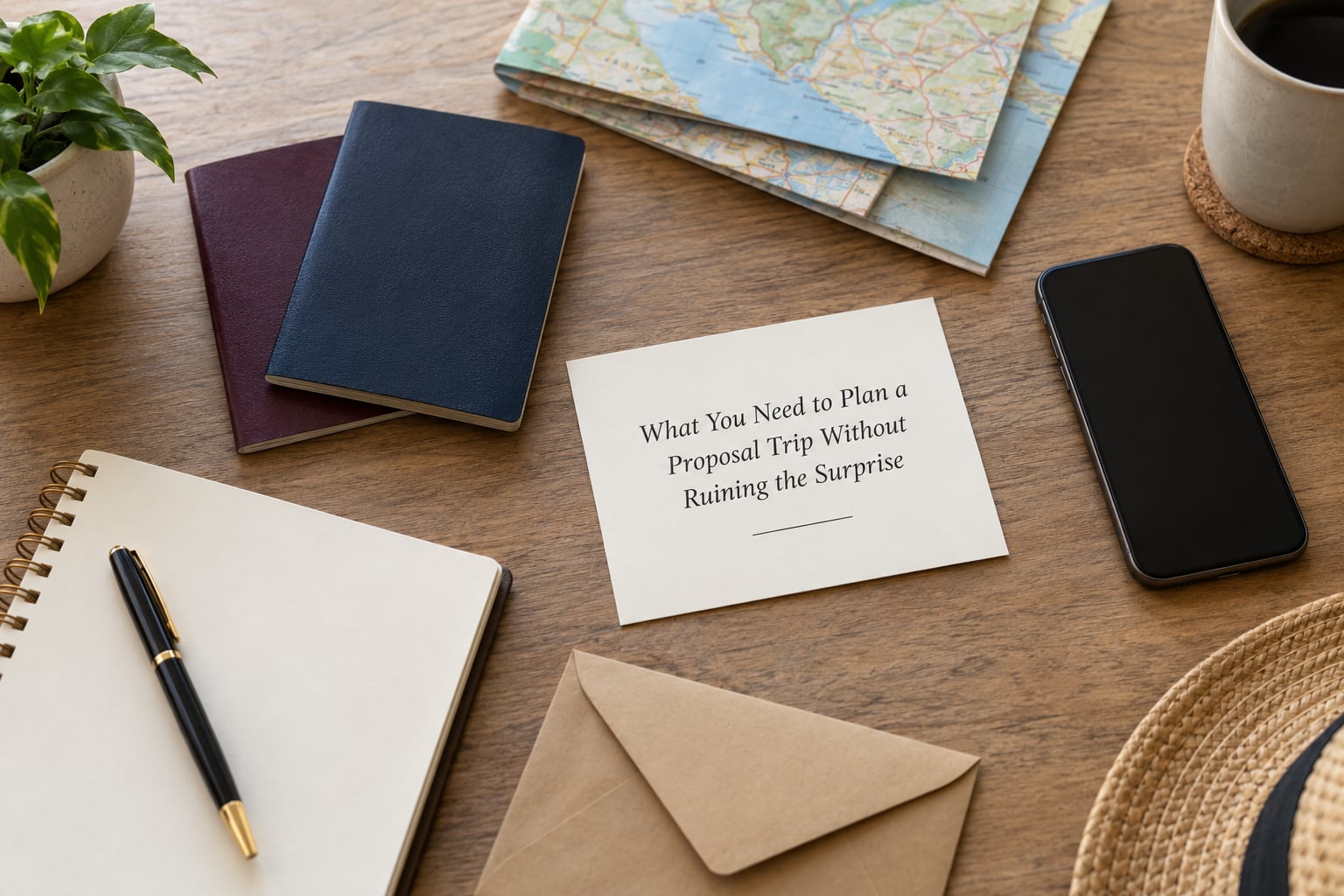
You need a partner clue before you need a destination. Without at least three real preferences to work from, any trip you build becomes a guess, and a wrong guess is the fastest way to a ruined surprise.
Work through these before you book anything nonrefundable:
- A shared trip vision. You both already agree on the kind of trip, roughly. Anniversaries and saved posts are evidence. If your partner has been talking about a specific country for months, that destination is already half-planned and a new one will raise questions.
- An agreed definition of surprise. Some people mean the ring is a surprise. Others mean the whole trip. Ask which, and say out loud that you are planning something and cannot confirm details.
- Three partner clues. A setting they love, a pace they can handle, and a time of day they enjoy.
- A realistic budget. Split it into trip, celebration and one photography budget line. Deciding where the money goes early keeps you from improvising on the day.
- Key bookings with real names. Reservations need the exact spelling of a passport name, and some venues want ID matching it.
- One discreet planning partner. A sibling or close friend who can hold a reservation and will not post anything.
- Emergency contacts. Local numbers, your travel insurance line, and someone at home who knows where you will be.
One item that gets missed: how the surprise ends if your partner says no. Agree with yourself in advance that you will not push, will not fill the silence, and will let the trip continue normally. Having that decided keeps you from improvising badly on a cliff edge in the dark.
Step-by-Step: Seven Moves From Surprise Boundary to Proposal
How to plan a proposal trip without ruining the surprise: set the boundary first
Write two columns. Left: things that must genuinely be unknown, usually the moment itself and the ring. Right: things it is fine for your partner to know, including the destination, the dates and who is coming.
A surprise trip is much harder to hold than a surprise proposal, because travel logistics leak. Flights get discussed, someone needs a date, a friend asks why you are taking days off. If you cannot keep the destination quiet for weeks, choose a trip you were going to take anyway and let the proposal be the surprise.
How to know this step worked: your partner can answer questions about the trip without you flinching, and nobody outside your list has been told anything.
Collect clues without turning them into an interrogation
Clues come from behavior, not questions. Watch what they save, what they walk past, and what they choose when ordering. Someone who always asks for the seat by the window and complains about early starts has just given you a time window and a setting.
Use open prompts instead of approvals. When a movie shows a beautiful coastal town, say that it looks like somewhere you would happily spend a week. You are collecting a reaction, not requesting permission for a ring.
Never ask a yes-or-no question with only one acceptable answer. Any partner who answers honestly is lying, and you can spot a lie in a second.
Build two layers: the real itinerary and the cover story
Layer one is the actual schedule, including the stop where you plan to propose and the celebration immediately after it. Layer two is what your partner sees, and it needs to be true enough that you never have to lie out loud.
The best cover stories are ordinary. A dinner reservation for two at a specific time is normal. A private table, a special menu, or a photographer on staff is not, and those are the details that tip people off.
Neutral explanations that hold up: we booked the good table early because it sells out, I want photos before the light goes, that walk was on my list for years. Say them once, casually, then change the subject yourself.
How to know this step worked: you can describe the whole day out loud without a single sentence that feels like a lie.
Book the essentials through discreet channels
Book in this order, because each one constrains the next: flights and accommodation, then transport, then the proposal location, then dining, then a photographer or celebrant.
Confirm with each vendor whether someone can hold a reservation without your partner’s name attached, whether they can keep a box or a bottle before arrival, and whether they can keep a photographer out of sight until a signal.
Also check four practical things before you pay: accessibility for stairs and uneven ground, an indoor alternative if the weather turns, cancellation terms in case you must move dates, and name requirements matching the ID you will both carry.
For longer trips, book the accommodation before the special reservations. A delayed flight is far easier to absorb than a lost reservation at a restaurant you cannot rebook.
Create clues that lead away from the finale
Clues should point somewhere boring. A packing prompt about comfortable shoes, a mention that dinner is earlier than usual, a request to charge a phone overnight. Each one is a small, specific instruction that a curious person could puzzle over and still guess wrong.
Then test every clue for exposure. Would it show up in a shared calendar invite? Would a payment notification appear on a phone your partner picks up? Would an excited third party repeat it back to them? A clue that survives a week of normal conversation is a good clue.
Do not stack more than three. Four clues stop being clever and start sounding like a countdown.
Rehearse the moment, not the entire relationship
Rehearsing a speech word for word makes you sound like a speech. Practice the first sentence, the pause after the question, and what you do while waiting. That is enough. Emotion in the moment will supply the rest.
Settle the practical mechanics too. Where does the ring live for the last hour, and how do you get it out without a pocket pat-down in front of a crowd. Where will you stand if the wind is coming off the water. And agree, however briefly, on a signal that means stop: you feel unwell, the moment feels forced, your partner wants to be alone.
Choose the audience deliberately. Strangers passing by make good photographs and bad moments. Private is usually kinder and almost always safer.
Run a final privacy and contingency check in the last 48 hours
Start with the boring list. Every booking confirmed and saved offline. Travel documents in hand. Ring in the same bag you will not be tempted to open twice. Chargers packed. Emergency contacts written down.
Then handle the digital trail. Turn off location sharing for the trip so an unusual detour does not appear on a shared map. Remove anything from your home screen that invites a peek. Mute the group chat that already knows.
Finally, name the trigger for Plan B: rain, a crowd above a comfortable number, the site closed, a delay, or your partner too tired to enjoy it. Choose a second location that requires no new booking and no new explanation, and treat switching as normal rather than as a failure.
How to know the whole plan worked: nothing you did in the last month would look strange to a stranger reading your booking history.
Plan B triggers worth deciding before you land
Deciding the switch in advance is what makes it usable. Here is a compact version I keep coming back to.
- Rain or high wind. The spot is loud, wet or unsafe. Move indoors to the backup location and keep the original timing.
- Crowds above comfortable. No space to stand or be heard. Wait or shorten, and pick a quieter edge of the same area rather than a new venue.
- Site closed or restricted. Permits, hours or security block the plan. Use the backup stop on the same route and do not explain the change.
- Delayed flight or transfer. Energy is gone before you arrive. Drop the plan to the next day and protect the day-of rest.
- Partner is exhausted or unwell. The moment will land flat. Postpone inside the trip, because an untimed good evening beats a scheduled bad one.
Common Mistakes That Ruin a Proposal Trip
Planning a trip your partner cannot take. A proposal they had to cancel work for is a memory they will keep. If availability is tight, pick a window that overlaps their time off before you build anything else.
Telling too many people. Well-meaning friends who wait in cars, hover, or text the group chat are the single most common leak. Two helpers is a working limit.
Over-using clues. Four hints in one trip is a countdown. Three, spaced out and boring, does the job.
Choosing a famous landmark at the wrong hour. Crowd flow and path geometry decide whether a place works. Aim for the first hour after it opens, or the last hour before it closes, not the middle of the afternoon.
Depending on one weather outcome. One forecast is not a plan. Every proposal location needs an indoor version within fifteen minutes of walking distance.
Spending the whole trip on logistics. If the first two days are car rentals and confirmations, the proposal lands on day three with everyone tired. Put the pause in the middle and keep the rest of the trip normal.
Saying nothing about ring preferences. Asking about size or metal is not spoiling anything. Borrow a ring they already wear, or ask a jeweler to size a finger with a piece of string.
Booking something high-profile. A proposal package with a string quartet and a photographer in the frame is an event, not a private moment, and it tells your partner something is happening.
Planning for a version of your partner they are not. The person who hates being the center of attention will not enjoy a public proposal, however well photographed it is.
Having no plan for a no. Decide in advance that you will not push, will not fill the silence, and will keep the rest of the trip exactly as booked. Recovery from a graceful no is possible. Recovery from a defensive argument is not.
Three habits cover most of it: keep the number of people who know at two, keep one backup location decided in advance, and keep the rest of the trip ordinary. Surprise depends on normalcy far more than on elaborate setup.
Frequently Asked Questions
How do I propose during a trip if my partner hates surprises?
Ask for a clear definition before you plan anything. Many people object to being ambushed but are happy to know a trip exists. If surprises genuinely upset your partner, propose in a low-key way: a note left in a coat pocket on the last morning, or a quiet question at dinner with no ring in sight. The moment lands better when it does not fight someone’s temperament.
Should the destination be a surprise, or only the proposal?
Only the proposal, wherever you can manage it. A surprise destination creates months of logistical leaks: dates, days off, questions about passports. If you cannot hide the destination for weeks, book a trip you would both take anyway and keep the moment as the surprise. Your partner will still get the experience, without a friend spotting the reservation.
How can I propose without friends or family giving away the plan?
Tell fewer people, and tell them exactly what you need. Two helpers is usually enough, and both should know not to post, text, or show up early. Ask them to keep the details out of the group chat entirely, since that is where plans leak fastest. If someone is visibly excited that week, quietly move them off the trip or off the day.
What if the weather or a venue changes at the last minute?
Decide your Plan B location before you leave home, within fifteen minutes of walking distance of the original spot, and needing no new booking. Switching to it should not require an explanation, since a change of plan reads as normal on any trip. Protect the timing rather than the place, and postpone inside the trip if your partner is too tired to enjoy the moment.
How do I choose a ring if I do not know my partner’s size?
Borrow a ring they already wear and have it sized, or trace a finger with a strip of paper or string while they are asleep. Ask a jeweler about loose stones or a temporary setting if the real ring will not arrive in time, so the proposal still happens on the day you chose. Resizing after is normal and takes a few days to two weeks.
Start With the Surprise Boundary
Write down what your partner will not know, name the one experience that matters most, and choose a single logistics partner you can trust. Do those three things this week, then start the bookings, since to plan a proposal trip without ruining the surprise the sequence is what keeps it quiet.