To plan a food-focused trip without eating out every meal, cook breakfast and one other meal a day in a rental with a real kitchen, and spend the rest of your dining budget on the meals that are actually the point of the trip: one market table, one food tour, one long dinner. It takes about an hour of planning before you leave, and it works whether you travel alone, by train, or for a week in one place.
Three restaurant meals a day is the biggest line item in most trip budgets, and it is also the least interesting version of a food trip. Three mediocre meals in three different restaurants teach you almost nothing. One cooked breakfast from the market downstairs, one long lunch, and one dinner you’ll still be thinking about next month teach you a great deal.
What follows is the framework I use when I plan a week of eating somewhere new: pick the base, set the split, write a loose plan, shop local first, cook light, store it safely, and keep a few meals flexible. It works in a rental kitchen with three pans and a temperamental hob, and it scales down cleanly to a single person.
A few terms worth defining up front, because they get mixed up constantly. Eating out means a sit-down or counter-service meal you pay for. Self-catering means you buy ingredients and assemble or cook them yourself, whether in a rental kitchen, a hostel kitchen, or a no-cook setup with bread and a deli counter. Saving money on food while traveling is simply the side effect that follows from doing more of the second and less of the first.
Table of Contents›
- What You Need
- How to Plan a Food-Focused Trip Without Eating Out Every Meal: Step by Step
- 1. Decide Which Meals Deserve a Restaurant
- 2. Confirm Your Base Can Support Cooking, and What to Do If It Can’t
- 3. Set a Daily Food Budget and Name Your Split Out Loud
- 4. Research Markets and Neighborhood Food Sources
- 5. Shop Once for Simple Meals That Repeat All Week
- 6. Choose Light, Realistic Cooking Methods
- 7. Store and Reheat Food Safely
- 8. Keep a Few Meals Flexible on a Food-Focused Trip Without Eating Out Every Meal
- Common Mistakes
- Common Mistakes and Quick Fixes
- Frequently Asked Questions
- Can I eat well on a food-focused trip without a kitchen?
- How should I shop for food while traveling alone?
- What is the easiest way to keep groceries safe in a hotel room?
- How do I handle dietary restrictions when planning meals myself?
- Should I cook every meal to save money on a food-focused trip?
- How do I plan a food-focused trip without eating out every meal?
- Conclusion: Start With One Flexible Self-Catered Meal
What You Need
None of this needs a single gadget. It needs a few decisions and a few things in your bag.
A rough food budget. Pick a daily figure before you book anything and split it into a cooked portion and a spent portion. You do not need exact local prices, because they vary by city and change constantly. Decide the shape of the split and let the local costs fill it in.
Lodging with usable food storage. A kitchen is ideal, but a working refrigerator matters more. Many places with a small kitchenette, and plenty of places with no kitchen at all, have a small fridge. Check that before you assume you can cook.
A soft tote and a set of containers. Reusable shopping bags, two or three deli containers, and a leakproof bag for anything wet or sharp. Containers are the difference between cooking once and eating well twice.
A refillable water bottle. Carrying water is the cheapest drink adjustment available, and it also makes market shopping bearable.
One knife and one board, if you can carry them. A small paring knife and a folding board handle almost any prep. Many travelers also bring a small folding pan or rely entirely on the rental’s stovetop.
A place to record your food sources. A note on your phone listing the market, the supermarket, the bakery, and the cheap counter-service place near your base. You will not remember them by day four.
How to Plan a Food-Focused Trip Without Eating Out Every Meal: Step by Step
1. Decide Which Meals Deserve a Restaurant
The core rule is simple: one anchor experience per day, everything else handled yourself. An anchor experience is a regional specialty you cannot get anywhere else, a market tasting, a cooking class, or a small place someone local recommended. One, maybe two on a rest-heavy day.
The rest of the day looks like this: breakfast cooked or assembled at the base, lunch from the market or a cheap counter, dinner cooked, snacks from the pantry you stocked on day one.
Here is the split most travelers land on once they see the numbers add up.
- Breakfast — cooked or assembled at the base. Toast, yogurt, fruit, eggs, coffee. About five minutes.
- Lunch — market produce, deli counter, or cheap counter-service. Keep it light so dinner still works. About ten minutes.
- Snacks — the pantry at the base. Zero minutes, and it stops the late-afternoon spend.
- Dinner — one anchor experience per day. This is where the budget goes, and effort varies wildly.
- One night in three — a low-effort fallback meal. Ten minutes, saved for exhausted evenings.
Two rules keep it from sliding back into eating out all day. First, the anchor meal has to be something you would regret missing, not just the nearest place with tables outside. Second, if you cannot name what a dinner spot is known for, it is not the anchor; it is a fallback.
2. Confirm Your Base Can Support Cooking, and What to Do If It Can’t
Before you book, ask three questions: is there a refrigerator, is there a stove or hot plate, and is cooking allowed. Cheap eats, common in much of the world, work well if you can wash up. Vacation rentals with a full kitchen are the easy case.
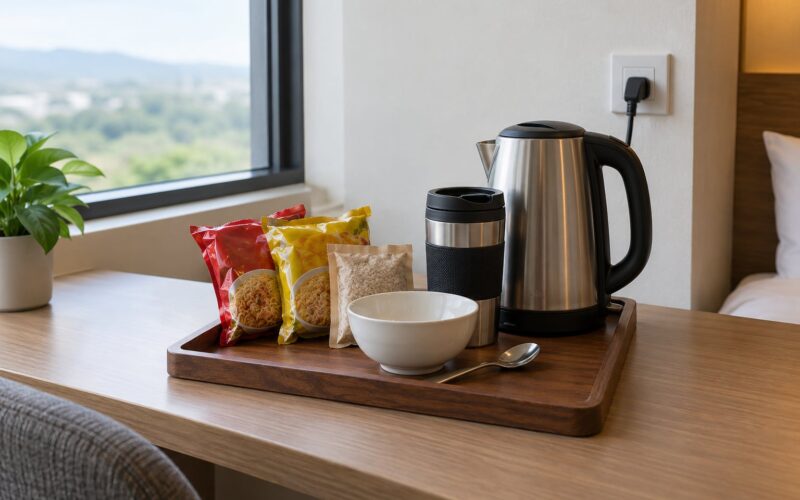
Hostels with a shared kitchen suit a solo traveler who wants to cook small amounts, though you may need to book a slot. Hotels without kitchens are workable if there is a small refrigerator. Apartments and guesthouses often have a hot plate, a kettle, and a microwave, which is genuinely enough for one-pot meals and no-cook lunches.
Pick a base within a short walk of a supermarket, a bakery, and a market if you can. That single factor does more for a food trip than almost anything else, because it decides whether you will actually cook or quietly order in.
If there is no refrigerator at all, plan around that. Buy food you can eat the same day, keep a cooler bag with ice for anything perishable, and lean on the no-cook list below. A room with a kettle and a good bakery nearby is not a failure; it is just a different trip.
3. Set a Daily Food Budget and Name Your Split Out Loud
Work out what your total food budget looks like per day, then decide in advance how much of it is the anchor meal and how much covers everything else. Writing the split down before you arrive is what stops it from drifting.
Research typical costs locally rather than trusting numbers from another country. Two things move food costs more than anything else: how central you are, and whether the place is a tourist strip or four streets back. A week’s worth of cooking in a busy city will never match cooking in a small town, so let your research set the figure rather than a rule of thumb from somewhere else.
Do not build the budget around raw costs only. Add the things that quietly eat a budget: coffee near the tourist area, luggage snacks, a second cocktail at the anchor dinner. Decide which of those you are happy to pay for.
4. Research Markets and Neighborhood Food Sources
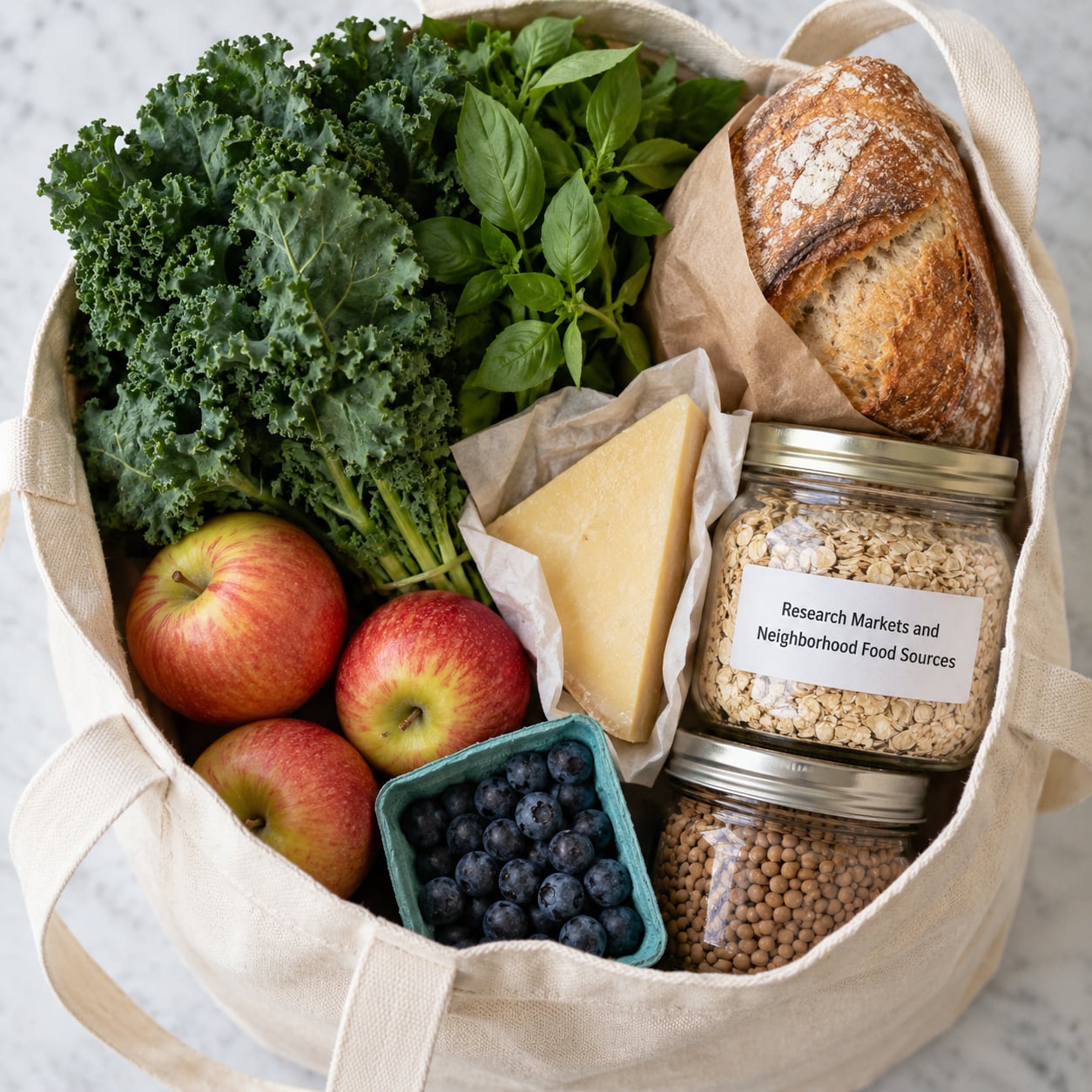
Open-air markets give you the trip’s flavor, supermarkets give you reliability, and you need both. Markets sell the ingredients that make the food here taste like this place: the actual cheese, the actual bread, whatever is seasonal that week. Supermarkets sell the staples that fill gaps and let a market day happen.
Compare them on a few practical things: what is actually produced locally, whether stalls sell prepared food you can eat on the spot, when they run, whether you can carry everything back in one trip, and how far they are from your base.
Check current local information before you go. Stall schedules, opening patterns, and delivery services all vary and change, and a market that mattered to someone else’s trip last year may not run on the same days now.
Back at the base, keep a simple list of your sources: market for produce and bread, supermarket for staples, deli counter for easy protein, and the one cheap counter place for a genuinely lazy night.
5. Shop Once for Simple Meals That Repeat All Week
Plan meals around components that do double duty, not dishes that need their own shopping trip. The reliable pattern is one grain, one protein, one vegetable, one sauce, and then assembly rather than cooking.
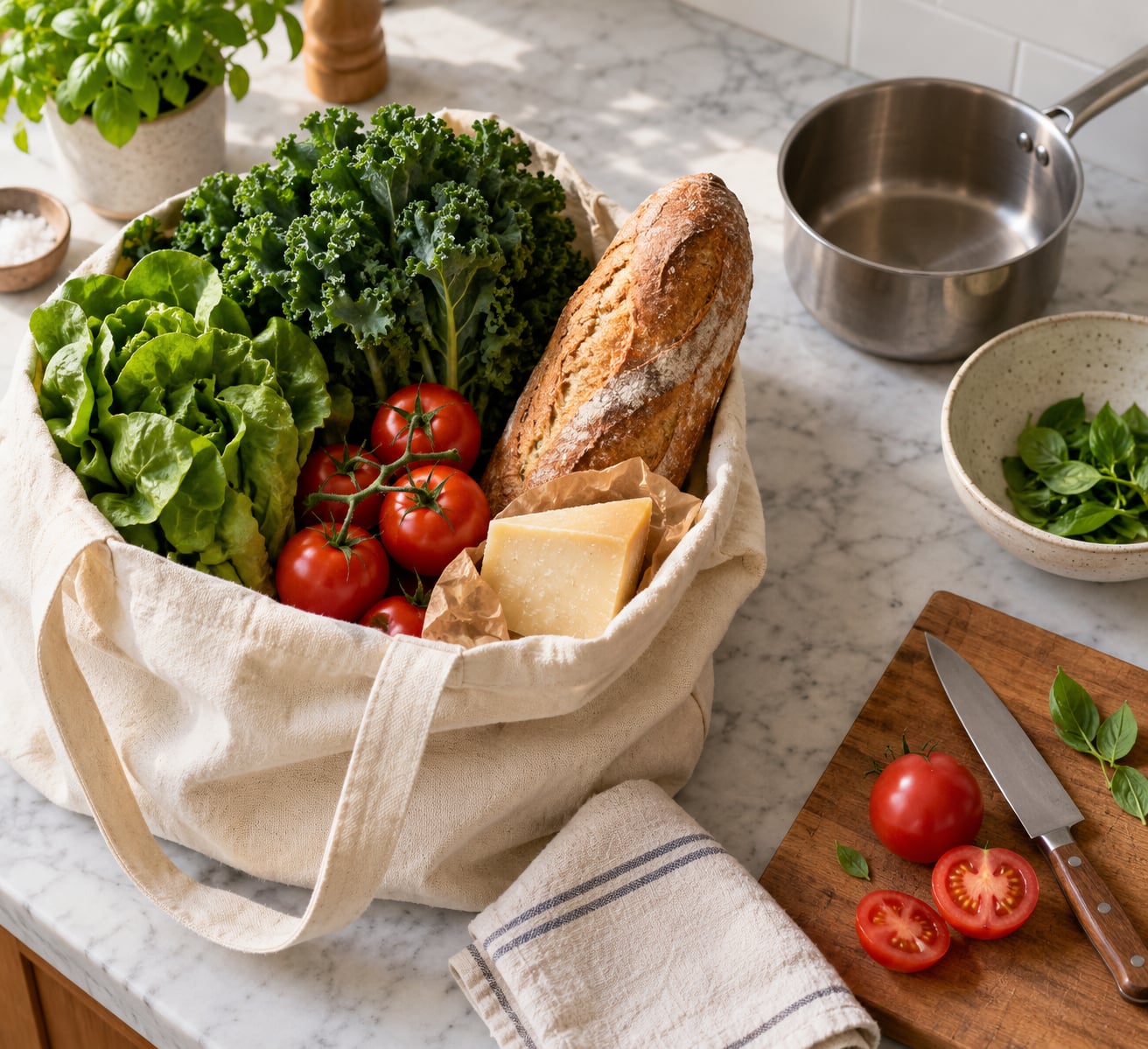
Build the list from things that repeat: a grain that works hot or cold, something you can roast once and use twice, a salad that gets interesting with different dressings, bread you can turn into sandwiches and toast, and fruit that survives a week without refrigeration.
Buy your pantry basics on the first supermarket run: bread, eggs, cheese, coffee, tea, olive oil, salt, pepper, something acidic, a starch. That base handles breakfast and snacks for most of the week without a second thought.
For a solo traveler, portion sizes are the real skill. Buy one portion of protein rather than a family pack, and choose a cut of produce that keeps. A week of leftovers is a plan, not an accident: cook two dinners, eat the second one the next night, and the third becomes lunch.
If you are cooking for a group, split the shopping across people and give each person one category. It is the fastest way to keep a rental kitchen from turning into a two-hour negotiation.
6. Choose Light, Realistic Cooking Methods
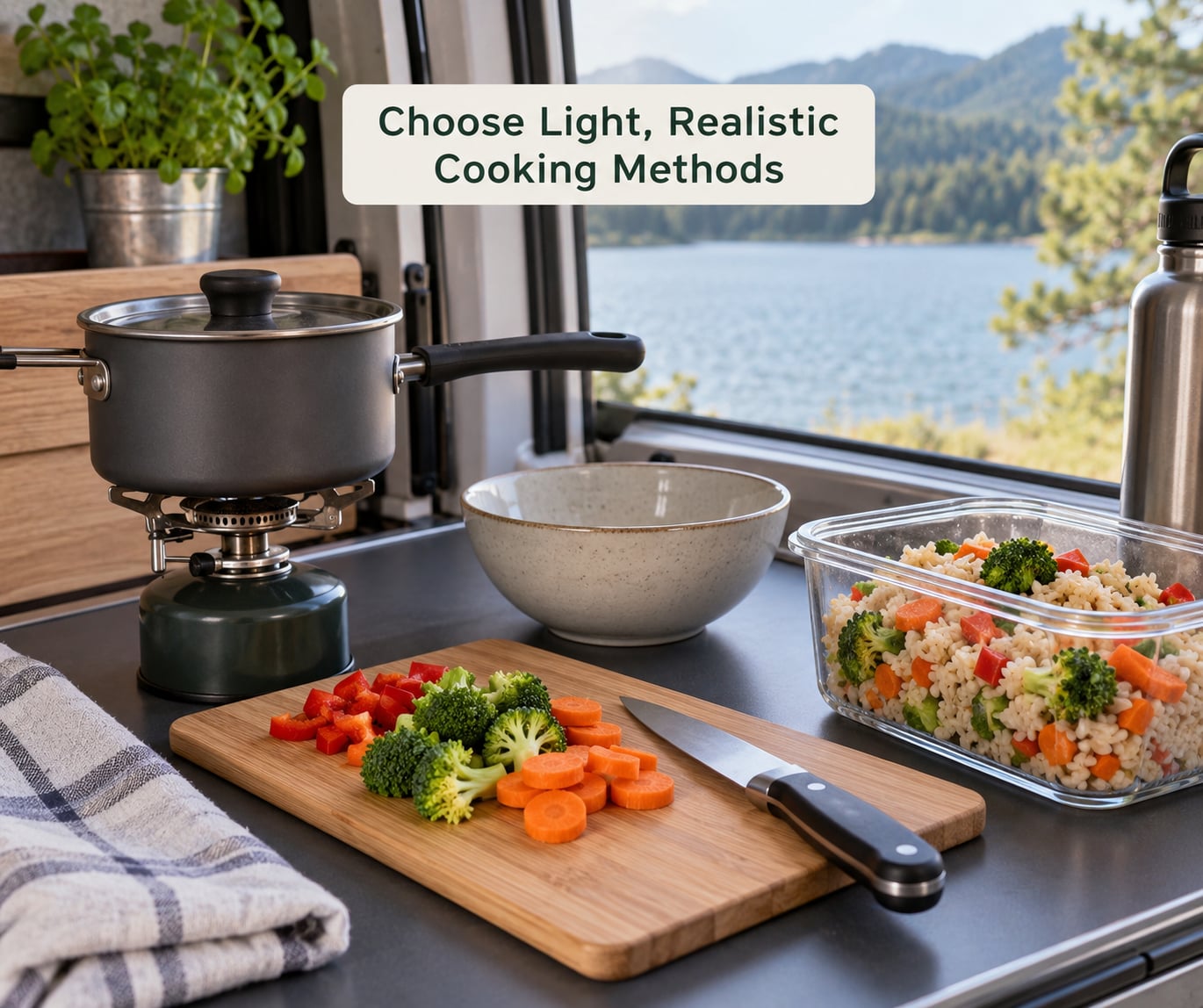
Assume the kitchen has two burners and no oven, or an oven that heats unevenly, or a kettle and nothing else. Choose cooking methods that work anyway.
- No-cook assembly. Bread, cheese, tomatoes, cured meat, olives, nuts, fruit. This is the most underrated method and it survives any kitchen, including none.
- One-pot meals. Stews, curries, pasta with vegetables, soup. One pot, one wash, and the next day’s lunch is already handled.
- Sheet-pan roasting. Line it with foil, roast protein and vegetables together, and clean-up is close to zero. If there is no oven, use the stovetop version.
- A slow cooker. Ideal for travel because it cannot burn anything, but start it before you leave for the day. That single habit is the difference between a slow cooker that helps and one that surprises you at midnight.
- A small electric kettle. Pasta, instant grains, reheating, boiled vegetables, and hot water for coffee.
Food safety is not optional. Poultry should reach 165°F or 74°C, ground meat 160°F or 71°C, and whole cuts and fish 145°F or 63°C. If you carry a small thermometer, use it; guessing at doneness by pressing is not a method.
Keep the low-effort fallback list ready for the night you cannot face a stove. Rotisserie chicken, bakery bread, and a bagged salad needs no cooking at all and still beats a restaurant meal. People on the road reach for this combination constantly for exactly that reason.
7. Store and Reheat Food Safely
Use the two-hour rule. Perishable food should not sit out for more than two hours, and in hot weather that drops to one hour. Hot weather includes anywhere genuinely warm, and a parked car counts.
Refrigerate leftovers within that window, in shallow containers so they cool quickly. Keep your refrigerator below 40°F or 4°C, and leave some air around containers rather than packing the shelf solid.
A cooler bag with reusable ice packs solves a lot of problems: day trips to a market, transit days, and stays where the refrigerator is questionable. Keep raw protein sealed and separate from anything ready to eat.
Reheat leftovers until they are steaming hot throughout, not just warm on top. One reheated portion in a container is often better value than cooking a second batch.
Follow local health guidance for the region you are in. Advice written for a temperate climate does not travel well, and in hot or humid places the rules are tighter, not looser.
8. Keep a Few Meals Flexible on a Food-Focused Trip Without Eating Out Every Meal
Rigid plans break. A market closes, a train runs late, someone invites you somewhere, the weather is too hot to cook. Build in slack so breaking the plan costs you nothing.
Leave two or three meals across a week unplanned. These are your landing spots for an unexpected market feast, a long walking day that ends at a bakery, a seasonal closure, or a recommendation from someone you like.
Keep a short backup list for each part of the day: groceries that make a meal in fifteen minutes, prepared food within walking distance, and one nearby casual option you have already walked past. Having walked past it matters, because it is the place you will go at nine at night.
Plan arrival and departure days separately. Your first evening is usually arrival at an unfamiliar hour with an unfamiliar fridge, so make it the easiest meal of the trip: assemble rather than cook. Your last morning needs no plan at all if you buy something portable for the journey.
Finally, make sure the food tour or cooking class is inside the budget rather than added on top of it. On a food trip, that experience is often the best-value item you will book, and the cooked meals around it are what let you afford it. Budget it as one anchor meal, not as an extra.
Common Mistakes
Common Mistakes and Quick Fixes
- Treating every meal as an outing. Decide the anchor before the day starts. If nothing about a place is destination-specific, it is not the anchor.
- Booking a place with no kitchen or no refrigerator. Check before you book, and pick somewhere within walking distance of a supermarket.
- Shopping for the week on day one. Buy pantry basics and market produce first, then top up at the supermarket later in the week.
- Buying greens and expecting them to last. Shop produce every two or three days, and buy a little less each time.
- Cooking elaborate meals after long days. Plan one low-effort fallback meal in advance so exhaustion does not push you to the nearest restaurant.
- Handling raw meat on the move. Pre-cooked proteins need less space, less attention, and no cooler discipline.
- Leaving the slow cooker for later. Start it before you go out, not when you come back hungry.
- Over-buying for a group without a list. Assign categories and let one person own the list.
- Forgetting the social part. If your group wants to eat out and you want to cook, cook one night and let the other nights go. You will get your meal and keep the peace.
- Building a timetable with no gaps. Leave slack. The trip is food, but the schedule is just scaffolding.
Four quick adaptations worth knowing. Solo travelers should buy single portions and choose produce that keeps; nobody is going to finish the bag of spinach. Anyone without a rental car should keep every source within walking distance and plan for the cooler bag, because shopping trips get harder fast.
Travellers with dietary restrictions often eat better and cheaper in a kitchen than at a restaurant, because you control every ingredient. Check labels at the market rather than assuming, and keep one known-safe meal in the pantry for days when reading labels gets tiring.
For slow travel, the whole plan simplifies: one base for a week means one shop per market cycle, a properly stocked pantry, and more time for slow cooking.
Frequently Asked Questions
Can I eat well on a food-focused trip without a kitchen?
Yes, as long as you have some food storage. A small refrigerator plus a kettle supports cold meals, sandwiches, salads, pasta and one-pot dishes. Look for a deli counter, a bakery and a supermarket within walking distance, and keep a no-cook list ready: bread, cheese, cured meat, fruit, nuts. You lose hot meals, not good ones.
How should I shop for food while traveling alone?
Shop small and often. One person should buy single portions of protein, produce that keeps, and enough for two or three days rather than a week. Use a tote and containers so nothing is single-use, and write your list before you go so impulse spending has to compete with something. Repeat the same route each time so shopping stops costing you mental energy.
What is the easiest way to keep groceries safe in a hotel room?
Use the two-hour rule: refrigerate perishable food within two hours, or within one hour in hot weather. Keep the refrigerator below 40°F or 4°C, use shallow containers, and leave air around them so they cool quickly. If the room has no refrigerator, a cooler bag with reusable ice packs works for market trips and transit days. When in doubt, buy food you can eat that day.
How do I handle dietary restrictions when planning meals myself?
Cooking gives you more control than restaurants usually do, because you choose every ingredient. Read labels at the market rather than assuming, and ask the person behind the counter when anything is unclear. Keep one known-safe meal in your pantry for days when reading labels gets tiring. For severe allergies, check whether local shops carry allergen-free ranges before you arrive, because that varies a lot between places.
Should I cook every meal to save money on a food-focused trip?
No, and trying to will usually make the trip worse. Cooking every meal turns a food trip into a chore and leaves no budget for the experiences that made you come. Cook breakfast, cook dinner most nights, and spend deliberately on one anchor meal a day. That keeps costs down without turning every evening into washing up after a long day out.
How do I plan a food-focused trip without eating out every meal?
Pick accommodation with a kitchen or at least a refrigerator, within walking distance of a supermarket. Set a daily food budget and split it into one anchor restaurant meal and everything else. Write a loose meal plan before you leave, shop at the market on your first full day, cook one-pot and no-cook meals, keep perishable food within the two-hour rule, and leave two or three meals flexible. Book one food tour or cooking class as your anchor, budgeted inside that same plan.
Conclusion: Start With One Flexible Self-Catered Meal
The whole method comes down to three moves: pick a base that can feed you, choose one meal a day worth paying for, and make everything else easy enough to do when you are tired. Everything else, the market list, the portion sizes, the food safety rules, the cooler bag, exists to protect those three moves.
Start small. Confirm your lodging has a refrigerator and a stove, name the one meal you most want to pay for, and plan a first dinner you can build from a single market shop. If that first meal goes well, you have a week of eating well without turning the trip into cooking duty.
Slow down for the food, not just the sights. A single week in one neighborhood, a market you return to until you know the stallholders, or a tea stop that becomes part of the routine will do more for a food trip than a fast itinerary across three towns.