A local walking tour is worth the money when the guide adds context you could not get on your own in the same time: accurate history told through real stories, a route that makes sense on foot, and a group small enough that you can actually ask a question. Here is how to find one in about 30 minutes of checking, before you pay anyone.
Most disappointing tours are not scams. They are simply mismatches — a scripted commentary read at a landmark instead of a story, or a group too large to hear over. This guide was last reviewed in 2026, and the checks below work in any city.
One quick decision rule before the details: pay for a guide when you want context you could not get in 20 minutes of reading. Skip the tour when you mainly want freedom, photos and the odd doorway down a side street.
Table of Contents›
- What You Need
- Step-by-Step
- How to define what makes a tour worthwhile
- Check the route before the price
- Read recent reviews for guide quality
- Compare inclusions and hidden costs
- Choose the right tour for your pace and group
- Look for local knowledge, not just local branding
- Book with a clear cancellation and meeting plan
- Common Mistakes
- Frequently Asked Questions
- How much should I tip on a free walking tour?
- Is it better to go on a walking tour or explore on my own?
- What are the cons of self-guided walking tours?
- Is it safe to book a walking tour through a marketplace like GuruWalk or a big booking site?
- What should I do if a walking tour is not worth what I paid?
What You Need
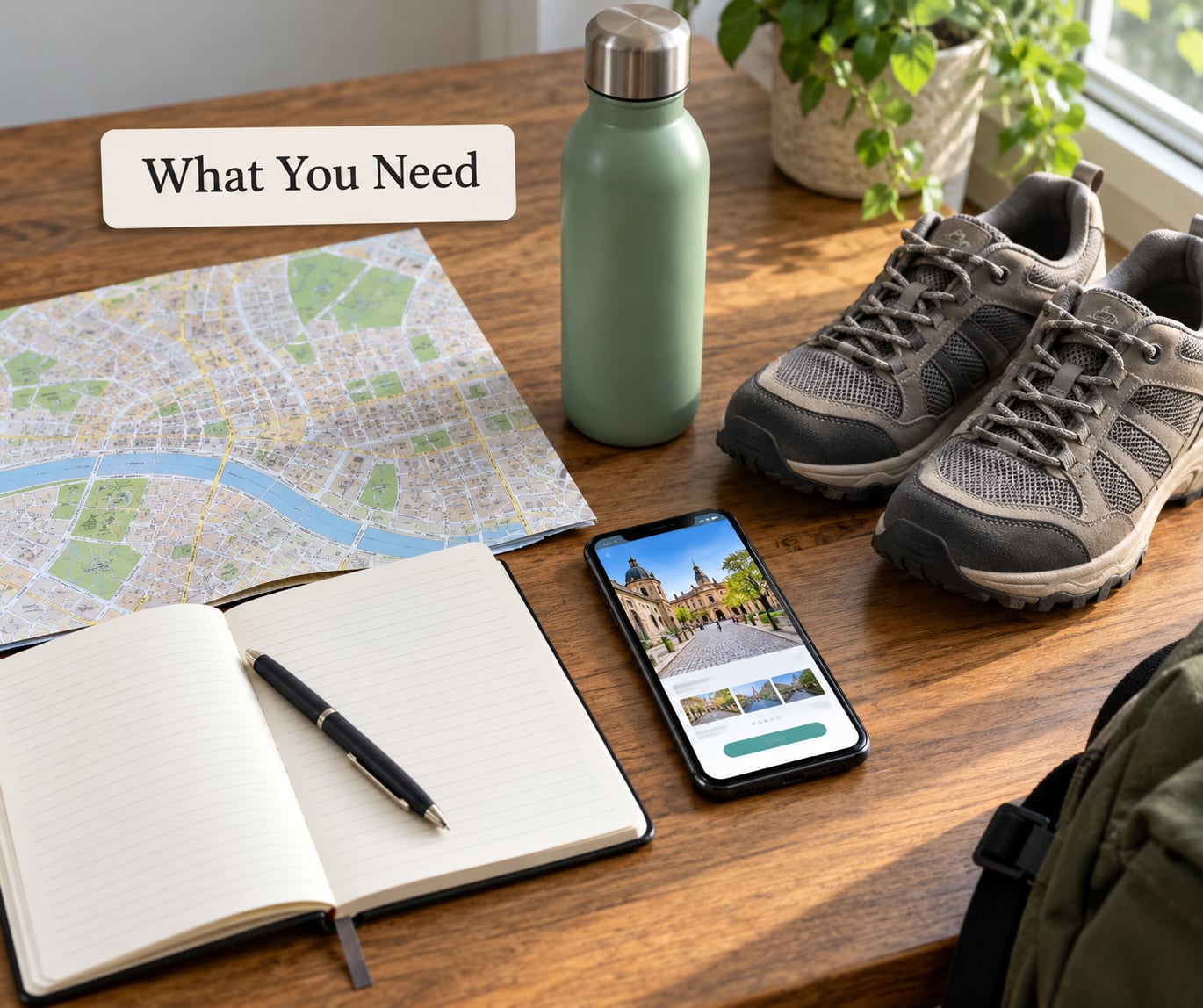
You need six things settled before you compare a single listing. Gathering them first turns a vague search into a short, decidable list.
- The neighbourhood focus. Old town, harbour district, street art, food, Jewish quarter, 1960s architecture. A tour that covers everything covers nothing.
- Your real dates and the hour you can walk. A tour that runs at 8am is a different product from one at 6pm.
- An honest note on your walking fitness. Two hours of flat pavement is not four hours with cobblestones and stairs.
- A spend ceiling you would actually defend. Decide what a good three hours is worth to you before a listing starts flattering you.
- The one thing you want to come away with. Orientation, a story you can retell, a list of places to eat, or just company for an afternoon.
- Twenty minutes of review reading. Filtered to the last three to six months, and to the season and time of day you would book.
The last item does the most work. A guide brilliant in July is a different experience from the same guide in November drizzle, and reviews reflect that when you read past the headline number.
Step-by-Step
How to define what makes a tour worthwhile
Start with the benefit, not the sights. Write one sentence: after this walk I want to be able to explain why this city looks the way it does. Orientation, food, architecture, photography, a manageable first day, or a companion for a few hours — these are different products sold under one heading.
Two SERP-ranking guides for this query agree on the same filter, which tells you it is the useful one: match the tour theme to what you actually want before you look at anything else. A landmark-heavy loop is a poor buy for someone hungry, and a food crawl is a poor buy for someone who wants the Romanesque portal at the north transept.
You have defined the tour correctly when you can tell whether a listing fits by reading the first two lines of its description. If the description does not name the theme, the tour probably does not have one.
Check the route before the price
Look for four specifics: total distance or duration, elevation or terrain, where you sit or pause, and whether bathrooms or a cafe break are part of the route. Listings that state all four are usually run by someone who has thought about a group on foot. Listings that say only “2.5 hours, see the highlights” are selling you a vague noun.
Watch for padding. Fifteen stops in two hours means you are standing in doorways rather than listening. A focused route with eight stops and time to sit down usually beats the wider one.
Forum advice on picking between tours is blunt and correct: ask where they go first, because “historic centre” and “river and market” are different days out. Do not compare on duration alone until the stops match.
Read recent reviews for guide quality
Sort by newest and read the specific ones — the ones that name the guide, mention a street or a story, or complain about something specific. Generic praise tells you nothing. A review that says the guide answered questions about 1920s housing policy for twenty minutes is doing the work you need it to do.
Scan for five behaviours: real knowledge beyond the brochure, storytelling rather than recitation, a pace that let people keep up, friendliness without pressure, and whether the guide recommended somewhere you then went and liked.
A good result looks like reviewers describing what the guide knew and why they cared, not what the tour “was.” If reviews only tell you the group had a nice time, you learned nothing about the guide.
Compare inclusions and hidden costs
Build a like-for-like column before you compare anything. Ticket inclusions, food or drink, transport between sites, headset equipment, entrance fees, optional extras, and the tip expectation all belong in one place.
Then read the cancellation terms. A tour sold with a free cancellation window up to 24 hours before the start is a different risk profile from one where the balance is non-refundable the moment you book, and that difference matters far more on a trip where your schedule may move.
Two fees catch people out repeatedly. A “free” tour still pays a per-head booking fee behind the scenes, and tips are sometimes remitted to the company rather than going straight to the guide — a fair arrangement, but one you should know about before deciding it does not suit you. An outfit documenting the tip-based model notes the arrangement leaves some guides, especially students working a summer, worse off than a fixed-price tour does.
Choose the right tour for your pace and group
Pace is the most underrated value factor. A slower group with a cap of around fifteen is worth more per hour than a fast one with thirty people and headsets.
| Format | Typical group size | Best for | Main catch |
|---|---|---|---|
| Free or pay-as-you-wish | Large, varies by weather and turnout | Orientation on a tight budget, and a low-risk first taste | Quality swings hardest; tips expected at the end |
| Fixed-price small group | Around 10 to 15 | Most first visits, and anyone who wants to ask questions | Fixed schedule, less flexibility on the day |
| Private tour | Just your party | Mobility needs, children, a specific interest, tight timings | The per-person cost only makes sense with a full group |
| Self-guided app or route | Just you | Repeat visits, slow mornings, travellers who dislike crowds | No local perspective; you get only what you already knew to look for |
Match the format to the traveller too. Solo walkers usually do better in a small group than on a private tour, where the guide is working overtime for one person. Families with a stroller, or anyone with limited mobility, need terrain and duration confirmed in writing, not inferred from a photo.
Look for local knowledge, not just local branding
“Local” gets claimed a lot. The tells are more specific: does the guide live in the neighbourhood, recommend a specific place with a reason attached, or tell you what has changed recently in a district that tourists do not photograph?
Forums on pay-as-you-wish tours report that quality is not a function of price — some of the best walks people take are free ones, in Tallinn and Ljubljana — while also reporting guides who were in town for a summer and got facts wrong all afternoon. Both can be true. That is exactly why you check for stated credentials rather than assuming.
A guide worth paying for will usually state something verifiable up front: a degree, a guiding licence, years on the same route, or a neighbourhood they grew up in.
Book with a clear cancellation and meeting plan
Before paying, write down five things: the exact meeting point in words, the start time with a time zone, the finishing time, what happens in rain, and how you reach the guide on the day. Then screenshot the confirmation. This is the stage at which most bad surprises are actually created, and all of them are avoidable.
Ask what happens if conditions change or the route is modified mid-walk. An operator with a stated policy for that has thought about it before, which is a reasonable proxy for how they handle everything else.
You have picked the right tour when you could explain the choice to a friend in one sentence and point to the two pieces of evidence that convinced you — a route that matches your theme, and reviews that describe the guide’s behaviour rather than the weather.
Common Mistakes
1. Booking on photos. Marketing images are shot at golden hour on the quietest street. Fix: look for the route description, the distance and the group cap. If those are missing, you are buying a mood, not a walk.
2. Ignoring what a review is not about. Five stars saying “beautiful day, lovely guide” is a weather report. Fix: read only reviews that describe something specific, and read the critical ones twice as carefully.
3. Accepting shopping or restaurant stops you did not choose. This is the most common complaint on travel forums, and the reason is simple: those stops pay commission. Tour time spent eating at a place that pays the guide is not your afternoon. Fix: check the itinerary for food or shop stops, and ask directly whether any stop is commission-based.
4. Confusing dryness with professionalism. A guide who recites dates at a wall is not adding value. Fix: prioritise energy and storytelling in the reviews, and treat monotone delivery as a dealbreaker rather than a personality clash.
5. Paying the private-tour rate alone. A private tour divided between two people can be reasonable; the same tour for one traveller rarely is. Fix: compare per-person cost across formats before assuming private means better.
6. No plan B on the refund front. Fix: photograph the cancellation policy before you pay, check the deadline against your own schedule, and note the operator’s contact details somewhere other than the booking app.
A few habits add value cheaply. Ask the front desk of your accommodation where they send guests; locally-run tours rarely run ads and word of mouth is accurate. Start early in the morning, when the streets are emptier and guides have more energy. And when you tip a pay-as-you-wish guide, do it at the end without being asked twice — a tip you were pressured into is not a thank you.
Frequently Asked Questions
How much should I tip on a free walking tour?
Tip based on satisfaction and tour length rather than a fixed rate. Guides and forums commonly treat a couple of tens of currency units for a two-hour walk as ordinary, with more for a long or genuinely excellent tour and less if the group was huge or the commentary thin. Give it at the end without announcing it, and tip the guide personally rather than leaving cash with the company if the arrangement allows it.
Is it better to go on a walking tour or explore on my own?
Take the tour for your first full day in a city, when context is what you are missing and you want a feel for the layout. Go alone when you have been there before, when you have a slow morning and a camera, or when a fixed schedule and a group drain you. A common good pattern is a cheap orientation tour on day one, then independent walking for the rest of the trip.
What are the cons of self-guided walking tours?
You see what you already know to look for, so the same streets you would have found alone. There is no local answer when something is closed, renamed or controversial, and nobody stops the group when a door is open behind you. Apps are genuinely good for audio commentary in big cities and for accessibility reasons, but they cannot replace someone who eats at the place around the corner.
Is it safe to book a walking tour through a marketplace like GuruWalk or a big booking site?
These sites are third-party consolidators selling other companies’ tours, so the listing quality and the guide quality can differ. Check for a named guide or company, a stated group cap, an exact meeting point and a cancellation policy before paying, and read reviews that describe the guide rather than the platform. A clear fixed price with free cancellation is a reasonable baseline for trust.
What should I do if a walking tour is not worth what I paid?
Say something early and calmly while the tour is still running; guides often adjust pace or skip a stop when a group is unhappy. After, write down what went wrong while it is fresh and send it to the operator within the cancellation window, referring to the policy you screenshotted. Booking platforms usually route complaints through a formal process, and documented refunds are far more common than vague complaints.
To find a local walking tour worth the money, decide what you want from the walk, then read the route and the newest reviews before you read anything about cost. Match the theme to your interest, check the group cap and the terrain, and book the option with a stated meeting point and a real cancellation policy. Everything else is decoration.