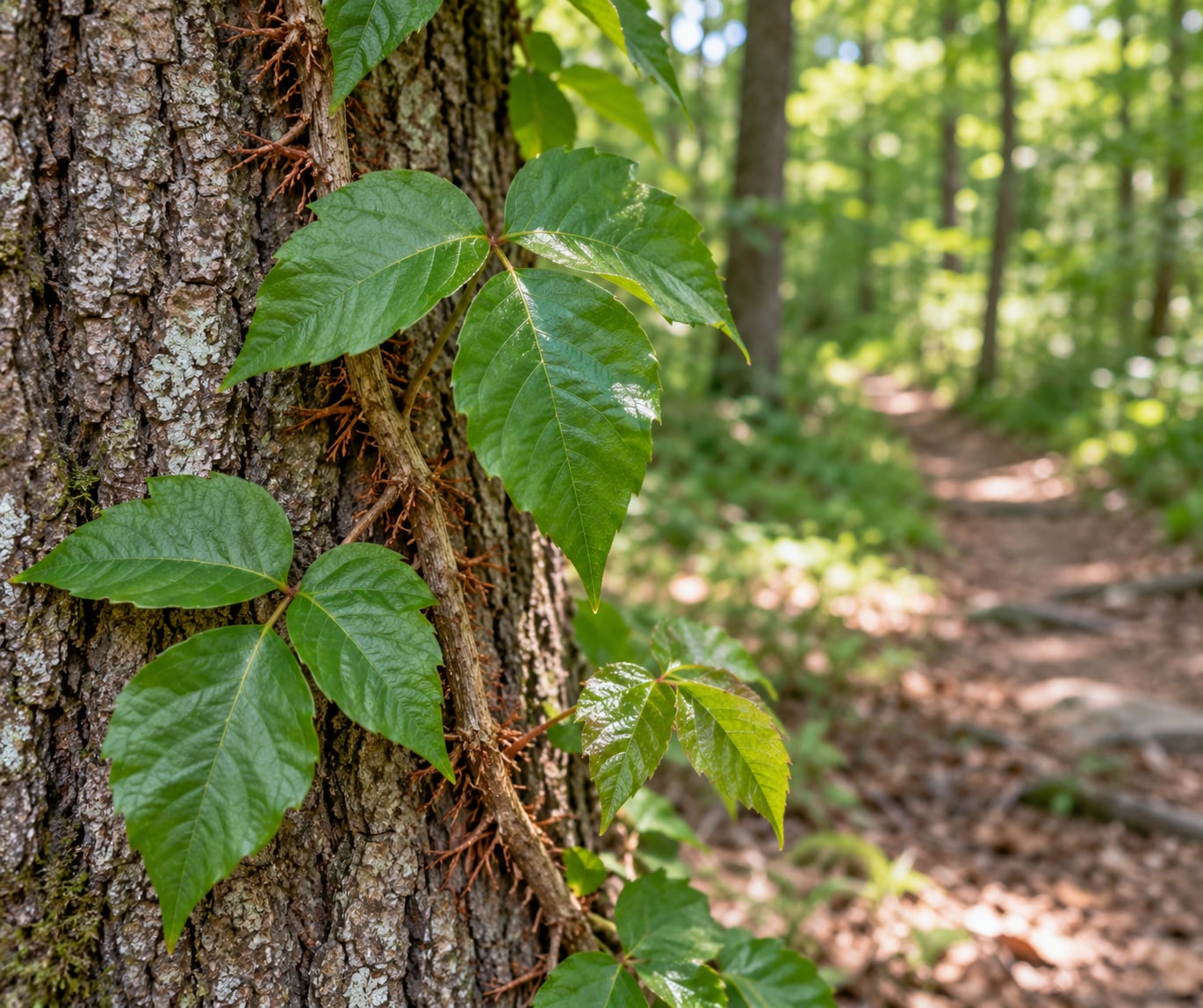
To learn how to identify poison ivy before you touch it, check four things from several feet back: three leaflets per stem, a woody climbing vine or low groundcover habit, fine reddish-brown aerial rootlets on the stem, and grayish-white berries. Use a camera zoom or binoculars rather than kneeling beside the plant.
That rule matters more than most people expect. A single brush against the plant coats your skin or gear with urushiol, an oily resin that is invisible, odorless and absorbed quickly. The rash shows up one to two days later, so by the time it appears you have usually forgotten the hike or the fence line where it happened.
I have walked enough wooded trails to know the moment most people go wrong: they get close enough to count leaves, then pull, snap or push a stem aside to see the underside. Everything below is built to keep you at arm’s length from the first second.
Table of Contents›
- What You Need
- How to Identify Poison Ivy Before You Touch It
- Step 1: Check the Overall Plant Shape
- Step 2: Examine the Leaf Edges and Surfaces
- Step 3: Look for Stems, Vines, and Roots
- Step 4: Note Berries, Flowers, and Seasonal Changes
- Step 5: Use Distance, Photos, and Local Guidance
- Common Poison Ivy Identification Mistakes
- What to Do If You Cannot Identify It
- Frequently Asked Questions
- Can poison ivy grow as a shrub instead of a vine?
- How do I tell poison ivy from Virginia creeper?
- Does dead or bare poison ivy still cause a rash?
- Can you get a rash without touching poison ivy?
- How soon does a poison ivy rash appear after contact?
- Conclusion
What You Need
You need very little, and none of it requires touching the plant. Bring long pants and long sleeves you do not mind ruining, because fabric that brushes a vine picks up oil that can sit there for weeks.
A phone with a decent zoom lens covers most situations, and a pair of binoculars makes woodland edges much easier to read from a distance. A trail marker, a stick you can lay across a path, or a pinned location on your phone helps you mark a suspicious plant so nobody else walks into it later.
Keep soap and water within reach. This is not for cleaning the plant, which you should never handle, but for your own hands and forearms if you think you brushed something. If you are walking with a child or a dog, decide the boundary before you enter dense growth, not halfway through it.
If you have already been through a patch and cannot get to water, keep going and deal with it at the next stream or campsite. Warm water and soap work; a wipe or a dry brush does not.
How to Identify Poison Ivy Before You Touch It
Poison ivy (Toxicodendron radicans) grows as a woody vine, a trailing groundcover or a low shrub, and it wears three almond-shaped leaflets with a waxy sheen, arranged on alternating stems. Mature vines climb trees and fences using fine reddish-brown aerial rootlets, and mature females put out clusters of grayish-white berries. Look at all of that from outside arm’s reach.
Two things make this harder than a single picture suggests. First, the leaves change through the year, so a photo taken in July tells you little about the bare vine you will meet in February. Second, several harmless plants wear three leaves too, and the confident answer comes from checking habit and stem, not from counting alone.
Step 1: Check the Overall Plant Shape
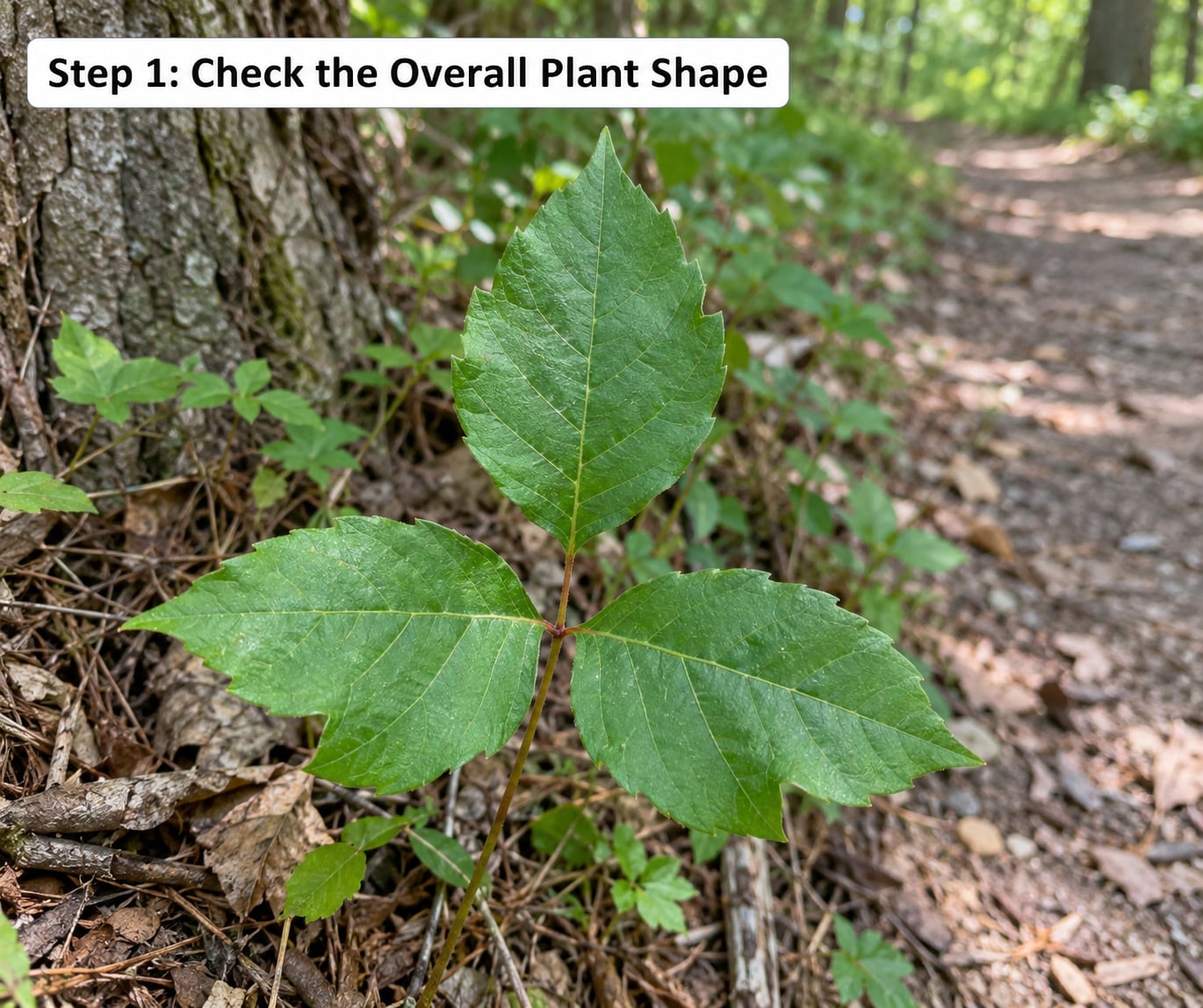
Look for three leaflets joined at the end of one stem, with the middle one on a noticeably longer stalk. Poison ivy leaflets are usually longer than they are wide, pointed at the tip, and arranged like three fingers on one hand.
Five is a useful number too. If a branch consistently shows five leaflets, you are looking at something else, most often Virginia creeper. One of the most repeated corrections on plant ID forums is exactly this: a plant gets called poison ivy on a single photo, then someone counts and finds five leaflets on several stems.
Younger plants break the pattern, so treat three leaflets as a reason to look closer rather than a reason to relax. Some leaves come in pairs on very small shoots near the ground.
Step 2: Examine the Leaf Edges and Surfaces
Poison ivy leaf edges are usually coarsely toothed or slightly uneven, with a pointed tip and a surface that catches light like a waxy or glossy leaf in summer. Autumn color runs yellow to orange to red, and spring shoots often come up reddish.
Boxwood has opposite leaves and a rounded, leathery edge, and it grows as a clipped hedge rather than a climber. Wild blackberry has serrated leaflets, but the edges are much sharper, the stems are prickly, and the leaflets are not all on one stalk. Raspberry and blackberry also form canes that stand above the ground on their own.
Young elm and young ash can throw three or five leaflets in opposite pairs, which is the giveaway: poison ivy leaves alternate along the stem, they do not sit in pairs directly across from each other.
Step 3: Look for Stems, Vines, and Roots
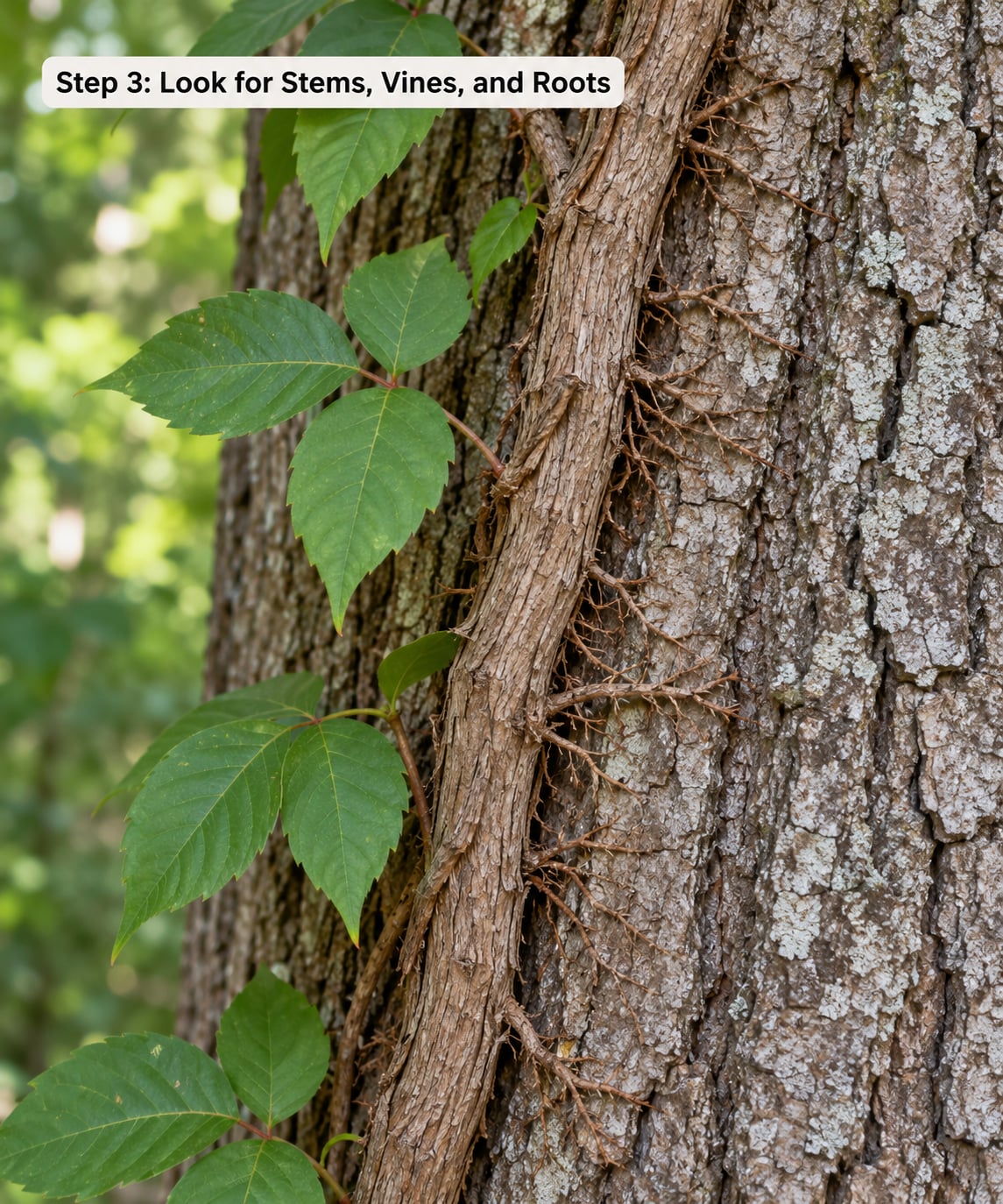
This is the step experienced foragers actually use. A mature vine has a woody, rope-like stem and grips bark, posts and siding with hundreds of fine, hair-like aerial rootlets that look reddish-brown to gray. Experienced people anchor on that habit rather than on leaf count.
You can also find poison ivy where there is nothing to climb, as a waist-high tangle in a flower bed or a mat across a lawn edge, with separate upright shoots that look like small shrubs. That form surprises people most, because they had it filed as a tree-dwelling vine only.
Do not dig at the base to confirm anything. Do not pull the vine off a log, cut through a root, or kick aside stems to look underneath. Roots and rootlets carry the same oil as the leaves, and clearing one out of a pile usually spreads it to every other stem in the pile.
Step 4: Note Berries, Flowers, and Seasonal Changes
Small pale greenish-white flowers appear in late spring, followed by clusters of dull grayish-white berries that hang on short stalks. Berries are a strong confirmation, and they are also the one sign that makes strangers obvious, since poison ivy berries are off-white rather than the red or blue of most woodland fruit. The pale color also means no animal is eating them, which is its own warning.
In winter the leaves are gone and the vine is bare, but the woody stem and the rootlets hugging the trunk remain, which is how it gets identified in the cold months. Old dead vines in a woodpile keep the stem and rootlets too.
A plant that is dead, brown or half-eaten should still be treated as suspect. The oil does not leave a dead stem, and a bare vine is exactly the kind of thing you grab for firewood without a second look.
Step 5: Use Distance, Photos, and Local Guidance
Zoom in, do not lean in. Fill the frame with one leaf cluster and one length of stem, shoot in daylight rather than zoom at dusk, and include something for scale like a fence post or a boot in a second photo. Record the date and the exact spot, because a photo of leaves alone is often not enough for a confident answer.
When a photo is not decisive, a state extension service, a county parks office or a university plant clinic is a better second opinion than a stranger’s guess in a comment thread. Extension agents see regional plants every day and answer identification questions without any risk to you.
Never use smell or taste as a test. Urushiol has no odor, so a plant that smells pleasant is not proven safe, and tasting an unknown plant in a field is a good way to end a trip early.
Common Poison Ivy Identification Mistakes
Assuming every three-leaf plant is poison ivy. Three leaflets only narrow the field. Count leaflets across several stems, check that the leaves alternate rather than pair, then check the stem for rootlets. A plant that is consistently five-leaflet is almost certainly not poison ivy.
Testing a plant by touching it. There is no safe touch test, and gloves are not a guarantee because the oil soaks through thin fabric. The fix is to treat anything that matches your uncertainty as poison ivy and go around it.
Ignoring the vine. Plenty of people identify the leaves correctly and then walk straight through the trailing stem at ankle height. Check the ground along your route as well as the eye level, especially on old fire roads and along fence lines.
Ruling it out from a blurry photo. A distant, backlit phone photo hides the one clue that matters, the stem. If you cannot see the stem in the picture, treat the identification as unconfirmed and give it room.
Assuming it only grows in the woods. Woodland edges, roadside ditches, disturbed ground, sand pits and freshly cleared lots are all classic habitat. Poison ivy likes disturbed soil around tree lines, which is where a lot of trail building and yard clearing happens.
Two more habits help more than any app. Walk narrow trails rather than cutting a switchback through the undergrowth, and keep your arms close to your body when you brush past a tree instead of reaching out to steady yourself.
What to Do If You Cannot Identify It
If you cannot confirm a plant, the decision is already made for you. Give unknown vegetation a wide berth, keep children and dogs away from it, and take the long way around. That rule costs a few minutes and removes the whole problem.
If you think you brushed it, your first hour matters most. Wash the skin with soap and cool water as soon as you can, then wash under fingernails, around the nails and along the forearms and face, since oil transfers from hands to those places. Wash contaminated clothing separately and rinse the machine; a load washed with your ordinary laundry spreads the oil to everything in it. Clean shoes, tools, dog harnesses and bike grips too, because oil on a surface can sit there for a long time.
If you have no water, do what you can and find some later. Do not rub your skin with dirt or leaves, which spreads the oil rather than lifting it.
Rash usually appears one to two days after exposure as itchy, blistering patches, and it can linger two to three weeks. See a clinician if the reaction covers a wide area, involves the face, eyes or genitals, or if the blistering is severe, and treat it as an urgent visit if you have trouble breathing or swallowing, which can happen with a widespread reaction. For anything else, get individual advice from a doctor or pharmacist rather than stacking home remedies.
If poison ivy has taken over a yard, do not pull it in bare hands and do not burn it, because smoke carries the oil into the air. Gloves, long sleeves and eye protection, plus repeated cutting or a properly labeled herbicide, are the usual routes, and a local extension service will tell you what works in your region.
Frequently Asked Questions
Can poison ivy grow as a shrub instead of a vine?
Yes. Poison ivy grows in three forms: a woody climbing vine, a trailing groundcover, and a low upright shrub that can reach waist height. The shrub form shows up most often in open yards, field edges and newly cleared ground, which surprises people who assume it only climbs trees. Leaves, stem and aerial rootlets look the same in all three forms, so check the shape of the whole plant before deciding what you are looking at.
How do I tell poison ivy from Virginia creeper?
Count the leaflets and look at the arrangement. Poison ivy has three leaflets, with the middle one on a longer stalk and leaves alternating along the stem. Virginia creeper usually has five leaflets fanned out like a hand, and on young shoots it can show only three, which is where the confusion starts. Leaflets in opposite pairs across the stem point toward ash or boxelder instead. When unsure, treat it as poison ivy and keep clear.
Does dead or bare poison ivy still cause a rash?
Yes. Urushiol stays in the leaves, stems, roots and rootlets, so dead growth and bare winter vines still carry it. Dry, brown vines in a woodpile are a common source of surprises because people handle them without a second look. The oil also persists on fabric, tools and gear for weeks, so an object that touched the plant can contaminate skin long after the vine is dead and dried.
Can you get a rash without touching poison ivy?
Rarely, but it happens. The main airborne route is burning poison ivy, because the oil can travel in smoke, which is why brush containing poison ivy should never go into a campfire. Clothes, tools, pet fur and shoes can also transfer the oil to skin later, which is how people end up with a rash on their arms and faces after a dog ran through a patch. Washing and separating contaminated items breaks that chain.
How soon does a poison ivy rash appear after contact?
Usually one to two days, sometimes longer, which is why people blame the wrong hike. The delay makes it hard to connect the cause, and the rash can then last two to three weeks. Washing exposed skin with soap and cool water within about an hour of suspected contact is the most useful thing you can do, and washing clothes, boots and tools separately stops the oil spreading to other people.
Conclusion
Stop at a distance and read the plant before you go near it: three leaflets with the middle one on a longer stalk, alternate along the stem, a woody vine or low groundcover with fine reddish-brown rootlets, and grayish-white berries in season. Zoom with your phone instead of leaning in, and when the photo does not settle it, treat the plant as poison ivy and go around.