To plan an accessible trip with mobility limits, work backwards from what your body can comfortably do: write down your walking distance, standing time, transfer needs and bathroom requirements, then pick a destination, a room, a transport route and a daily pace that all fit inside those numbers. Confirm every detail with the provider before you pay. Two or three evenings of research and a handful of phone calls do most of the work, and they save the trip from falling apart on arrival.
The awkward part is rarely the booking itself. It is the small unknowns: a bathroom with a step you did not see in the photo, a metro station with a lift out of service, an old town that turns a gentle hour into a struggle. Each of those is checkable before you book, and each one is easy to miss if you rely on an “accessible” label.
Here is the sequence I would follow, in the order that avoids expensive mistakes.
Table of Contents›
- What You Need
- Step-by-Step
- How to Plan an Accessible Trip With Mobility Limits
- Choose a Destination With Reliable Access
- Select an Accessible Place to Stay
- Plan Transport Door to Door
- Match Activities to Your Energy and Access Needs
- Build Rest, Backup, and Emergency Plans
- Common Mistakes
- Frequently Asked Questions
- How do I check whether a hotel is accessible?
- What should I ask an airline or train company about mobility assistance?
- How much walking is reasonable when planning an accessible trip?
- Should I book a wheelchair-accessible room?
- What accessibility information should I keep with me while traveling?
What You Need
Accessible travel planning depends on one document that most people do not write: your mobility profile. It turns vague requests like “I need an accessible room” into a list a hotel receptionist can actually act on.
Write it on one page and keep it in your phone notes. It should cover these things:
- Walking and standing limits. How far you can walk on the flat in one go, and how long you can stand still without needing to sit down.
- Sitting and resting needs. Whether you need a seat every few minutes, whether you can use a backless perch, and whether you can transfer independently or need a board or two people.
- Stairs, kerbs and slopes. Whether you can manage a short flight of steps, a handrail-less ramp, or a steep gradient with a kerb on the other side.
- Bathroom needs. A roll-in shower, a wet room, grab rails, a raised toilet seat, a wall-mounted sink, or simply a wide enough doorway for a frame or chair to turn in.
- Equipment details. Make, model, weight, folded dimensions, battery type and watt-hours if you travel with a power chair or scooter, plus whether it dismantles or folds.
- Medication and fatigue patterns. What you take, when you take it, and the time of day your energy usually drops. Jet lag and pain peaks are the two most common reasons a good plan collapses.
- Emergency contacts. A person at home, your insurer’s assistance line, your doctor or clinic, and the local emergency number for wherever you are going.
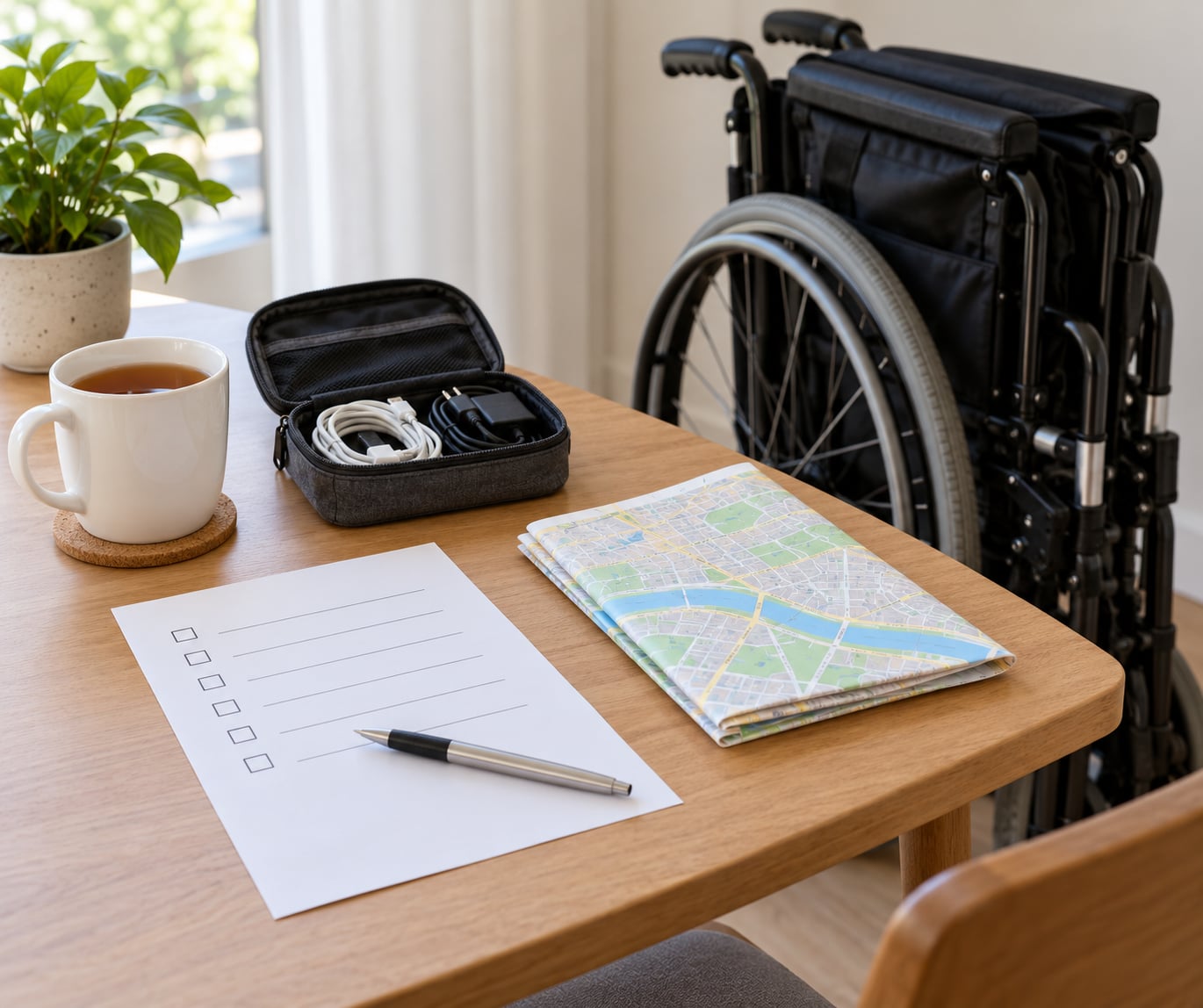
On top of that page, keep a short request checklist you can reuse: step-free entrance, lift access to your floor, door width, bathroom specification, transfer space beside the bed, and whether assistance is offered at the door. Sending the same six questions to every hotel takes far less energy than a fresh conversation each time, and it gets you comparable answers you can compare.
Do the same for transport. Ask each airline or rail company the same short set of questions about assistance, boarding method and equipment stowage, so the answers sit side by side.
Step-by-Step
How to Plan an Accessible Trip With Mobility Limits
Start with a realistic baseline rather than your best day. Most ruined days come from planning around how you walk on a good morning, not around how you walk after a long flight, a hot afternoon or a night of broken sleep.
Write down the hardest part of a normal day, not the easiest. If standing for ten minutes at a bus stop is the thing that wipes you out, then a day built around four attractions with three queues is not a good day, however accessible each venue claims to be.
Then run the whole plan through eight questions:
- What are my real limits on walking, standing, sitting and transferring?
- Which destination has reliable step-free routes, not just an accessibility policy?
- Can I verify the exact accessible room, the exact station and the exact attraction?
- Does the transport chain work end to end, from the front door to the front door?
- How many hours of the day am I spending on queues, transfers and standing?
- Where can I sit down for as long as I like, without buying anything?
- What is the plan B if a lift is broken or a path is closed?
- What am I doing if the day goes wrong?
If you cannot answer question seven for a leg of the trip, that leg is the one to fix or drop before you commit money to it.
Choose a Destination With Reliable Access
Choose the destination where the hard part is easy. A flat city with low-floor buses and working metro lifts is far more accessible than a spectacular coastal town whose old town is cobbled from end to end, and the difference is measurable rather than a matter of taste.
Screen a shortlist on four things: the proportion of step-free routes between the things you actually want to see, the quality of public transport, how far you are from a pharmacy or clinic, and how much of the appeal needs you to stand in a queue.
Searchers repeatedly name Madrid and Barcelona as comparatively manageable European cities for wheelchair users, largely because of kerb-free streets, adapted transport and accessible beaches. Valencia gets a similar write-up from accessibility guides, with an honest warning that parts of the historic centre are genuinely difficult even for people who consider the city easy overall.
Historic centres deserve particular caution. Cobbles and stairs are the most commonly reported physical barrier in European city breaks, and they cluster in exactly the districts people most want to visit. A map that says “wheelchair accessible” for a route will happily route you through a square of uneven stone. Travellers on mobility forums point out that powered chairs and scooters cope with cobbles noticeably better than manual chairs, and that the smoothest route is usually the main avenue rather than the side lane.
Two research tools come up more than any others. Google Maps will plan a wheelchair-accessible route that avoids stairs, which people travelling with limitations in places like Japan credit as genuinely useful. Wheelmap and accessible toilet maps tell you where the toilets, changing places and powered doors actually are, which matters far more once you are tired and hungry.
For beaches and nature, look for the specific kit rather than the word “accessible”: a beach access mat, a beach wheelchair, a transfer trolley, or an accessible viewpoint with a firm path to it. In the US, a lifetime access pass for national parks is available to people with a permanent disability, and a surprising number of travellers never apply for it.
Cruises get recommended often in forums for one reason: the operator publishes the ship’s own limitations and handles embarkation assistance, so the unknowns are on paper before you pay.
Select an Accessible Place to Stay
The word “accessible” on a booking site is a category, not a description of a room. The gap between the two is where disappointed travellers end up, and it shows up most often in the bathroom.
Ask the property these questions in writing before you book, and ask for the answer about a specific room rather than a room type:
- Is the entrance step-free, and is there a lift from the entrance to your floor?
- What is the width of the bathroom doorway, and is there turning space in front of the sink and toilet?
- Is the shower roll-in, a wet room, or a low step-over tray? Where exactly are the grab rails?
- What is the bed height, and is there space on both sides for a transfer?
- Is there an accessible bathroom on the same floor as the room?
- Can an accessible taxi or the local adapted taxi service reach the door?
- If the lift breaks, what is the fallback?
For a stay where you need it, the strongest move is to ask for photos or a short video walk-through of the bathroom. It is faster than three email exchanges and it settles arguments that descriptions cannot.
Front desks often cannot answer accessibility questions, which disabled travellers describe as exhausting rather than merely inconvenient. When that happens, ask to be put through to the duty manager or the person who handles accessibility, and note the name and direct number. That contact is worth more later in the trip than the booking confirmation.
Two details are worth requesting specifically. Ask for the room closest to the lift, which shortens every journey you make. And ask for the quietest of the accessible rooms, because a room off a main corridor is the reason a good night becomes a bad one.
On arrival, check the room properly before you unpack. Confirm the bathroom, the bed height and the route to the lift, and tell reception the same day if something is wrong. Most properties will move a guest who reports a real problem early, and almost none will after a full week.
Plan Transport Door to Door
Most accessible travel planning stops at the front door of the attraction. The failure happens in the gaps: the airport is accessible, the metro is not, and the taxi refuses the chair. Treat the whole chain as one thing to verify, from the front door at home to the front door of the room.
Break the journey into five legs and check each one: arrival at the airport or station, the local transit leg, any transfer between terminals or lines, the taxi or ride service, and the final stretch on foot or on wheels.
For flights, contact the airline’s assistance desk rather than relying on a field in the booking form. Ask whether you can keep your chair in the cabin or whether it travels in the hold, whether boarding is by jet bridge or stairs, how long assistance takes at each end, how a power chair or scooter battery is handled, and what happens if the flight is delayed. Give the booking reference in every message, then confirm the assistance request in writing at least a couple of days before departure.
Aisle seats and boarding bridges are the two details that decide whether a flight works for you. In the US, TSA Cares handles screening questions and can arrange a private screening, and it is the number to have saved before you travel.
For trains, ask about level boarding or a boarding ramp, whether a staff member meets you on the platform, how much of a gap there is between platform and train, and where your chair is stowed. A seat reservation does not guarantee anything about access, so ask about both in the same message.
For the last mile, book adapted taxis in advance where you can. Accessible ride-hailing services now run in many cities and are worth comparing with local adapted taxi firms on wait time and on whether the vehicle can carry a power chair rather than a folding one. Travellers who book equipment and vehicles ahead rather than on arrival avoid a wasted first day, and in busy weeks local supply simply runs out.
Match Activities to Your Energy and Access Needs
Choose activities with confirmed access rather than labels. For each one, you want to know the entrance situation, whether there is seating, where the toilets are and whether they are accessible, how far the route is, and whether you can sit down for twenty minutes without buying anything.
Pick things with flexible timing. A venue that lets you arrive late, stay an hour and leave early adapts itself to you; a fixed schedule does the opposite. Museums with seating in most rooms, gardens with benches every short stretch, and markets with seating at the edges of a square tend to work better than a viewpoint you have to reach on a slope.
Plan around the bathroom, too. An accessible toilet or a Changing Places facility is a genuine planning tool: once you know where the next one is, you can size the rest of the day around it, and you can rule out a route you would otherwise have attempted.
Build in the weather alternative for every outdoor plan. A beach path that is firm in dry sand can be impassable when wet, and rain makes many stone surfaces worse. Decide the wet-weather version of the day while you are still at the planning stage, when it costs nothing.
Keep the number of stops low. One anchor activity a day, with everything else optional, is the difference between a good trip and a week of counting steps.
Build Rest, Backup, and Emergency Plans
Add buffer time to every part of the plan. Allow extra minutes at the airport, extra transfers between trains, and a fallback in the middle of the day that you can reach from a seated position. Buffer time is what turns a small failure into an annoyance rather than a cancellation.
Write the day plan down in a light form: two or three items, the rest stops, the toilet stops, and one thing you are happy to drop. Keep the rest of the day flexible rather than filling every hour.
Sort insurance before you go, and read what it excludes. Standard travel policies often treat damage to a wheelchair or mobility aid as baggage rather than as essential equipment, and medical evacuation cover is worth checking in detail if you travel far from home. Ask the insurer directly, in writing, what happens to your chair if it is damaged in transit.
Prepare the equipment itself. Charge fully the night before, and carry a second charger and a spare power bank for anything electric. Pack the small repairs you can actually do yourself, and know who does the rest in the destination city. A backup chair, a hire arranged in advance, or a named repair contact turns a stranded day into an inconvenience.
Decide in advance what to do when access fails: which alternative attraction you will take instead, which accessible toilet you can fall back on, and who you call. Forum threads describe broken lifts, flooded paths and assistance that never turned up, and the people who enjoy those trips are the ones who had already decided what to do about it.
Keep two phone numbers charged at all times: the insurer’s assistance line and the local emergency number. If you are travelling alone, tell one person at home your rough plan for each day.
Common Mistakes
Most of these are recoverable once you know to look for them.
- Trusting a broad accessibility label. A property marked “wheelchair accessible” tells you the building has an accessible entrance, not that the room’s bathroom is usable. Ask about the specific room, and ask for pictures.
- Booking the cheapest room without checking transfers. A standard room on an upper floor can cost you the whole trip if the lift is unreliable. Confirm the floor and the lift before you book.
- Assuming a station is accessible end to end. Accessibility pages describe stations, not the gap between them. Check each leg, including the walk between platforms and the last mile to the hotel door.
- Filling the day with four attractions. Queues, standing and transfers consume energy faster than walking does. One anchor per day protects the rest of the trip.
- Leaving equipment prep to the night before. Charged batteries, a repair kit and a planned charging routine are cheaper than a stranded afternoon.
- Assuming a taxi will take a power chair. Many standard vehicles cannot. Confirm the vehicle type when you book the ride, not when you are standing at the door.
- Skipping insurance details about equipment. Cover for damage to your chair and for medical evacuation is often excluded by default.
- Forgetting the emotional cost of the planning. Doing the research in one focused block, with a written profile, is a lot easier than having every guest venue interrogate you on arrival. That is most of what this process is for.
Frequently Asked Questions
How do I check whether a hotel is accessible?
Ask the property for the specific room number of the accessible room, then confirm doorway widths, whether the bathroom has a roll-in shower or wet room, where the grab rails sit, and whether the lift reaches the floor you need. Ask for photos or a video walk-through of the bathroom. If the front desk cannot answer, ask for the duty manager or the accessibility contact by name and number.
What should I ask an airline or train company about mobility assistance?
Ask whether you can keep your chair in the cabin or whether it travels in the hold, whether boarding is by jet bridge or stairs, how long assistance takes at each end, how the chair is stowed, and what battery rules apply to a power chair or scooter. Give the booking reference in every message and confirm the assistance request in writing at least a couple of days before you travel.
How much walking is reasonable when planning an accessible trip?
Set your own ceiling and treat it as a hard limit rather than a target, because most people overestimate what they can do after a long journey. Plan one anchor activity a day, break every route into short sections, and place seated stops before you feel you need them. Check the actual distance and gradient of each route rather than trusting a map that counts a path as accessible.
Should I book a wheelchair-accessible room?
Book one if you transfer, use a walking aid indoors or need an accessible bathroom, and confirm the specific room rather than the room type. Ask for the lowest floor served by a working lift, a bed height you can rise from, and turning space beside the bed. If a property has several accessible rooms, ask which one is quietest and closest to the lift.
What accessibility information should I keep with me while traveling?
Keep one page with your diagnosis summary and medication list, the direct contact for the hotel accessibility manager, the assistance booking reference for each leg, the location of the nearest accessible toilet or Changing Places facility at every stop, and the local emergency number. Add your insurer’s assistance line and a spare charging cable for your mobility device.
Start where the plan is most often wrong. Write your mobility profile today, then confirm the hardest transfer in the whole trip, usually the one between the station or airport and the hotel, before you pay for anything. Everything else on the list gets easier once that single connection is solid.