Step-free access means there is a level route with no stairs, steps or raised thresholds from the street or car park all the way to your guest room and its bathroom. To find a hotel that offers it, filter on booking platforms, trace the whole route rather than the front door, ask the property a fixed set of questions in writing, and save that reply with your booking before you pay.
Most disappointing accessible stays fail for a boring reason: the listing described the front entrance, and nobody checked what came after it. That is the gap this method closes.
Step-free access and wheelchair accessible are two different claims. Step-free access is a property-level statement about the route, covering the entrance, reception, lifts, corridors, restaurant and any steps between them. A wheelchair accessible room is a room-level statement about clear door width, turning space, bathroom layout and bed height. Plenty of hotels have a beautiful step-free lobby and then two steps down to reception, or a level entrance into a lift that needs a key card. Treat them as two boxes to tick, not one.
This guide is written for wheelchair and mobility scooter users, people who walk with a cane or rollator, travellers going with a carer or companion, and anyone booking on behalf of a disabled guest. It matters most for solo travellers, because there is no second person at check-in to lift a bag, hold a heavy door, or argue the point when the room you booked is not the room you got.
Table of Contents›
- What You Need
- Step-by-Step: How to Find Hotels With Step Free Access
- 1. Define the access route you need
- 2. Search with specific accessibility terms
- 3. Compare rooms, not just properties
- 4. Contact the hotel with precise questions about step-free access
- 5. Check the arrival and booking details
- 6. Save the evidence and book confidently
- Accessibility measurements worth holding a hotel to
- Common Mistakes
- Frequently Asked Questions
- What does step-free access mean in a hotel listing?
- Is a step-free entrance the same as a wheelchair accessible room?
- How do I know a hotel is really wheelchair accessible?
- Can a non-disabled person book an accessible hotel room?
- What are the requirements for an ADA compliant hotel room?
- What if my accessible room is not available when I arrive?
What You Need
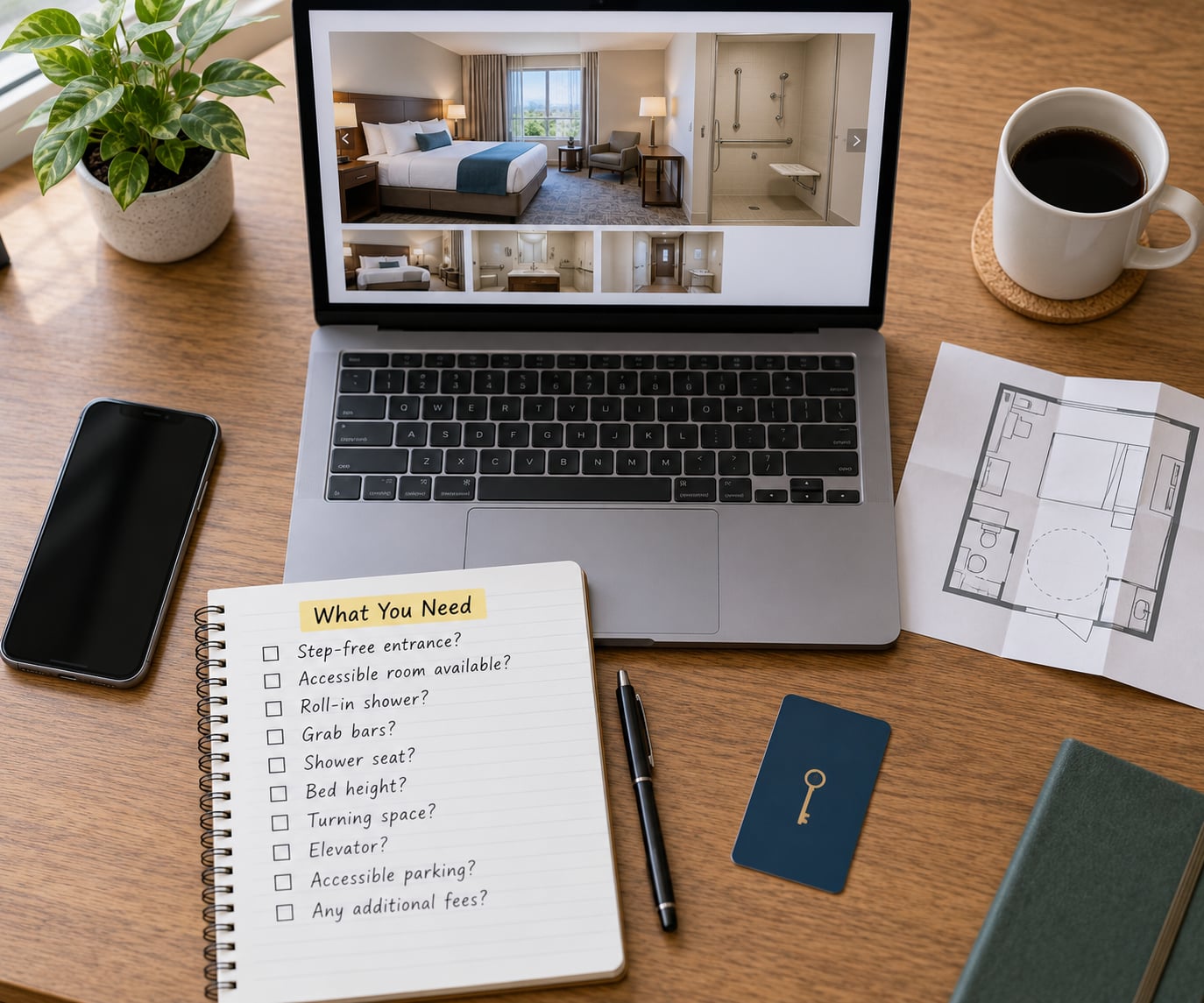
Before you open a single booking site, five things need to be written down. Doing this first turns a vague search into something you can actually check.
- Your access route. Write out every point that has to work in order: car park or kerb, the door into reception, the lift, the corridor, the room door, the bathroom, and any restaurant, bar or spa you plan to use.
- Your body measurements and equipment. Width of your wheelchair or the widest part of you when standing, your height for reach to shelves and switches, whether you transfer independently, and whether you need a shower seat or a transfer bench.
- Your room requirements. Floor-to-mattress bed height, whether you need space either side of the bed for a hoist or a second chair, and whether a wet room is essential or a level-access shower will do.
- Transfer arrangements. Whether you travel with a carer, whether a companion is staying in an adjoining room, and whether you need assistance lifting or moving with you, because hotel staff are often not permitted to do manual handling.
- Your sources of truth. Accessibility information lives in three places with different reliability: the property’s own access statement, reviews written by other disabled travellers, and what the front desk tells you on the phone. You need all three, and the written reply from the property is the one that counts.
Add your budget as a range rather than a figure, and note that accessible rooms are a small share of any hotel’s inventory, low single-digit percentages in most properties. That single fact changes your booking strategy more than anything else on this list.
Step-by-Step: How to Find Hotels With Step Free Access
1. Define the access route you need
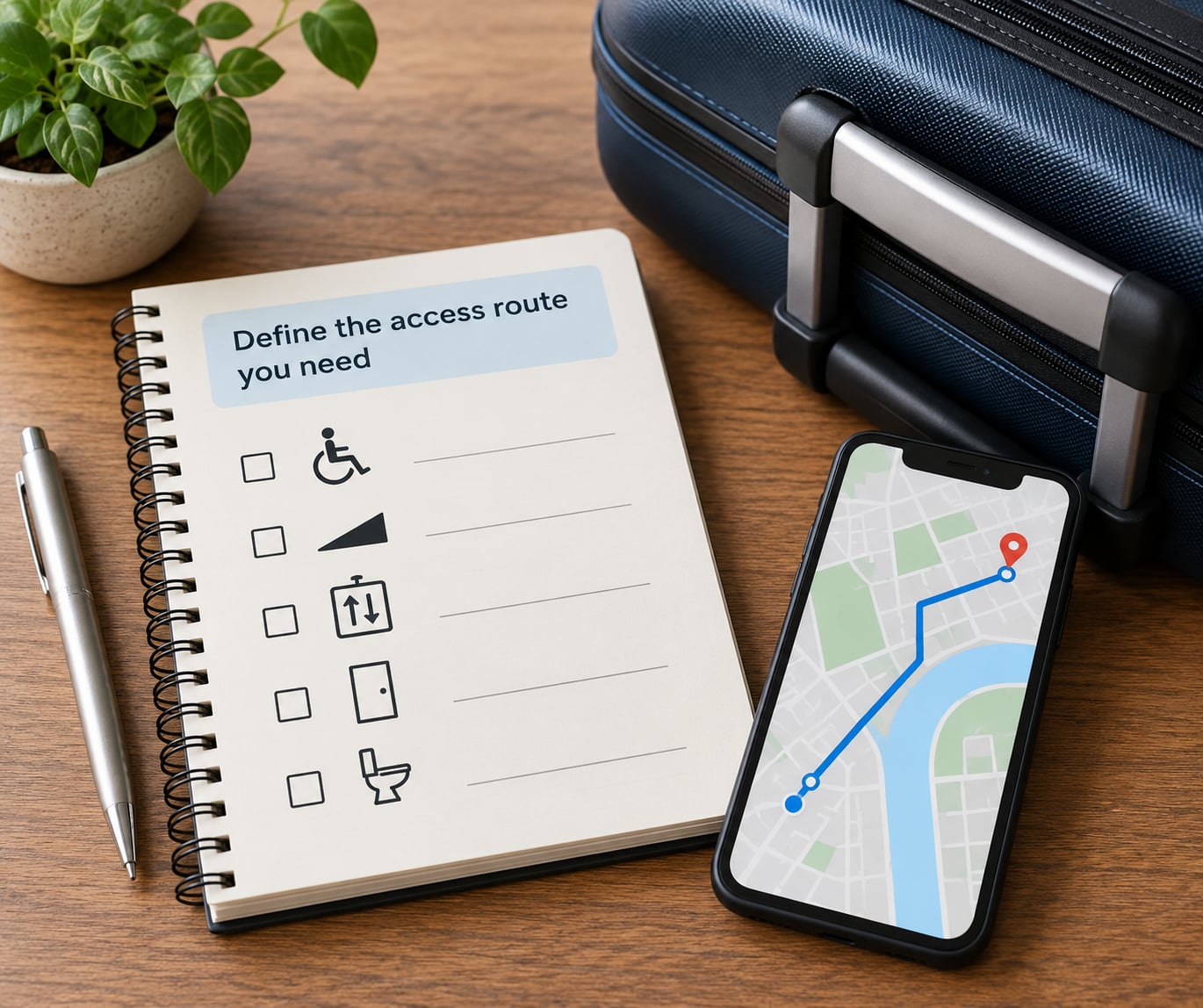
Most searches fail because people search for a property feature when they actually need a route. Spend five minutes mapping every point that must be level between the kerb and the bathroom door, and note which ones are negotiable.
For a wheelchair user driving in, that usually means a parking bay wide enough for a transfer or a ramped kerb cut, an automatic or power-assisted entrance door, and no threshold or revolving door. For someone walking with a rollator, a handrail on any incline usually matters more than door width.
Decide now whether a lift is acceptable. Plenty of otherwise accessible buildings are only reachable by stairs, and finding that out after you have booked a room on the fourth floor is an expensive surprise. If a lift is not optional, write that at the top of your list and ask about it in your first message.
2. Search with specific accessibility terms
How to find hotels with step free access comes down to using terms that separate real properties from marketing copy. Search for step-free entrance, level access, and threshold-free entrance for the building, then accessible room, roll-in shower, wet room and grab rails for the room itself.
Broad searches on accessible travel pull in properties that simply have one ground-floor accessible room in a building with eight steps and no lift. Narrowing the language is the cheapest filter available. Turning off the location pin in favour of whole-region searches also works better, because it stops the search engine optimising for a single city centre where accessible inventory is scarce.
Check accessibility-specific directories too, where properties have supplied measurements and photographs of the exact room. Their coverage is patchier, usually covers a country or a chain, and some listings are old. They are worth scanning, but every finding still needs confirming directly.
3. Compare rooms, not just properties
Two rooms in the same hotel can be completely different. Property-level filters tell you about the building; they say nothing about which specific room you will be given. When you book an accessible room, the confirmation should name the room type, the floor, and whether it is a front or rear room.
Look at the bathroom layout in photos rather than the marketing gallery, since galleries often show the best bathroom in the property rather than yours. A roll-in shower means a curbless floor with a fold-down seat and bars, and no lip to cross. A step-in shower with a grab rail is a different thing entirely, and plenty of listings call it accessible without the distinction.
For dexterity differences, mention the Radar Key scheme when you email, a large-handle key system used by some UK properties and raised in MND Association forums as a real improvement for hands with limited grip. Almost no booking filter covers it.
4. Contact the hotel with precise questions about step-free access
One phone call or email with a fixed list of questions beats an hour of reading reviews. Ask for the route in order, and ask them to describe it rather than confirm it. Someone saying yes, it is step-free is less useful than someone describing the ramp at the side entrance and the two thresholds inside the lobby.
Here is the set of questions worth sending:
- Is the route from the accessible parking bay or the kerb drop-off point to the reception desk completely level, with no steps, curbs or thresholds?
- If it is not level, what is the gradient and the rise of the ramp, and is there a handrail?
- Is there a lift to every floor, and how wide is its door and cabin?
- How wide is the bathroom door in centimetres, and is there a threshold?
- Is there a roll-in shower or a level-access wet room with a fold-down seat, and are grab bars fitted?
- What is the floor-to-mattress height of the bed?
- Is there clear floor space beside the bed for a wheelchair or a hoist?
- Which accessible room type can you guarantee me in writing for these dates?
- Is the restaurant, bar and reception desk step-free, and is there a lowered section at the desk?
- Who is the duty manager, and is there 24-hour on-call assistance?
Send it as an email rather than a phone call, so the reply becomes a record. If the answer comes back vague, ask one narrower follow-up question and wait for a second reply. Two round trips is normal and worth it.
5. Check the arrival and booking details
Where the bus or taxi stops matters as much as the hotel itself. Ask for the exact drop-off point, not a street name, and check whether the pavement outside drops below the kerb or has a bollard line. Accessible parking bays are often at the far end of a car park, so ask about the surface and the distance to the entrance door in metres.
Check the cancellation terms before you pay, specifically the deadline and whether the accessible room can be held at the same rate. Then look at what happens on arrival: is check-in at a lowered counter, can you complete it in the lobby, and does the property hold a small number of rooms for late arrivals on request.
If you rely on a wheelchair being carried on a flight, or on a mobility aid being charged and returned separately, add those logistics before you pay rather than after. If the property has no lift, treat that as a no unless the ground floor room is genuinely guaranteed for your whole stay, not just the first night.
6. Save the evidence and book confidently
Screenshot the listing, the accessibility filter view, the room type, the property’s replies and the cancellation terms. Keep the confirmation number somewhere you can reach without a data connection.
Attach the accessibility confirmation to the reservation where you can, or put it in the special requests field and paste the key facts into the first line of your message to the hotel. Booking platforms vary in how long they keep special requests attached, so the email thread is your backup.
Reconfirm about 48 hours before arrival with one short message quoting the room type and the route. If the reply has changed, you still have time to cancel under the terms you checked in step 5.
Accessibility measurements worth holding a hotel to
Numbers are the most useful thing you can ask for, because they turn a marketing word into something checkable. Disabled travellers routinely ask for these, and hotels that answer precisely are usually the ones that run the route properly.
| Feature | What to ask for | Why it matters |
|---|---|---|
| Door clear width | Width in centimetres of the room and bathroom doors | The single most common reason an accessible room does not work |
| Turning radius | Clear floor space in the bedroom and bathroom | A chair cannot be turned around in a narrow room, whatever the door width |
| Bed height | Floor-to-mattress measurement | Determines whether a transfer onto the bed is possible |
| Transfer space | Clear space at one or both sides of the bed | A hoisted transfer needs room a standard room rarely has |
| Shower type | Roll-in, level-access wet room, or step-in with seat | Only the first two are level; a shower tray needs crossing |
| Thresholds | Height and number of any raised lips on the route | Small lips snag small front casters and are often unlisted |
| Ramp gradient | Rise and run, and whether a handrail is fitted | A steep unpaved ramp can be harder than a step |
| Reachable fittings | Height of switches, sockets, the door lock and the alarm | Fittings fixed at standing height are unusable from a seated position |
Filters differ more than most travellers assume. A step-free entrance flag tells you about the main door and says nothing about the bathroom or the floor your room sits on. A wheelchair accessible room flag describes a room type, not the route to it. Some platforms let you filter for roll-in showers, others only record the word accessible, and dedicated accessibility directories usually hold the most detail because they ask for measurements at listing time.
Read the filter definitions, not just the filter labels, and check whether a property can be listed as accessible by self-declaration or by verification. Verified listings age better. Most filters also describe the main entrance rather than a side or rear entrance, which can be where the ramp actually is.
Common Mistakes
Treating step-free access as a synonym for an accessible room. The one tells you about the route, the other about the room. Ask both questions separately, because plenty of hotels answer only the one they advertise.
Assuming a ground floor room is always step-free. Older properties often slope, step or narrow toward the back of the ground floor, and a bathroom door in a converted ground floor room can still be far narrower than the one the listing photographs.
Ask for the measurements even on the ground floor.Trusting a review written years ago. Ramps get rebuilt, lifts get replaced, and construction changes entrances. Weight recent written feedback from disabled travellers far more heavily than star ratings, and treat a specific complaint about a ramp as more useful than a generic five-star review.
Skipping the bathroom. Listings focus on the entrance because that is what a filter measures. Ask for shower type, door width, grab bar positions and bed height, and hold the room to them.
Booking the room type but not the specific room. Accessible rooms are reassigned during busy weekends. Ask which room number or at least the floor and position, and confirm in writing that it will be held for you.
Looking only at a wheelchair icon or a star. Icons and star ratings measure brand reputation, not the route. A five-star chain in a listed building can be less accessible than a modest modern property, and historic buildings with the charm slow travellers look for are often the least accessible.
Assuming staff will move or lean on your mobility aids. Ask for assistance with lifting and transfers rather than expecting it, and phrase the request plainly, because well-meaning improvisation is a common complaint. Nobody in the building should touch your chair without asking.
Frequently Asked Questions
What does step-free access mean in a hotel listing?
Step-free access means the route from the street, car park or drop-off point to your room and its bathroom contains no stairs, steps or raised thresholds. It covers the entrance, reception, lift, corridor and restaurant as a property-level feature. It says nothing about the room itself. Door width, turning space, shower type and bed height are separate room-level questions, and hotels that advertise accessibility usually only mean one of the two.
Is a step-free entrance the same as a wheelchair accessible room?
No. A step-free entrance describes the path into and through the building. A wheelchair accessible room describes what is inside one specific room, usually clear door width, turning space, a roll-in shower and grab bars. You need both confirmed separately. Many properties have a level entrance and then rooms that cannot take a wheelchair, and the reverse is also common.
How do I know a hotel is really wheelchair accessible?
Ask for measurements in centimetres rather than adjectives: bathroom door clear width, clear floor space for turning, floor-to-mattress bed height, threshold heights, and whether the shower is roll-in with a seat. Request photographs of the exact room type you will be given rather than the gallery. A property that answers these precisely is usually one that has surveyed its own building.
Can a non-disabled person book an accessible hotel room?
Yes. Accessible rooms are sold like any other inventory, so a companion, carer, family member or colleague can book and pay for one. Policies on who must be named in the room differ, but most properties will note accessibility requirements in the reservation for anyone, not just the registered guest. Add your needs as a special request and get the confirmation in writing.
What are the requirements for an ADA compliant hotel room?
US rules are governed by the Americans with Disabilities Act, mainly Title III for hotels. Accessible rooms generally need a clear route to the entrance, accessible parking and routes to guest rooms, doors wide enough to pass a wheelchair, accessible bathroom fixtures with grab bars, controls and alarms within reach, and adequate turning space. Outside the US, the Equality Act in the UK and the European Accessibility Act set comparable duties, and local rules vary.
What if my accessible room is not available when I arrive?
Say so at check-in immediately and ask for the duty manager, not the desk clerk, and keep your written confirmation to hand. Ask what accessible rooms remain, whether they match what you paid for, and what compensation the property offers, such as a refund of the difference or covering relocation costs. If you hold travel insurance that explicitly covers accessibility failures, this is when to use it.
Travel insurance that names disability-related cancellation, damaged medical equipment and relocation costs is worth more than a generic policy here, because most standard policies exclude pre-existing conditions and treat a missing accessible room as an ordinary service failure rather than a covered event.
Start with one thing: pick three properties, send the same ten questions to all three, and compare how precisely each reply describes the route. The answers you get back will tell you more than any filter, and most of the work is done before you commit to a single booking. If you are still deciding on the destination itself, weighing slower routes and fewer transfers usually matters more than the hotel list.
That is how to find hotels with step free access that genuinely fit. Filter for the route, measure the room, get it in writing, and keep the evidence.