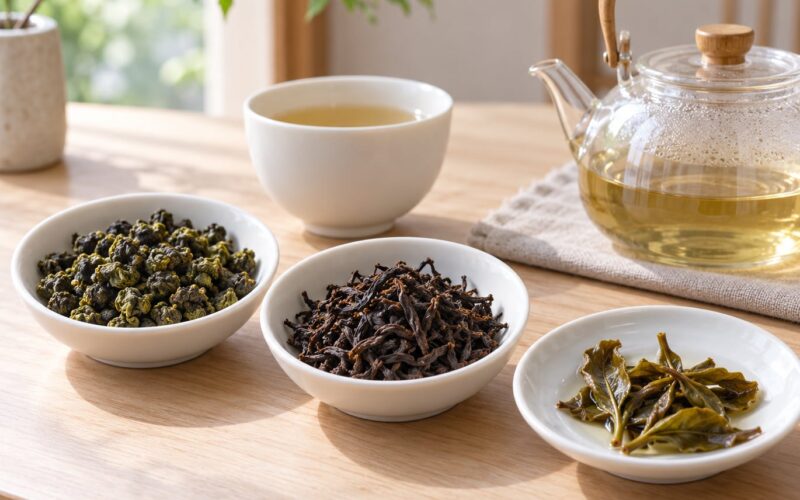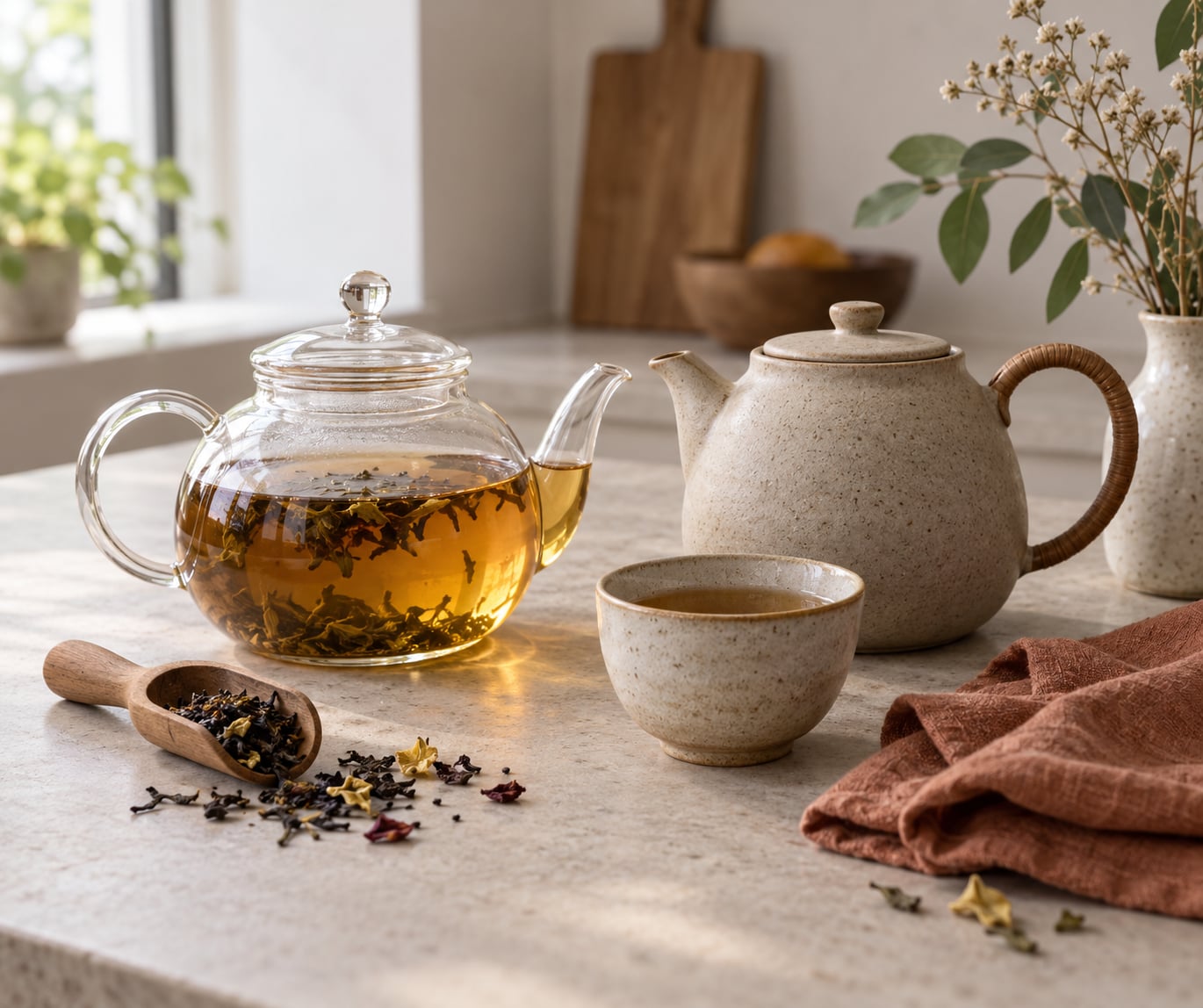
If you are picking a teapot for loose leaf tea, the infuser matters more than the material. Pick a pot whose infuser holds back the leaf grade you buy, holds enough water for the number of cups you actually drink, and comes out whole so you can tip the leaves into the sink when the steep is done. Glass, porcelain and cast iron all work; the wrong infuser ruins good tea no matter how handsome the pot is.
Most people end up with a borosilicate glass pot around 20 to 25 ounces (600 to 750 ml) with a fully removable fine-mesh stainless steel infuser and a lid that stays on during a pour. That is a solid default, but the right answer shifts with your tea, your batch size and whether you brew from a kettle or on the stove. The steps below walk through each decision in the order buyers usually regret getting wrong.
Table of Contents›
- What You Need Before You Shop
- Step-by-Step: How to Choose a Teapot for Loose Leaf Tea
- 1. Choose the Teapot Size for Your Batch
- 2. Match the Material to Your Tea
- 3. Check the Spout and Pouring Control
- 4. Decide How You Will Heat the Teapot
- 5. Look for a Lid That Works for Your Brewing Method
- 6. Balance Comfort, Cleaning, and Durability
- 7. Set a Realistic Budget and Check the Final Details of Your Teapot for Loose Leaf Tea
- Common Mistakes
- Frequently Asked Questions
- What material is best for a teapot?
- Which teapot is better for tea, ceramic or glass?
- Are glass teapots any good?
- How many cups does one teapot make?
- Can you use a teapot on the stove?
- Do I need a teapot to make loose leaf tea?
- The Short Checklist Before You Buy
What You Need Before You Shop
Six things are worth settling before you start reading product pages. Decide them first and the choice narrows fast.
- Your tea type. Delicate green and white teas, robust black blends, roasted oolong, fermented pu-erh and herbal tisanes each behave differently in different materials.
- Your batch size. One person at a desk is a different pot from a pot serving four, and gongfu brewing is smaller again.
- Your brewing temperature. Water near boiling suits black tea, while green and white teas want cooler water that a heavy pot can scorch.
- Your serving style. One-handed pouring, pouring through a strainer, or decanting into a jug.
- Your heat source. Kettle-poured, direct stovetop, electric kettle, microwave or an insulated pot that never sees heat.
- Your cleaning routine. Hand-wash only, dishwasher safe, or a pot you barely want to wash at all.
One distinction first. An infuser bag holds a single serving and is thrown away; a teapot is built for leaf that expands as it steeps. Whole-leaf tea needs room and a longer steep, so a pot with a basket is worth buying. If you drink one cup of bagged tea a day, a pot is optional and an infuser mug is faster.
Step-by-Step: How to Choose a Teapot for Loose Leaf Tea
1. Choose the Teapot Size for Your Batch
Capacity is the easiest decision to get wrong, because pot size is quoted in ounces of water rather than cups of tea. A full pot gives you roughly one cup less than its nominal capacity, since the leaves and the infuser take up room. A 20-ounce pot holds about three and a half cups once you allow for that displacement.
| Pot capacity | Roughly | Black tea | Green or white tea | Good for |
|---|---|---|---|---|
| 8 oz / 240 ml | 1 cup | 2 g | 1.5 g | Gongfu brewing, second pot at a desk |
| 12 oz / 350 ml | 2 cups | 4 g | 3 g | One person, two rounds |
| 20 oz / 600 ml | 3 to 4 cups | 7 g | 5 g | One to two people, the everyday default |
| 32 oz / 950 ml | 5 to 6 cups | 11 g | 8 g | Guests, afternoon service |
| 40 oz / 1.2 L | 6 to 8 cups | 15 g | 11 g | Family or small guesthouse service |
The checkpoint is simple: brew a full pot and count the cups you actually pour. If the last pour runs thin or the pot is still half full, you bought the wrong size. For gongfu cha, where you brew many short infusions in small cups, the whole table shifts down two rows.
2. Match the Material to Your Tea
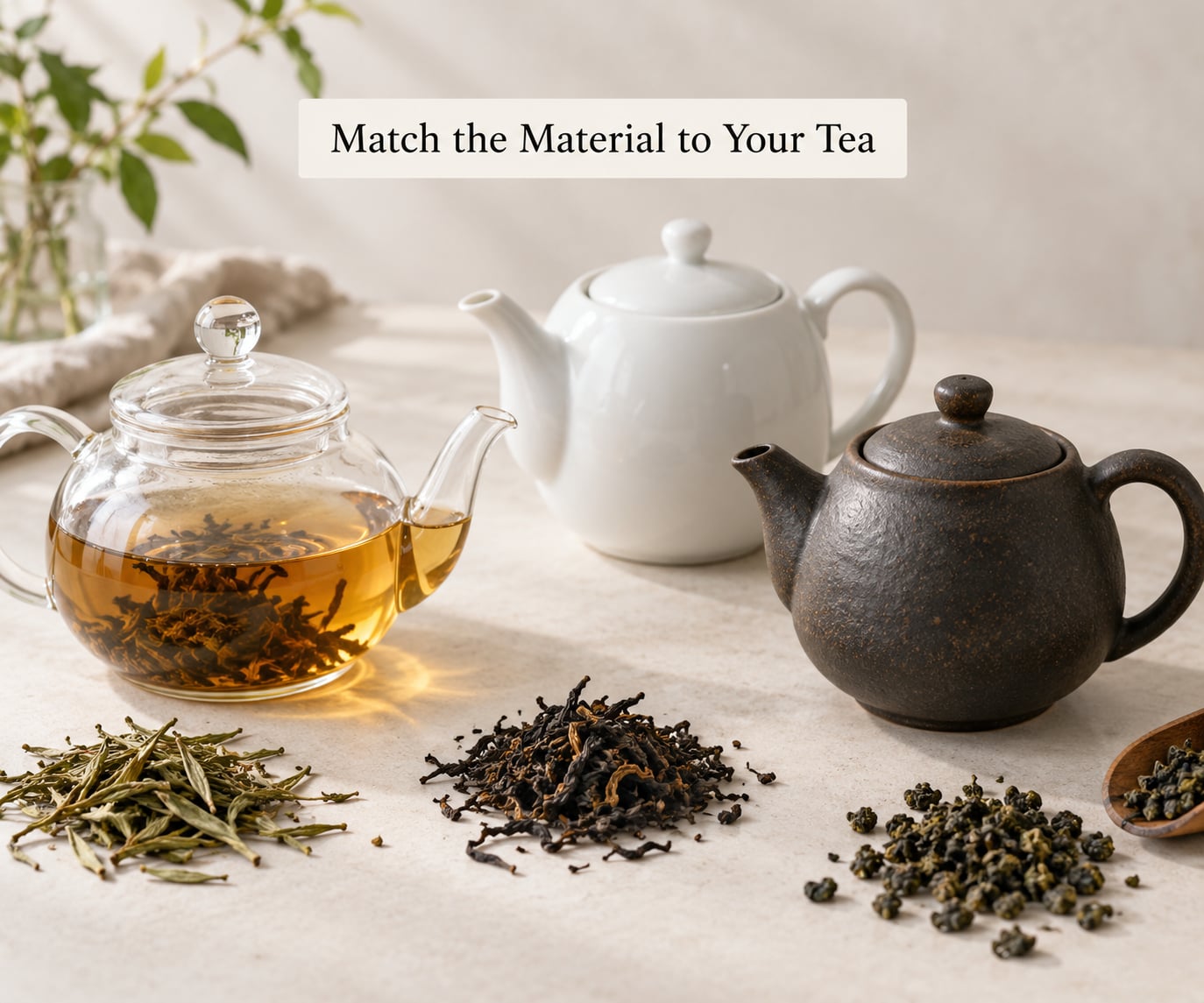
Material decides two things: how much heat the pot holds, and whether it tints or holds on to flavours from one brew to the next. Neither is glamorous, but both change what you taste.
| Material | Neutral? | Heat retention | Best for | Watch out for |
|---|---|---|---|---|
| Borosilicate glass | Yes | Low | Beginners, delicate teas, watching the infusion | Breaks if knocked, cools quickly, scale builds in hard water |
| Porcelain | Yes | Medium | White tea, oolong, green tea, a varied diet | Chips rather than dents, thin walls lose heat |
| Glazed stoneware or ceramic | Yes | High | Black tea, breakfast blends, herbal | Heavy, unglazed exteriors can stain |
| Enamelled cast iron | Yes | Very high | Strong tea, cold weather, tea cosy pairing | Enamel chips if heated empty or dropped, rust on exposed rims |
| Unglazed clay, including Yixing | No | High | Puer, roasted oolong, one pot per tea | Absorbs aroma, needs rinsing, not for delicate tea |
| Stainless steel or aluminium | Mostly | Low to medium | Herbal, mint, travel, durability | Can taste metallic to sensitive palates, dents |
Glass is genuinely the easiest place to start, because you can watch the leaves open and read the colour of the infusion instead of guessing at steep time. Its weakness is thermal mass: thin glass drops in temperature mid-steep, which matters for oolong but barely at all for a delicate green.
Porcelain is the neutral answer for people who drink a wide range of tea, because the glazed interior does not hold flavour between brews. Unglazed clay is the opposite and the enthusiast answer: the walls are porous, they season over months of use, and a pot that has brewed pu-erh will never be right for sencha again. Kyusu, the Japanese side-handle pot, filters against the spout so the leaves stay in a heap and can be lifted out in one movement, while a tetsubin is the cast iron pot used for Japanese senchado. Neither is wrong, and both ask for technique a beginner does not need yet.
The checkpoint is whether you drink more than one kind of tea. If yes, choose neutral: glass or porcelain. If you have settled on one tea and want it to taste like itself for years, unglazed clay is worth the extra care.
3. Check the Spout and Pouring Control
A spout has to do two jobs at once: let liquid out fast and keep leaves in. Spout length, opening width and angle decide how well it does the second job, and internal filter placement decides how well it does the first.
A long spout drains the pot almost to the last drop and reaches into a tall mug. A short spout is easier to aim but leaves liquid behind in the belly. A wide opening slows the pour, which helps you stop the pour mid-steep without a rush. A narrow tip gives a thin stream that is easy to control and hard to slosh.
The water-pour test takes a minute. Fill the pot, put the lid on, and pour at the angle you normally use into a mug and a cup. If the pour dribbles from the spout tip afterwards, look for a drip-proof cut or a recessed rim. If liquid streams back into the pot when you stop, the spout is likely cut below the rim. Pouring with the lid on also tells you whether it stays seated or has to be held with a second hand.
One more detail matters more than most buyers expect: where the filter sits. A basket hung high in the pot pushes leaves down toward the spout when you pour, which is how grit ends up in your cup. A filter seated low, or a spout with a built-in strainer, keeps the leaf mass clear of the pour path.
4. Decide How You Will Heat the Teapot
Almost all teapots are filled with water you heat somewhere else, and that is the safest default by a wide margin. Put the water in a kettle or a pot on the stove, let it cool if the tea needs cooler water, then pour it into your teapot.
Direct stovetop use is the exception, not the rule. Only heat a teapot itself when the maker states it is stovetop safe, and even then, never set an empty enamel or cast iron pot on a flame. Empty heating is what cracks enamel and warps metal. Glass teapots labelled stovetop safe are usually borosilicate, which tolerates direct heat, but an unmarked glass pot should never touch a burner.
For the other heat sources, check the details. Microwave brewing needs a pot without metal trim, a vented lid or loose lid, and a removable basket. Electric setups usually need a lid that stays on and a warm plate underneath, since a boiling pot cools quickly in an open room. Fully insulated pots, the travel type that holds heat for hours with a tea cosy inside, suit commuting and brewing on a hotel tray with no kettle.
The checkpoint: your pot’s handle should stay cool in a full pour. If it is moulded from the same material as the body and the pot is heavy, plan on using two hands or a cloth.
5. Look for a Lid That Works for Your Brewing Method
The lid decides how much aroma stays in the pot and whether you can pour one-handed. A conventional seated lid sits in an opening and is held in place by the rim, which means one hand can pour. A loose lid that drops on top tends to slide when you tilt, and a lid with a button or chain in the way blocks a full pour.
Ventilation is the other half. An unvented lid traps steam under the lid and drops condensation back into the brew, which dilutes it. A lid with a small hole, or a basket lid that lifts for the pour, lets steam escape. Many glass and porcelain pots sold for loose leaf tea have a hole in the lid rim for exactly this reason.
A built-in infuser is worth its place when you buy one pot for one tea type and want the simplest possible routine. The basket lifts out, leaves go in the bin, pot gets rinsed. A removable basket is the more flexible option and the one most buyers insist on, because you can brew a second infusion, lift the basket halfway to control strength, or take it out to serve without straining. Where you have no basket at all, the decant method still works: brew in a mug or a small jug, and pour the liquid off before the leaves over-extract.
6. Balance Comfort, Cleaning, and Durability
Weight and balance decide whether you enjoy the pot after two months. A full cast iron or stoneware pot is genuinely heavy, and pouring it with one hand while holding a mug is a test worth doing in a shop. Side handles give control without heat transfer, top handles pour in a smooth arc, and a handle with a gap lets you fit a thumb underneath, which is the easiest grip of all.
Opening width is the cleaning story. A narrow mouth traps leaves and smells, even in a pot you can reach into. A wide mouth you can put your hand through gets washed properly. Detachable parts matter more than any listing claim: a lid, basket and body that all come apart can be washed and dried properly, while a fixed one-piece filter will collect fine dust that no dishwasher reaches.
Check dishwasher safety honestly rather than optimistically. Glazed porcelain and most glass survive a cycle. Unglazed clay, enamel cast iron with a wooden handle, and anything with a bamboo or cork grip cannot go near a machine.
The checkpoint: pour a full pot three times without straining your wrist. If your grip changes on the third pour, the pot is too heavy or the handle is wrong for you.
7. Set a Realistic Budget and Check the Final Details of Your Teapot for Loose Leaf Tea
Price tracks four things in a teapot for loose leaf tea: spout machining, mesh quality, thermal mass and finish quality. Below the basic tier you get a thin-walled body, a spun spout that drips, and a basket welded with wide openings that lets dust through. In the middle range, spouts are cut cleanly, mesh is finer, and walls have some heft. At the top, you are paying for hand-finished clay, a spout built to a precise angle, and glaze that resists staining. That last tier is worth it for one pot; it is wasted across a set you will not use.
Run this final comparison before you commit:
- Usable cups per brew, allowing for displacement
- Material, and whether it is neutral for more than one tea
- Heat source, and whether the maker states it is rated for your method
- Spout length, tip cut, and where the filter sits
- Lid that stays on, and whether it vents
- Infuser that lifts out whole, with mesh finer than your leaf grade
- Dishwasher safety and how many parts come apart
- Warranty length, and whether a replacement basket or lid is sold separately
Common Mistakes
Choosing by decoration. A painted pot tells you nothing about mesh size or spout quality. Read the basket and the spout first, and treat the pattern as a bonus.
Buying a pot too small. Under-sizing is the most common regret in forums. Brewing too much and reheating it makes tea bitter in a way that gets blamed on the leaves.
Overlooking heat compatibility. Assume any unmarked pot is kettle-poured only. Check the maker’s own statement rather than a photo, since listings reuse images across models.
Expecting the spout to filter everything. Most spouts strain only what passes through the filter seat. Leaves sitting above that seat get poured out with the last cup unless the basket lifts out first.
Ignoring care. Unglazed clay needs rinsing with hot water and no detergent. Enamel cast iron needs dried fully to stop rust. Glass in hard water needs descaling every few months or the flavour drifts.
Skipping the tea cosy. A pot that reaches brewing temperature quickly also loses it quickly. A cosy or warmed pot extends the steep for a few minutes and matters most for second and third infusions.
Frequently Asked Questions
What material is best for a teapot?
For most people, borosilicate glass or glazed porcelain. Both are neutral, so one pot can brew green, white, oolong and black tea without carrying the last brew into the next. Glass shows you the leaves opening so you can read the infusion, while porcelain holds heat a little better for black tea. Unglazed clay wins for a single dedicated tea, and cast iron wins for strong tea in cold weather.
Which teapot is better for tea, ceramic or glass?
Glass for delicate tea, ceramic for robust tea. Glass is non-porous and lets you watch the infusion colour to judge steep time, but thin walls lose heat quickly and the pot chips rather than dents. Glazed ceramic or stoneware has more thermal mass, holds temperature through a long steep and forgives a rushed pour. Both break if dropped, so think about how much travel you do.
Are glass teapots any good?
Yes, and they are the best default for a beginner. The transparency lets you see when the leaves have opened and when the colour has reached the strength you like, which removes most of the guesswork from steeping. The two real drawbacks are breakage and poor heat retention, so keep glass for home or a desk and use a metal or stoneware pot for travel and outdoor brewing.
How many cups does one teapot make?
About one cup less than the capacity printed on the pot. Leaves and the infuser basket displace liquid, so a 20-ounce pot fills with roughly 17 ounces of water and yields three and a half cups. A 32-ounce pot gives you five to six cups, which is enough for a few guests or one afternoon. For a single drinker brewing alone, 12 to 20 ounces is usually the comfortable range.
Can you use a teapot on the stove?
Only if the maker states it is stovetop safe. Heat water in a kettle or saucepan instead, which is safer and gives you control over temperature. If a teapot is rated for direct heat, never heat it empty, since thermal shock cracks glass and enamel and warps metal. For the classic senchado method, a tetsubin is heated with charcoal to about 90 degrees Celsius, then the charcoal is removed before brewing.
Do I need a teapot to make loose leaf tea?
Not always. If you brew one cup at a time, an infuser mug or a small press pot takes the same leaves and water and cleans up in seconds. A teapot earns its place when you want to steep longer, make several infusions from the same leaf, brew for guests, or keep the pot warm while you drink. That is when the lid, spout and capacity start to matter.
The Short Checklist Before You Buy
Decide the infuser first, since it does more for the cup than the material does. If you drink one kind of tea and nothing else, go unglazed clay; if your week includes green on Monday and a breakfast blend on Saturday, take glass or porcelain at 12 to 20 ounces with a basket that lifts out whole. Then check the spout against the mug you drink from, and buy the pot you will still want to hold when it is full and steaming. Updated for 2026, this guide reflects what buyers tell us they wish they had checked before they bought.