Learning how to buy travel insurance is mostly an exercise in matching coverage to the specific trip in front of you, not picking the cheapest quote on a comparison site. A policy that suits a two-week city break in Europe can be nearly useless for a three-month stay in a country with expensive hospitals, and the difference is usually a few lines of the policy wording.
This guide walks through what to gather before you shop, how to compare coverage line by line, where the exclusions hide, and what to do on the day you click buy. Most of it applies whether you are booking a solo trip from your kitchen table or coordinating a family holiday.
Table of Contents›
- What Does Travel Insurance Actually Cover?
- What You Need Before You Shop
- How to Buy Travel Insurance and Know What It Covers: Step by Step
- How to Buy Travel Insurance: Start With the Trip You Are Insuring
- Compare Medical, Trip Cancellation, and Interruption Coverage
- Read the Exclusions and Conditions Before You Pay
- Check the Insurer, Policy Terms, and Total Cost
- Buy the Policy and Save the Confirmation
- Common Mistakes Travelers Make, and How to Fix Them
- Frequently Asked Questions
- When should I buy travel insurance?
- Does travel insurance cover pre-existing medical conditions?
- Is trip cancellation insurance worth it for international travel?
- Does travel insurance cover missed flights and travel delays?
- What documents do I need to make a travel insurance claim?
- Can I buy travel insurance after booking a trip?
What Does Travel Insurance Actually Cover?
Travel insurance reimburses you for losses you would otherwise carry yourself: a cancelled trip, emergency medical treatment abroad, evacuation from a remote area, lost luggage, or a delay that eats into your plans. You buy it before the trip, you pay a premium, and if a covered event happens you document the loss and claim up to the policy limits.
The critical word in that paragraph is covered. Every policy covers a defined list of events and excludes a longer one, and the exclusions are where the money leaks out. Here is the short version of what the main coverage types actually do.
| Coverage type | What it usually pays for | What to check before buying |
|---|---|---|
| Trip cancellation | Non-refundable deposits and prepaid costs when a listed reason stops you travelling | Which triggers count, the deadline for cancelling, and whether airline credits count as a loss |
| Trip interruption | Additional fares, lodging and lost days after you have already left | Whether the benefit pays out from the first night or after a delay threshold |
| Emergency medical | Treatment, hospital stays, prescriptions and follow-up care abroad | The benefit limit, the deductible, and whether coverage is primary or secondary |
| Medical evacuation and repatriation | Ambulance flights, transfer to a better hospital, and return home after treatment | The ceiling on evacuation costs, which usually sits above the medical limit |
| Baggage loss and delay | Lost, stolen or damaged luggage and essential items during a delay | Per-item and total limits, depreciation applied to electronics |
| Trip delay | Meals, hotel and transport when a delay runs past a set number of hours | The threshold hours and the daily cap |
Policies bundle these in different ways. Some are sold as a single all-in plan, others as separate riders you add one at a time, and the annual multi-trip versions usually cap the length of each individual journey, often somewhere between 30 and 45 days.
What You Need Before You Shop
Before you open a quote form, gather the details below. Nearly every quote and every eligibility decision depends on them, and answering them in advance keeps you from being quoted for the wrong policy and then having to redo it.
- Trip basics: departure and return dates, every country on the itinerary, and whether you cross borders or stay in one country. Long stays and multi-country trips get different treatment from a two-week trip.
- Total prepaid, non-refundable spend: flights, lodging, tours, rail passes, rental cars. This figure drives the cancellation limit, because that is the most the policy will ever reimburse on the trip side.
- Current government travel advisory level for each destination, and the date it was issued. Timing here decides whether a cancellation is covered at all.
- Activities planned: scuba diving, mountaineering, skiing beyond marked runs, motorcycling, surfing, trekking above a set altitude, or any rental of a private aircraft.
- Where you will actually sleep: a hotel, a home stay, a work exchange, or a volunteer placement. Some coverage categories behave differently for long-term placements.
- Your age. Premiums step up sharply in bands, and some providers stop selling single-trip medical cover entirely at a certain age while still offering cancellation cover.
- Your country of residence. Most policies are written for residents of the country they are sold in, and residency is the single most common reason an application is refused at the medical questionnaire stage.
- Your health history for the last few years, especially anything diagnosed, prescribed, hospitalised, or advised to change your lifestyle. The lookback period is usually 60, 90 or 120 days, and the answer has to match.
- Evidence of coverage you already hold: your health plan’s out-of-country benefit, any existing travel policy, and the benefits section of your credit card agreement.
- Emergency contact details and the assistance phone number for whoever is at home, in case you need to call from a hospital at two in the morning.
Two of those deserve an extra warning. Residency is not a technicality: travelers who lose their home-country connection, including many digital nomads, find that standard travel policies no longer apply and that expat or long-stay cover is the correct product. And credit card benefits almost always require you to pay for the entire trip with that card, which is a condition many travelers assume means “most of it” rather than “all of it”.
How to Buy Travel Insurance and Know What It Covers: Step by Step
Here is the process I would follow, in order. It takes about half an hour with a notebook, and the order matters because each step depends on the one before it.
How to Buy Travel Insurance: Start With the Trip You Are Insuring
Write the trip down on one page before you touch a website. Dates, countries, prepaid totals, activities, who is going, and what would hurt most if it fell apart.
That last item is the one people skip, and it is the one that decides the policy. If the answer is a non-refundable deposit on a small guesthouse, you need cancellation cover sized to that deposit. If the answer is that a broken leg in a country with no English-speaking clinics would end the trip, you need medical and evacuation cover with a high limit and direct billing. Solo travelers on a tight schedule usually fall into the second group, and the cost of a rescue flight from an island is the reason people who never thought about insurance end up reading about it.
Destination matters as much as duration. Medical costs vary enormously between countries, and coverage for travel into the United States is usually priced and limited differently from coverage for travel into countries with publicly funded healthcare. Your own health plan is the other variable: most domestic plans either exclude care delivered abroad entirely or pay only for emergency treatment and not routine care.
Compare Medical, Trip Cancellation, and Interruption Coverage
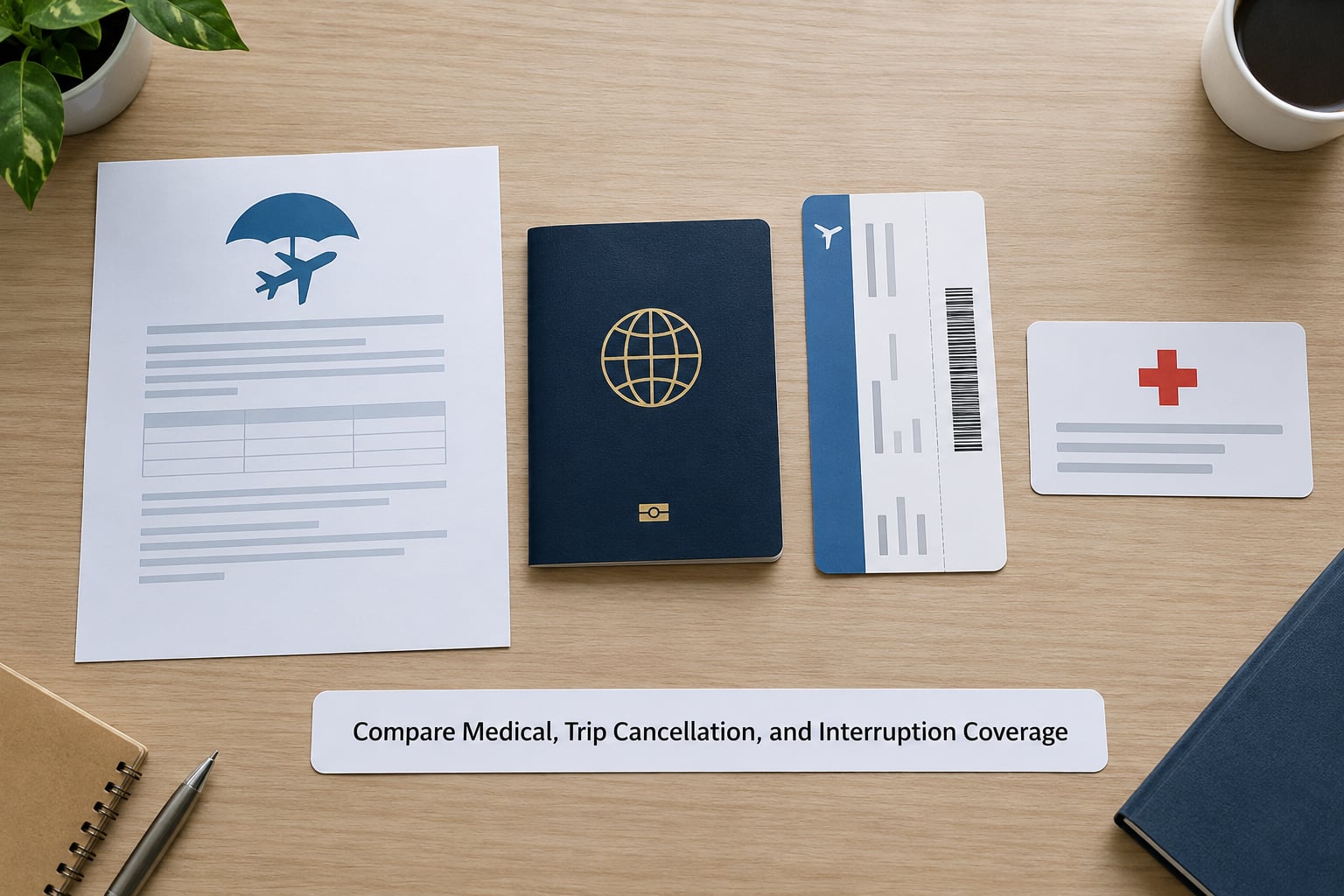
Compare the policies side by side on four things: the benefit limit, the deductible, whether the insurer pays the hospital directly or reimburses you afterwards, and what counts as a covered reason.
That last one is where trip cancellation policies differ most, and it is easy to misread. The covered reasons are usually a short enumerated list: illness or injury in you or an immediate family member, death, a court order, a natural disaster at the destination, a government travel advisory issued after you booked, a delay that causes you to miss a connection by a stated margin, or a mandatory quarantine. “Any reason you decide not to go” is almost never on that list unless you buy cancel for any reason cover, which pays a percentage rather than your full cost.
Interruption cover works differently from cancellation cover. Cancellation happens before you leave and reimburses sunk costs. Interruption happens once you are already travelling and pays for the additional cost of getting home, plus in some cases the lost remainder of the trip.
Now the medical side, where the language gets denser. Look at the maximum benefit, which is the ceiling on what the policy will ever pay for medical care, and at the deductible, which is the amount you pay before the insurer starts. A policy with a high benefit limit and a high deductible protects a catastrophic bill, while a low deductible pays out on small claims too. Many plans use a fixed deductible; some use co-insurance, meaning the insurer pays a percentage and you pay the rest up to an out-of-pocket cap. A plan with a hundred-percent co-insurance and a modest deductible is usually the easiest to reason about.
Primary and secondary is the distinction that trips people up most, and it decides who pays the hospital first. Primary cover means your travel insurer pays and does not ask what your health plan does. Secondary cover means your travel insurer steps in only after your health plan has paid, or after you have paid and been reimbursed, and if your health plan pays nothing abroad, a secondary policy can leave you holding the whole bill. For international trips, primary cover is worth paying for.
Direct billing matters more than people expect. With direct billing, the insurer’s assistance line arranges payment with the hospital and you are not fronting tens of thousands on a credit card in a language you do not speak. Without it, you pay up front and claim later, which means keeping receipts in the local currency and paying conversion charges you may never recover. Forum travelers describe this as the difference between a manageable week and a genuinely frightening one.
Finally, medical evacuation and repatriation. Evacuation is getting you to a hospital that can treat you; repatriation is bringing you home once you are stable. This is the coverage you will rarely need and cannot afford to be without in remote or mountainous destinations, and its limit is set separately, usually higher than the medical limit, because a helicopter or air ambulance transfer is not a medical bill.
Credit card cover sits in a separate category and rarely substitutes. It is secondary to your health plan, capped at a fairly low medical figure, usually excludes pre-existing conditions, often covers only trip interruption rather than cancellation, and requires the full trip to be paid on that card. Some premium cards offer trip cancellation if you pay with them and decline the airline’s own protection, which can be useful, but read the specific card’s benefit terms rather than trusting the marketing line.
Read the Exclusions and Conditions Before You Pay
Exclusions decide whether a claim is paid, so give this section the most attention. Most policies run to dozens of pages and the relevant parts are concentrated in a few sections: the general exclusions, the definitions, and the conditions.
Pre-existing conditions. A pre-existing condition is any condition you had, were diagnosed with, treated for, prescribed medication for, or were advised about within the lookback period before the policy started, which is usually 60 to 120 days. It also typically catches conditions that a reasonable person would have sought advice for, and stability-related triggers such as a new prescription or a change in dosage. Many providers offer a waiver if you buy within a short window, commonly 14 to 21 days of your first trip payment, but that waiver is a separate mechanism and you must satisfy it.
If you have a genuine ongoing condition, the routes that work are limited: a waiver when you are inside the purchase window and the condition is stable, or medical underwriting, which means answering the health questionnaire and waiting for an accept, an exclusion for the specific condition, or a premium increase. Declaring honestly is not optional. A material non-disclosure usually voids the whole policy, not just the related claim.
High-risk activities. Most policies exclude a defined list, and the definitions are narrower than people assume. Ordinary hiking is usually covered; trekking above a stated altitude without a guide, mountaineering, ski touring outside marked pistes, diving below a certain depth, and motorised or powered activities generally are not. If your trip depends on one of these, you need an adventure sports rider or a dedicated policy, and you should buy it before you book, because it is often an optional add-on with its own eligibility questions.
Alcohol and drugs. The exclusion is broader than people expect. A claim can be reduced or refused where alcohol or drug use contributed to the event, and insurers often apply this to injuries and hospital stays rather than to every part of a claim. The practical rule is simple and slightly boring: behave as though the exclusion is absolute, because that is how it tends to be read.
Government travel advisories and known events. Most policies exclude anything that was already public knowledge or already advised before you bought. If an advisory or a storm forecast exists at the moment of purchase, the resulting cancellation is generally not covered. The date the advisory was issued matters more than its level, and booking before the advisory then claiming after it is exactly the scenario these clauses are designed for. Check the level and issue date for each destination before you buy and again before you cancel.
Known-event doctrine. A named storm, outbreak, strike or government order is treated as a known event, and a policy will not reimburse you for it if it was foreseeable when you purchased. This is why last-minute cancellation in the middle of a widely reported situation tends to fail.
Claims deadlines and proof of loss. Almost every policy sets a deadline for notifying the insurer, often ten days or less from the event, and a longer window for submitting the final claim documentation. Miss the notification window and you may have forfeited cover entirely, which is one of the most avoidable losses travelers make.
Other exclusions worth finding: war and civil unrest, nuclear incidents, terrorism depending on where you are, government-recommended evacuation, acts of a third party, deliberate acts, criminal activity, and a general clause covering anything the provider considers a moral hazard. Loss of a passport, money, and personal items are often capped or excluded as well, and jewellery, cameras, and laptops frequently suffer heavy depreciation rather than replacement cost.
Check the Insurer, Policy Terms, and Total Cost
Look past the brand name to who actually underwrites the policy. The named underwriter and its regulatory home matter, because that entity pays the claim, and a reputable onshore or regulated carrier is a reasonable filter. Financial strength ratings and complaint records are published and worth a few minutes before you commit to an expensive limit.
Then read reviews of the claims service specifically, not the purchase experience. Travelers consistently say that the buying process is smooth for everyone and only the claim reveals the difference. A pattern of slow responses, repeated requests for the same document, or difficulty reaching a human being on the assistance line is the kind of thing worth weighing heavily, especially if you are a solo traveler who has nobody at home to handle it.
On terms, compare like for like across policies: maximum medical benefit, evacuation limit, cancellation and interruption benefit, trip delay threshold and daily cap, baggage limits, deductible, and whether medical is primary. Compare the sum of what is excluded against the sum of what is covered, not just the headline limit.
On total cost, premiums for a comprehensive trip policy commonly land somewhere around four to ten percent of the total trip price, higher for older travelers, higher for higher medical-benefit limits, higher for destinations with expensive healthcare, and higher again with cancel for any reason added. These are typical US ranges that change over time and vary by state and by traveler, so treat any single figure you see as a starting point rather than a quote. Add the optional riders you actually intend to use and resist the ones you do not, then compare the final total across at least three quotes rather than the cheapest headline premium, which often excludes the medical limit you were hoping for.
Cancel for any reason deserves its own paragraph, because it is the most misunderstood add-on. It lets you cancel for essentially any reason stated at the time of cancellation, but it typically only reimburses 50 to 75 percent of your trip cost, must be bought within a short window of the first trip payment, must be exercised by a deadline such as 60 days before departure, and is not available to residents of every state. Read those four conditions before deciding, because the reimbursement percentage is where the disappointment shows up.
Finally, compare single-trip against annual cover. If you take three or four trips a year and none longer than the per-trip day limit, an annual multi-trip policy is usually simpler and often cheaper. If you plan one long stay of two months, note that most annual policies cap each trip, and you may need a long-stay or expat product instead, which also changes the residency rules.
Buy the Policy and Save the Confirmation
Buy from the insurer directly or through a licensed comparison site or broker, and pay by credit card where the issuer offers coverage, since a credit card dispute is a real alternative when a policy is misrepresented. Screenshots do not count as a policy, so download the full wording and the certificate of insurance the same day.
Record four things and keep them somewhere you can reach without your luggage: the policy number, the effective date and time, the 24-hour assistance number that accepts collect calls, and the claims address. Check the effective date carefully, because cover does not attach retroactively and a policy bought after a qualifying event has already occurred pays nothing.
Add the assistance number to your phone and to a card in your passport wallet, and tell a family member or friend who stays behind where to find it. Also confirm how extension works while you are already abroad, because many policies can be extended for a fee if the trip runs long, while a new policy cannot be bought mid-journey.
Common Mistakes Travelers Make, and How to Fix Them
Most denied claims trace back to a decision made in the ten minutes after booking a flight, so here are the errors that recur, with the correction.
- Buying too late. Once the advisory is issued or the storm is named, the event is known and cover is gone. Buy within the first days after the first trip payment.
- Waiting past the pre-existing condition window. Waivers usually require purchase within 14 to 21 days of the first payment. Past that window the condition may be permanently excluded unless you go through underwriting.
- Assuming health insurance works abroad. Most domestic plans exclude care delivered outside the country or limit it to emergencies. Confirm the out-of-country benefit in writing before you rely on it, and remember that even where it applies, coordination of benefits rules decide which policy pays first.
- Relying on the credit card benefit. The full trip usually has to be paid on that card, the medical limit is modest, the cover is secondary, and pre-existing conditions are excluded. Treat it as a backstop that pays part of an interruption bill, not as your policy.
- Choosing a medical limit that is too low for the destination. A benefit ceiling set for a low-cost country will not stretch to a hospital bill in a high-cost country. Match the limit to where the care will actually happen.
- Ignoring the activity exclusions. A trek, a dive or a motorbike trip can void the entire medical section, not just the activity itself. If the activity matters, buy the rider.
- Missing the advisory timing. Check the advisory level and issue date for every country before cancelling, and keep evidence of when it changed if it changed after purchase.
- Treating credits as losses. An airline voucher or a carrier refund for future travel is often not a reimbursable loss, which is the reason some interruption claims stop at zero.
- Expecting full reimbursement from cancel for any reason. The reimbursement is a percentage, capped, time-limited, and restricted in some states.
- Not collecting proof at the time. Itemised invoices, medical records, a police report for theft, and a written cancellation request are much harder to reconstruct months later.
One more that deserves its own line, because it does not apply to claims at all: buying travel insurance after something has already gone wrong. A policy cannot be backdated, so a policy purchased after the illness, the storm, or the cancellation is not a solution.
Frequently Asked Questions
When should I buy travel insurance?
Buy it as soon as you make the first non-refundable payment, ideally within a few days. That window matters for three reasons: pre-existing condition waivers usually require purchase within 14 to 21 days of the first payment, cancellation cover only works while no covered event is already known, and underwriting for a health condition takes time. Waiting until the week before departure often removes your choices.
Does travel insurance cover pre-existing medical conditions?
Only if the policy says so, and it usually does not by default. A condition is commonly treated as pre-existing if you were diagnosed, treated, prescribed medication for, or advised about it within the lookback period before the policy started, often 60 to 120 days. Two routes exist: a waiver, available when you buy inside the short purchase window and the condition is stable, or medical underwriting after you answer the health questionnaire. Undeclared conditions usually void the policy entirely, not just that claim.
Is trip cancellation insurance worth it for international travel?
It is worth it whenever a meaningful share of your trip cost is non-refundable and you could not absorb losing it. Flights, package tours, and prepaid lodging are the usual triggers, along with a booked medical procedure, a visa appointment, or a family obligation. International trips add the travel advisory clause, which pays only if the advisory is issued after you bought the policy. If everything is booked flexibly and refundable, the case for cancellation cover is much weaker.
Does travel insurance cover missed flights and travel delays?
Usually yes, through two separate sections. Trip delay cover reimburses meals, a hotel, and transport once a delay passes a stated threshold, commonly several hours, capped at a daily amount. Trip interruption cover steps in when you have already left and the delay means new flights, extra nights, or a trip cut short. Be aware that a delay you caused yourself, weather you chose to travel through, or a carrier credit rather than a cash loss can reduce or remove the payout.
What documents do I need to make a travel insurance claim?
Notify the insurer first, since most policies set a short deadline for that. Then gather itemised invoices rather than receipts, medical reports and prescriptions, proof of payment, a written cancellation request plus the airline or supplier refund correspondence, a police report for theft, photographs for damaged or missing items, and a written statement of what happened with dates. Keep foreign-language documents and convert the currency only once, using the rate stated on the invoice, because insurers often pay the amount shown on the bill.
Can I buy travel insurance after booking a trip?
Yes, but with limits. It can still cover the remainder of the trip and events occurring after the effective date. It cannot cover anything that happened or became public knowledge before purchase, including an advisory already issued, a named storm, or a sickness that has already stopped you travelling. It may also fall outside the pre-existing condition waiver window, so a delay of a few days can permanently remove that option for conditions you have.
The first thing to do is write down what would actually hurt if the trip went wrong, then buy a policy that covers that specific loss while you are still inside the early purchase window. Compare three quotes on limits, deductibles, and exclusions rather than on the premium alone, and save the confirmation document the same day you pay. Rules, premiums and state requirements change over time, so treat the figures here as a framework and confirm the current wording with the insurer before you buy.