To find a cabin rental with real quiet, screen the property on a map first, read the reviews for repeated mentions of traffic, machinery or neighbors, then message the host and get distance to the nearest road in miles before you pay. Real quiet means the closest human-made sound is roughly a mile away, so you hear wind and birds instead of trucks.
That whole check takes 30 to 45 minutes per property if you do it in the right order, and it works on any booking platform. Most disappointing cabin stays fail the same way: the listing says secluded, and the driveway empties onto a highway.
Table of Contents›
- What You Need
- Step-by-Step: How to Find a Cabin Rental with Real Quiet
- Set the Location Before the Property
- Use Search Filters to Find a Cabin Rental With Real Quiet
- Read Reviews for Repeated Sound Problems
- Check the Property Layout and Equipment
- Ask the Host Direct Questions
- Confirm Quiet Conditions Before Booking
- What to Do When the Cabin Is Not Quiet on Arrival
- Common Mistakes
- Frequently Asked Questions
- How do I make sure a cabin is actually quiet before I book?
- How far should a cabin be from a highway?
- Do cabins with hot tubs make more noise?
- Are quiet cabins quieter on weeknights?
- How do I find a quiet cabin in a busy destination like the Smoky Mountains?
- What do I do if the cabin is not quiet when I arrive?
What You Need
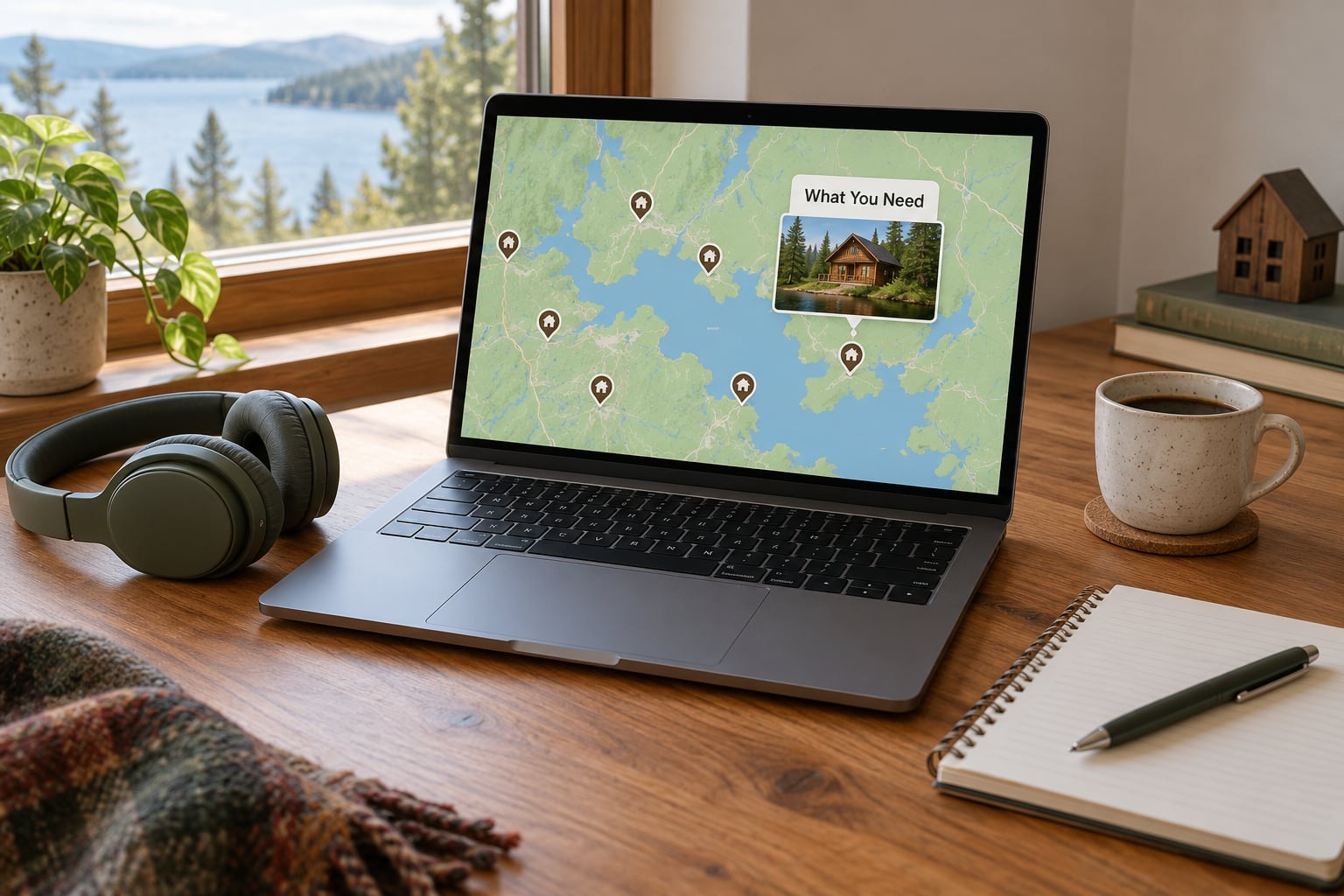
Gather five things before you open a single listing, and the search stops being a scrolling exercise and starts being a screening process.
- A map tool with a satellite view. Satellite imagery shows the road, the driveway length and the neighbors. Street view shows the approach.
- A noise checklist. Road, rail line, airport approach path, town center, construction site, campground, gravel pit, livestock, water. Anything within about a mile matters.
- A list of review keywords. noise, road, traffic, highway, generator, neighbors, barking, train, rooster, chainsaw, ATV, quiet, peaceful, isolated, HVAC, pump.
- Your booking platform logins. Airbnb, Vrbo and Booking.com all hold different inventory, and direct-from-owner listings show up only on local sites.
- A note on the practicalities. How long is the grocery run, is there cell service, and is the access road gravel or pavement. Isolation gets tiring when it is also inconvenient.
Keep the checklist somewhere you can paste it. Most people do the map work, get excited about a photo, and forget the checklist by the third property.
Step-by-Step: How to Find a Cabin Rental with Real Quiet
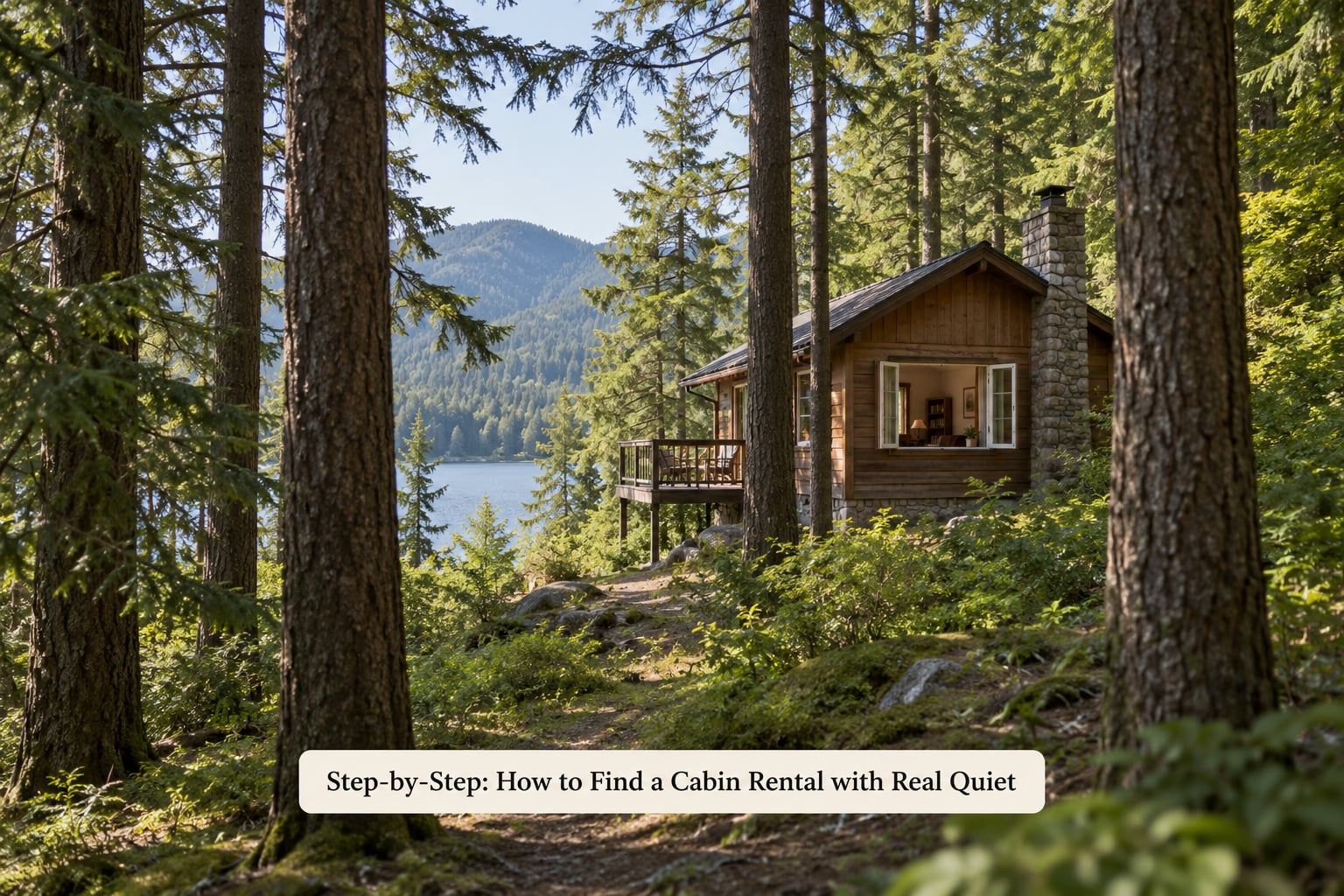
Set the Location Before the Property
Choose the area by its distance from sound sources, not by the destination name. A cabin 40 minutes outside a busy town is a different acoustic situation from one on the edge of it, even at the same nightly rate.
This matters most in tourism corridors, where the neighborhood itself is the problem. The advice that circulates in r/Gatlinburg threads is consistent: rather than searching harder inside Gatlinburg or Pigeon Forge, travelers are pointed toward Townsend, Walland and Cosby, which sit further out of the traffic and the shuttle buses. Same mountains, completely different sound environment.
Look for terrain that helps. Valleys behind ridges block highway noise, and thick forest between a cabin and a road does more acoustic work than most people expect, especially with wind in the canopy.
Use Search Filters to Find a Cabin Rental With Real Quiet
Filters narrow the list. They do not prove anything. Airbnb and Vrbo both let you sort on remote or rural location, private homes, entire cabin rather than shared walls, and reviews that mention quiet, which is the single most useful filter on either site.
Understand what the adjectives actually mean. Secluded usually describes the view out the window, meaning no neighbor in the photograph. Private usually means the cabin is not shared. Remote sometimes means a long paved drive from a paved road, which tells you very little. Only one of those three words addresses noise.
Open the satellite view for every finalist. You should be able to see the nearest paved road, the length of the drive, and whether another structure sits within sight. If the driveway meets a county road at the property line, that road carries traffic noise far more than the listing photo suggests.
Read Reviews for Repeated Sound Problems
Open the reviews and search the text for the keyword list rather than skimming the star rating. Reviews mentioning a specific noise type are treated as credible by the travelers who rely on them, and vague praise tells you nothing.
One guest mentioning traffic could be a bad week. Three guests in different years mentioning traffic is a structural fact about the property. Pay attention to the most recent twelve reviews, since a cabin can change hands, get a new neighbor or gain a new road project.
Also read what people say about the experience, not just the sound. Phrases like peaceful, only the wind, and we did not hear a single car are strong signals. Silence described by a guest who checked out twice is worth a lot.
Check the Property Layout and Equipment
Modern cabins make their own noise, and this is where comfortable listings often lose. A hot tub has a pump, an air conditioner has an outdoor compressor, a well needs a well pump, and a metal roof turns rain into a drum set. None of that ruins a stay, but you should hear it coming.
Look through every photo for the view out the windows and the driveway. Neighboring roofs in the frame, a road visible from the deck, a portable air unit on a pad, or a generator housing are all answers without a single question asked.
| Noise source | Why it gets you | What to check | What to ask the host |
|---|---|---|---|
| Highway or county road | Carries all night, worst at 2am | Satellite view, length of the drive | How far is the cabin from the nearest paved road, in miles? |
| Rail line or airport path | Intermittent and impossible to sleep through | Map layer for rail and airport proximity | Is there a rail line or flight path within a few miles? |
| Neighbors, dogs, ATVs | Recurring, unpredictable, often at dawn | Nearby structures on satellite | Are there other homes within sight or earshot? |
| Generator or well pump | Runs whenever power is out or water is used | Photos of mechanical equipment | Does the property have a generator or well pump, and when does it run? |
| HVAC compressor | Constant, near the bedroom wall | Outdoor unit position relative to the deck | Is the air conditioning central or a wall unit? |
| Rain on a metal roof | Fine on drizzle, severe in a storm | Roof material in photos | Is the roof metal, and how is it insulated? |
Hot tubs are worth a separate note because they cut both ways. A private hot tub on a deck with no neighbors in sight is one of the best quiet experiences available in a cabin rental. The pump is background level, not a road.
Ask the Host Direct Questions
Message the host before you book. You are not being difficult, and a host who answers specifically is usually telling the truth. Copy this list and keep the questions in one thread:
- How far is the cabin from the nearest paved road, in miles?
- Are there other cabins, houses or campgrounds within sight or earshot?
- What can be heard from inside the cabin at night, specifically?
- Does the property have a generator, well pump or water heater that runs continuously?
- Are there construction projects, new roads or logging nearby, planned or underway?
- Is the property ever rented for events, and do neighbors host gatherings?
- Are there dogs, livestock or ATVs on the property or next door?
- Is the access road gravel or pavement, and how far is the nearest grocery store?
Read the answer for specificity. A host who says the cabin is a quarter mile off a county road with no year-round neighbors is giving you usable information. A host who says it is peaceful and secluded is giving you a mood.
Confirm Quiet Conditions Before Booking
Save the answers in the message thread. If conditions change, you have a written record, and some platforms let you raise an issue through the chat history rather than by email alone.
Then adjust the timing, because when you arrive changes the noise more than almost any property feature. A Sunday to Thursday check-in in October gives you a different cabin than a Friday in July at the same address. Genuinely remote cabins also book first, so the quietest options go earlier in the season and earlier in the week.
Read the cancellation policy before you read the amenities. Free cancellation for the first few days is what gives you a real chance to leave if the location turns out to be louder than the description. A non-refundable booking has no safety net at all, so the host’s answers carry much more weight.
What to Do When the Cabin Is Not Quiet on Arrival
Wait until dark before deciding. Traffic noise reads louder in daylight, and a creek that looks loud in photos can be a ten-minute walk from the bedroom.
If it is genuinely quiet-breaking, message the host the same day with specific times and sounds rather than a general complaint. Hosts running rental properties often have a lever they have not tried yet, such as a different bedroom, a white noise machine, or a refund for the worst night. Document arrival time and the noise you are hearing, and keep your cancellation window open if you have one.
One note for solo travelers. True isolation and personal safety pull in opposite directions, and the most remote cabins are also the ones with the longest drive to another person. Tell someone your address and check-in time, confirm the property has working cell service or a satellite messenger, and arrive in daylight. Offline does not have to mean unwitnessed.
Common Mistakes
Choosing a cabin by the photographs. Scenic marketing shots are shot from a corner of the property facing away from the road. Look for the view out the window instead, and for the driveway.
Skipping the satellite view. It takes two minutes and it answers the neighbor question before you ever message anyone. Several finalists usually disappear at this stage.
Ignoring reviews that name specific noises. A guest naming a train, a generator or a neighbor’s rooster is handing you verified information. Skipping it to reach the overall score wastes the most reliable source on the page.
Assuming every isolated cabin is silent. Remote properties often sit near logging roads, gravel pits and cell towers. Isolation cuts off neighbors, not machinery.
Booking a Friday check-in in peak season. Friday arrivals mean weekend traffic, day visitors and the neighbor’s Saturday project. Midweek in shoulder season is quieter and usually easier to book.
Treating amenities as automatic. Luxury cabins mean more equipment running more often. A fireplace, a hot tub, a washer and a central air system can each add background sound, so ask where the mechanical equipment sits.
Forgetting the logistics. A three-hour round trip to the nearest grocery store turns a quiet stay into a restless one. Many travelers who want silence say they are happy with no Wi-Fi and real running water, but nobody wants to discover the food situation at 9pm.
Frequently Asked Questions
How do I make sure a cabin is actually quiet before I book?
Screen in this order: satellite view for road distance and neighbors, reviews searched for noise keywords, then a host message asking how far the cabin is from the nearest paved road in miles. Read the most recent twelve reviews rather than the overall score, and confirm the answers before paying. Timing helps too, since a midweek shoulder-season stay is usually quieter than a Friday in peak season.
How far should a cabin be from a highway?
About a mile is the practical threshold for most travelers, since highway noise travels far more easily than people expect on flat ground. Tree cover, hills and a long gravel drive all soften sound, so a cabin three tenths of a mile off a busy county road can still be louder than one a mile off a quiet forest road. Ask for distance in miles and check the satellite view.
Do cabins with hot tubs make more noise?
A hot tub pump is real but manageable noise, and a private tub on a deck with no neighbors nearby is usually a better experience than no tub at all. Ask where the equipment sits relative to the bedroom and whether it runs continuously or on a schedule. The same reasoning applies to air conditioning, well pumps and generators, which are worth asking about before booking.
Are quiet cabins quieter on weeknights?
Yes, noticeably. A Sunday to Thursday check-in removes weekend traffic, day visitors and the neighbor’s Saturday project, and midweek rates are often easier to get. Combined with shoulder-season dates, a midweek stay changes the acoustic picture more than most property upgrades do. It also works in your favor on availability, since the most isolated cabins tend to sell first.
How do I find a quiet cabin in a busy destination like the Smoky Mountains?
Move out of the tourism core instead of searching harder inside it. Travelers in r/Gatlinburg threads consistently point to Townsend, Walland and Cosby as quieter alternatives with the same mountain access. In any busy corridor, set the map radius around an outlying town and check satellite imagery for cabins well away from the main road before you filter listings.
What do I do if the cabin is not quiet when I arrive?
Wait until dark before deciding, since traffic reads louder in daylight. Then message the host the same day with specific times and sounds, because concrete details usually get a better response than a general complaint. Keep photos of the situation, stay inside your cancellation window if you have one, and ask about a partial refund or a move for the worst night.
Run the map check, read the reviews for repeated noise words, then send the host message and wait for a distance in miles. That order takes under an hour and it is the difference between a restorative week and three nights of truck noise. If you have to pick one step, pick the host question, because a specific answer in miles settles the question faster than any photo or star rating.