Preventing sunburn on a long hiking day takes layers, not a single coat of lotion. Cover exposed skin with UPF-rated clothing and a wide-brim hat, apply broad-spectrum SPF 30 or higher water-resistant sunscreen 15 to 20 minutes before you start, reapply every two hours and after heavy sweating, and plan your start time and route so the strongest hours land where you are covered or in shade.
That is the short version, and it takes about five minutes at the trailhead to set up. The reason it matters: one long day at altitude, on snow, or on open desert terrain can deliver more UV exposure than a month of ordinary city life. This guide walks through the gear, the application order, a reapplication timeline for a full day out, and what to do when protection fails anyway. Guidance here is general information, not medical advice.
Table of Contents›
- What You Need
- Step-by-Step: How to Prevent Sunburn on a Long Hiking Day
- How to Apply Sunscreen Before Hiking
- How to Dress for Long Hours in the Sun
- How to Time Your Hike to Reduce Strongest Exposure
- How to Reapply Sunscreen While Hiking
- How to Protect Your Skin While Moving and Sweating
- Common Mistakes on a Long Hiking Day
- Frequently Asked Questions
- What type of sunscreen is best for a long hiking day?
- How often should I reapply sunscreen while hiking?
- Does sweating or swimming require more frequent sunscreen application?
- Is a hat and long-sleeved shirt enough to prevent sunburn?
- What should I do if my skin turns red after a long hike?
- Conclusion
What You Need
Gather these before you leave the trailhead, not halfway up the first climb where you are already sweating and out of sunscreen.
- Broad-spectrum, water-resistant SPF 30 or higher. SPF 50 gives you a real but modest extra margin, roughly 97% of UVB blocked at SPF 30 versus about 98% at SPF 50, so application amount matters far more than the last few points on the label.
- A second container. A stick for your face, ears, and nose and a lotion or cream for your body and hands. Hikers routinely run out because they bring one small bottle.
- A shot glass worth of product for a full day. That is roughly an ounce per application set for exposed skin, so two to three applications on a nine-hour hike. Pack a little extra rather than exactly enough.
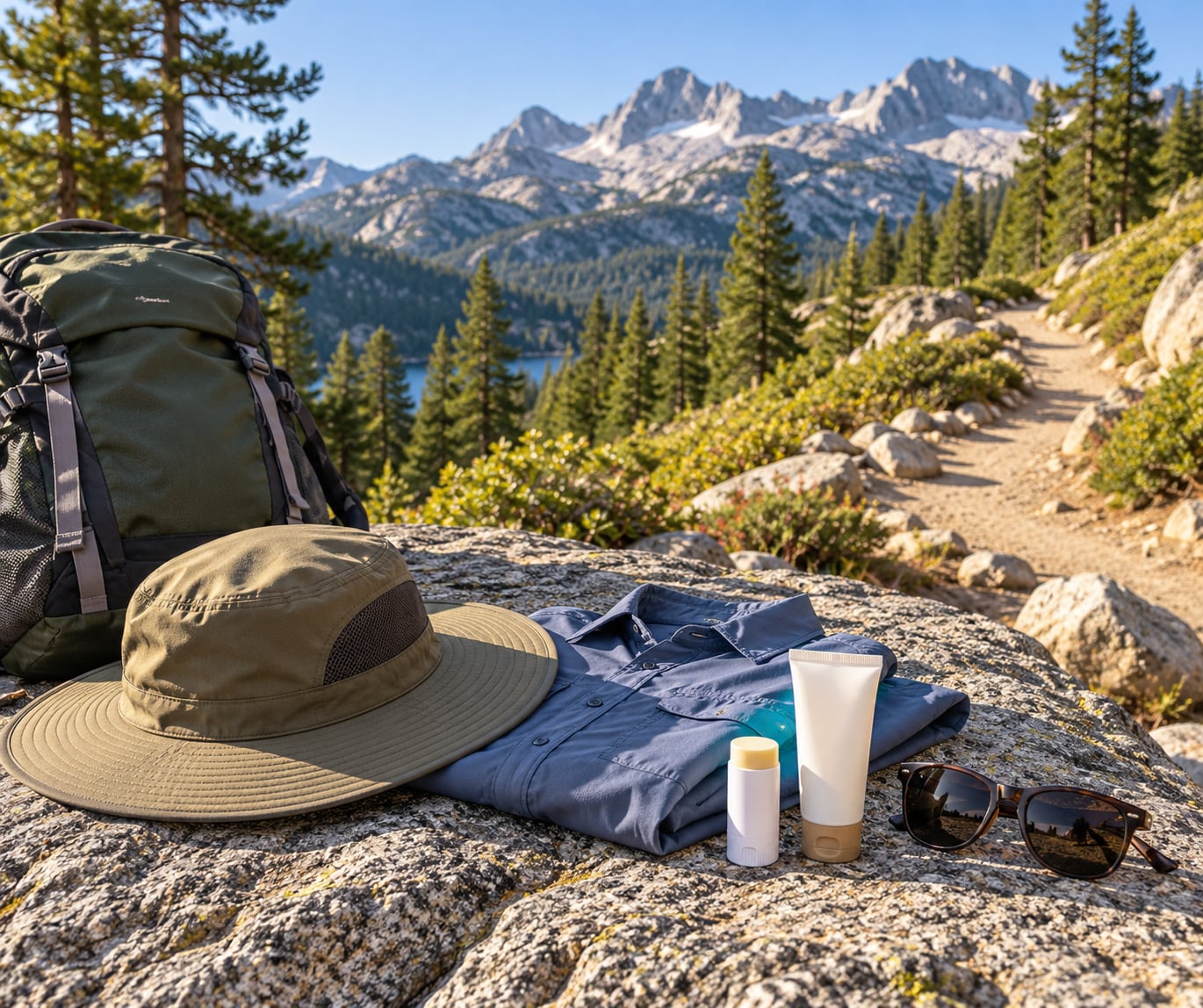
- A tight-weave long-sleeve shirt with a UPF 30 to 50+ rating if your skin burns easily. Color and weave matter more than the marketing number.
- A wide-brim hat with a brim of at least two to three inches all around, plus a buff or neck gaiter you can pull over your lower face.
- Fingerless sun gloves, UV400 sunglasses, and breathable trousers or leggings. Eyes and hands get burned more often than most people expect.
- A timer and a UV index forecast for your start time. A cheap phone alarm set for two-hour intervals is the whole system.
- A place in the pack for the sunscreen that is not your main pocket. Body heat and a pack liner will melt a lotion bottle and ruin everything around it.
Step-by-Step: How to Prevent Sunburn on a Long Hiking Day
How to Apply Sunscreen Before Hiking
Apply to clean, dry skin 15 to 20 minutes before your first step so it has time to bond with the skin. Rub it in rather than spreading it thinly, and use roughly a shot glass for your body on a full day of exposure.
The commonly missed zones are the ears, the back of the neck, the hairline, the tops of the feet, the backs of the hands, and the strip of skin between your socks and trousers. Hiking forum regulars report the same short list over and over, and one poster described coming back from a hot, high snow route with a burn shaped by nothing but the gaps in his application.
Do not forget lips. A tinted lip balm with SPF 30 is cheap insurance on a day with no shade.
How to Dress for Long Hours in the Sun
Clothing is the layer that does not wash off, run down, or rub away at the third switchback. Dense synthetic or merino long sleeves, a brimmed hat, gloves, and a buff block the light before it reaches your skin, and they work when your sunscreen has quit.
Judging UPF quality is straightforward. Hold the fabric up to a light: if you can see through it, UV gets through it. A loose, open-weave linen shirt looks proper in a shop and offers far less protection than its label suggests, while a tight synthetic weave can block most UV even at a modest rating. Hikers who report never burning usually name the same combination: a light long-sleeve plus a large-brim hat.
Watch the heat tradeoff. The reason people get burned on hot hikes is that overheating pushes them to strip the very layers that were doing the work. Lightweight, loose, moisture-wicking fabric that vents heat lets you keep coverage on without cooking. A packable sun umbrella is worth the weight if your route has no shade at all.
How to Time Your Hike to Reduce Strongest Exposure
Check the UV index for your start time, not the temperature. UV peaks around solar noon, and a cool 15 degrees does not mean low exposure. Cloud cover cuts UVB but a large share of UVA still gets through, so an overcast day is not an off day.
Start early if you can. Walking the exposed section before mid-morning and saving the shaded valley or forested section for the afternoon flips the risk profile of the whole route. The UV index scale runs from 0 to 11 and above; treat anything above 5 as full precautions and 8 or higher as a reason to add a buff and gloves.
Three conditions quietly multiply exposure. Altitude adds roughly 4 to 5 percent more UV per 1,000 feet of elevation gained. Snow reflects up to about 80 percent of UV, which is why light arrives from below as well as above and a hat alone is never enough. Water, pale sand, and light rock bounce light back at your chest and face. If your hike has one of these, plan for more coverage than the forecast number alone suggests.
How to Reapply Sunscreen While Hiking
Set two alarms for the day, at fixed times, and treat them as non-negotiable. Sunscreen wears off on schedule whether or not you feel it, and nobody is going to mention it if you are hiking alone.
For a nine-hour day on the trail, a workable timeline looks like this:
- 20 minutes before start: full application to face, ears, neck, hands, arms, and any exposed leg skin.
- Hour 2: reapply to everything exposed, with extra attention to shoulders under the pack straps and the back of the neck.
- Hour 4: full reapplication, including face and ears. This is usually where people stop.
- Hour 6: reapply. Gloves off, ears and tops of feet included.
- Hour 8 and any time you stop for a long break: final coat before the last stretch.
- Any time: straight after wiping sweat from your face with a shirt or buff, or after any stretch of rain or water crossing. These events matter more than the clock.
A stick is the format that survives a hike. No hands to clean, no dripping bottle, and it goes on over a damp face without fighting you.
How to Protect Your Skin While Moving and Sweating
On a hot climb you can sweat through a shirt in twenty minutes, and that sweat carries sunscreen off with it. Water-resistant formulas hold up better than standard lotions, but nothing holds up forever against friction.
Pack straps are the quiet problem. Repeated rubbing wears sunscreen off your shoulders and collarbones faster than any sun does, which is why shoulder burns show up so consistently in trail reports. Wearing a long sleeve under the straps covers that contact zone entirely, and you can also dab a little sunscreen under the strap line at each break.
Sunscreen in a hot pack is its own issue. Body heat softens lotion, and a burst bottle can soak a shirt and a map. Carry it upright in a side pocket or in a small sealed pouch, keep it away from the inside of your back panel, and consider a solid stick as the main container precisely because heat cannot ruin it.
Finally, remember that sunscreen is one layer in a system, not the whole system. Shade, fabric, a hat, and route timing do not expire. A single coat of lotion does.
Common Mistakes on a Long Hiking Day
- Applying too little. Thin layers evaporate and wear off fast. If your first coat disappears into the skin in under a minute, you used too little for the day ahead.
- Treating a hat as the whole plan. A brim shades your forehead and eyes and nothing else. Ears, neck, and shoulders still need fabric or sunscreen.
- Skipping ears, lips, hands, and the hairline. These are the four zones hikers report burning most, every time.
- Waiting until you feel hot. The sensation of burning arrives after damage has started. Use the clock.
- Stripping layers because of heat. Overheating drives the decision, and the decision costs you coverage. Ventilating fabric is the fix; removing it is the symptom.
- Underestimating clouds, snow, or altitude. Overcast skies, snowfields, and high elevation each raise exposure without changing how the day feels.
- Carrying one small bottle. Running out at hour five leaves you exposed for the rest of the hike. Bring more than you think you need.
- Trusting a tan or a base tan. Tanned skin burns, it just burns later. Color is not protection.
Frequently Asked Questions
What type of sunscreen is best for a long hiking day?
Broad-spectrum, water-resistant SPF 30 or higher is the practical choice for a full day on the trail. SPF 50 adds only a few percentage points of UVB protection, so amount and reapplication matter more than the number. Mineral formulas with zinc oxide or titanium dioxide are gentler on sensitive skin and sit on top rather than absorbing, which helps when sweat is running down your face.
How often should I reapply sunscreen while hiking?
Every two hours, plus any time you wipe sweat from your face, change layers, or finish a water crossing. On a nine-hour day that means roughly four to five applications after the one you put on at the trailhead. Set phone alarms at fixed times instead of waiting to feel it, because sunburn starts before you notice anything.
Does sweating or swimming require more frequent sunscreen application?
Yes. Sweat, water, wind, and friction all wear sunscreen film away faster than the clock predicts, and swimming can wash most of it off completely. Treat any heavy sweating or a stream crossing as an immediate cue to reapply rather than waiting for your next scheduled alarm. If you are crossing water regularly, choose a water-resistant formula and plan on reapplying on the far bank.
Is a hat and long-sleeved shirt enough to prevent sunburn?
They do most of the work, but not all of it. A brimmed hat shades your face and a long sleeve covers your arms and torso, yet the ears, back of the neck, hairline, tops of the feet, and backs of the hands stay exposed. Use UPF-rated fabric where you can and sunscreen on the exposed zones, especially above treeline or on snow.
What should I do if my skin turns red after a long hike?
Get out of the sun first, then cool the skin with a cool compress or damp cloth and drink water. Aloe and plain moisturiser help with discomfort, and over-the-counter anti-inflammatory pain relief can take the edge off. Loosen clothing and boots, and do not break blisters. Seek medical care for blistering burns, burns on the face, hands or feet, or any fever, nausea, or headache, which can signal heat illness rather than sunburn alone.
Conclusion
Put sunscreen on at the trailhead, not at the summit, and pack more than the one bottle. Wear the long sleeves and the brim even when the heat makes them tempting to drop, cover the zones you normally forget, and set two-hour alarms so reapplication happens whether or not anyone reminds you. Checking the UV index before you start, and shifting the exposed part of your route away from solar noon, costs nothing and removes most of the risk. If you finish red anyway, cool the skin, drink water, and ask a doctor about anything severe.