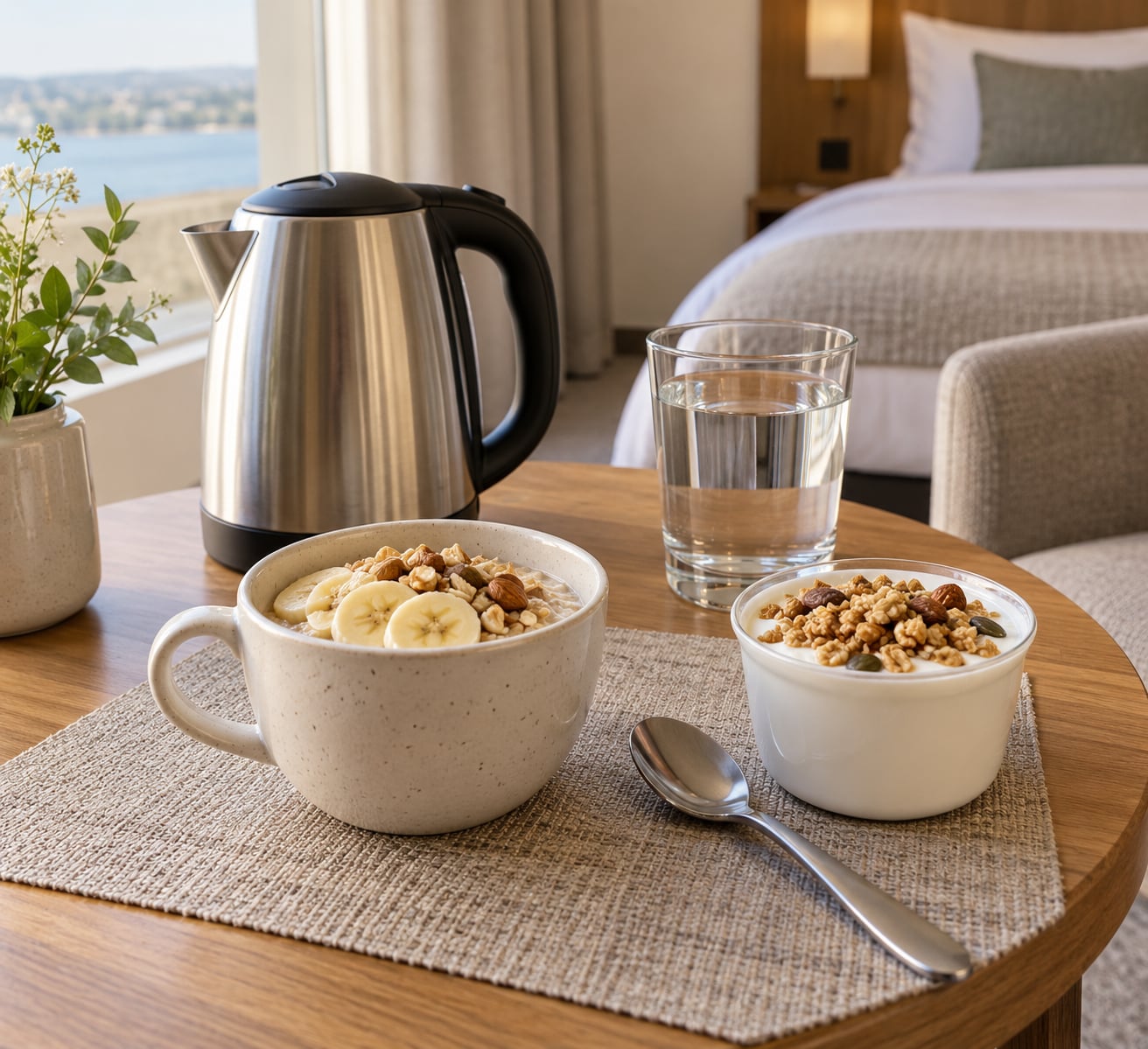
You can make breakfast in a hotel room with no kitchen at all: boil water in the kettle or run the coffee maker for a jug of hot water, pour it over instant oats in the room mug, and add fruit, nuts or nut butter from what you carried or picked up nearby. Add a microwave and you get eggs or a mug pancake in about 90 seconds. Most of it is under five minutes, and there is one mug to wash.
That matters more than it sounds. A sit-down breakfast eats 30 to 60 minutes of a travel day, costs several times what the same food costs from a supermarket, and leaves you full of pastry that fades by ten o’clock. Learning how to make breakfast in a hotel room is a small skill with a real payoff on any trip where breakfast is not included, the flight is at six, or the per diem is tight.
The thing to know before you start is that a mini fridge is a beverage cooler, not a refrigerator, and hotel rooms rarely have plates, bowls or a knife. Plan around those two facts and the rest is easy.
Table of Contents›
- What You Need to Make Breakfast in a Hotel Room
- What is usually already in the room
- What to ask the front desk before you unpack
- What to pack from home
- Step-by-Step: Your First Hotel Room Breakfast
- 1. Check What the Hotel Room Provides
- 2. Choose a No-Cook or Quick-Preparation Base for Breakfast in a Hotel Room
- 3. Make the Meal Filling and Balanced
- 4. Use the Kettle or Microwave Safely
- 5. Set Up, Eat, and Clean Up
- Common Mistakes to Avoid
- Frequently Asked Questions
- Can I make breakfast in a hotel room without a microwave?
- What foods can I prepare with only a hotel kettle?
- How can I keep yogurt or fruit cold in a hotel mini-fridge?
- Is it allowed to use a hotel-room kettle for oatmeal?
- What is the easiest hotel-room breakfast for someone traveling alone?
- What should I do if my hotel room has no cooking facilities?
- Conclusion: Start With the Kettle
What You Need to Make Breakfast in a Hotel Room
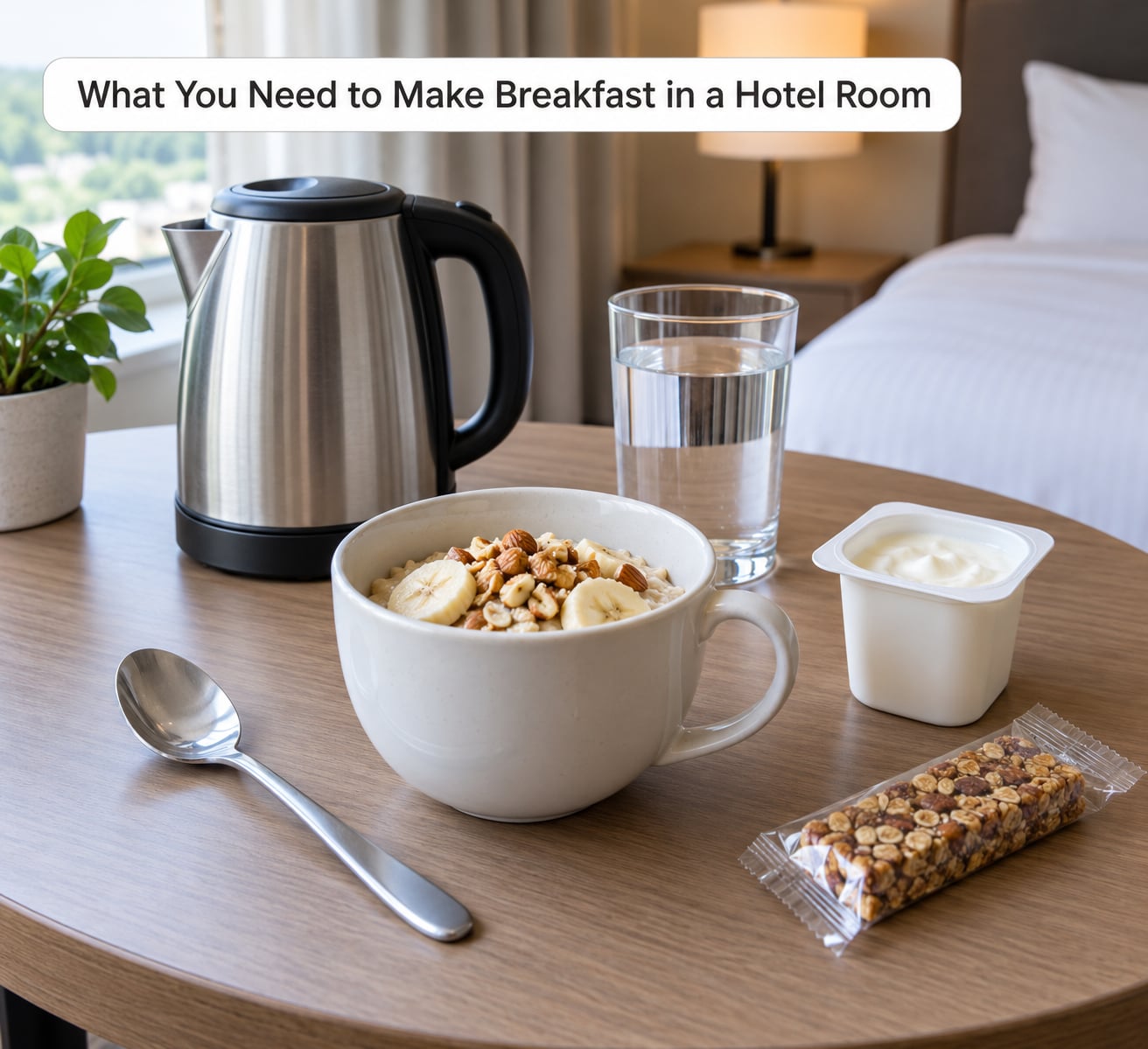
Almost every hotel room gives you three things: an electric kettle, at least one mug, and tap water. Everything else is either a question for the front desk or something you bring yourself.
What is usually already in the room
- Kettle and mug: the reliable pair. Assume water only, since many rooms stock tea and coffee sachets but no sugar or milk.
- Mini fridge: good for cold drinks and short-term storage, unreliable as a real fridge. More on temperature below.
- Coffee maker: common in older and mid-range properties, increasingly absent from newer and luxury hotels. Treat it as a bonus, not a plan.
- Microwave: rare in guest rooms, more common in suites, aparthotels and long-stay properties. Sometimes there is one on the same floor.
- Trays and sachets: a small tray, teaspoon, napkins, and tea or coffee sachets. Rarely a knife, a bowl or a plate.
What to ask the front desk before you unpack
Two questions at check-in save the whole morning. Ask whether there is a microwave in the room or on the floor, and ask for an extra mug, a knife and a plate if you plan to eat anything that needs them. Front desks hand out these things far more often than most travellers expect, and it takes ten seconds.
A fridge does not mean cooking facilities. Some rooms have a generous mini fridge and no heat source at all beyond the kettle, so check for the kettle and microwave before you commit to a menu.
What to pack from home
About six items cover almost every breakfast in this guide, and they fit in a laptop sleeve:
- A travel cutlery set, including a teaspoon and a folding knife
- A collapsible silicone container or a microwave-safe tub with a lid, for overnight oats and reheats
- Zip-lock bags, for storage, ice and cutting without a board
- Rubber bands, to keep lids on rolled-up fruit skins or open packets
- Dish soap sheets or hand-wash soap, because the sink is right there and so is the mug
- A small pack of instant oats or granola bars for the night you land too late to shop
Step-by-Step: Your First Hotel Room Breakfast
Follow this once and it becomes automatic. The order matters: check the room, pick a base, build balance around it, heat safely, then clean up while the food is still fresh enough to eat.
1. Check What the Hotel Room Provides
First, do a two-minute sweep. Look for the kettle on the tray or under the cabinet, the coffee maker on the counter, and the mini fridge under the desk. Open the fridge and check whether it feels genuinely cold rather than merely cool to the touch.
Then decide which branch you are on: kettle only, kettle plus coffee maker, kettle plus microwave, kettle plus microwave plus fridge, or nothing at all. Write the branch in your notes app with the room number. It saves you standing in the doorway at 7am trying to remember whether the microwave was real.
2. Choose a No-Cook or Quick-Preparation Base for Breakfast in a Hotel Room
Next, pick one base and add to it. Trying to build a meal from scratch with a kettle and a teaspoon is how people end up eating biscuits for breakfast again.
- Instant oats or a porridge pot: the most reliable option anywhere. Add hot water, wait two minutes, stir.
- Overnight oats: stir oats, long-life milk and yogurt in a covered container, fridge it overnight, eat cold.
- Yogurt pot with fruit and granola: no preparation, works in a room with nothing but a spoon.
- Cereal with long-life milk: long-life cartons do not need a fridge until you open them, which makes them ideal for the first morning.
- Supermarket toast with spreads: a loaf, a hard cheese or cream cheese, and jam. You need the knife you asked the front desk for.
- Protein bar plus fruit: the 5am option, eaten standing up, still better than a vending machine.
3. Make the Meal Filling and Balanced
Third, add three things to any base: a carbohydrate for energy, a protein source to keep you full, and something fresh. A small amount of fat is what makes the whole thing stick until lunch.
Concrete examples rather than rules. Instant oats with a spoonful of peanut butter and a sliced banana. Greek yogurt with granola and a handful of nuts. Rice cakes with nut butter and an apple. Toast with two eggs and a tomato if the room has a microwave. Each takes the same two minutes as the plain version and behaves completely differently by mid-morning.
The comparison you are making is with a pastry and a coffee, which is mostly sugar. Two of these options will carry you past eleven without a second snack.
4. Use the Kettle or Microwave Safely
Fourth, heat things with attention. Fill the kettle only to the marked line, no higher. Never put milk, milk powder or anything that has been used into a kettle, because of the scale. Stay in the room while it boils, and follow any instructions printed on the appliance or in the room folder.
For the microwave, use only a microwave-safe mug, keep metal cutlery away from the walls, and loosen any lid or cover so steam can escape. Scrambled eggs in a mug take about 90 seconds at full power, then you stir and continue in short bursts until they reach 160°F (71°C) and no liquid egg remains. A plate on top of the mug catches splatter, which saves you a wipe-down later.
No microwave? Run the coffee maker with water in the reservoir and no coffee in the basket, and many machines will give you a full hot-water jug. This is the most repeated tip on travel forums, and it is what unlocks instant oatmeal, ramen and instant noodles in a room with nothing else. Rinse the carafe and run a clear jug through it first, because hotel coffee makers are seldom cleaned between guests and residue in the reservoir is common. If your machine has no hot-water setting, the kettle covers the same need.
5. Set Up, Eat, and Clean Up
Fifth, use the tray and a napkin, and treat the desk as your worktop. If you brought a container, portion into it rather than eating out of the packet, which stops crumbs reaching the keyboard and the bedding.
Then wash as you go. Rinse the mug, wash the spoon, wipe the tray, and put anything unused back in the fridge. Check the fridge temperature question: a hotel mini fridge is often a beverage cooler running above 40°F (4°C), so it is fine for drinks and short storage, not for keeping dairy or cut fruit for more than a couple of hours. If you have bought ice from a shop, a small insulated bag makes the fridge irrelevant.
Finishing this step in five minutes keeps the room pleasant for the rest of the stay, and it means checkout is not a scramble with a sticky mug in the sink.
Common Mistakes to Avoid
Treating the mini fridge as a real refrigerator. Many are beverage coolers, and few hotels will tell you the temperature. The fix: buy a bag of ice and keep perishables in an insulated bag, or buy items you can finish the same morning.
Boiling water in the coffee maker without rinsing it. The fix: run one full clear jug through before you use the water for food. It costs you ninety seconds and removes the most reported hygiene complaint in hotel rooms.
Heating a drink and walking away. Nobody should be boiling water or microwaving eggs in an empty room. The fix: stay in the room, and keep the mug on the tray rather than the bed.
Pouring milk into the kettle. Protein and heat scale up inside kettles and it is a genuine chore to clean. The fix: heat water only, then cool it slightly before adding milk powder or long-life milk to your mug.
Building a breakfast out of one sweet thing. A chocolate bar and a coffee is not breakfast, however hungry you were. The fix: add one protein and one piece of fruit, which takes one minute and changes the morning.
Forgetting storage. Half a bag of oats and a peeled apple do not survive on a desk until evening. The fix: sealed bags or a container, in the fridge or an insulated bag.
Leaving the mess for housekeeping. A room with a kettle, crumbs and a used mug reads as a problem rather than a stay. The fix: rinse and wipe as you cook, and do a five-minute sweep before you leave the room for the day.
Frequently Asked Questions
Can I make breakfast in a hotel room without a microwave?
Yes. A kettle is enough for instant oats, a porridge pot, instant noodles, tea and instant coffee, and you can run the coffee maker with water only to get a hot jug. Cold options need no heat at all: yogurt with granola and fruit, cereal with long-life milk, cheese and crackers, or a protein bar with an apple. Most of these use only a mug and a spoon.
What foods can I prepare with only a hotel kettle?
Instant oatmeal and single-serve porridge pots are the classics, since they only need hot water and a two-minute wait. You can also make instant noodles, instant coffee and tea, reheat a soup sachet with hot water in a bowl, or soften dried fruit and nuts to top your oats. The kettle sets the limit: anything raw, anything that needs frying, and anything that takes more than about five minutes.
How can I keep yogurt or fruit cold in a hotel mini-fridge?
Test it rather than trusting it. Put a glass of water in for an hour and see if it feels properly cold, or ask the front desk if there is a thermometer in the room. Many hotel mini fridges are beverage coolers running above 40F (4C), which is fine for drinks but not for cut fruit or dairy overnight. A bag of ice from a nearby shop in an insulated bag beats the fridge on almost every stay.
Is it allowed to use a hotel-room kettle for oatmeal?
Almost always yes, since the kettle is there for making hot drinks and instant oats need nothing more than boiling water. Stay in the room while it heats, keep to the water line, and never put milk, milk powder or used drink residue into it. If the kettle looks grimy or the room folder says otherwise, use the coffee maker for hot water or ask the front desk for a clean replacement.
What is the easiest hotel-room breakfast for someone traveling alone?
Overnight oats made the night before. Stir half a cup of oats, a splash of long-life milk and a spoonful of yogurt in a covered container, put it in the fridge or an insulated bag, and eat it cold from the container at the desk over five minutes. No cooking, no washing up beyond a spoon, and it works on a morning when you have to leave at six.
What should I do if my hotel room has no cooking facilities?
Switch to cold and shelf-stable food instead of trying to heat anything. Buy yogurt, cereal, long-life milk, nuts, fruit, bread and a hard cheese from a nearby supermarket or bakery, and bring a travel cutlery set. If even that is not possible, the lobby shop, a kiosk or a street bakery is the fallback, and a protein bar plus fruit keeps an early start manageable.
Conclusion: Start With the Kettle
Check the room first, because the kettle and the mini fridge decide everything else. Then pick one prepared base, add a protein and a piece of fruit, and keep the whole thing to five minutes and one mug to wash. That is how to make breakfast in a hotel room without a kitchen, a bill or a wasted morning.