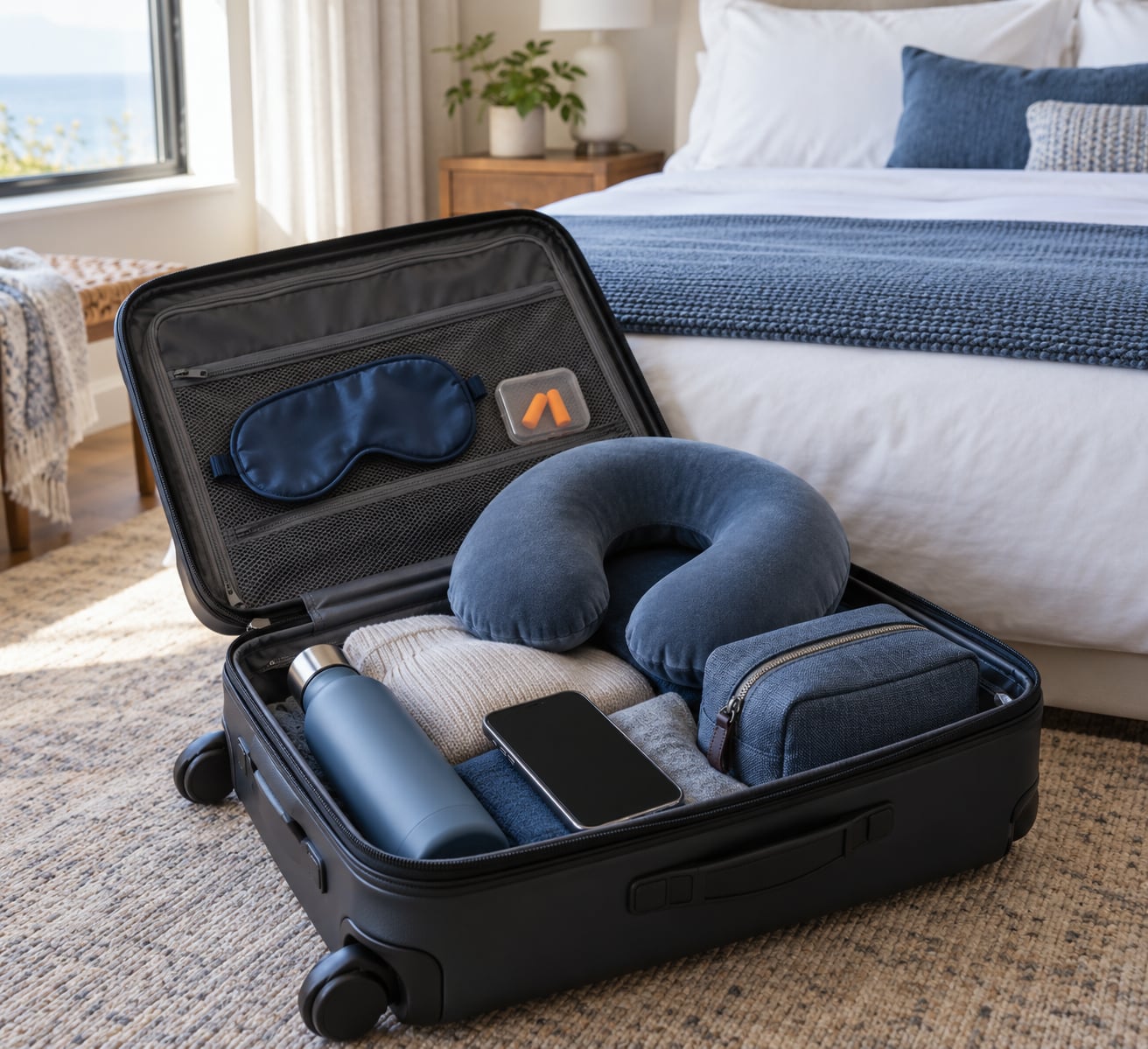
How to survive a red eye flight and feel human comes down to three things: prepare your body before you leave, pack the gear that makes upright sleep possible, and treat the seat you book as part of the plan. A red-eye flight is any overnight flight that departs in the late evening and lands in the early morning, so you sleep on the plane and wake up where you were headed.
The catch is that almost none of that sleep is real sleep. You get maybe four broken hours with your neck bent at an angle, and the tiredness lands on you at 6 a.m. exactly when you planned to be a functioning person. So the recovery half matters as much as the sleeping half.
It is worth saying up front that red-eyes are not the relaxed, half-empty flights travel blogs claim. On r/unitedairlines and r/flying, frequent flyers complain the opposite: full loads, crying babies, and overnight routings as short as two and a half hours that give you a night of terrible sleep and a morning landing with nowhere to go. Whether a red-eye is worth it depends entirely on what you are walking into on the other side.
Work through the plan below in order. It takes about fifteen minutes of prep the day before, and it is the difference between arriving tired-but-useful and arriving hollow.
Table of Contents›
- What You Need
- Step-by-Step: How to Survive a Red-Eye Flight and Feel Human
- 1. Shift Your Sleep Schedule Before Departure
- 2. Choose Clothes and Essentials for Maximum Comfort
- 3. Eat and Hydrate on Your Own Schedule
- 4. Protect Your Eyes, Ears, and Body During the Flight
- 5. Sleep in a Strategy That Matches Your Body Clock
- 6. Avoid the In-Flight Energy Crash That Ruins Your Red-Eye
- 7. Build a Gentle Plan for Arrival
- Common Mistakes
- Frequently Asked Questions
- Can you really sleep on a red-eye flight?
- Should I stay awake on an overnight flight?
- What is the best way to avoid jet lag after a red eye?
- Does drinking water prevent jet lag?
- What helps with ear pain on a plane?
- How should I plan my first day after landing?
- What to Do First
What You Need
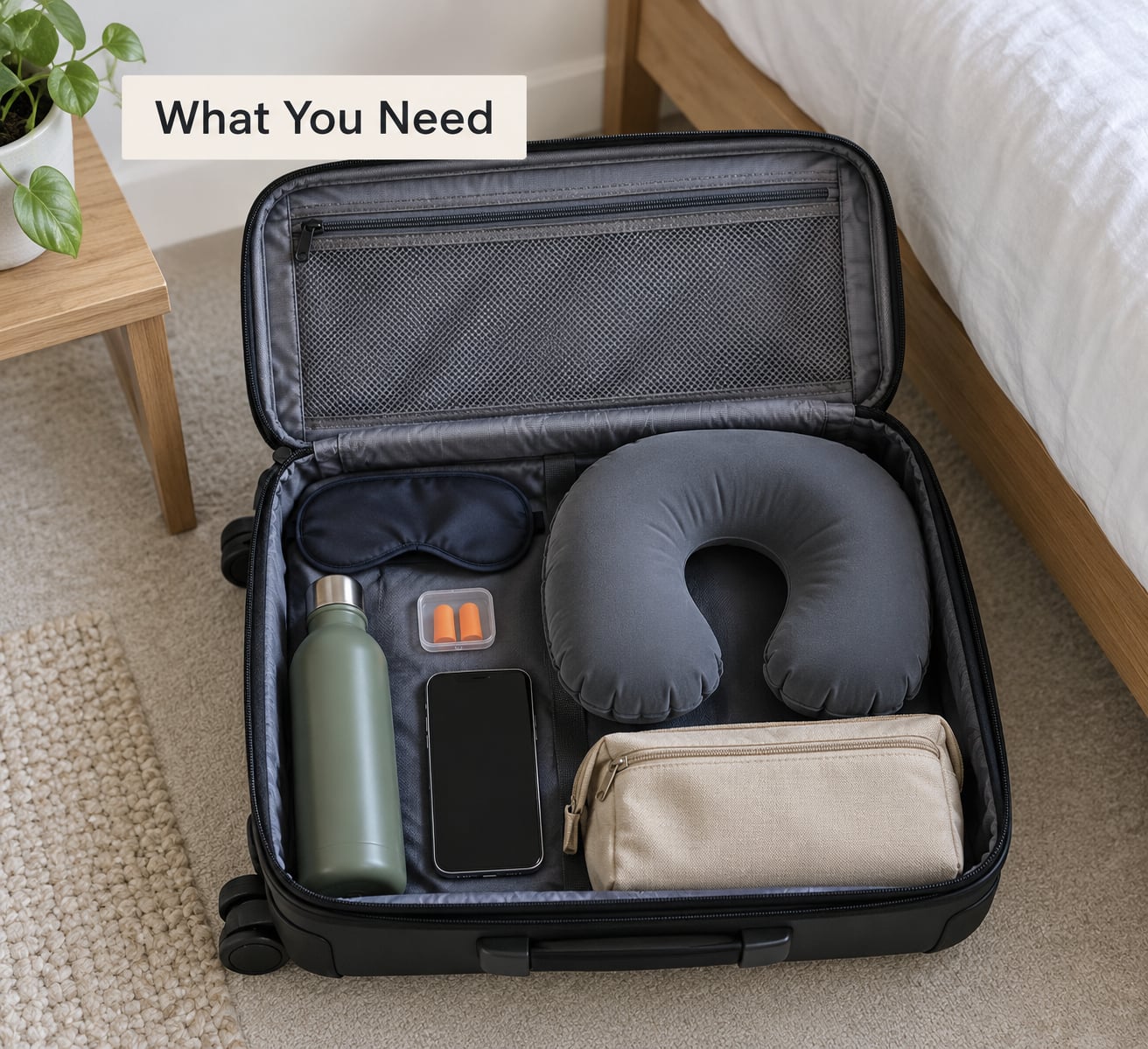
The gear list for a red-eye is short, and that is the point. You want everything reachable without standing up, because every trip to the overhead bin is another chance to wake up properly.
- A sleep plan. Decide in advance whether you are staying awake for the whole flight or sleeping most of it. People who have not decided end up do neither.
- An eye mask. Cabin lights dim, they do not go out. A mask is the single highest-value thing in the bag.
- Earplugs or noise-cancelling headphones. Earplugs block snorers and announcement crackle; headphones also handle engine drone. Travellers on r/AskReddit lean toward headphones with low-volume sleep music.
- An inflatable neck pillow. If you have never used one, this is the night to start. A rolled hoodie or your coat works too.
- An empty water bottle. Fill it after security so hydration costs you nothing in the air.
- Layers. Cabins run cold at night and the air conditioning is aimed at you all flight.
- Toiletries. A toothbrush, face wash and deodorant in your personal item. Nothing changes the arrival more.
- Medications you already use. Anything you take regularly, plus your own supply of pain relief. Ask a pharmacist before travel if you are considering anything new, especially anything sedating.
Two things you do not need: a neck pillow with a memory foam ridge you have never tested, and a complicated sleep routine. Travellers who land functional keep it boring.
Step-by-Step: How to Survive a Red-Eye Flight and Feel Human
1. Shift Your Sleep Schedule Before Departure
Start moving your bedtime toward your destination’s time zone two or three nights before you fly, in 30 to 60 minute steps. Long-haul pilots tell r/flying that adjusting to the destination clock before departure is the thing that genuinely works; nothing you do at 30,000 feet changes your circadian rhythm retroactively.
Go gently, though. Push your bedtime too far forward and you spend the flight exhausted rather than rested. People who are naturally flexible can move faster than those who are not, and if you know you sleep badly when pushed, keep the shift smaller and accept a rougher arrival.
On departure day, stay awake through the afternoon. That single decision does more for your in-flight sleep than any gadget you can buy.
2. Choose Clothes and Essentials for Maximum Comfort
Dress in loose layers you can adjust as the cabin temperature swings. A long-sleeved shirt or thin top, joggers or soft trousers, and thick socks matter more than anything else, because your feet get cold long before you notice you are cold.
The famous question about jeans deserves an honest answer. Denim is stiff, and sitting in it for eight hours is uncomfortable in a way that keeps waking you up, so it is a poor choice for an overnight flight. Save it for daytime travel.
The hoodie trick works: wear a hooded sweatshirt, then take your coat off and use the coat as a pillow, keeping the hood up for warmth around your head and neck. It is unglamorous and it works better than most travel pillows.
Shoes off at the door. Your feet swell in flight, and shoes that feel fine on boarding feel awful at 4 a.m.
3. Eat and Hydrate on Your Own Schedule
Do not arrive at the airport starving, because the meal you eats two hours before a night flight is the difference between waking up hungry and waking up queasy. Eat a normal dinner at a normal hour, even if it is earlier than you would like.
Skip alcohol. It is the most common sleep advice on the internet and it is wrong for this: alcohol shortens the time to sleep, then costs you deep sleep once it wears off, and leaves you dehydrated and headachey on arrival.
Drink water steadily instead of in one big gulp. Most travellers wake up on a red-eye with a headache, dry mouth and constipation, and all three come from doing this backwards. Skip the heavy meal at boarding if your stomach is not up for it, and eat properly once you land.
4. Protect Your Eyes, Ears, and Body During the Flight
Your eyes dry out faster in a dry cabin, which is why half-finished movies feel painful. An eye mask does double duty by blocking light and stopping you blinking at a screen.
Ear pressure on descent is fixed by swallowing and yawning, so keep water with you and drink steadily on the way down. If you already have trouble with ear pain on flights, ask your doctor before you travel for advice specific to you.
For a stiff neck and dead legs, stand up and walk every couple of hours, ideally during service when the aisle is busy anyway. Walk in your cabin socks. Ten minutes of movement does more for how you feel at landing than any amount of stretching while seated.
5. Sleep in a Strategy That Matches Your Body Clock
There are three workable strategies, and which one works depends on the flight. Staying awake suits short domestic red-eyes, where a bad attempt at sleep leaves you awake for the whole flight and groggy at landing. Sleeping through suits long-haul transatlantic flights, where you are crossing enough time zones that the clock you want at the end is completely different from the one you started in.
A planned nap suits the awkward middle, such as a nine-hour flight or an itinerary with a connection. Set an alarm for 90 minutes so you do not wake up from a two-hour coma feeling worse than when you started.
If you are westbound, going to bed early the night before usually feels natural. Eastbound is the brutal direction: you are asking your body to sleep through the middle of its natural day, so the eye mask earns its place twice over.
6. Avoid the In-Flight Energy Crash That Ruins Your Red-Eye
Coffee on boarding, then nothing until landing, is the standard mistake. The caffeine lifts you for an hour and drops you at exactly the wrong point in the flight.
Instead, take one caffeine hit early in the flight and set a cutoff a few hours before you land, so it wears off as you arrive rather than keeping you up in a strange hotel bed at midday. Screens, noise and stress all feed the same crash, and sitting still for eight hours makes it worse.
Think about melatonin in the same careful way. It is widely used and generally well tolerated, but timing and dose vary between people and some travellers report a heavy fog that costs them their arrival day. Talk to a pharmacist, start low, and take it at the right point in the flight rather than before boarding. If you take anything sedating, do not combine it with alcohol, and never fly on a first attempt.
7. Build a Gentle Plan for Arrival
This is the half that gets skipped and the half that decides whether you feel human. Before you land, know where you are showering, where your first real meal is, and what time you are going to bed.
Get outside and into daylight soon after landing, since daylight is the strongest signal your body uses to set its clock. Eat a proper meal, drink water, and move around.
Plan the nap honestly rather than fighting it. If you land at 6 a.m. and your body wants sleep at 3 p.m., take a short nap and set an alarm, because a three-hour daytime nap leaves you awake at 2 a.m. and a broken first night becomes two.
It helps to know whether you are fighting jet lag or plain exhaustion. Jet lag is a mismatch between your body clock and local time, it shows up as difficulty sleeping at night and sleepiness during the day, and it takes roughly a day per time zone to adjust, sometimes much longer. Travel exhaustion is just tiredness, and it disappears with one good night’s sleep. People flying to a destination in the same time zone never get jet lag at all, only a long night’s sleep on a plane.
Book nothing demanding on arrival day if you can move it. A red-eye saves a hotel night and costs you a usable day at the other end, so protecting the first morning is what makes the trade worth making.
Common Mistakes
- Drinking to fall asleep. You get a shorter night, more pain waking up, and dehydration. Melatonin or nothing is the better bet.
- Chasing an empty row. Every travel blog promises one and almost nobody finds one. Choose a window seat toward the back of the cabin and stop treating the seat map as a lottery.
- Sitting behind the lavatory on the aisle. Constant foot traffic, noise and the queue of people waiting to get past you. Pick a seat two or three rows ahead of it, or an aisle seat on the quiet side.
- Booking the very last row. On many narrow-body aircraft it does not recline, which means a night of sitting upright on your spine.
- Overpacking clothes. Denim and stiff fabrics lose. Soft layers you can sleep in win.
- Skipping the arrival meal. Eating nothing and then arriving starving is what makes the first day feel like a write-off. Eat at the destination.
- Treating every seat as sleep-capable. Middle seats rarely recline and rarely have an empty neighbour. If you care about sleep, pay for the window or the exit row.
- Scheduling a meeting for the arrival morning. You are booking someone who has not slept properly. Move it.
One more worth naming: flying a very short overnight route. A flight that leaves at 1:30 a.m. and lands at 6 a.m. gives you a night of bad sleep and half a morning at the destination, which is rarely a good trade no matter how good the fare looks.
Frequently Asked Questions
Can you really sleep on a red-eye flight?
Yes, but treat it as broken sleep rather than real sleep. Most economy passengers get three to four broken hours with an eye mask, earplugs or noise-cancelling headphones, an inflatable neck pillow, a window seat toward the back of the cabin, and a plan to stay awake through the day of departure. Long-haul night flights give you the best odds because you are crossing time zones anyway.
Should I stay awake on an overnight flight?
It depends on the length of the flight. On a short domestic red-eye, staying awake is usually the better call, because an interrupted attempt at sleep leaves you tired all flight. On a long-haul overnight, sleeping through is the strategy that works, because you will land in a different time zone anyway. For a flight of roughly nine hours, a planned nap with an alarm suits you best.
What is the best way to avoid jet lag after a red eye?
Move your bedtime toward the destination’s time zone two or three nights before you fly, in small steps rather than one big jump. Stay awake through the afternoon of travel, set a caffeine cutoff so it wears off before landing, and get into daylight soon after you arrive. If you cross several time zones eastbound, expect a day per zone and keep the first day light.
Does drinking water prevent jet lag?
Water does not prevent jet lag, and it is not a cure for anything, but it is the easiest thing you can control. Cabin air is dry and most travellers wake up from a red-eye dehydrated, headachy and bloated, which feels a lot like feeling worse than jet lag actually is. Drink steadily rather than in one big gulp, and eat a proper meal once you land.
What helps with ear pain on a plane?
Swallowing and yawning during descent equalises the pressure in your middle ear, so keep water with you and drink steadily on the way down. Chewing gum, eating something, or a slow equalising manoeuvre can help too. Saline nasal spray before and during the flight is often suggested. If you already suffer with ear pain on flights, ask your doctor for advice before you travel.
How should I plan my first day after landing?
Keep it light and predictable: daylight soon after landing, a real meal, water, and movement. Nap only if you are genuinely sleepy and set an alarm, since a long daytime nap turns into a night of broken sleep at the wrong local time. Bring a toothbrush and change of clothes if you can, and move anything work-related out of the first morning if you have the choice.
What to Do First
Decide tonight whether you are staying awake or sleeping most of the flight, and book the seat that matches that decision: window at the back of the cabin for sleep, or aisle near the front for moving around without waking anyone. Everything else on the list is small change by comparison.
Then start shifting your bedtime and keep the arrival day deliberately empty. That second part is where most people undo all the good work they did in the air.
Surviving a red-eye flight really comes down to boring repetition: sleep when you should, drink when you should, move every couple of hours, and do not schedule your best day at the far end of a night of broken sleep.