A personal item is the small bag that stays under the seat in front of you, usually no bigger than about 18 x 14 x 8 inches (45 x 36 x 22 cm). It is the only bag you can reach without standing up, so what to keep in a personal item bag on a flight comes down to one question: what do I need during the hours I am stuck in a seat?
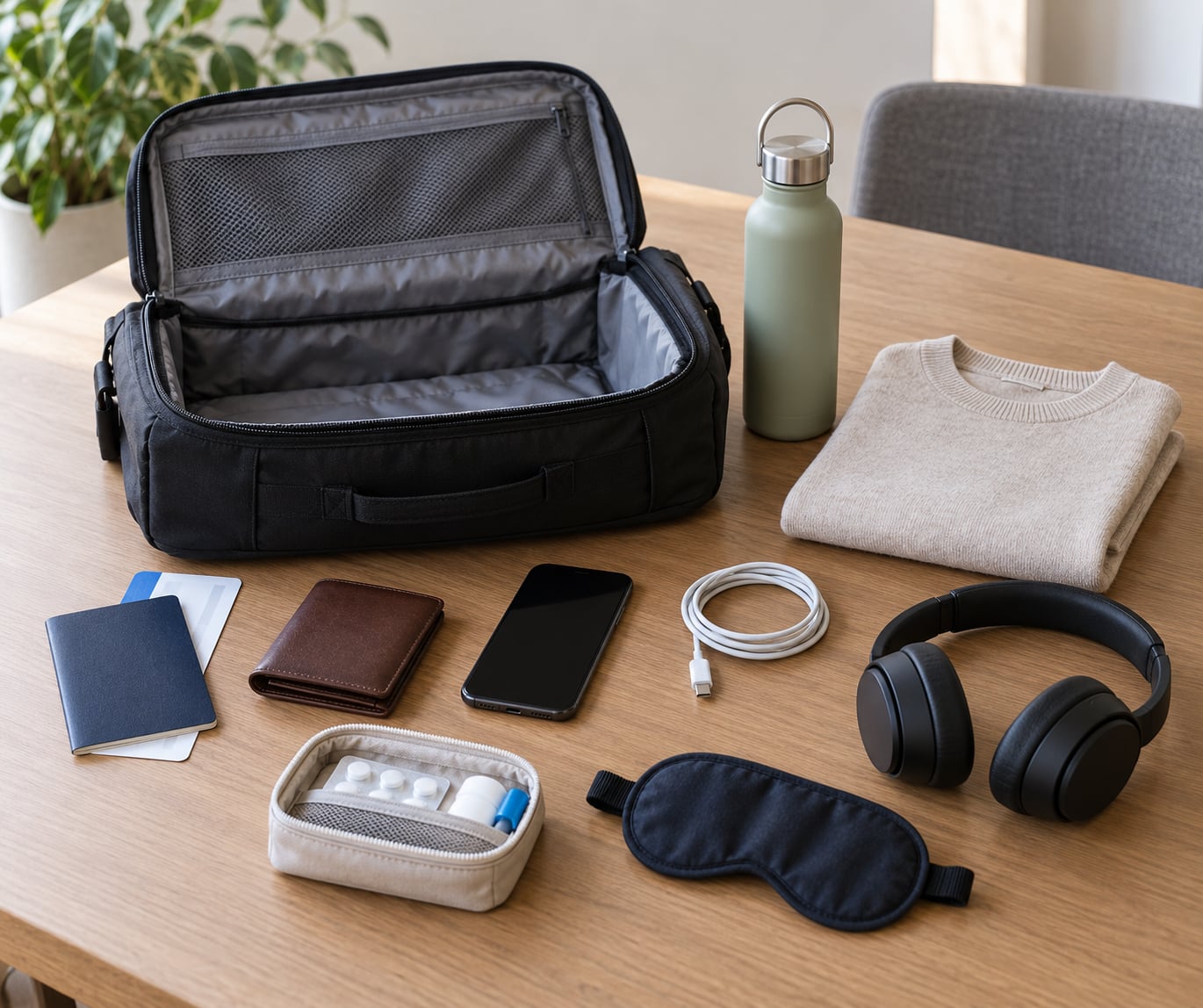
Here is the short version. Most travelers need the same dozen things:
- Photo ID or passport, plus your boarding pass
- Wallet, cards and a little cash
- Phone, charger and cable
- Power bank in the main cabin, not the checked bag
- Headphones
- Any medication you take on a schedule
- Keys
- Glasses or a spare pair
- Empty refillable water bottle
- Tissues, hand sanitizer and a small personal care kit
- A light layer, plus socks for a long flight
- Sleep kit: eye mask, earplugs, inflatable neck pillow
Everything below is the reasoning behind that list, the order to pack it in, and what to cut when the bag gets tight at the gate.
Table of Contents›
- What You Need to Keep in a Personal Item Bag on a Flight
- Step-by-Step: Pack a Personal Item Bag for the Flight
- Start With Documents and Flight-Critical Items
- Add Electronics Without Creating a Charging Mess
- Pack Medication, Valuables and Small Comfort Items
- Add a Light Change of Clothes and Travel Extras
- Check the Bag Before You Leave
- Common Mistakes
- Overpacking: What to Keep in a Personal Item Bag and What to Leave Out
- Frequently Asked Questions
- Do airlines care about personal item size?
- What if my personal item is 2 inches too big?
- What not to put in a personal item bag?
- Can I bring a laptop in my personal item bag?
- What is the 5 4 3 2 1 rule for packing?
- Conclusion
What You Need to Keep in a Personal Item Bag on a Flight
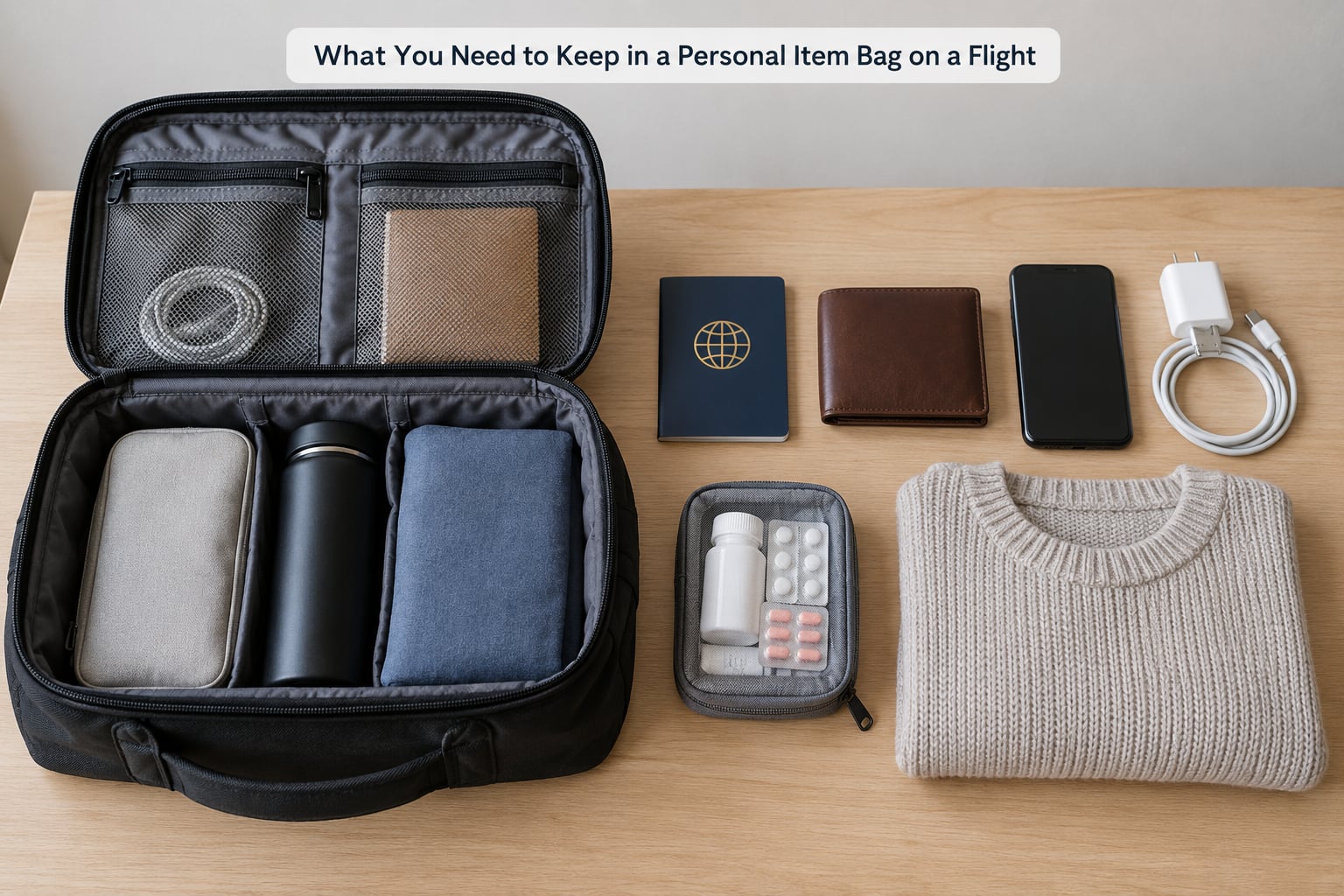
The personal item is not a smaller carry-on. It is the bag that lives under the seat in front of you for the whole flight, and that single fact decides everything you put in it. Anything that only matters at your destination belongs in the overhead bin instead.
Sizes and allowances vary by airline, aircraft type and even route. Most major US carriers such as Delta, United, American, Southwest, JetBlue and Alaska state something close to 18 x 14 x 8 inches for the bag that goes under the seat. Budget carriers work to tighter numbers and check more often, and travelers who pack to about 17 x 14 x 8 inches describe the extra inch of margin as the difference between keeping the bag and watching it disappear into the hold. Check your airline’s page before you pack, not at the counter.
Most personal item bags are free and included with your fare, and the fee for losing one to a gate agent is the thing people regret.
Across every trip type, the packing categories stay the same:
- Identification and travel documents — passport or photo ID, boarding pass, any visas or entry paperwork
- Electronics — phone, laptop or tablet, headphones, chargers, power bank, plug adapter
- Medication — anything prescribed, anything you need on a schedule, plus a spare dose in case of delay
- Valuables — wallet, cards, keys, wedding ring, small electronics you would rather not lose
- Comfort items — neck pillow, eye mask, earplugs, a layer, socks
- A light change of clothes — for overnight flights and checked-bag problems
One packing rule you will keep hearing is the 5-4-3-2-1 rule: five pieces of clothing, four pairs of shoes, three accessories or outfits, two tech items and one sentimental or toiletry item. It is a carry-on framework rather than a personal item one, but the personal item version is simpler. Take one top, one bottom, one set of underwear and socks, and leave the rest to the bin.
Step-by-Step: Pack a Personal Item Bag for the Flight
Start With Documents and Flight-Critical Items
Put the things that can end a trip in one small zip pouch: passport or photo ID, boarding pass, cards, cash and insurance details. Keep the pouch near the top of the bag or in a front pocket so you can find it without unpacking anything.
Never bury documents at the bottom. If a gate agent pulls your bag and repacks it, or if you have to repack at the jet bridge, the last thing you want is to dig through a sweater and a laptop sleeve to find your passport. When I travel solo, my documents pouch is the first thing in the bag and the last thing to come out.
Add Electronics Without Creating a Charging Mess
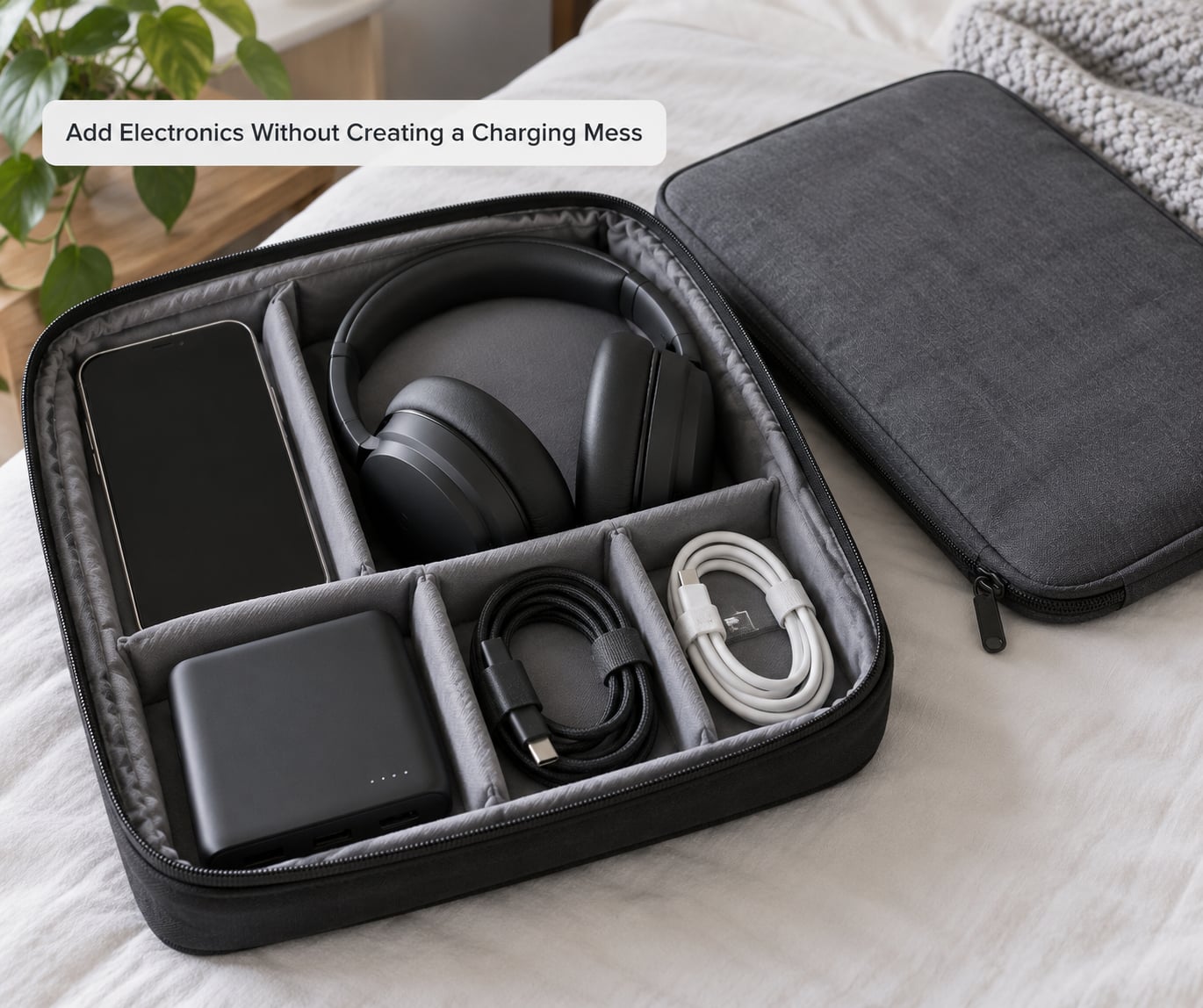
Keep one tech pouch for the flight itself: phone, headphones, a short charging cable and a power bank. If you work on the way, the laptop goes in a padded sleeve inside the bag, and you should know whether it has to come out at screening before you reach the front of the line.
Power banks and spare lithium batteries belong in the cabin, never in checked luggage, and airlines often cap capacity by watt-hours. A quick check of your airline’s lithium battery page takes a minute and saves you from a bag search at the gate. Some carriers ask you to keep spare batteries in the cabin rather than in a checked bag at all, so treat them as an item to verify rather than assume.
Two habits make this work. Download anything you want to watch before you board, and bring the headphones in the pouch rather than loose, so one grab gets you both.
Pack Medication, Valuables and Small Comfort Items
Scheduled medication goes in the personal item every time. Cabin crews have seen checked bags delayed and lost, and a delay that costs you a dose is a much worse problem than a gate check. Keep the original labelled packaging, and carry a copy of any prescription you might need to show.
Valuables follow the same logic. Overhead bins fill early on full flights, and a bag moved down the line can end up at the front of the aircraft or in someone else’s zone. On one-bag and solo-travel forums the consensus is the same: money, documents, medication and electronics stay under the seat with you.
Small comfort items do the same job. A refillable water bottle travels empty through security and gets filled afterward, which travel tip sites recommend for a simple reason. Add tissues, hand sanitizer, a toothbrush if you will arrive at night, and the sleep kit: an inflatable neck pillow, an eye mask and foam earplugs.
If you fly solo, plan for the fact that there is no second bag to reach into and no companion to hand you a charger. Duplicating the two things you cannot replace mid-flight, your medication and your payment method, is cheap insurance.
Add a Light Change of Clothes and Travel Extras
One soft top, a pair of trousers or leggings and clean socks cover the most common bad scenario, which is arriving at midnight with your checked bag three hours behind you. Keep it in a packing cube so it stays flat and does not fill the bag with air.
Avoid denim for long flights if you can. Jeans are warm, stiff and uncomfortable to sit in for hours, which is exactly the situation a personal item exists to solve. A layer that folds small and packs flat solves the same problem better.
Travel extras worth the space: a paperback or e-reader for flights without screens, a toothbrush and toothpaste in a one-ounce container, a laundry strip if you are traveling for a week, and a small bag of snacks for a long segment. A refillable bottle beats anything you buy after the security line, both on price and on how long you are stuck in the air.
Watch the weight. Personal items generally carry a weight limit lower than they carry a size limit, and a bag packed with a laptop, a sweater and a full toiletry kit can tip over it without looking oversized.
Check the Bag Before You Leave
Run through this before you walk out the door:
- Measure it packed, not empty. A soft bag that passed empty often bulges past its profile once zipped. Experienced one-bag travelers repeat this advice more than any other.
- Confirm one bag, one passenger. Most airlines allow one personal item in addition to your carry-on. A backpack plus a crossbody counts as two on many carriers, and the second one can be gate-checked.
- Sort liquids. Containers of 3.4 ounces (100 ml) or less go in one clear quart-size resealable bag at security. Anything larger stays home.
- Confirm batteries. Power banks and spare lithium batteries travel with you, subject to airline capacity rules.
- Put the essentials where you can reach them. Documents, medication, phone and charger stay in quick-grab pockets, not under a laptop.
- Re-read your airline’s personal item page. Rules change, and an old packing guide will not tell you what your carrier allows now.
Common Mistakes
Overpacking: What to Keep in a Personal Item Bag and What to Leave Out
The most common packing mistake is treating the personal item as a second suitcase. Fixes for the mistakes I see most:
- Burying documents. Fix: one front pouch for passport, boarding pass and cards.
- Putting medication in checked luggage. Fix: scheduled medication always stays in the personal item, with a spare dose.
- Bringing a bag sized for a normal day bag. Fix: measure it packed and subtract an inch of margin if you are flying a budget carrier.
- Ignoring the liquids rule. Fix: everything liquid, cream or gel goes in one clear quart bag, and toothpaste and sprays count as liquids.
- Treating power banks like ordinary electronics. Fix: they never go in checked luggage, and capacity rules differ by airline.
- Expanding a bag after the size check. Fix: if it expands, check it expanded, or gate agents measure what is actually handed over.
- Assuming two small bags are fine. Fix: one personal item per passenger is the standard allowance.
Do airlines care about size? Yes, and enforcement is inconsistent by carrier and by how full the flight is. A bag that fits at check-in can still be gate-checked at the jet bridge, where repacking is stressful and you are standing in a line with everyone else.
If it happens, the 90-second repack is simple: move the soft sweater and anything non-essential into the bin above you, take the laptop out of its sleeve and slide it flat against the back panel, pull liquids into their quart bag, and re-zip. That fixes most bags that are a couple of inches over.
Frequently Asked Questions
Do airlines care about personal item size?
Yes. Most US carriers state a limit near 18 x 14 x 8 inches (45 x 36 x 22 cm) for the bag that goes under the seat in front of you, but budget carriers check more strictly. A bag that fits at check-in can still be gate-checked at the jet bridge, especially on a full flight. Measure your bag packed, leave a small margin, and re-read your airline’s personal item page before every trip.
What if my personal item is 2 inches too big?
It may pass at check-in and fail at the gate, which is the most common way travelers get caught out. Repack in about 90 seconds: move the sweater and non-essentials into the overhead bin, remove the laptop from its sleeve and press it flat against the back panel, and consolidate liquids into one quart bag. If it still does not fit, the airline will most likely gate-check it for a fee.
What not to put in a personal item bag?
Skip liquids over 3.4 ounces (100 ml) unless they are inside your clear quart-size bag, plus anything on the prohibited list such as firearms, ammunition and alcohol above 140 proof. Never put power banks or spare lithium batteries in checked luggage, and avoid overfilling the bag past its stated size or weight limit. Oversized or overweight personal items are the items most likely to be gate-checked.
Can I bring a laptop in my personal item bag?
Yes, as long as the bag still fits the under-seat limit once the laptop is inside. Use a padded sleeve and place it flat against the back panel so it does not create a bulge. Some airports ask you to remove laptops for screening, so keep it easy to pull out rather than buried under clothing. On longer flights this is usually the single most valuable item in the bag.
What is the 5 4 3 2 1 rule for packing?
It is a carry-on framework: five pieces of clothing, four pairs of shoes, three accessories, two tech items and one sentimental or toiletry item. For a personal item, the rule is far simpler. Pack one top, one bottom, one set of underwear and socks, one change of underwear, and leave clothing and shoes in your overhead carry-on. The personal item is for what you need in the seat, not for the whole trip.
Conclusion
Start with the airline’s personal item page, then build the bag from the outside in: documents and medication first, electronics in one pouch next, a sleep kit and a light layer after that, and everything else in the overhead bin. Pack it the night before, measure it full, and do not put a single thing in there that you could replace at your destination.