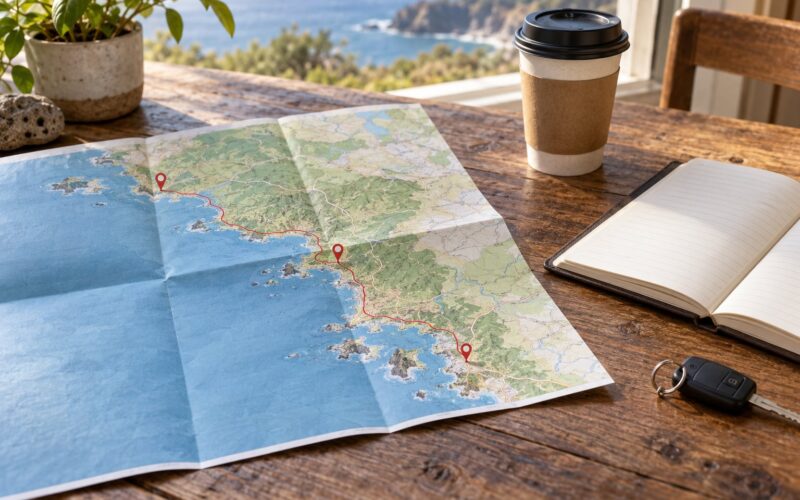
To plan a honeymoon in the off season, you pick dates outside a destination’s peak months, book flexible lodging and transport, and build an itinerary with indoor and weather-dependent backups. The same trip often costs far less, the rooms feel quieter, and staff have more time for you. The trade is weather risk and some seasonal closures.
This takes about two to three weeks of evening work spread over a few months. Couples who do it well treat the off-season less as a bargain hunt and more as a scheduling problem: find the window where the weather is tolerable and the crowds are thin, then book the parts that cannot move.
There is one thing to settle before anything else. Off-season is not one thing. Peak, shoulder and low season describe different windows, and the difference between them is often the difference between a good trip and a disappointing one.
Table of Contents›
- What You Need Before You Book Anything
- How to Plan a Honeymoon in the Off-Season Step by Step
- How to Choose the Right Off-Season Window
- How to Build a Romantic Destination Shortlist
- How to Choose a Boutique Stay That Feels Private
- How to Reserve Flights and Transportation
- How to Create a Weather-Proof Honeymoon Itinerary
- How to Find Quiet Romantic Experiences
- How to Build the Honeymoon Budget
- How to Pack for Variable Conditions
- How to Reconfirm and Protect the Trip
- Common Mistakes
- Frequently Asked Questions
- Is the off-season a bad time to take a honeymoon?
- How far in advance should we book an off-season honeymoon?
- Will restaurants and excursions be closed during low season?
- How much cheaper is an off-season honeymoon?
- What do we do if it rains for most of the trip?
- How long should an off-season honeymoon be?
- Conclusion
What You Need Before You Book Anything
Six things need to be settled before you start looking at rooms. Couples who skip this step end up with bookings that fight each other for six months.
- Your real date flexibility. Not the ideal, the actual. If your wedding is in October, the honeymoon window is narrower than you think, and every downstream decision depends on it.
- A shared budget ceiling. A number both of you accept, including the wedding spend already behind you. Honeymoon funds from a registry often land in a specific window, so check when yours can actually be drawn down.
- Your preferred pace. Some couples want five nights of doing nothing. Others want a trip with two anchor experiences and slack around them. Write this down; it saves arguments later.
- Your non-negotiables. Usually one thing: a real bed, a spa, a beach, a specific restaurant, a drive worth taking. Two people with one non-negotiable each can negotiate; four cannot.
- Passport and document status. Check validity periods and blank pages now, not in the departure month.
- Booking status of anything already paid. Registry funds, gift cards, cancelled travel credit. You cannot build a budget on money that arrives after the flight does.
Then agree on how you will research. My preference is one shared document: destination, candidate dates, what you found, what it costs, and a yes or no. Couples who pass links back and forth in a chat thread lose decisions. Couples who keep one list make them in half the time.
Finally, look up the weather, not the temperature. Average highs hide the thing that ruins trips: how many days a month it actually rains, and whether that rain comes in hour-long bursts or all-day washouts. It is the most useful single hour of research in this whole process.
How to Plan a Honeymoon in the Off-Season Step by Step
Work through these nine steps in order. Each one narrows the next, and each one has a clear signal that it worked. Skipping ahead to booking rooms is the most common expensive mistake, because the season dictates which rooms are even open.
How to Choose the Right Off-Season Window
Peak season is when demand and weather overlap, usually summer in the northern hemisphere, or the winter dry season in tropical places. Shoulder season is the month or two on either side, when conditions stay reasonable and prices fall. Low season is the rest: the cheapest and quietest window, and the one most likely to have reduced services.
That last sentence is the one to remember. Low season is where you get the biggest discount and the smallest menu of things to do. Shoulder season is where most couples are better served.
Do not rely on a destination’s marketing label. Look up three things for each candidate window:
- Rain days, not averages. Check the daily probability of meaningful rain for that month, and whether it falls in short bursts or long spells.
- Regional hazards. Some areas carry a rainy season, some carry a typhoon or hurricane season, some carry wildfire season, and some carry extreme heat. They are not the same problem, and they need different answers.
- What is running. Seasonal boat services, guided excursions, mountain lifts and small restaurants often operate on a fixed calendar, not a demand basis. Check each one you care about for the exact dates you are considering.
One good rule: choose the week, not the month. Travellers on r/honeymoonplanning frequently describe picking a specific window rather than a season, and it is the difference between a trip where the weather cooperates and one where it does not.
How to Build a Romantic Destination Shortlist
Build a shortlist of three, not ten. Score each candidate against five criteria, and weight the first two highest for most couples.
- Quietness in your window. Check crowd levels for those specific weeks, not the destination’s reputation.
- Reliable transport. Off-season timetables are thinner. If the only flight runs three times a week, your trip now has a fixed shape.
- Enough to do indoors. A town with two restaurants and one museum is not a bad honeymoon, but you need to know that going in.
- Seasonal food that still exists. Ask what the regional specialities are and whether they are a winter or summer thing.
- A reason to leave the room. A coastal path, a vineyard, a hot spring, a historic town within a short drive. This is what stops a quiet week from feeling stuck.
Cross off anything that fails the first two. A cheaper trip you cannot get to easily is not cheaper.
How to Choose a Boutique Stay That Feels Private
A small hotel or inn in the off-season gives you something a large resort cannot: the same staff, the same quiet, and often the room you wanted. Judge it on character and location rather than the amenity list.
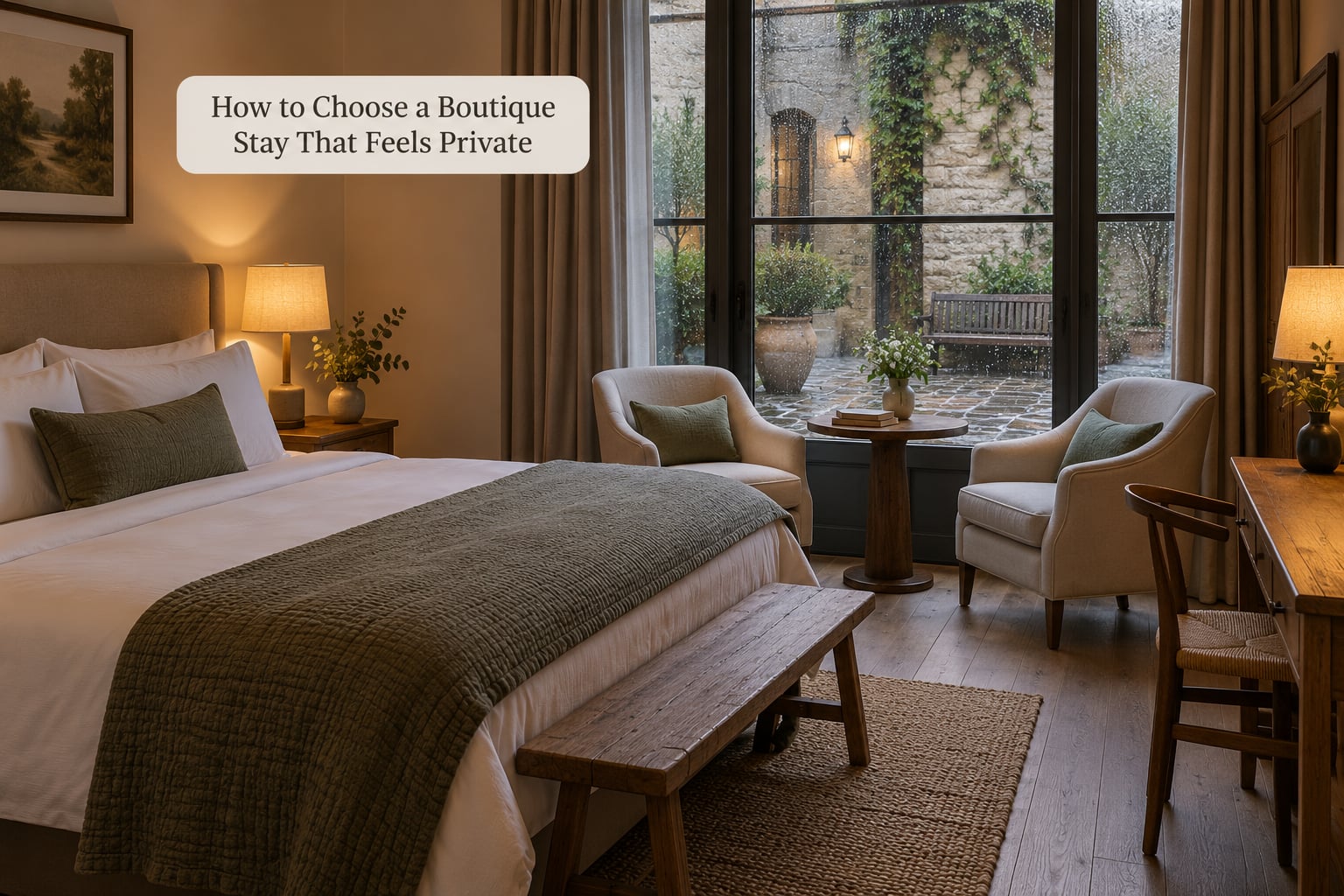
Ask these questions directly before you book, ideally by email so you have the answers in writing:
- Which parts of the property operate during our specific dates, and which close.
- Is breakfast served every morning, or only on certain days.
- Is the restaurant open in the evening, and does it run a limited menu in low season.
- Which room numbers are farthest from the stairs, the road and shared space.
- What is the cancellation deadline, and what happens if we need to move the dates.
- Is the spa open, and on what days. Off-season spa hours are often the first thing cut.
Breakfast matters more than couples expect. It is the meal you will not have to schedule, and in a quiet property it is often the one place with other guests, which sets the tone for the day.
In the low season there is a real upside here. Fewer guests means staff are less stretched, so requests get met. Ask about a late check-out, a room upgrade, or a spa credit when you reserve rather than at the desk, because a quiet property has more room to say yes.
How to Reserve Flights and Transportation
Off-season fares are cheaper, but they are cheapest when you book early. Several operators and travel writers point out that off-season does not mean last-minute; the good shoulder-season fares go to people who plan ahead.
What to do, concretely:
- Compare flexible fare options against the cheapest non-refundable one. On an uncertain weather window, a changeable fare can be worth more than the saving.
- Track prices rather than buying on the first search. Flight comparison tools and Google Flights price alerts are useful here specifically because the off-season fare curve is steadier than the peak one.
- Avoid arriving on the day a major holiday runs into your window. The airfare may be shoulder-rate and the destination will be packed.
- Check the return schedule before the outbound. A single daily flight that departs early can wreck a last morning.
- Leave a real buffer on arrival day. Nothing memorable should be booked for the day you land.
Then plan the ground transfer before you land. In shoulder season, airport shuttles and ferries often run on a reduced timetable, and a missed transfer at the end of a long day is a bad start to a honeymoon. Know the plan before you are in the country, including the fallback if the flight is delayed by a day.
How to Create a Weather-Proof Honeymoon Itinerary
The best off-season itineraries are short on anchors and generous with gaps. Bad weather should cost you one plan, not the whole week.
Structure it like this:
- Two or three anchors. The thing you came for, each needing a full day.
- One indoor reserve for each anchor. A museum district, a cooking class, a long lunch with no deadline.
- Half a day a day unscheduled. This is the part couples skip and later wish they had.
- No more than one transfer per day. Two moves in a day is how a honeymoon turns into a commute.
Assume you will lose one day to weather and plan the trip around ten percent less than it looks like on paper. That single assumption changes how you book. It also changes your mood on the morning it rains.
How to Find Quiet Romantic Experiences
In the low season, the loud things are shut. What replaces them is usually better for a honeymoon, because you are not competing for attention.
Look for the small version of the big thing: a neighbourhood market instead of a tour, a family-run restaurant instead of a buffet, a local gallery instead of the headline attraction. Add a slow walk with no destination, a scenic drive with a planned stop, a tea room or a bathhouse, a cooking or craft workshop booked through the hotel, and a long second breakfast.
Seasonal rhythms set the tone. Harvest is the best season in wine country, and it is not a romantic abstraction; there are long lunches and rooms to sit in. Couples on r/BigBudgetBrides describe planning a fall trip around food and local experience rather than landmarks, and that is exactly the register that suits an off-season trip.
Off-season Europe is often a rail trip rather than a single base. Couples on r/traveleurope take the train for multi-city trips and single out the rail system as the reason it works, which is worth considering if you want two places without flight days.
How to Build the Honeymoon Budget
Start from your ceiling and allocate, rather than booking things until you hit the number. A workable starting split for most couples is roughly 30 to 35 percent for flights and transport, 30 to 35 percent for lodging, 15 to 20 percent for food, 10 to 15 percent for experiences, and a contingency you actually leave alone.
Three rules make it hold:
- Use real current prices, not last year’s memory. Build the budget from actual quotes for your dates and room type, then add the shift between shoulder and peak rates for the same property so you can see what the off-season choice is actually buying you.
- Prefer flexible terms over a lower headline rate. Free cancellation is worth real money when a forecast is uncertain.
- Decide what you will not spend on. Couples who agree in advance on the categories that matter stop arguing about them in the booking phase.
If your budget is genuinely tight, the trade that works best is fewer nights in a better place rather than more nights in a busy one. r/chubbytravel describes the pattern clearly: a short trip near home for a wedding-adjacent minimoon, and the larger journey saved for the following year when the money has landed.
How to Pack for Variable Conditions
Pack for four seasons in one week, because in the shoulder season you may get all of them. Bring layers that mix and match, a proper waterproof shell rather than a decorative umbrella, and footwear that works on wet stone and wet grass.
Also pack:
- Any prescription medication, plus a small supply for a day of delay. Pharmacy hours shrink off-season.
- Travel documents, a backup copy of key bookings on your phone, and emergency contacts written down.
- Chargers, a power bank, and a universal adapter.
- One occasion item. Off-season trips are often birthdays or anniversaries, and it is easy to forget in a casual wardrobe.
- Something warm for evenings. In many places the off-season problem is not rain but a temperature drop once the sun goes.
Check the forecast again three days before departure and once more on the day. Adjust the anchors, not the whole trip. Forecasts at that range are reliable enough to plan around and wrong often enough that you should not book anything non-refundable on the strength of one.
How to Reconfirm and Protect the Trip
Seven to ten days out, run this checklist. It is short enough to do in one sitting and catches nearly everything that goes wrong.
- Reconfirm every reservation, flight and transfer by email and note the contact.
- Reconfirm which hotel services are operating during your dates.
- Check the long-range forecast and adjust outdoor anchors to the best available days.
- Reconfirm document validity and entry requirements.
- Ask the hotel about arrival time, room preference and any early check-in.
- Save offline copies of addresses in the local language.
- Write down the backup plan for each anchor day, so a rained-out morning does not become a lost one.
If you are travelling somewhere with a storm or typhoon season in your window, add insurance that covers weather disruption and check whether your policy treats a cancelled excursion as a covered event.
Common Mistakes
Six errors account for most disappointing off-season honeymoons. Each has a straightforward fix.
1. Choosing a destination for the low price alone. The cheapest window in a place with reduced services is rarely the cheapest trip. Fix: price the trip you would actually enjoy in that window, including transfers and meals, before deciding.
2. Assuming every seasonal attraction runs. Couples on r/malaysians describe Langkawi’s rainy season plainly: hotel charges are cheapest, but no boat rides because of choppy seas. That is the cheapest experience money can buy and it is not an experience. Fix: check the operating calendar for every activity you care about, before booking.
3. Booking the trip for peak conditions. People plan a September beach week because it is off-season, then pack for August heat. Fix: pack and schedule for the worst typical day, not the average.
4. Overfilling the itinerary. Nothing makes a quiet week feel busy. Fix: two anchors a week, one transfer a day, one unscheduled half-day.
5. Booking inflexible arrangements in a flexible season. That is backwards. Fix: choose refundable rates and free cancellation on the big-ticket items, and check deadlines before committing.
6. Not agreeing on priorities first. Two couples planning separately end up with a trip neither described. Fix: one shared document, one non-negotiable each, one decision meeting.
A few timing notes that help. Book shoulder-season properties six to nine months out, earlier for a destination with a small number of good rooms. Two to four months is enough for flexible fares in most off-season windows. And where a couple can move the date by a few weeks to dodge a storm season entirely, they should, as couples on r/LuxurySafari describe for the safari shoulder, the later window into the season, the better the trip.
Frequently Asked Questions
Is the off-season a bad time to take a honeymoon?
Not if you pick the shoulder window rather than the deepest low season. Shoulder season keeps weather reasonable while rates fall and crowds thin out. The deep low season is cheaper still, but some excursions, boat services and restaurants close or shorten their hours, and weather risk is highest there.
How far in advance should we book an off-season honeymoon?
Six to nine months for accommodation in most shoulder-season windows, and twelve months if the destination has a limited number of small properties you actually want. Flights can go three to six months out for flexible fares. Off-season is cheaper, but it is not last-minute, and the best rooms still go to whoever booked first.
Will restaurants and excursions be closed during low season?
Some of them will. Boat services, guided trips, mountain lifts and small restaurants often run on a fixed seasonal calendar rather than on demand. Email the property or operator with your exact dates and ask what is running. That single message will tell you more than any destination article.
How much cheaper is an off-season honeymoon?
It varies widely by destination and tier, but the shoulder-season saving on the same room and itinerary is commonly in the range of twenty to forty percent against peak rates. Deals go deeper in the low season. The saving is easier to verify yourself: price your actual dates, then compare them to the peak weeks for the same property.
What do we do if it rains for most of the trip?
That is why the itinerary needs indoor reserves. Keep a museum district, a long lunch, a cooking class or a spa day ready for each anchor day, leave half-days unscheduled, and accept that one lost day is normal. r/nationalparks regulars make the same point about mountain trips, where a rainstorm is a fact of planning rather than bad luck.
How long should an off-season honeymoon be?
Six to eight nights works well for most couples. It is long enough to settle in after a wedding and short enough that weather disruption does not dominate. Longer trips suit slower travel, where the off-season saving stretches further and a rail itinerary replaces flights.
Conclusion
An off-season honeymoon works when the season drives the plan rather than the other way around. Choose the window by weather and operating calendars, not by a marketing label. Confirm in writing what the property actually runs during your dates, book flexible, and build an itinerary with room to lose a day.
Start with three things this week. Compare the off-season weeks against the peak weeks for two destinations you are considering. Check your document status. Then agree, in writing, on the two or three priorities that matter most, because those are what the whole trip is for.