Planning separate time on a couples trip is simple: agree on one or two blocks where you each do your own thing alone, set a meeting point and time, and keep everything around those blocks shared. On a trip of three days or more, one half-day apart is usually enough. It is a normal request, not a complaint about your partner, and ten minutes of planning stops it from turning into a sulk.
Most couples who do this well treat it like a scheduling decision rather than an emotional one. They book the flights and the dinner first, then decide where the open hours go. The version that fails is the one where somebody announces at breakfast that they need “space,” and the other partner spends the morning trying to work out what that means.
Table of Contents›
- What You Need to Plan Separate Time on a Couples Trip
- Step-by-Step: How to Plan Separate Time on a Couples Trip
- Agree on the purpose of the time apart
- Choose a balanced day structure for the split itinerary
- Set a clear meeting point and flexible backup
- Keep communication light and purposeful
- Protect shared moments after splitting up
- Sample activity pairs that work in real destinations
- Common Mistakes When Planning Time Apart
- Treating every free hour as mandatory separation
- Over-scheduling the split
- Assuming equal energy
- Forgetting the logistics
- Reading silence as disapproval
- Using separate time to avoid something
- The partner who does not want to split up
- Frequently Asked Questions
- Is it normal for couples to want separate time on a trip?
- How much alone time is reasonable on a couples trip?
- How do I ask my partner for me time without it sounding like rejection?
- What if my partner wants to do everything together on the trip?
- Should we book separate hotel rooms to get space?
- How do we decide between splitting a trip and taking separate vacations?
- Conclusion
What You Need to Plan Separate Time on a Couples Trip
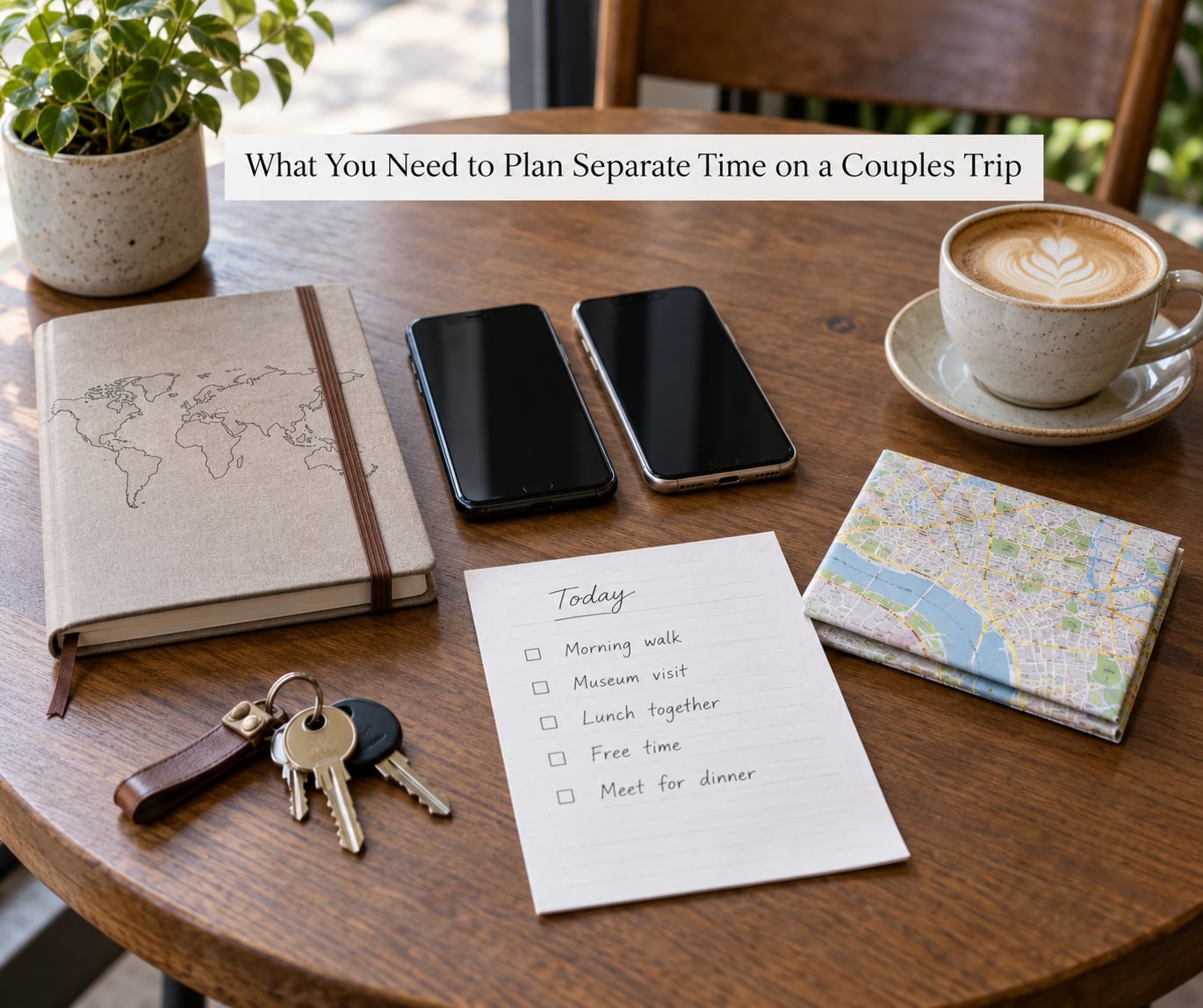
You do not need much, but you do need six things settled before anyone books anything.
- Shared anchors. The flights, the accommodation, and at least one meal a day that both of you are attending. These are the fixed points the split day hangs from.
- Realistic time blocks. Three to four hours is a comfortable first split. Twelve is not a break, it is a second trip with extra steps.
- A meeting point and a time. A cafe, a square, a lobby bench. Somewhere you can find without either of you walking around describing landmarks.
- Transport figured out. Do you both walk, take the bus, get a rideshare, or is one of you borrowing a bike? Nothing derails a split day faster than a person who assumed they could split the bill for a taxi.
- A communication preference. How often to check in, and by what method. Some couples love a text, some find texting all day exhausting.
- A plan for rejoining. Decide in advance that you meet for dinner, not that you will bump into each other.
The accommodation matters more than most people expect. A room with two doors, a suite with a sofa, or a two-bedroom rental gives you decompression space that a shared bed does not. On the days you are together, that space still gets used.
Step-by-Step: How to Plan Separate Time on a Couples Trip
Agree on the purpose of the time apart
Start by naming what the time is for, out loud, in that order. Rest, an interest the other person does not share, seeing friends, exercise, work, or simply a different pace. The reason changes how long it should be.
Rest needs two or three hours and no output. A museum you have wanted to see for a decade needs half a day. “I want to walk ten miles and be unreachable” is a different request from “I need to sit in a cafe and read,” and only one of those is easy to say without sounding like an escape.
The phrase that works for most people is naming your own need rather than diagnosing theirs. “I would like some me time this afternoon, it has nothing to do with you” is much harder to read as rejection than “you never let me have a minute.”
Choose a balanced day structure for the split itinerary
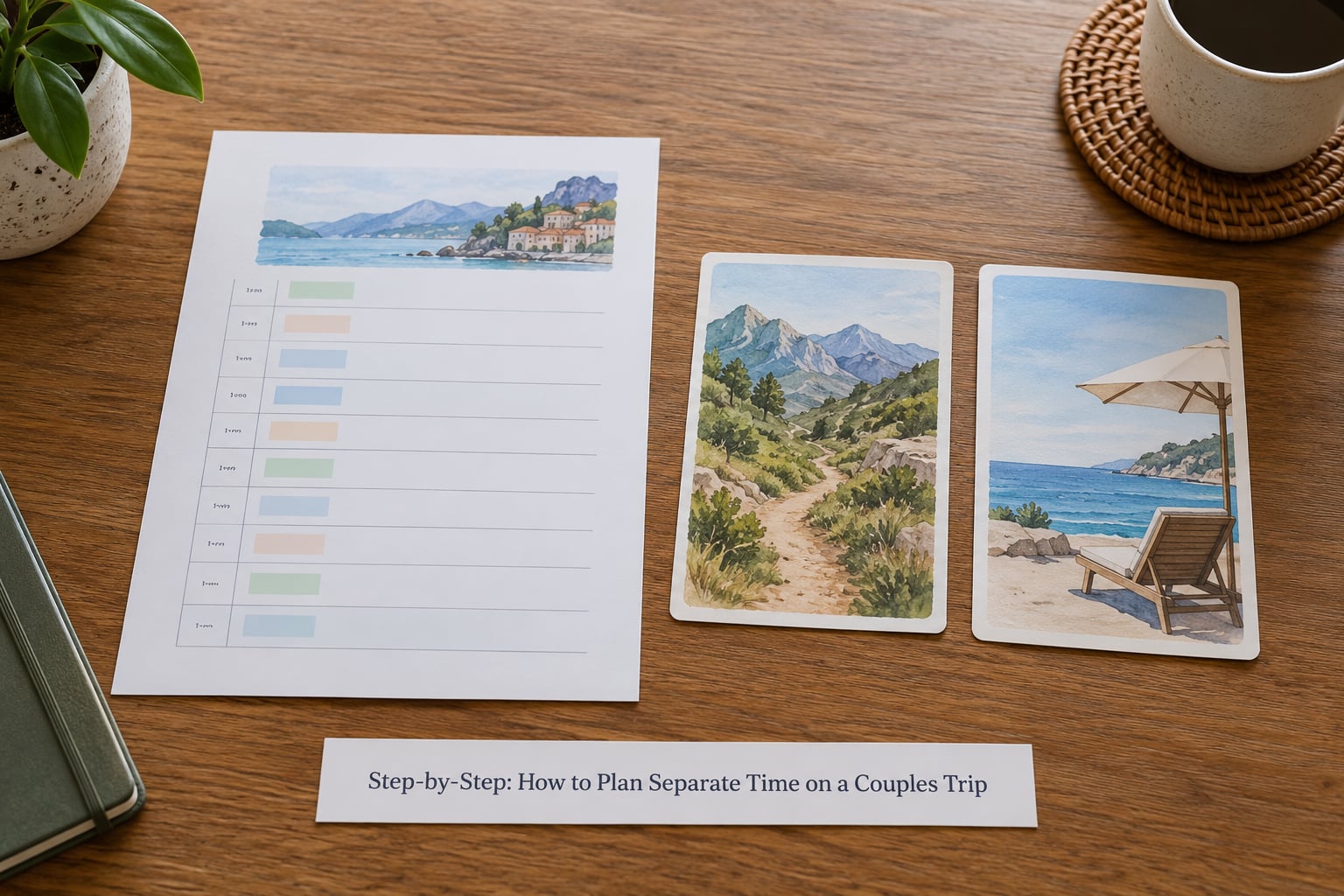
A split day that starts at 8am and ends whenever feels like two separate vacations that happened to share a bed. A balanced one has the same five parts every time you do it: a shared start, an independent block, an optional check-in, a shared meal, and unhurried couple time after.
| Time block | Partner A | Partner B | Reconvergence point |
|---|---|---|---|
| 8:00-9:00 | Breakfast together | Breakfast together | Table booked at the base |
| 9:30-13:00 | Hike on the ridge trail | Bookshop, then a long cafe session | Left to each other |
| 13:00-14:00 | Quick check-in text or nothing at all | Quick check-in text or nothing at all | Optional, not required |
| 14:00-18:30 | Second shower, nothing booked | Second shower, nothing booked | Both back at the base |
| 19:30 onwards | Dinner, then a walk | Dinner, then a walk | The same table, then outside |
Notice the two empty-ish hours before dinner. Beginners overbook the split and then feel guilty about the leftover time. Leaving something unscheduled on both sides means nobody is performing.
A useful rule of thumb: one half-day block per three or four day trip. On a week-long trip, two or three blocks spread across the week, not all in the same burst.
Set a clear meeting point and flexible backup
Pick somewhere you can describe in one sentence. “The cafe at the bottom of our street with the red awning” beats “the square.” Set a clock time, not a vague one, and write it down.
Share live location with each other for the block. That is not surveillance, it is the same thing you would do if you were alone in an unfamiliar city, and it removes the awkward ten-minute phone call where someone tries to describe where they are standing.
Agree on a backup before you go: if either of you is running late, tired, or has changed plans, you send one word and default to meeting at the base instead. The backup is what stops a split day turning into a missed dinner.
Keep communication light and purposeful
Decide the rhythm before you separate. One message in the middle of the block saying where you are and roughly when you will be back is plenty for most trips. Constant texting recreates the togetherness you were both trying to step out of, and it makes the split feel like a work shift.
Use a two-tier rule. A short ping is logistics: arriving, delayed, heading back now. Anything real, like the slight irritation you felt at lunch or the thing you actually want to talk about, waits until you are sitting across from each other with food in front of you. It lands differently in person.
Protect shared moments after splitting up
The block is the easy part. What makes the day feel like part of a trip instead of two people politely tolerating each other is what you rebuild around it.
Anchor at least one shared thing on the same day. Breakfast together before you split, a sunset walk, dinner where neither of you has to make a decision about where to go. Pick the anchor in advance so the person who is more spontaneous is not the only one holding it together.
Dinner works best as the anchor because it comes with a natural debrief. Ask what the other person actually saw and liked. You will hear about things you would never have gone to, and that is the whole point.
Sample activity pairs that work in real destinations
The pairs matter less than the shape: one person moving, one person still, or one person alone, one person socially. In a city, one walks a neighbourhood and the other sits in a cafe. In the mountains, one hikes and one reads at the lodge. At a resort, one swims and one takes a long bath, then you meet for the sauna hour. On a beach, one walks the headland at six in the morning and the other sleeps in.
If you are somewhere new and stuck, walk fifteen minutes from the base and see what is there. Most couples over-plan the split and under-plan the finding. Ask the front desk, read the board in the lobby, check what is running at the local cinema. The activity does not need to be impressive, only possible in three hours and reachable on foot.
Common Mistakes When Planning Time Apart
Treating every free hour as mandatory separation
If every gap in the itinerary becomes a split, you stop travelling together and start sharing an address. One block per three or four days is plenty for most couples. The rest of the time is genuinely together, and that is the thing you booked the trip for.
Over-scheduling the split
A four-hour block with two booked activities in it is not me time, it is a second itinerary. Pick one thing, and let the other hours be open. Free hours are what make the block feel restful rather than efficient.
Assuming equal energy
One of you will always want more out of a day than the other. That is not a character flaw, it is a mismatch in pacing. Unbalanced energy is the single most common reason couples think they need a whole day apart when what they actually needed was one slow morning and one evening each on their own.
Forgetting the logistics
Splitting up somewhere you both do not know means one of you ends up stranded without a way home, no battery, and no idea where the meeting point is. Agree transport, keep a phone charged, carry a card that works locally, and keep one shared contact saved between you in case your own phone dies.
Reading silence as disapproval
Two hours of no contact can mean anything from a great museum to a difficult patch. Agree in advance that no news during a block is a neutral signal. This one assumption removes more friction than any other line in this article.
Using separate time to avoid something
If the block is where you go to avoid a conversation, an argument you never had, or the last day of a holiday, it is avoidance wearing a holiday hat. The same trip that gives one person a hard morning alone can give the other a hard evening alone. If the mismatch keeps happening across trips, it is worth talking about at home rather than scheduling around.
The partner who does not want to split up
Plenty of couples have one person who reads every hour apart as a review of the relationship. Do not push it. Try a smaller ask instead: you take the first ninety minutes of one morning and they sleep in, or you split one dinner with friends and they take the evening alone. Prove the concept once and it usually gets easier. If it does not, take the time anyway, kindly, and check in on what is underneath.
Frequently Asked Questions
Is it normal for couples to want separate time on a trip?
Yes. Couples who split up for part of a day usually come back calmer, not further apart, because shared travel strips out your normal routine and fatigue shows up as irritation. The pattern that works is one scheduled block with a clear end, kept inside a trip that is mostly together. What tends to cause friction is unscheduled absence rather than planned separation.
How much alone time is reasonable on a couples trip?
For most couples, one half-day block per three or four day trip works well. On a week-long trip, that means two or three blocks spread across the week. Three to four hours is a comfortable length: long enough to actually switch off, short enough that nobody is negotiating dinner by text. Keep everything around the block shared.
How do I ask my partner for me time without it sounding like rejection?
Name your own need instead of describing theirs. Say something like: I would love some me time this afternoon, there is nothing wrong with us and I want to enjoy the trip more. Give a reason and a time, and offer the same thing back in the other direction. Vague requests about needing space are what get read as criticism.
What if my partner wants to do everything together on the trip?
Start smaller than you think you need. Try ninety minutes where you sleep in, or one dinner with friends they are not part of, and prove the day still feels good. If they still say no, take the time anyway, kindly, rather than dropping it entirely. Their discomfort is worth taking seriously without turning into a veto.
Should we book separate hotel rooms to get space?
Not usually, unless you already stay that way. A suite with a sofa, a two-bedroom rental, or a room with two doors gives you the decompression space that matters, at no extra cost to the intimacy. Separate rooms tend to signal something is wrong to the person who does not want separate time, which is the opposite of the effect you are going for.
How do we decide between splitting a trip and taking separate vacations?
Split inside one trip when you still want most days together, or when one of you only needs a few hours back. Consider entirely separate trips when the interests have genuinely diverged, when one of you cannot take the pace, or when you are saving for a big trip and want to go twice. Same trip with a shared base is usually the cheaper, lower-drama option.
Conclusion
Pick one block of three or four hours on a three or four day trip, choose a meeting point you can both find without directions, and keep one anchor you both show up for, such as dinner. Agree that silence during the block means nothing, and the whole thing takes one conversation to arrange.