To plan a couples trip when you want different things, agree on your non-negotiables before you book anything, then design an itinerary with fixed anchors and open space rather than a fixed schedule. Most arguments about holidays are not about destinations. They are about who gets to decide, who pays, and who always gives way.
I’m a solo traveller who has spent years learning which compromises hold up over a long flight and which ones quietly wreck a week. That has turned into useful judgment for couples too, because a trip taken alone forces you to notice the difference between what you planned and what actually made the day good. Couples usually don’t notice that at all, because they are busy negotiating.
The good news is that every disagreement you are likely to hit has a structure you can prepare for. Below is the process I would run with my own partner, in order.
Table of Contents›
- What You Need
- Step-by-Step: How to Plan a Couples Trip When You Want Different Things
- 1. Name the Actual Conflict
- 2. Separate Must-Haves from Nice-to-Haves
- 3. Build a Shared Priority List
- 4. Design a Flexible Itinerary
- 5. Choose a Place That Can Support Both Styles
- 6. Set the Budget Before Booking
- 7. Book the Anchors, Leave Space for Discovery
- 8. Agree on a Decision Rule for the Trip
- Common Mistakes
- Frequently Asked Questions
- How do we choose a destination when one person wants a lively city break and the other wants a quiet nature retreat?
- What is a fair way to compromise when our travel budgets are different?
- How can we plan a romantic trip without making it feel overly scheduled?
- Should every activity be agreed upon in advance, or should we leave room for spontaneous choices?
- How do we handle the trip if one of us wants more activity than the other?
- What should we do if one person changes their mind about an activity after booking?
- How do we plan a couples trip when you want different things without one person feeling like they always lose?
- Conclusion
What You Need
Before you open a single booking site, gather five things from each person. Doing this on paper or in a shared note, not in a passing conversation, is what makes it stick.
- Priorities: the three experiences you most want out of this specific trip. Not a general list of everything you enjoy. Three, for this trip.
- Non-negotiables: the things you will not give up, such as budget ceiling, travel dates, dietary needs, mobility limits, or a requirement to fly home rather than take a night bus.
- Budget: an honest ceiling, not an aspiration. Include what you can release from savings without a fight.
- Energy level: what a normal day costs you, honestly. For one of you that is a long walk and a slow dinner; for the other it is a hike up a hill and dinner at nine.
- Schedule constraints: work, family, health, and the things at home that will pull one of you off your phone.
A simple worksheet format works well: two columns, one per person, rows for those five headings, ten minutes each, then swap and read them out loud. The reading out loud is the part people skip and the part that matters.
None of this asks either of you to give up your travel style. You are not converting a spontaneous person into an itinerary builder. You are finding out what each of you is actually protecting, so the plan stops trampling it.
Step-by-Step: How to Plan a Couples Trip When You Want Different Things
1. Name the Actual Conflict
Most disagreements are stated as preferences when they are really needs wearing a preference’s coat.
“I want a quiet beach holiday” is a preference. What sits under it is usually “I need to sleep properly, or I get sick.” “I want to see as much as possible” usually covers “I don’t want to feel like I wasted the flight.” Ask each other three questions: what are you afraid will happen if this goes your way, what would make the trip feel wasted, and what would you regret not having done.
Then rewrite the disagreement in the room. Sample rewrite: “You want to be somewhere that does not require planning, and you want me to stop needing a plan” becomes “you need to be able to improvise without feeling like the trip is unravelling, and I need to know what each day looks like.” Those two sentences can be solved. The original one usually just escalates.
2. Separate Must-Haves from Nice-to-Haves
Everything you want becomes non-negotiable, you will concede nothing, and one of you caves in month three. Sort instead.
Make three lists per person: must-haves (you would be disappointed, not devastated, to miss them), preferences (you would adapt if the trade were worth it), and optional extras (nice if they happen). Then find the smallest set of must-haves that both people can actually get.
A useful test: if the trip had room for four must-do experiences in total, two each, could both lists survive? If not, you are still pricing everything at its full value. Aim for one or two true must-dos each, written down, and let the rest go to preference territory. My rule is that a must-do has to be something you would still want in five years, otherwise it is a preference wearing a fake moustache.
3. Build a Shared Priority List
Two separate wish lists is how you get a compromise that satisfies neither of you. One shared ranked list is how you get a trip both people can point at.
Pick six to eight categories together: pace, atmosphere, food, culture, nature, nightlife, downtime, and shopping. Give each category three points per person, so you are ranking importance rather than picking favourites. Three points for the thing you would most like the trip to be about, two for the thing that matters, one for the thing you can live without. Add the scores, rank them together, and work down from the top.
On ties, use a test rather than a coin flip: which category is harder to get somewhere else? Nature in a city is easy; a good dinner is easy; somewhere with genuine wilderness within an hour’s drive is not. When a tie is genuinely equal, give it to whoever has less flexibility in the calendar that year, and note the reason where the other person can see it.
4. Design a Flexible Itinerary
The plan that works is one with anchors and open space, not a minute-by-minute grid. Anchors are the fixed points you reconnect around, usually breakfast or lunch, one main activity, and dinner in the same neighbourhood.
Between anchors, leave blocks that either person can fill differently. A real day might look like this: a shared early breakfast, then one person takes the museum and the other takes the riverside path, meeting for lunch at a place you booked, an afternoon where one person naps and the other reads in the square, and dinner as a shared decision at six.
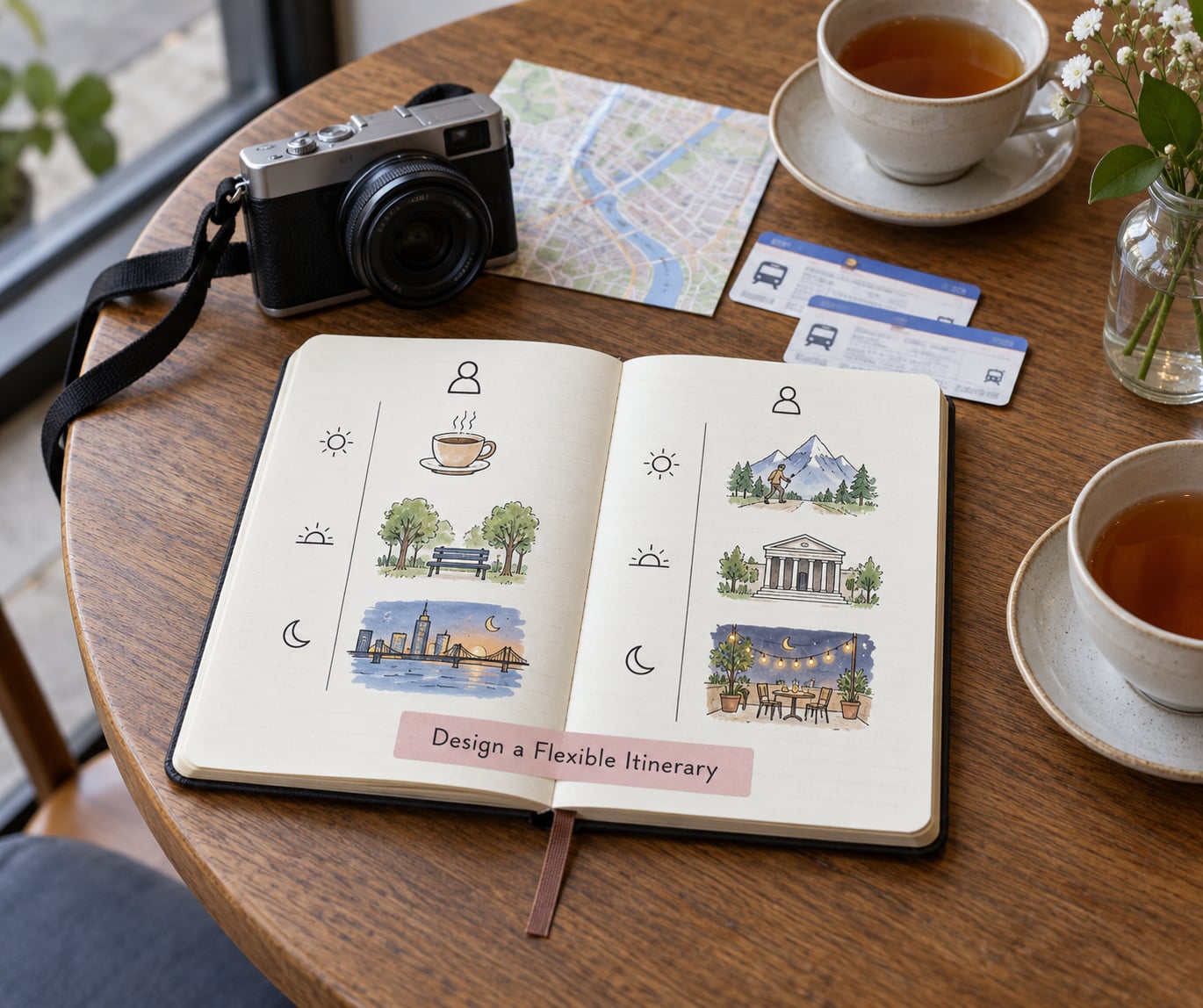
Three things make this work. Add one daily reset point, a specific moment where you both check in and can change the evening without drama, usually coffee in the morning. Put one flexible item in every single day, because a trip with zero unscheduled hours is the thing people resent by day three. And write down who leads which block, so nobody is quietly following a plan they did not agree to.
5. Choose a Place That Can Support Both Styles
Choose the destination by whether one base can serve both preferences, not by which person’s dream trip is prettier on a screen. Look at variety, travel time between neighbourhoods, character per district, access to the activities on both lists, and whether you can change your mind without losing money.
| Destination type | Works well for | What to check first |
|---|---|---|
| City with day-trip access | Culture plus nature without packing bags | Typical travel time to the day-trip area on a weekday |
| Coastal town with inland activities | Rest plus walking, kayaking or cycling | What is open outside summer months |
| Small town with varied day trips | Slow pace plus variety without long transfers | Weekend versus weekday opening patterns |
| Split stay, two bases | City energy plus genuine quiet | How tiring the transfer between bases really is |
| Resort with activity access | Rest plus a scheduled adventure window | Whether off-site excursions need booking well ahead |
Before you commit, check three things separately for each place: seasonal conditions, since what works in one month can be closed or unpleasant in another; opening information, which means current published hours and whether anything needs reservation; and booking requirements, including lead time for anything popular and what the cancellation terms look like.
If you are still torn between two places, look at them from a weather and distance angle rather than a vibe angle. A destination that is a short flight beats a slightly better one that means two long transfers, because every transfer is time you are both spending on logistics rather than the trip.
6. Set the Budget Before Booking
Agree on a ceiling and a daily spending cap before any money moves. The cap matters more than the ceiling, because ceilings get tested repeatedly and caps do not.
Work through the categories in the open: accommodation, transport, meals, activities, plus a flexible pot that both of you can spend without approval. Set the shared limit as a number you could cover comfortably, not your best case. Then decide how a personal splurge gets funded, because this is where resentment hides.
The fair version is simple: each person pays for their own individual extras out of their own money, out loud, without commentary, and the shared costs stay shared. Say it plainly before the trip. A surprise “I treated us to this” turns into a scoreboard later, and the other person never asked to be behind.
7. Book the Anchors, Leave Space for Discovery
Book the trip’s structure and leave the texture of it open.
Reserve the accommodation, the flights or main transport, and the one or two experiences on both must-have lists. Everything else stays undecided. Check cancellation terms on each booked item before you pay rather than after, note the date the booking was made, and keep every confirmation in one folder you both can reach.
A simple rule: if something is expensive to change, book it early after you have agreed. If it is cheap to change, leave it alone until you are there. That single distinction removes most of the pressure people feel about getting everything perfect in advance.
8. Agree on a Decision Rule for the Trip
Decide in advance how small choices get made, so you are not renegotiating at every corner.
Three systems work well. Take a quick vote, usually in a chat thread, with a ten-minute deadline on anything that needs an answer. Rotate: whoever had no say yesterday decides today. Or keep one veto each, usable once, no explanation owed, which tends to do more for goodwill than it looks like it will.
Mark clearly which decisions need both of you and which do not. Restaurant choice, accommodation, money above the daily cap, and anything involving travel safety always need mutual agreement. Everything else can rotate.
One rule worth adding: energy is not a preference that gets overruled in the moment. If one of you is genuinely spent, that is information, not an obstacle. Say “I am done for today” as a complete sentence and treat it as final. It takes less energy to rest than to argue about resting.
Common Mistakes
Picking the destination before talking about priorities. You end up trying to force two trip ideas into one place. Correction: finish steps one to three first, then look at places. Tip: keep a running note of the two phrases each of you used most, and use them as your search filters.
Treating compromise as a fifty-fifty split. Nobody actually wants half of a bad plan. Correction: aim for both people getting their must-haves, not for the number of days being even. Tip: count must-haves delivered rather than days shared, and check that number before you book.
Filling every hour of the itinerary. Over-planning kills the days you remember. Correction: one flexible item per day, minimum. Tip: if the plan has three fixed commitments after dinner, delete one.
Hiding the budget conversation until booking. Money is the real trigger in most trip fights, and it surfaces at the worst moment. Correction: the ceiling and the cap, out loud, before anything is paid. Tip: if the numbers feel uncomfortable, say so early, when it is still a conversation rather than a cancellation.
Treating every preference as non-negotiable. A list of twenty must-haves cannot be satisfied by any trip. Correction: three must-haves each, and let the rest move. Tip: rank the list twice, a week apart, and see which items survive the second pass.
Letting one person plan and the other follow. The planner does all the work, then watches decisions get made anyway. Correction: write down who leads which block, and rotate the decisions that are not non-negotiables. Tip: give the following partner one solo morning with no debrief afterwards, and see how much of the tension remains.
Frequently Asked Questions
How do we choose a destination when one person wants a lively city break and the other wants a quiet nature retreat?
Look for a destination with two usable bases rather than one perfect one. Many coastal towns have a busy harbour district for the first couple of days and hiking or farmland a short drive away for the rest, which lets you split the trip without packing bags twice. Check the typical weekday travel time between the two areas before committing, and confirm what is actually open in the shoulder of the season you can travel in.
What is a fair way to compromise when our travel budgets are different?
Agree on a shared ceiling first, based on what you can both cover without a fight, and decide that shared costs split equally regardless of who earns more. Each person then funds their own individual extras from their own money, announced openly and without discussion. Set a daily spending cap rather than a total budget alone, since caps hold up better when the week gets long.
How can we plan a romantic trip without making it feel overly scheduled?
Keep the fixed parts to anchors: breakfast together, one main activity, and dinner in the same neighbourhood each evening. Leave the middle of the day open so each of you can follow your own preference, then set one specific moment to check in and change the evening if either of you wants to. One flexible item a day is the minimum that keeps a trip feeling like a holiday.
Should every activity be agreed upon in advance, or should we leave room for spontaneous choices?
Agree in advance only on the things that are costly to change or that are genuine must-dos for one of you. Leave anything cheap to change, and anything that only appeals to one person, undecided until you are there. Book the structure, keep the texture open. Couples who plan every hour usually spend the trip resenting the schedule more than the destination.
How do we handle the trip if one of us wants more activity than the other?
Split the days rather than the pace. One of you takes the active mornings, the other takes the active afternoons, and both of you keep one block of nothing. Then agree in advance that saying you are done for the day is a complete answer, not an opening bid in a negotiation. A daily reset point, usually coffee in the morning, lets you adjust the evening without reopening the whole day.
What should we do if one person changes their mind about an activity after booking?
Expect it, and plan for it. Before booking, agree on a swap rule: one booked item per person per trip can be released if someone changes their mind, as long as the other person does not want to do that activity instead. Anything beyond that, you cover between you. Cancelling a shared booking to go somewhere one of you prefers is a different decision, and worth doing openly.
How do we plan a couples trip when you want different things without one person feeling like they always lose?
Track what each person got rather than who conceded. At the end of each day, or the whole trip, check whether your must-haves actually happened. If one person’s list is consistently short, the plan is not working regardless of how relaxed it looks. Also split the visible work: one person researches and books, the other owns the shared folder, the itinerary, and the decision rule.
Conclusion
Start tonight, not at the booking stage. Each of you writes three must-haves and one genuine non-negotiable, then compare notes and agree on the shared priority list. From there, build a trip with a few anchors and plenty of open space.
A good couples trip is not identical for both people. It is one where each person got something they actually wanted, and neither of them spent the whole week waiting for the trip to be over.