To find wildflower blooms without trampling them, you pick your viewpoint before you pick your route: check live bloom reports, read habitat and snowmelt for timing, and then do all of your moving on trail, boardwalk, rock or gravel. The best blooms usually sit a few feet off a path, not in the middle of it, so the whole method is about working with that distance instead of closing it. The research takes about twenty minutes before you leave the house; the day itself needs binoculars or a zoom lens and a pair of steady legs.
Here is the short version, then the full method.
- Where to look: sunny slope edges, seeps, stream margins, meadow margins and forest openings, at the aspect and elevation that matches the species you want.
- When to go: inside the local bloom window, not the calendar month. Snowmelt and rain move everything.
- How to check: the land manager’s own bloom page or hotline first, park social accounts second, community maps and recent geotagged photos third.
- How to photograph: from a fixed spot on the trail tread or a rock, with a zoom, never by walking in and parting the stems.
- The one rule: a meadow you can walk through is a meadow that has already lost the plants you came to see.
Table of Contents›
- What You Need
- Binoculars, and something to zoom with
- A field guide or an ID app, plus a notebook
- The boring essentials
- Step-by-Step
- Choose the Right Season and Location
- Read the Habitat Before the Flowers
- Use Paths, Boardwalks, and Fixed Viewpoints
- Look Closely Without Moving In
- Record the Bloom and Leave No Trace
- Common Mistakes
- Chasing a better angle across the grass
- Parking on the shoulder beside the flowers
- Picking one flower to identify it
- Following an animal into the habitat
- Spreading out to “not crush the plants”
- Arriving at the busiest hour on the busiest weekend
- Frequently Asked Questions
- Can I pick a wildflower to identify it?
- How can I photograph wildflowers without damaging them?
- What should I do if I accidentally step on a flower?
- What is the best app for identifying wildflowers?
- Why should you not trample wildflowers?
- Conclusion
What You Need
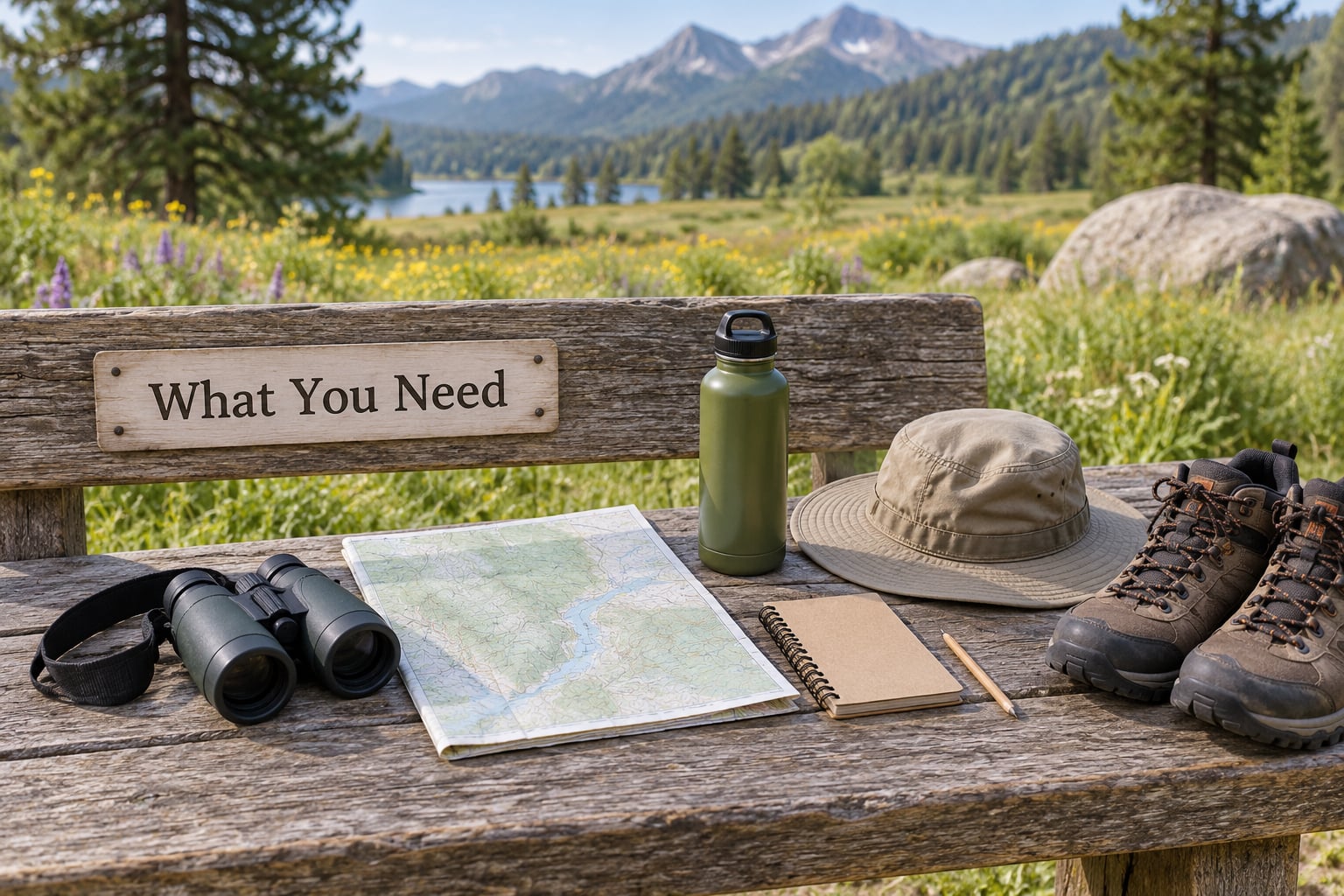
None of this is specialised gear. It is the difference between a walk that ends in a photograph you can use and a walk that ends in a flattened patch you feel bad about for the rest of the drive home.
Binoculars, and something to zoom with
A pair of 8×42 binoculars is the single most useful thing in the kit. Most flower ID depends on counting petals and looking at leaf arrangement, and you cannot do either from four metres away.
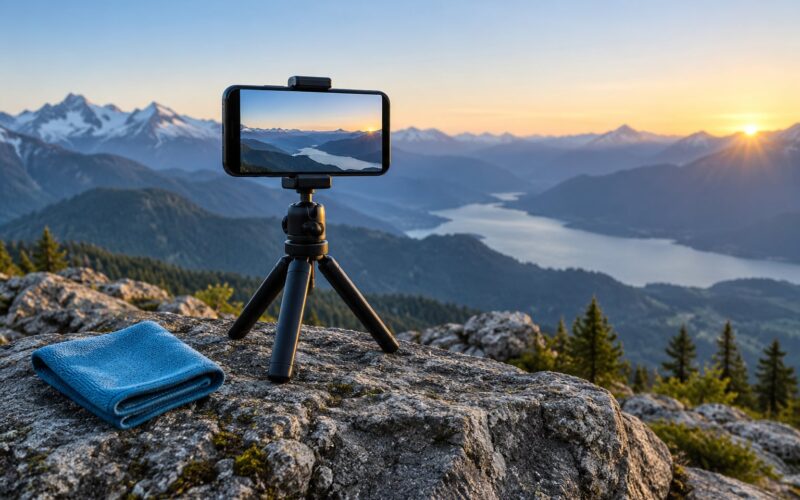
For photos, bring whatever your phone or camera already does well. A phone with a 2x or 3x optical lens beats a cheap clip-on wide angle every time for flowers, because a close wide-angle shot is usually a shot taken from too close. A 70-300mm lens does the whole job from a trail edge. Skip the tripod on a meadow path unless you have somewhere solid to set it, because spreading the legs plants a tripod in exactly the ground you are trying to protect.
A field guide or an ID app, plus a notebook
Take one of each. Apps are fast and rough, guides are slow and certain, and cross-checking is how you avoid confidently mislabelling a lupine as a bluebell. Write down what you see rather than what you think it is: petal count, colour, leaf shape, height, and how many plants are in the patch.
The boring essentials
Water, sun protection, a warm layer even on a warm forecast, and a paper map or an offline map download. Meadow paths cross wet ground, and a phone that dies at the trailhead leaves you guessing at the walk back.
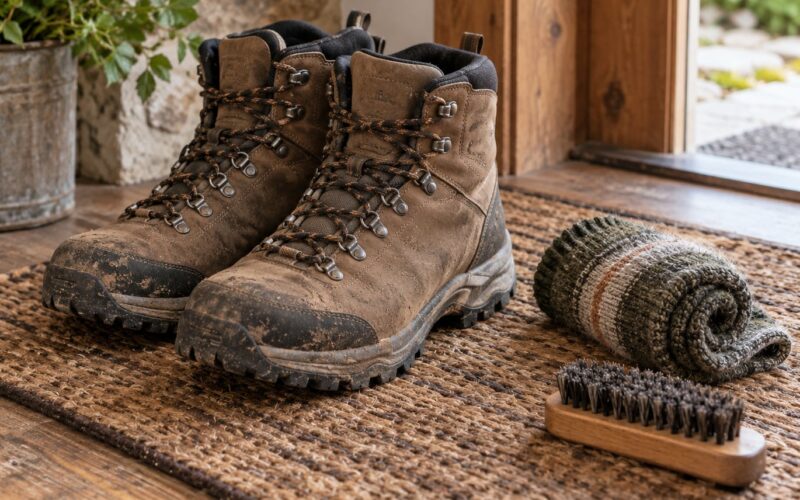
Leave the drone, the balloon weights used to pin a picnic blanket against wind, and any wide-angle ring light at home. All three end up in a meadow, and all three destroy a bloom in a way nobody notices until the season is over.
| What to carry | What it actually does for you | What to leave in the pack |
|---|---|---|
| Binoculars | Count petals and read leaf arrangement from the trail edge | Nothing, they never touch a plant |
| Phone or camera with zoom | Close frames from a fixed stance, no walking in | Tripod legs in soft ground |
| Field guide and ID app | Cross-check each other, confirm rather than guess | Nothing |
| Notebook and pen | Records date, place, species and condition for later | Nothing |
| Water, hat, warm layer | Lets you stay still and watch for twenty minutes | Nothing |
| Dog on a six-foot leash | Keeps a single animal out of the densest stems | Anything that anchors you to the ground |
Bloom-reporting sources last checked October 2026. Rates, hours and coverage change; treat anything you find as a starting point rather than a promise.
Step-by-Step
Choose the Right Season and Location
Timing beats everything else on a wildflower trip. Elevation, snowmelt, temperature and recent rainfall decide the bloom window more than the month does, and local land managers publish it before any blog does. Choose a region, then check its own report, and aim for the middle of the window rather than the first week you can get off work.
Two rules of thumb do most of the work. Snowmelt is the release button: wet alpine meadows lag the low country by weeks, and a trail that is still bare in May can be past peak by the time you arrive in July. Rain is the fertiliser: a soaking in the autumn or winter sets the seed that produces the following spring’s abundance, which is why a single spectacular superbloom follows a wet year rather than a lucky one.
Aspect matters too. South and west facing slopes in the northern hemisphere warm earlier and dry out, favouring the early, sun-loving species. North and east facing slopes stay cool and damp longer, which means they flower later but hold on. Walking a single trail that crosses both can hand you a two-week-long bloom season in one morning.
Add the words that make your search specific. “Tiger lily bloom times in the Cascades” or “lupine bloom report Carrizo Plain” returns something useful. “Wildflowers this weekend” mostly returns allergy content and stock photography, which is the single most common complaint I hear from people trying to plan a trip.
| Region | Typical peak window | Flagship species | Crowd level at peak |
|---|---|---|---|
| Desert Southwest | Late February to March | Desert lilac, poppies, brittlebush | High, concentrated at a few well-known sites |
| California coastal ranges | March to May | Lupine, poppies, wild lilac | High, heavy roadside parking pressure |
| Sierra and Cascades | May to July, rising with elevation | Paintbrush, lupine, monkeyflower | Moderate, heavy on weekends |
| Appalachians and Smokies | April to May | Trillium, bloodroot, magnolia companions | Low to moderate |
| Rockies and high country | June to August, later with height | Alpine forget-me-not, gentian, yarrow | Low, weather drives most cancellations |
| Pacific Northwest valleys | April to June | Camas, balsamroot, wild rose | Low |
| Tallgrass prairie | August to October | Blazing star, coneflower, big bluestem | Very low |
Windows shift by a couple of weeks year to year, so treat the table as a shape, not a schedule. If you can only travel in one week, pick the region whose window is widest rather than the one with the most famous flowers.
Read the Habitat Before the Flowers
You can predict a lot from the ground itself. Water, sun and soil do the selecting, and once you know which side of a slope you are on, you know which plants you are walking toward.
Start with water. Seeps, spring-fed alcoves, snowmelt edges and stream margins hold moisture longest and carry the densest displays, because they stay damp after everything around them has dried. Next look for open ground inside forest: clearings, trail edges, road cuts, south-facing openings. Shade is the limiting factor under canopy, which is why the biggest carpets in a wooded valley usually stop exactly at the treeline of light.
Then read the soil. Thin, rocky, low-nutrient soils in western North America grow the most unusual species and take the longest to recover from damage, because there is very little topsoil to compact. Serpentine soils around the Bay Area are the textbook case, which is why local hikers point people toward them for rare finds and warn them harder than anywhere else. Meadows, by contrast, are mostly deep grass roots holding a layer of organic soil, so they tolerate some foot traffic far better than a rocky slope does, and they still should not get it.
Read the ground for what it is not, too. Skip anything inside a fence or a posted boundary, skip ground under a sign that asks you not to, and skip any patch that is already bare, dusty or mashed flat. Once the plants are off, the soil is the next casualty, and bare soil takes decades to recover in a place where soil forms at a few millimetres a year.
Use Paths, Boardwalks, and Fixed Viewpoints
Stay on durable surfaces: trail tread, boardwalk, paved path, bare rock, gravel, a paved overlook. Everything else in a flowering area is someone’s meadow, and a meadow is a plant community, not a lawn. If a trail is signed as closed or a boardwalk has a rope across it, the flowers are not worth the detour.
Boardwalks exist for exactly this. Where a park has built one, you are standing above the plants and looking down into them, which is the best possible position and costs the habitat nothing. Overlooks and pull-outs do the same job for people who cannot walk a meadow trail at all, and driving routes past good desert bloom are one of the best low-impact ways to see wildflowers there is.
Group size changes the maths, which is why it is worth thinking about before the walk. One person walking a single track can stay on durable tread. Six people spread out across a meadow cannot, and a photo session of eight graduates in an overgrown field will flatten more than a week of foot traffic. If you are travelling solo, that works in your favour: a single-file line is the quietest way to move through a bloom, and you can simply stop and stand still when a patch is worth looking at.
If you are walking with kids, the rule is the same and it is easier than it sounds: the child walks on the path, and the photograph happens from the path. The most common trampler in a spring meadow is a five-year-old on a picnic blanket, and the fix is a blanket on gravel or bare ground at the trailhead rather than in the flowers.
Look Closely Without Moving In
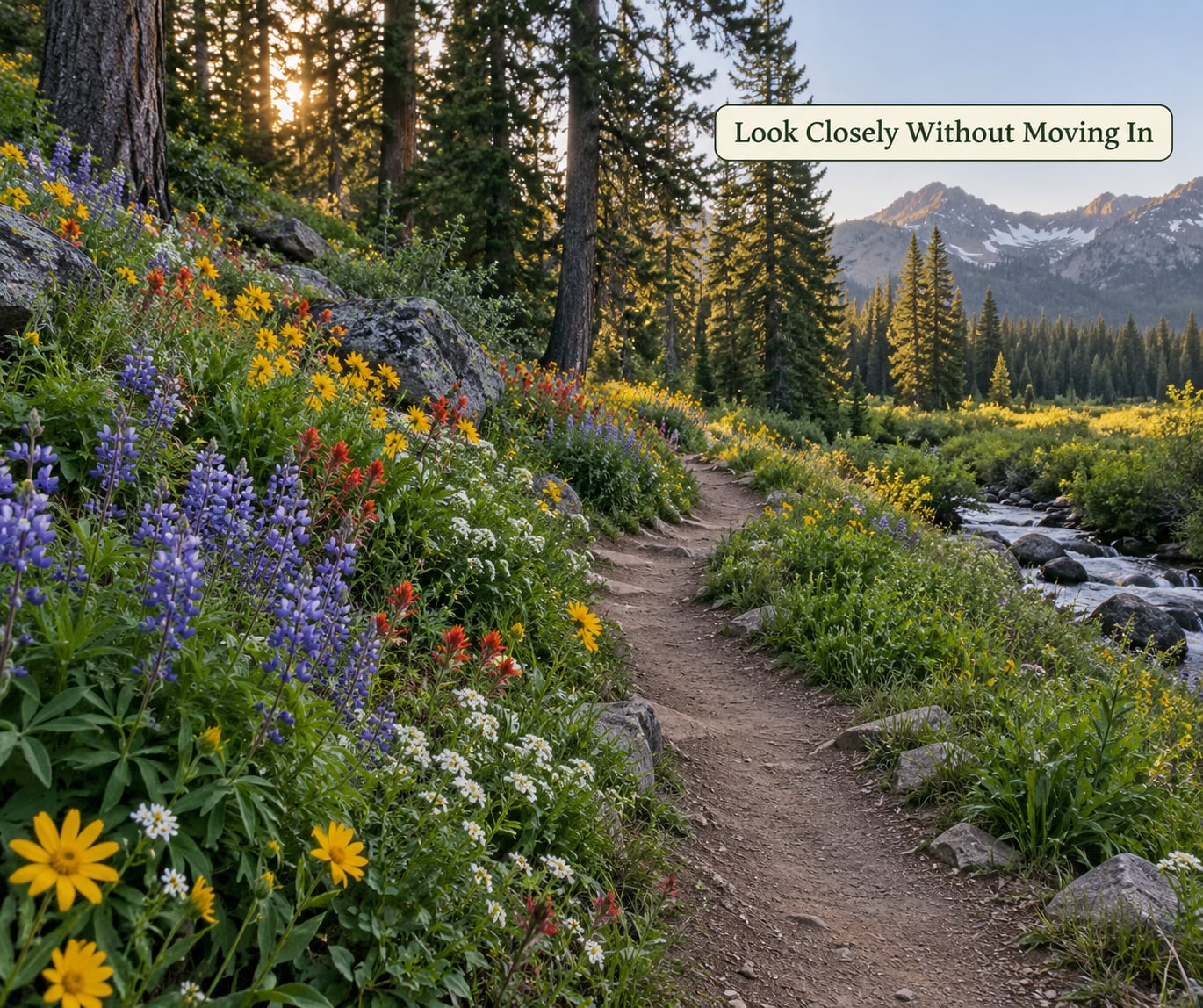
You do not need to be in the meadow to fill the frame. Stand still on the trail, put the zoom on, and wait. Most wildflower photographs people regret are the ones taken while walking, because the photographer stepped into the stems, parted them with a foot, and framed a gap that closes the moment they move.
A few things make the difference between a good close frame and a flattened patch:
- Kneel on the trail’s own compacted tread, or on rock or gravel, and shoot across it. Never kneel in the meadow itself, even once, even briefly.
- Use the longest focal length you have and step back along the path rather than forward into the flowers. Backing up along your own line is free; going around the stems is not.
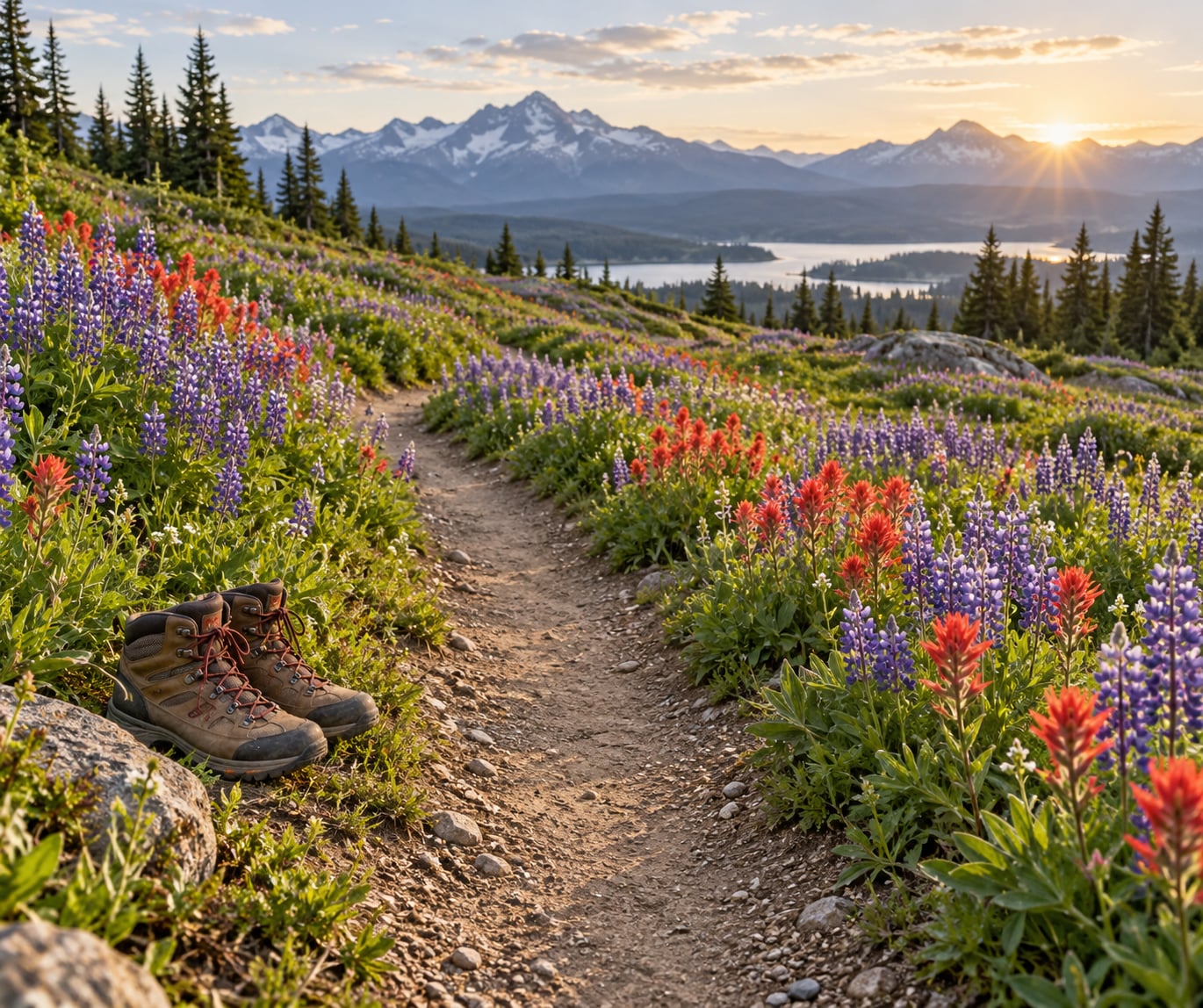
- Look for backlight. Low sun behind a lupine or paintbrush patch gives you translucent petals and a rim of light, and it works from the same fixed position as a flat midday shot.
- Work with the path edge. The best compositions in most meadows come from looking along the trail into the flowers, not from over them.
- Photograph vertical species like paintbrush and lupine straight on, and low mats like cinquefoil or alpine cinquefoil from a low kneeling position, all from the tread.
- Never bend a stem down to it, lift a bloom to face the light, or move a bloom to clear the background. The stem does not recover, and the photograph is not worth a plant that will not bloom again.
If you are not carrying a camera at all, the technique is the same with your eyes. Sit down on the path, stay still for five minutes, and let your eyes adjust to the detail. You will see more than people who walked through the patch taking photos the whole time.
Record the Bloom and Leave No Trace
Write down what you saw and leave the ground as you found it. Notebooks and photo apps both help here, because a record is what makes a bloom worth protecting next year.
A useful note has four parts: the date, the location as precisely as you can, the species, and the condition. Condition matters most for reporting: note where stems are bent or broken, where the ground is bare, where people have parked, and whether anything has been dug up. That report is genuinely useful to the people who manage the site, and land managers can often close and rehabilitate a pull-out before the season is over.
On the way out, take everything you brought in, including things that were not yours. Tissue, food scraps and plastic collect in the same soft ground that holds moisture and flowers, and a single abandoned blanket can sit in a seep for years.
Keep dogs on a leash, and short. A single dog on a six-foot line does less damage than two on retracts. Drones have no business over a bloom at all, both for the disturbance and because a hovering camera is a good way to drive every pollinator out of a patch at the exact moment it is working.
If you do step on something, the response is simple and nobody will hold it against you: stop, note where it happened, step out of the patch, and do not try to fix it. Bent stems left alone often recover. A stomped, rebuilt plant does not.
Common Mistakes
Chasing a better angle across the grass
One person moves fifteen feet sideways for a cleaner background and crosses a compressed patch that held several hundred plants. Zoom in or move back along your existing line instead. The frame will be slightly less tidy and the meadow will be intact.
Parking on the shoulder beside the flowers
Desert blooms and roadside meadows get flattened by tires, not boots, and the damage is invisible until the plants regrow several years later. Park at the designated pull-out, however far it is, and read the signs about where you cannot put the car. If the shoulder is already churned, add to it and you have just made the patch that people photograph as evidence of damage.
Picking one flower to identify it
It is illegal in many parks and reserves, it removes a plant’s entire reproductive structure for the season, and the meadow pays for your curiosity. Photograph it, note the leaf arrangement and petal count, and check it later against a guide. A picked stem is the least useful identifier anyway, because colour fades and the field marks that matter are usually still in the ground.
Following an animal into the habitat
Deer, birds and ground-nesting insects use the meadow, and so do the pollinators you are trying to protect. Following a bird or a deer off the trail is how people step on nests. The bloom will still be there if you watch the animal from where you are standing.
Spreading out to “not crush the plants”
Widening the group feels considerate and does the opposite, because it puts more feet into a larger area of soft ground. Stay single file on the established tread, even if the line is narrow. The rule set experienced hikers keep coming back to is short: do not pick, do not trample, pack out everything, and look for unusual species on the odd soils without disturbing them.
Arriving at the busiest hour on the busiest weekend
Crowds do more damage to a bloom than any camera will, because crowding pushes people off the trail and onto the flowers. Shift to a weekday morning or a weekday afternoon, and you will often get a better photograph from a clear path. If you are travelling alone, this is the easiest improvement available to you and it costs nothing but a different day.
Frequently Asked Questions
Can I pick a wildflower to identify it?
Usually no, and in many parks and reserves it is illegal. A picked stem removes the plant’s reproductive structure for the whole season, and in thin alpine or desert soils that plant may not be back the following year. Photograph it in place instead, note the petal count, leaf arrangement, stem height and how many plants are in the patch, then check it against a field guide or a trusted ID app once you are off the trail. It is slower and far more reliable.
How can I photograph wildflowers without damaging them?
Work from a fixed position on a durable surface. Stand or kneel on the trail tread, on rock or on gravel, use the longest zoom you have, and step back along your own line rather than forward into the stems. Backlit shoots from a low sun give you translucent petals from that same spot. Never bend a stem to meet the lens, lift a bloom toward the light, or clear stems out of the background, because none of those recover.
What should I do if I accidentally step on a flower?
Stop, note roughly where it happened, step out of the patch, and carry on with your feet on the path. Do not try to stand the plant up or rebuild the soil around it. Bent stems that are left alone often recover on their own, while a stomped and reassembled plant rarely does. If the damage is significant, or if you see digging, picking or off-trail vehicle damage, report it to the land manager for that area, because early reports can lead to a closure before the rest of the season is lost.
What is the best app for identifying wildflowers?
None is reliable enough to trust on its own, which is why the better habit is to run two and cross-check them. Seek and iNaturalist are the two most commonly used for a quick match, and both are better with a photo that includes the leaf arrangement and the whole plant rather than a tight flower shot. Region-specific field apps built by local botanical societies, such as Oregon Wildflower Search, tend to be more accurate locally. Carry a printed regional field guide as the final check before you record a species.
Why should you not trample wildflowers?
Because the damage is mechanical, not sentimental. Crushed stems cannot photosynthesise or set seed, compacted soil loses the pore space that roots and soil life need, and in alpine, desert and prairie meadows the growing season may only be six to eight weeks long. A popular bloom that gets heavy foot traffic one season can take years, sometimes a decade, to come back. On thin soils the growing season is very short, so trampled ground can stay visibly bare long after the flowers are gone.
Conclusion
Start with the check, not the drive. Find the land manager’s bloom report for your region, pick a day inside the middle of the window, and choose a trail that has a boardwalk, an overlook or a wide path through it. Then stay on the durable ground the whole time, get the close shot with a zoom from where you are standing, and leave the plants, the stems and the soil exactly as you found them.