How to find natural hot springs that are safe to soak in comes down to two separate jobs: confirming the spring really exists through official land agency sources, then vetting the water on arrival. Most of the risk sits in that second half. Geothermal water is untreated, its temperature swings between pools and seasons, and the injuries that actually happen at springs come from heat and water rather than from anything a sign warns you about.
The whole process takes about an hour at your desk and ten minutes at the pool. Get it wrong and you can burn your feet on a rock nobody told you was hot, or soak in water that a county health department quietly closed for contamination the week before.
Below is the method I use, in the order that actually works, including the checks that get skipped. It is aimed at solo travelers and road-trippers heading for undeveloped springs where there is no staff, no sign, no lifeguard, and often no cell signal.
Table of Contents›
- What You Need
- How to Find Natural Hot Springs That Are Safe to Soak In
- Step 1: Confirm the spring and its exact location
- Step 2: Check access rules and current local advisories
- Step 3: Look for water-quality and weather warnings
- Step 4: Inspect the site before getting into the water
- Step 5: Choose a safe way to soak
- Step 6: Leave the spring and report problems
- Common Mistakes
- Frequently Asked Questions
- Can natural hot springs be safe if the water looks clean?
- How can I check whether a natural hot spring is closed or contaminated?
- Is it safe to soak in a natural hot spring after rain?
- How long should I stay in a natural hot spring?
- Can I soak in a natural hot spring with children or while pregnant?
- What should I do if I feel dizzy or develop a rash after soaking?
- Conclusion
What You Need
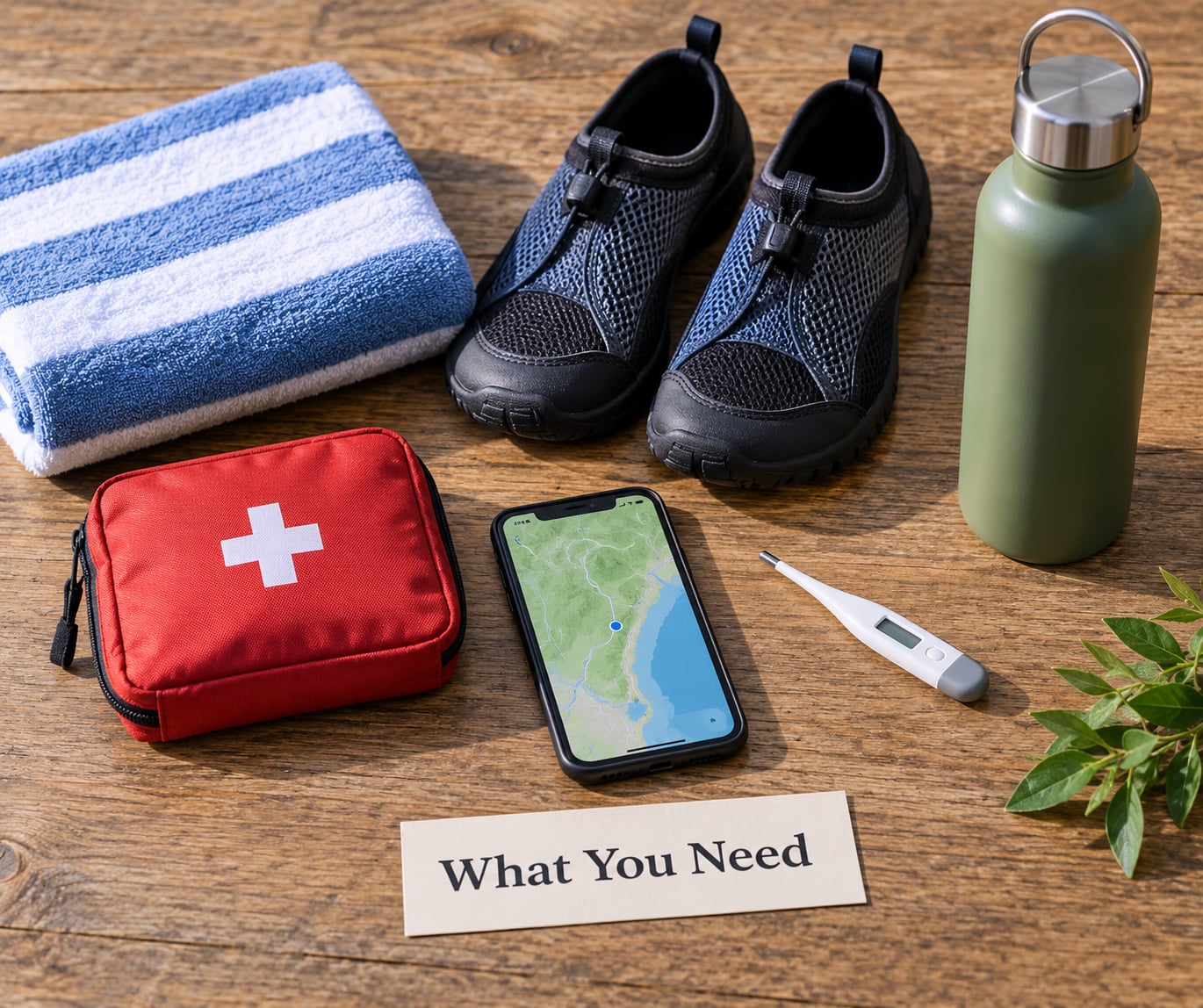
Start with sources, not gear. Gear decides how you move and what happens if the water surprises you. It cannot make contaminated water drinkable-safe or make a closed site open.
- Official land agency sources. National Park Service, US Forest Service, and Bureau of Land Management site pages, plus the specific state park or state recreation area. These carry closure orders, seasonal shut-downs, and water-quality advisories.
- State geological surveys and USGS geothermal resources. These document known springs, their approximate locations, and in many cases measured temperatures and mineral content.
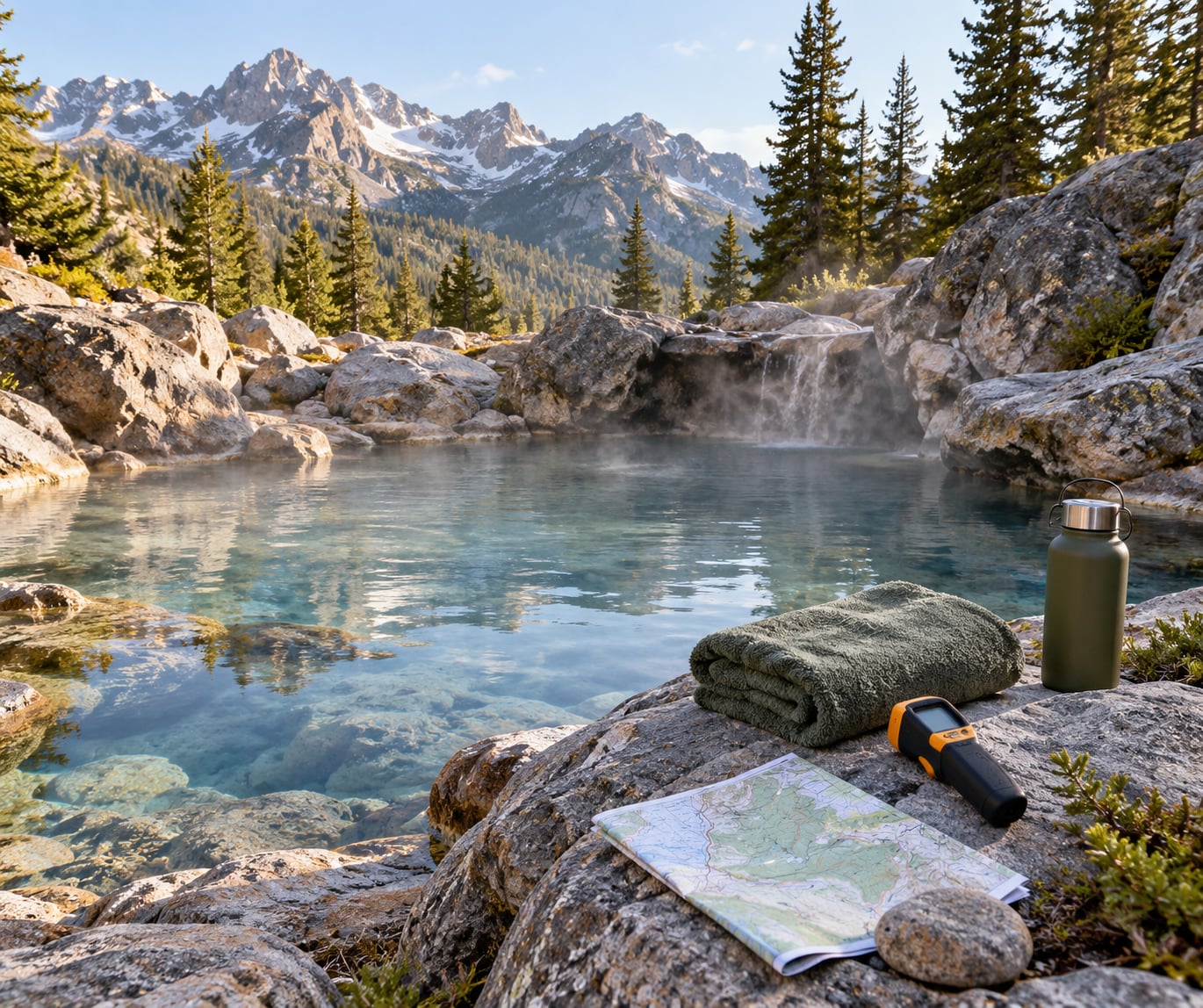
- An infrared thermometer. A cheap pistol-grip model handles unmarked pools and the outflow channel, where you check without putting a hand in scalding water.
- Offline navigation. Download the area on your maps app before you lose signal. Topographic maps matter here, because spring names on satellite labels and the actual pool do not always agree.
- Water shoes or grippy sandals. Wet mineral rock is slick, and the bottom of a natural pool is often uneven travertine or rounded stone.
- A quick-dry towel, dry change of clothes, and a wind layer. You will be wet in shade and wind after you come out.
- Drinking water with electrolytes. Heat plus immersion drains you faster than thirst tells you.
- A small first-aid kit, insect repellent, and a charged phone with a power bank.
How to Find Natural Hot Springs That Are Safe to Soak In
The sequence below runs from your kitchen to the pool edge. Do not skip forward: the steps that look least interesting, the access rules and the advisories, are the ones that end trips early at the trailhead.
Step 1: Confirm the spring and its exact location
A documented natural hot spring is not the same thing as a swimming hole that shares its name online. Names get borrowed, pools get renamed after a season of closures, and coordinates on community maps drift by a mile or more.
Match three things before you load the car: the place name, the coordinates, and a description of the pool itself from a dated source. If a listing says “small travertine pool with an outflow channel on the north side,” and the source is three years old, treat it as a starting point rather than a fact. Winter avalanche debris, wildfire debris, or a new access gate can change the last mile completely.
Save the source with its date. The date matters more than the map pin.
Step 2: Check access rules and current local advisories
Check who owns the ground and whether the water is open. Federal and state agency pages carry closure notices, seasonal closures, permit requirements for some backcountry routes, and swimming restrictions that change with fire danger, snowmelt, or a wildlife season.
County health departments sometimes post advisories that the park’s own site does not surface, particularly after a sewage plant discharge upstream or a livestock spill. Search the county name with the spring name plus the words advisory, closure, and contaminated, and read any recent water district minutes if the pool sits near a community.
A spring on private land, or one behind a gate or a closed sign, is off limits until you have permission from the owner. “Closed” means closed regardless of how inviting the water looks or how many people are already in it.
Step 3: Look for water-quality and weather warnings
Watch for recent heavy rain or snowmelt, a sewage overflow upstream, livestock or wildlife concentrations above the pool, mining or industrial drainage, wildfire ash and debris, and algal blooms. Those are the conditions that turn a spring from fine to no.
Visual clarity alone proves nothing microbiological. Clear water can carry pathogens at concentrations high enough to matter, and a pool that looks spotless on a dry summer day can be different a week after a storm.
Skipping a soak beats negotiating with a hot spring you cannot evaluate. Move on and come back in better conditions.
Step 4: Inspect the site before getting into the water
This is the part people rush, and it takes about five minutes. Work through it in order.
- Walk the shore. Look for posted rules, damaged signs, taped-off areas, new debris, and any recent evidence of contamination such as a scum line, foam, dead animals, or litter concentrated on the waterline.
- Read the water. Unusually cloudy, milky, or swirling water is a no. So is a foul or chemical smell beyond the usual sulfur, or a surface sheen that does not disperse when you disturb it.
- Check the temperature. Aim the infrared thermometer at the outflow channel and at the main pool, from a distance and then from the bank. Measure more than one pool. Never put a limb in to test.
- Probe the depth and footing. Use a walking stick. Look for drop-offs you cannot see, submerged branches, sharp rock, and unstable banks.
- Find your entry and exit. Decide where you climb out before you get in, and note a second exit if there is one.
- Note the animals and the surroundings. Standing or wandering birds, deadstock, foam concentrated in a corner, or a strong current all change the assessment.
- Read the posted rules again. Some pools are day-use only, some ban glass, some close at dusk, and some set a maximum time limit.
Use the temperature numbers as a guide for how long you plan to stay. Published occupational burn thresholds put prolonged exposure around 110°F at the start of tissue injury, first-degree burns near 118°F, and second- or third-degree burns around 130°F, with near-instant damage far above that. Spring runoff channels can run much hotter than the pool they feed.
| Water temperature | Suggested time in the water | What to watch |
|---|---|---|
| Under 100°F | 20-30 minutes | Cold-water risk once you climb out; dry off promptly |
| 100-104°F | 15-20 minutes | Comfortable for most adults; watch children closely |
| 104-108°F | 10-15 minutes | Warmth accumulates fast; take a break before you feel fine |
| 108-112°F | 5-10 minutes | Real burn and cardiac load risk; check with a clinician first if unsure |
| Over 112°F | Splash only, no soaking | Scalding risk, including from submerged rocks and outflow channels |
One useful habit: test the outflow channel temperature, not just the pool. Pool edges are often cooler, and the channel is where scalds actually happen.
Separately, some things look alarming and are normal. Sulfur odor, orange or black iron staining, white silica film on your skin after drying, and a slight sulfurous taste in the air are all normal geothermal signatures and are not reasons to skip a soak on their own.
| Green flags | Red flags |
|---|---|
| Clear water with a visible bottom | Murky, milky, or swirling water |
| Stable banks and a gradual entry | Undercut banks or a sudden drop-off |
| Stable temperature checked at the outflow | Rising, foamy, or unusually hot outflow |
| No posted advisory, gate open, rules clear | Closure sign, gate closed, or posted water advisory |
| Sulfur smell, iron staining, mineral film | Scum line, dead animals, livestock concentration, strong waste odor |
| Other bathers present on a normal weekend | Empty on a peak weekend, after a storm or fire |
| Vehicle tracks and recent tire impressions | New debris, ash, mud, or flood staining above the pool |
If two or more red flags show up, get out. You can always come back another day; you cannot undo a burn.
Step 5: Choose a safe way to soak
Enter the water gradually with a stable foothold rather than jumping or diving. Unknown depth plus an uneven mineral bottom is a bad combination, and there is no lifeguard at a primitive pool.
Keep your head above the water and do not swallow it. Time your first round at 10 to 15 minutes, get out, and see how you feel before going back. Thirty minutes of total soak is a sensible ceiling, which is roughly where experienced regulars draw the line to avoid feeling faint.
Drink water throughout, and step out at the first sign of dizziness, nausea, headache, cramping, unusual fatigue, or a racing or irregular heartbeat. Those are heat and dehydration signals, and they build slowly enough that people ignore them. The safest person in the pool is the one who got out early and felt slightly premature about it.
Do not soak alone in an isolated location with no cell service. If you are going anyway, tell someone your plan and your expected return time, set a hard turnaround time you will honor, download offline maps, arrive in daylight, and be out well before dark.
Step 6: Leave the spring and report problems
Climb out slowly on the footing you chose on the way in, then dry off and put on dry layers before you cool down. Wind and shade cool you faster than you expect, and a shivering hiker on a ridge is a real story I have heard too many times.
Clean any cuts, check yourself for ticks and irritated skin, and note whether a rash appears hours later rather than immediately.
If you find damaged signs, contamination, or a hazard like an undercut bank, report it to the land manager or local authority. Do not remove private markers, dig, move rocks, or clear a trail yourself; that is a violation on most public land and it destroys information the next visitor needs.
Common Mistakes
Assuming every natural spring is safe. The popular ones have rules, testing, and staff. Primitive ones have none of that. Fix: treat any pool without posted rules and regular maintenance as a site you evaluate in five minutes, not one you trust on sight.
Relying only on reviews and social posts. A glowing post from last summer tells you nothing about a closed gate or post-storm contamination. Fix: use community posts to find candidates, then confirm each one on an agency page before you drive.
Going after heavy rain or a wildfire. Snowmelt and flood water carry everything upstream into a pool. Fix: wait until flows drop back to normal and the water runs clear, or skip the trip. This is the one rule I would not bend.
Ignoring private-property rules. A spring on someone’s land can look like public land and even have a social media reputation. Fix: ask the owner, or do not go. Trespass charges are real and land managers do share them.
Diving or jumping into unfamiliar water. Depth is unpredictable and the bottom can be undercut. Fix: walk in, hold the rock, keep your head up.
Soaking too long. Thirty minutes total is a reasonable ceiling, and shorter at higher temperatures. Fix: set a timer on your watch. Nobody has ever regretted leaving at twenty-five minutes.
Going alone to a remote pool with no signal. A slip on a slick mineral edge is a very ordinary accident with no one nearby. Fix: bring someone, or share your plan, your route, and your return time with someone at home.
Treating hot water as a cure. Soaking is not a treatment for a medical condition, and heat can be genuinely dangerous for people with heart conditions, low blood pressure, pregnancy, recent surgery, or a fever. Fix: ask a clinician before you go, and keep the soak short and cool-down serious.
One last safety tip worth memorizing: when you are wet in the shade and the wind picks up, get dressed immediately. Most hypothermia incidents at springs are mild and entirely preventable.
Frequently Asked Questions
Can natural hot springs be safe if the water looks clean?
Clear water tells you almost nothing about microbiology. Pathogens at natural springs come from runoff, soil, wildlife, and livestock, not from what you can see, and a spotless pool can still carry bacteria at levels that matter. When someone asks how to find natural hot springs that are safe to soak in, appearance never settles the question. Check closures and advisories first, keep your head above water, do not swallow any, cover open cuts, and skip the soak entirely after heavy rain, a sewage discharge upstream, or a wildfire.
How can I check whether a natural hot spring is closed or contaminated?
Start with the land agency that manages the ground: NPS, US Forest Service, BLM, or the state park and recreation area page. Look for closure orders, seasonal shut-downs, and fire or weather restrictions. Then check the county health department for advisories, since they often post separately from park sites. Search the spring name with the words advisory, closure, and contaminated, and read recent water district minutes if a community sits upstream. A closed gate or posted sign ends the trip.
Is it safe to soak in a natural hot spring after rain?
Usually not, at least not right away. Rain, snowmelt, and flood water carry sediment, animal waste, and runoff from everything upstream, and many closures follow storms precisely for that reason. If the water has turned murky, is flowing hard, or carries foam and debris, do not get in. Wait until flows drop back to normal and the pool runs clear again, which in some drainages takes several dry days.
How long should I stay in a natural hot spring?
Most experienced soakers recommend 15 to 20 minutes per round with a break, and treat 30 minutes of total soak time as a hard ceiling. Shorter is better as water temperature climbs: roughly 10 to 15 minutes in water near 104 to 108u0026deg;F, and 5 to 10 minutes between 108 and 112u0026deg;F. Set a timer so the decision is not made by feel, and get out at the first hint of dizziness, nausea, headache, or unusual fatigue.
Can I soak in a natural hot spring with children or while pregnant?
With children, keep rounds to 10 to 15 minutes, stay within arm’s reach, test the temperature yourself first, and check the depth and footing at the entry point. Children heat up faster and burn risk rises with water temperature. During pregnancy, soaking in very hot water can raise body temperature, so check with your clinician before a hot soak and keep sessions short and moderate. Open wounds, recent surgery, fever, and heart conditions are all reasons to ask a doctor first.
What should I do if I feel dizzy or develop a rash after soaking?
Get out of the water, sit or lie down in the shade, and cool gradually with cool water rather than ice. Drink fluids with electrolytes, and do not drive if you feel unsteady. Dizziness, nausea, headache, cramping, or an irregular heartbeat after a hot soak can signal heat stress, so seek medical care if symptoms persist or worsen. For a rash, rinse the skin, stop using any soap or lotion you applied afterward, and see a clinician if it spreads, blisters, or comes with fever.
Conclusion
The safest order of operations is short enough to memorize. Confirm the spring exists and that the ground is open. Check current advisories and closures the morning you leave. Inspect the pool on arrival: water clarity, bank stability, temperature at the outflow, depth and footing. Enter slowly and only when everything looks acceptable. Leave the moment the situation feels wrong, because that instinct has kept more people out of trouble than any rule on this page.
If you have a medical condition, an open wound, a fever, recent surgery, or any doubt at all about your health, ask a clinician before soaking. Heat and water are a genuinely risky combination when your body is not handling normal stress well, and there is no medic at a primitive pool.