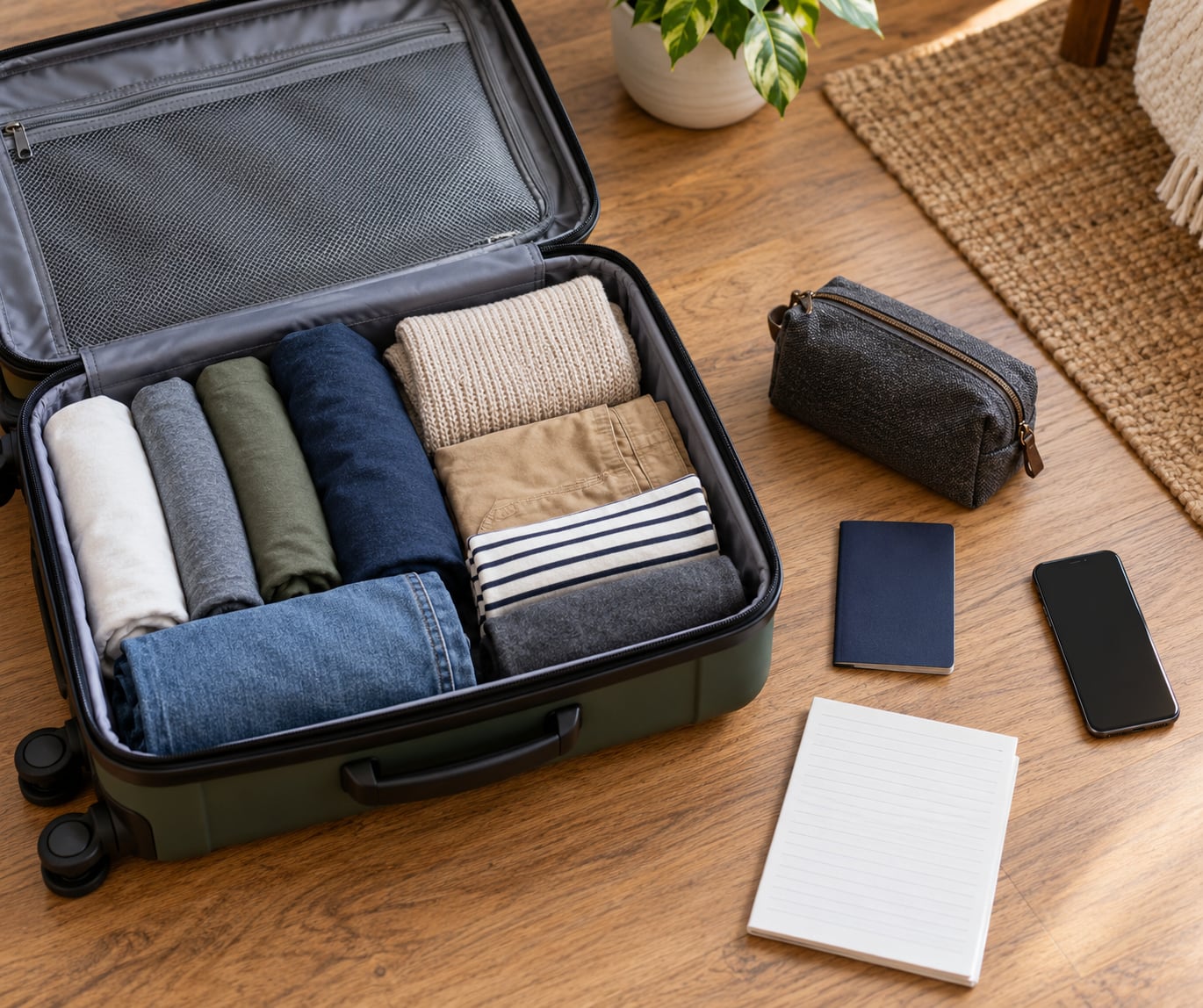
Carry-on only travel works when you do three things: wear your bulkiest clothes and shoes on the plane, pack a small group of mix-and-match layers instead of full outfits, and organize everything into cubes so you can find it without emptying the bag. Skip the checked bag and you also skip the baggage drop queue, the carousel, and the anxious hour when your bag does not appear.
Here is the short version of the system I use:
- Wear the jacket, the jeans, and the heaviest shoes on the flight.
- Pack one week’s clothing no matter how long the trip runs, and wash once mid-trip.
- Divide the bag into three zones: carry-on, personal item, and on your body.
- Set a hard 20-minute timer and stop when it rings, even with space remaining.
- Check the airline’s carry-on limit before you pack, not at the gate.
The timer is the part almost nobody does, and it is the whole reason this works. Packing stress is not really about volume — it is about the last hour of second-guessing, when you start adding “just in case” items that never get worn.
One more framing note: this is written for people traveling alone or light, because that is where the pay-off is biggest. One bag is easier to move through an unfamiliar train station, easier to store in a rented room, and there is less of your life sitting unattended on a carousel while a stranger walks past.
Table of Contents›
- What You Need
- Information, not gear
- A bag that fits your airline’s limit
- The small kit
- Step-by-Step: How to Pack for a Trip With No Checked Bag and No Stress
- How to Pack for a Trip With No Checked Bag and No Stress: Build a Flexible Clothing Capsule
- Choose Shoes and Wear Your Bulkiest Pair
- Pack Toileties, Tech, and Small Essentials
- Use Packing Cubes and Compression Wisely
- Check the Bag Before You Leave
- Common Mistakes
- Frequently Asked Questions
- What is the 5-4-3-2-1 rule for packing?
- How many days can I pack in a carry-on?
- What happens if my carry-on bag is one inch too big?
- Can I bring a full-size shampoo in my carry-on?
- What is the 3-3-3 rule for travel packing?
- How do I avoid overpacking a carry-on?
- What to Do First
What You Need
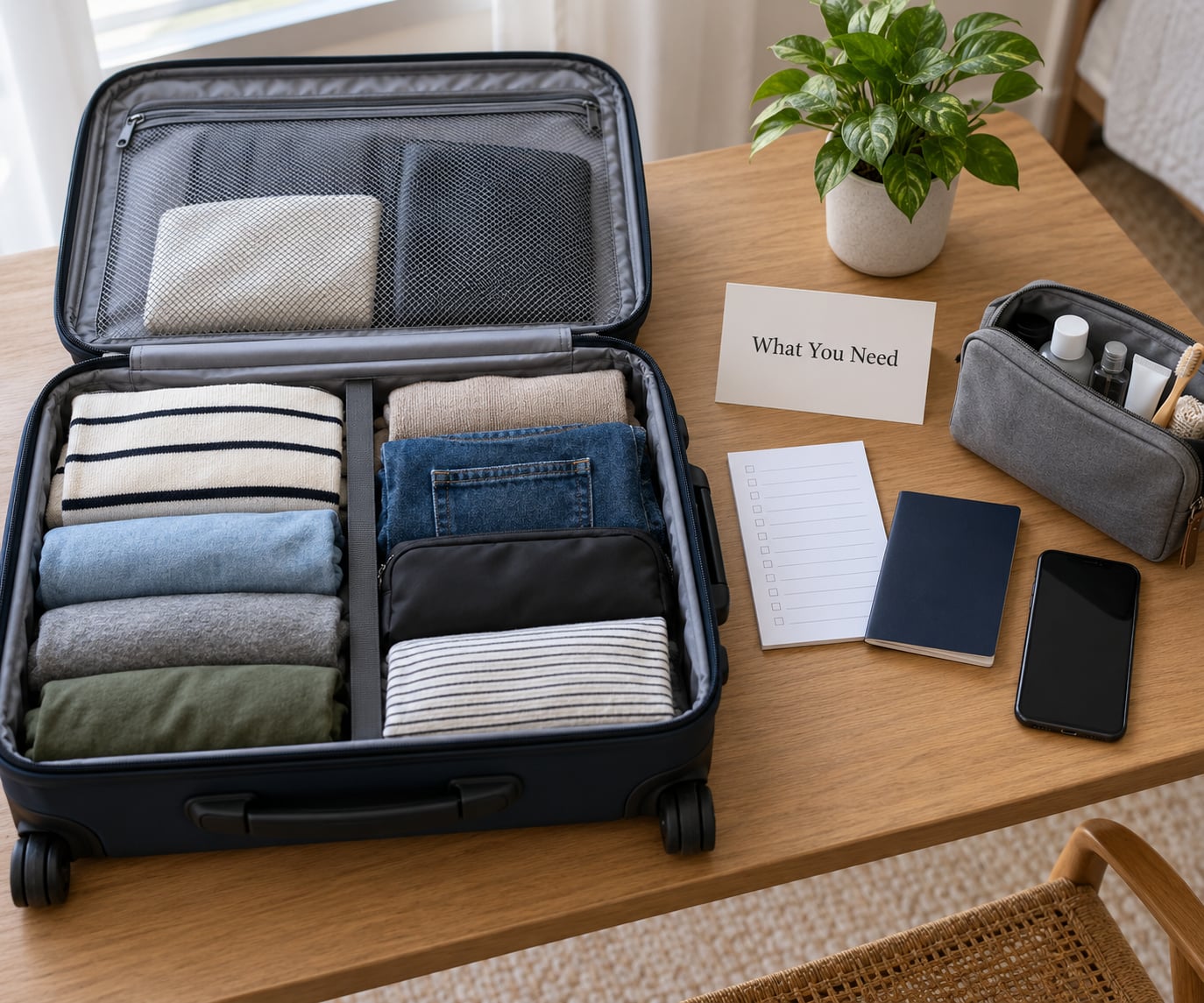
The goal is not to pack everything you might want. It is to choose a short list of items that each work in several situations, so the bag holds your whole trip without growing every day.
Information, not gear
Before a single item goes in the bag, write down four facts: the length of the trip in nights, the forecast range for the whole stay, what you are actually doing each day, and whether your accommodations have a washer or are near a laundromat. That last one decides whether you pack for the whole trip or for one week. Travelers on the r/onebag forums describe the week-plus-laundry rule as the thing that makes long trips fit; it is the difference between a bag that stays the same size and one that grows.
A bag that fits your airline’s limit
Most US domestic carriers cap a carry-on at 22 x 14 x 9 inches including wheels and handles, and many international carriers sit closer to 21 inches with slightly narrower depth. Several low-cost carriers go further and weigh the bag on the scale, and personal item limits are usually tighter than the main bag allowance. These numbers change often, so check the bag policy on your airline’s own site before you pack, and measure the bag including its wheels rather than trusting the label.
The small kit
- Packing cubes, 3 to 5 of them. The most-recommended item on every packing forum by a wide margin. Sized, labeled cubes turn a soft-sided bag into shelves.
- A laundry bag. A zip mesh bag doubles as your dirty-clothes container and your sink-washing bag.
- A shoe bag. Two spare bags, one for each pair, so shoes do not soil your clothes or crush them.
- A cable pouch. Chargers, adapters, and headphones in one place instead of a knot at the bottom of the bag.
- A refillable water bottle. Empty at the security checkpoint, full at the gate.
- A clear quart-size bag. For the liquids that pass through screening.
Add anything your body requires: prescription medication in the original labeled container, a glasses backup, anything you use daily that a week of disruption would upset. These are the items you do not improvise when your bag gets gate-checked.
Step-by-Step: How to Pack for a Trip With No Checked Bag and No Stress
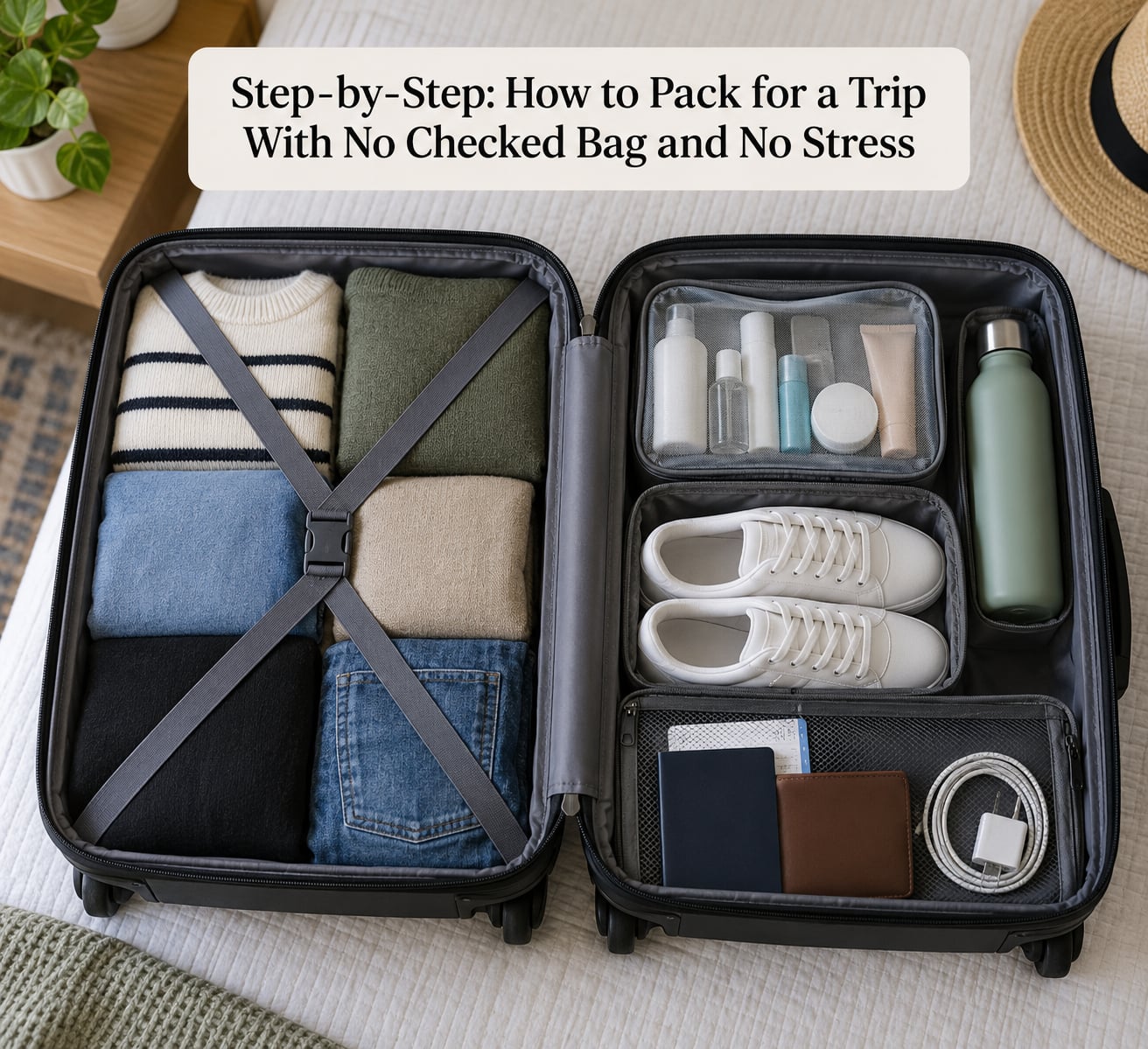
How to Pack for a Trip With No Checked Bag and No Stress: Build a Flexible Clothing Capsule
A capsule is a small set of pieces that combine into many outfits. One neutral bottom that matches three tops gives you six combinations; three bottoms that share a color family give you more. The formula that circulates most, called 5-4-3-2-1, is a useful starting point:
- 5 tops or layers — two short sleeves, one long sleeve, one layer that works over anything, one warmer piece.
- 4 bottoms — or 3 bottoms plus 1 pair of shorts or a second skirt depending on the weather.
- 3 sets of underwear and socks, plus 1 spare set in your personal item.
- 2 outer layers — one packable jacket and one mid-weight piece, because a down jacket compresses to almost nothing.
- 1 pair of packed shoes, plus the pair on your feet.
A concrete example: five days in a mild coastal city in shoulder season, with one long day trip. Four tops in two colors, two pairs of trousers that both work with a sandal and a boot, one pair of shorts, a light knit, a packable shell, underwear and socks for five days, and a scarf that doubles as a blanket on a cold plane. That is fifteen garments, and it fits in a single carry-on with room for a jacket worn on the plane.
How much clothing you need depends on the trip length and whether you wash:
| Trip length | Tops | Bottoms | Underwear sets | Shoes |
|---|---|---|---|---|
| 2 to 3 days | 3 | 2 | 3 | 1 worn only |
| 4 to 7 days | 5 | 3 | 5 | 1 worn, 1 packed |
| 10 to 14 days | 5 | 3 | 7 | 1 worn, 1 packed |
Notice the top and bottom counts do not change between 7 and 14 days. Only underwear and socks grow, because they are the only items you genuinely cannot reuse. Fabrics matter more than people expect: merino wool, tencel, and wrinkle-resistant synthetics come out of a bag ready to wear, while cotton creases from sitting in a seat for four hours.
Choose Shoes and Wear Your Bulkiest Pair
Shoes are the item that turns a carry-on into a checked bag, and the two-shoe rule is close to universal advice in the forums: one pair worn, one pair packed, never three.
Your walking pair should be comfortable enough for the longest day of the trip and light enough to pack. The packed pair should do a different job — a flat sandal that works with trousers and a skirt, or a low-profile trainer for a city where cobblestones ruin delicate soles. Pack each in its own bag, fill the empty interior with socks and underwear, and put your socks inside the shoes so they hold shape.
During the flight, wear the bulkiest pair you own. Even the heaviest shoes become free suitcase volume the moment they are on your feet, and if you land and immediately go for a long walk, you are glad to have them on rather than digging.
Pack Toileties, Tech, and Small Essentials
The TSA 3-1-1 liquids rule is simple once you say it in one sentence: three-point-four ounces, or 100 milliliters, or less per container; one quart-sized clear resealable bag; one bag per traveler. Anything over that goes in the bin or stays home.
The easiest way to avoid standing at security with a bag of rejected bottles is to change what you carry rather than how you carry it. Solid shampoo bars, lotion bars, and stick deodorant are not subject to the liquid limit at all, and a few drops of a concentrated liquid in a reusable travel bottle covers the rest. Prescription medication and medically necessary items are treated differently and travel best in your personal item with documentation.
For tech, I keep a small pouch that never gets unpacked: phone charger, plug adapter, headphones, a short cable, and a battery pack. Entertainment goes on the device rather than in paper form — an e-reader loaded before you leave home or downloaded shows beat a book in terms of weight. A sleep kit of eye mask, earplugs, and a neck pillow lives in the personal item, where you can reach it without opening the main bag in a dark row.
Your personal item is bonus carry-on space and it should hold the things you want within thirty seconds of landing: documents, phone, chargers, medication, a snack, water bottle, and one change of underwear. People who pack their personal item as an afterthought end up digging through a main bag at the carousel — except that you have no carousel.
Use Packing Cubes and Compression Wisely
Compression packing cubes squeeze garments down and can genuinely buy you two or three days of extra capacity. They also make a bag rigid, and a rigid bag is harder to rearrange when your plans change mid-trip. Use them for the dense stuff like jeans and sweaters; leave the zone holding the jacket and anything you might need mid-transit uncompressed.
A simple three-zone system beats a complicated one:
- Zone one, the main bag. Cubes stacked bottom to top: shoes and bulk at the bottom near the wheels, then clothing, then the toiletry pouch and soft items on top so nothing gets crushed.
- Zone two, the personal item. Documents, tech pouch, sleep kit, laundry bag, and the outfit for your first full day.
- Zone three, on your body. Heaviest shoes, jacket, and anything bulky that you would rather not check.
How you fold matters less than people claim. Rolling saves a little space and works well for knits and casual pants, and it makes items easier to find. A vertical fold — folding each item into a neat rectangle and stacking them upright in the cube — makes wrinkles nearly impossible and is my preference for anything that creases. Either is fine; overthinking the technique is what turns packing into a project.
Check the Bag Before You Leave
Run this test in the hallway, not in the airport. It takes four minutes and it catches almost every problem.
- Weigh it. A cheap luggage scale, or stand on a bathroom scale holding the bag and subtract your weight. Overweight bags are the most common reason a carry-on gets gate-checked.
- Measure it. Include wheels and handles. Slightly over the limit is not a guarantee of a free ride.
- Close it and unzip it again. If you have to force the zipper, remove something rather than hoping.
- Open it and find your essentials. Medication, chargers, documents, a change of underwear, and the sleep kit, all without unpacking everything. Anything you cannot find in fifteen seconds does not belong in the bottom.
- Check documents are on you, not in the bag. Passport, boarding pass, and any required travel papers stay in the personal item or a pocket, because a gate-checked bag may not arrive when you land.
- Separate your dirty laundry. Nothing worn goes back into the clean cubes, which is the habit that makes a two-week trip possible in a small bag.
If your bag is slightly over the allowance, the honest answer is that you may be asked to check it free at the jet bridge. Gate agents apply the limit unevenly, and small European regional aircraft run out of space first. Keep 20 to 30 percent of the bag empty and the question never comes up.
Common Mistakes
Packing “just in case” and then wearing none of it. The fix is a written list before the bag comes out. If an item is not on the list, it does not go in, including the third pair of jeans you keep moving around for reasons nobody can explain.
Forgetting the weight until the airport scale. Bags get heavy in a boring, predictable way: one more book, a second charger cable, shoes worn too thick. Weigh at home and you avoid the conversation at the gate entirely.
Packing full-size bottles. Decant into containers you have actually used, or switch to bars. Getting binned at security turns a calm morning into a scramble, and it happens to confident one-bag travelers constantly.
Folding everything into one hard brick. A single dense block buries small items and guarantees a reshuffle every time you open the bag. Cubes, even a few cheap ones, turn the bag into something you can work with mid-trip.
Treating laundry as optional. Hotel sinks are fine for underwear, tees, and leggings if you use cool water and a small amount of detergent, then press the water out and hang them overnight. A small travel clothesline or safety pins on a hanger cover a handle solves most of it. Not having a laundromat is not a reason to overpack.
Forgetting the trip home. This is the mistake that catches experienced travelers. Before you fly back, wash everything, dry it, and re-fold from the bottom up so clean items pack first and the messiest wear goes in last. Pack purchases into the personal item or wear them, and put anything bulky in the spot vacated by the shoes you no longer need.
Two smaller habits worth keeping: a photo of your bag’s contents on your phone helps you replace something without describing it over the phone, and putting the items you need at every stop on top means repacking takes five minutes instead of an evening.
Frequently Asked Questions
What is the 5-4-3-2-1 rule for packing?
The 5-4-3-2-1 rule is a carry-on packing formula: 5 tops or layers, 4 bottoms, 3 sets of underwear and socks, 2 outer layers, and 1 pair of packed shoes, with anything bulky worn on the plane. It was designed so one week of clothing fits comfortably in a carry-on. For trips longer than a week, you keep the clothing counts the same and wash underwear and socks instead of adding more.
How many days can I pack in a carry-on?
Most people fit 7 to 10 days of travel in one carry-on without laundry, and 2 to 3 weeks if you wash underwear and shirts once or twice mid-trip. Beyond that, plan for a laundromat or a hotel sink. Keep tops and bottoms roughly constant regardless of trip length, since they can be reworn, and grow only the items that cannot be reused.
What happens if my carry-on bag is one inch too big?
It depends on the flight. Most US domestic carriers allow up to 22 x 14 x 9 inches, and many international carriers sit closer to 21 inches, so a bag over by an inch can exceed the limit. Some agents ask you to check it at the gate free of charge; others do not, which is a bad gamble on a full flight. Measure your bag at home and stay under.
Can I bring a full-size shampoo in my carry-on?
Only if the container holds 3.4 ounces, or 100 milliliters, or less. Under the TSA 3-1-1 rule those containers travel in a single quart-sized clear resealable bag. A full-size bottle over the limit has to go in the bin or stay home. A shampoo bar or a small bottle you refill from a larger one removes the problem entirely.
What is the 3-3-3 rule for travel packing?
The 3-3-3 rule is a newer, tighter version of the carry-on formula: 3 tops, 3 bottoms, and 3 sets of underwear and socks. It suits a weekend or a very light trip where you wash often. The older 5-4-3-2-1 formula covers about a week. Both work; pick the one that matches how often you will actually do laundry.
How do I avoid overpacking a carry-on?
Write your list before packing and treat the list as final, because overpacking usually starts with a just-in-case item rather than a volume problem. Wear your bulkiest clothes and shoes, choose pieces that mix and match, and give yourself a hard 20-minute timer. When it rings, stop, even if there is room left. Anything forgotten will fit in a shopping bag or a wash-and-dry cycle.
What to Do First
Check your airline’s carry-on size and weight limit, then write your clothing list and set a timer. Everything else — the cubes, the personal item, the decant bottles — just makes that list easier to fit in the bag you already own.