You support local businesses when you travel by directing money you are already spending toward places owned and staffed by people who live where you are visiting: an independent guesthouse instead of a chain hotel, a neighbourhood cafe instead of a global coffee chain, a small operator’s walking tour instead of a reseller’s package. Learning how to support local businesses when you travel takes about ten minutes of research before you book and one habit change while you are there.
Nothing here needs a bigger budget or a moral crisis. This guide covers what to prepare, eight concrete steps for the trip itself, and the mistakes that quietly undo good intentions.
Table of Contents›
- What You Need
- Step-by-Step: Support Local Businesses During Your Trip
- 1. Learn Who Counts as Local Before You Book
- 2. Book Directly When It Is Practical
- 3. Choose Locally Owned Places to Stay and Eat
- 4. Ask Recommendations Instead of Assuming
- 5. Spend Where Money Stays in the Community
- 6. Use Local Guides and Experiences Responsibly
- 7. Buy Directly, Respectfully, and Without Waste
- 8. Leave Feedback, Referrals, and Repeat Business
- Common Mistakes to Avoid
- Frequently Asked Questions
- How do I find locally owned businesses when I travel?
- Why is it important to support small businesses when traveling?
- How can tourism actually benefit a local community?
- What are the most useful responsible travel practices?
- How much should I tip, and what if tipping norms are different?
- Does spending at local businesses really solve overtourism?
- Start With One Local Choice
What You Need

Before you pack, you need three things: a rough sense of who actually operates in the destination, a budget that is honest about what a local business charges, and a decision about how much of your spending you want to redirect.
Start with ownership research. Search the city or town along with the word family-run, cooperative, or worker-owned, then check who the actual proprietor is. A hotel branded with a local-sounding name can still be a franchise; a cafe chain can hold the lease on a corner that looks independent from the street.
Next, set a realistic daily budget in the currency of the place you are going. Prices for a bus ride, a bowl of soup, and a museum ticket tell you more about what a local week costs than any travel article will. When a locally owned guesthouse costs more than the chain on the same street, that gap is usually wages rather than markup.
Finally, pick your support style. Staying longer in one town and spending heavily there affects more small businesses than three rushed days of attraction tickets. You do not have to do everything. One well-chosen meal, one direct booking, and one honest review already puts a real owner ahead of you.
Step-by-Step: Support Local Businesses During Your Trip
How to support local businesses when you travel comes down to eight steps, and each one is a decision you can make in a couple of minutes on the ground.
1. Learn Who Counts as Local Before You Book
Locally owned means the person who owns the business lives in or near the place you are visiting, and so do most of the people they employ. Independent only means it is not part of a chain, which is a weaker claim. A franchise is independent of its parent brand in the legal sense and not independent in the way that matters here.
Check the about page, the booking platform’s owner field, local business directories, and the menu or shopfront for a named proprietor. Where a business publishes ownership openly, that transparency is itself a signal. On destination subreddits, travelers repeatedly ask for specific names rather than a category, and the answers that get useful replies usually describe a person, not a brand.
2. Book Directly When It Is Practical
Booking a small guesthouse, studio, guide or cooking class by email or a direct message usually sends the full amount to the operator. A large booking platform keeps a commission and layers support and cancellation terms in between, which matters less to a traveller than it does to a business running on a thin margin.
Compare like for like before you assume direct is cheaper: check the total price including taxes and any cleaning fees, and check whether direct rates come with a stricter cancellation window. Ask what is included, when payment is due, and whether the price changes for a single traveller, since solo guests are often quoted a two-person rate by default.
3. Choose Locally Owned Places to Stay and Eat
Small hotels, guesthouses, inns and family-run rentals employ people from the area and buy supplies nearby. A multinational hotel sends a large share of the room rate to a central reservation system and corporate purchasing.
For meals, watch where locals queue at lunchtime rather than where the menus are translated into six languages. Markets, independent bakeries, and cafes with a lunch counter are all reasonable picks. The food hall is worth knowing about: several stalls under one roof are usually separate independent businesses, each with its own staff and suppliers.
4. Ask Recommendations Instead of Assuming
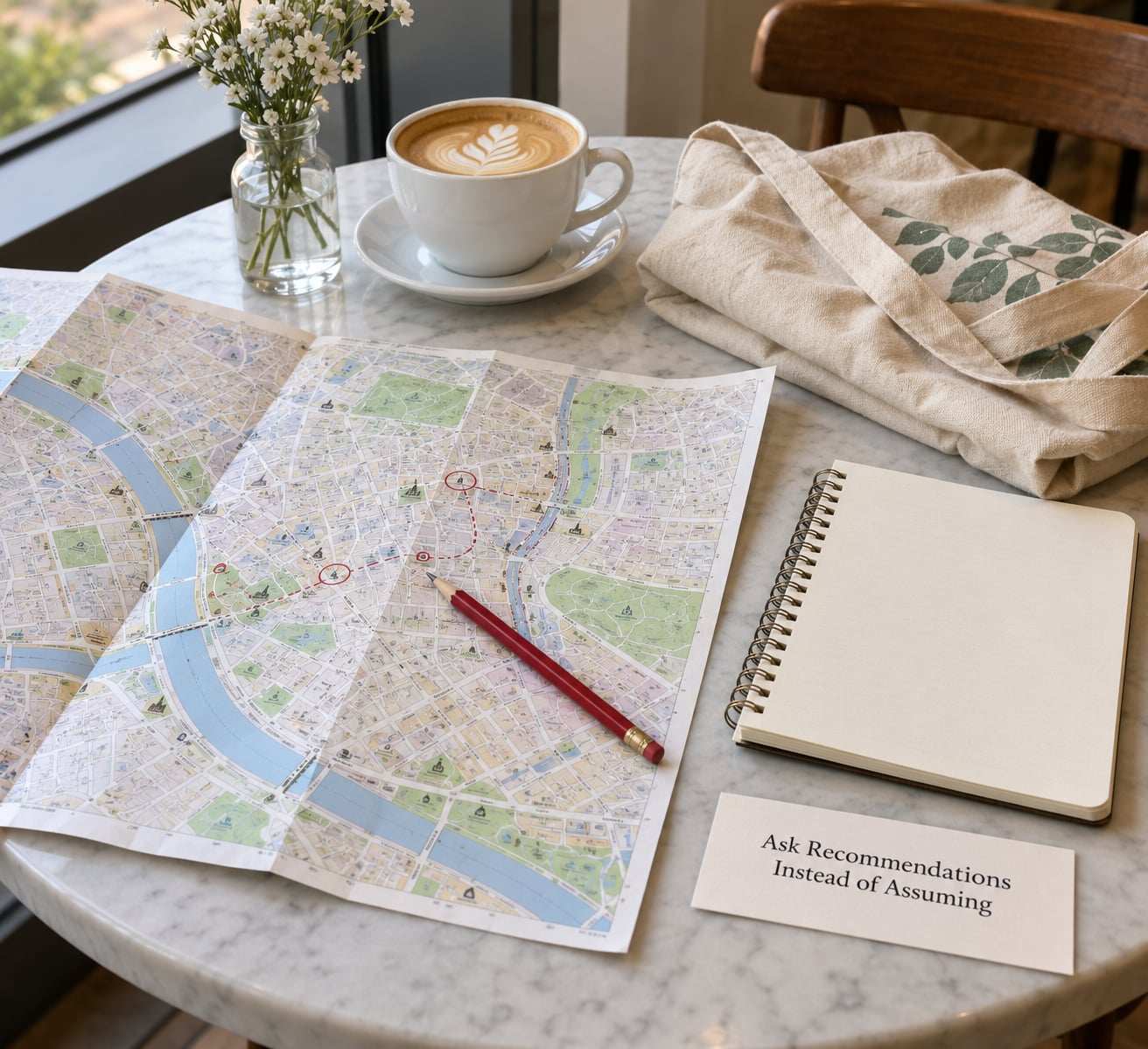
The question you ask changes the answer you get. Instead of where is the best restaurant here, ask where the person you are speaking to eats on a Tuesday when they do not want tourists in the room. Travel forums keep rediscovering this trick, and it works because it asks for a habit rather than a review.
Ask drivers, shopkeepers, bartenders, and market vendors. Be specific about constraints: how long you have, whether you eat anything specific, whether you are walking or have a bike. Accept the answer even when it is not convenient, and go somewhere nobody put on a list.
5. Spend Where Money Stays in the Community
The same meal has two very different destinations depending on where it is ordered. Money paid to an independent cafe typically gets spent again on local produce, local rent and local wages, and that repeat spending is what a local economy is made of. Money paid to a chain leaves the region, minus whatever a franchisee happens to keep.
Useful tests for whether spending recirculates locally: are the staff from the area, is the food or stock sourced nearby, is the owner visible and known, does the business buy from other local suppliers. No single label guarantees impact, so treat a marketing claim such as locally sourced as a starting point rather than proof.
6. Use Local Guides and Experiences Responsibly
A guide who lives in the town earns from a longer, repeat relationship, not from a single commission paid out of your booking. On travel forums, solo travellers consistently say the same thing: walking neighbourhoods, using public transport, and following the queues is the highest-signal way to find these businesses yourself.
In Japan, for example, travellers search restaurant platforms by genre and rating, then cross-check on a map before booking. That two-step habit works anywhere. Skip animal attractions and experiences that treat culture as a performance, and pay the posted rate without negotiating a local worker down to a discount.
7. Buy Directly, Respectfully, and Without Waste
Artisans, farms, markets, repair shops and independent retailers sell things that were actually made or grown where you are standing. Ask where a product comes from before you assume; a locally branded souvenir is frequently manufactured elsewhere and only printed with a place name.
Buy fewer things and buy them directly. Haggling hard with someone who makes their goods by hand is not a saving, and a mass-produced copy from a factory outlet funds a very different economy. Skip anything you will not use, and skip the pieces meant only for a photograph.
8. Leave Feedback, Referrals, and Repeat Business
An honest review is the cheapest high-return thing a visitor can do, because most small owners have no marketing budget and rely on search results and recommendation. Write it a day or two after the visit while details are accurate, mention something specific that the staff would recognise, and keep it honest. Inflate it and the reviews stop carrying information for everyone.
Beyond the review: come back to the same cafe, tell the owner what you sent friends, take a class twice, or subscribe. If something you bought can be ordered from the maker afterwards, order it direct rather than through a marketplace. Repeat customers are the closest thing a small business has to a growth plan.
Common Mistakes to Avoid
Treating support as a checklist turns a decent trip into a scavenger hunt. Hitting the market, the local cafe and one craft shop and then relaxing for three days helps almost nobody; booking a small guesthouse and eating well every day helps a real owner all week.
Assuming ownership is another. Signage saying local is a starting point, not proof, and in some destinations a business on a main strip pays a premium rent precisely because tourists find it easy. Ask, and accept the answer.
Chasing the cheapest option inverts the entire idea. The cheapest meal in a tourist district is cheap because the labour is the part being cut. Where a local business costs more than a chain, the difference is often wages and rent that stay in the country.
Using discounts meant for residents also misreads the situation. A resident rate or a locals-only promotion exists because the owner set it for people who live there. Using one as a visitor takes a benefit that was not yours.
Ignoring how the money is actually paid is subtler. A guide paid entirely through a platform fee has less left than the sticker price suggests. Ask who receives the money and how much of it reaches the person doing the work.
Turning community into content is the failure people regret most. Travellers on destination forums talk about being asked to photograph and post at very small businesses, usually ones that cannot afford the attention. Ask before you photograph, pay for anything you shoot, and do not treat a family’s market stall as a backdrop for your account.
Finally, do not expect a good trip to fix overtourism. Digital nomad forums are full of residents saying the places they loved are now unaffordable or overcrowded. Spending local is one part of the answer. Staying longer in fewer places and travelling off-peak does more for a community than any restaurant choice.
Frequently Asked Questions
How do I find locally owned businesses when I travel?
Skip the listicles and use local signals. Walk the streets away from the main square, notice where people queue at lunchtime, check local radio and small neighbourhood accounts for what is on this week, and ask your host, driver or shopkeeper where they eat when they do not want a crowd. Booking platforms show a property owner field, and business about pages usually name the proprietor. A named owner you can identify is the strongest verification you can get before you arrive.
Why is it important to support small businesses when traveling?
Because small businesses are where a destination’s spending actually stays. The U.S. Small Business Administration has put the figure at roughly 68 of every 100 spent at an independent business remaining in that community, and the American Independent Business Alliance has reported local spending recirculating at about 48 percent against about 14 percent at chains. Where you eat and sleep decides which of those numbers your trip lands on.
How can tourism actually benefit a local community?
Two ways dominate. Direct spending at independent businesses pays local wages, rent and suppliers, so the money is spent again in the same area instead of leaving it. Second, visitor income supports the things that make a place worth living in, including the small firms that employ year-round residents. That benefit erodes quickly when staffing costs rise, housing goes to short lets, and seasonal work replaces year-round jobs.
What are the most useful responsible travel practices?
Eat and drink where locals eat, stay in independently owned accommodation, book guides and classes directly, buy goods made in the region, tip according to local norms, travel slower in fewer places, and leave an honest review after you leave. The practices that matter most are ordinary ones repeated over days rather than one dramatic gesture. Reserving a neighbourhood guesthouse for three nights does more local good than most single acts of activism on a trip.
How much should I tip, and what if tipping norms are different?
Tip where tipping is normal, and ask quietly if it is not. In the United States, 18 to 20 percent for table service is the usual range and rounding up for good service is normal. In much of Europe the service charge already covers the staff, so tipping is optional. In Japan, tipping can cause confusion rather than gratitude. A direct booking operator who quotes the rate you should pay is more useful than any general rule.
Does spending at local businesses really solve overtourism?
No. Local spending helps the businesses that are still there, but it does nothing about rent, housing pressure or seasonal work. The complaints residents raise on travel forums are usually about volume and cost of living rather than which restaurants visitors pick. Staying longer in one place, travelling outside the peak window, and visiting neighbourhoods outside the postcard districts address the pressure that choosing a restaurant cannot.
Start With One Local Choice
You do not need to overhaul the whole trip to do this well. Book one night at an independently owned guesthouse instead of the chain, or ask one person where they eat and go there. Both take a few minutes, and both put a named person ahead of you for the week.
Everything else in this guide is a variation on that same move: look past the brand, find out who is behind it, and let your ordinary spending go to them.